
Russian FM says if his government were given intel, it would take action so IDF wouldn’t have to, following recent reports of major strikes on Iran-linked sites in eastern Syria


Russian Foreign Minister Sergey Lavrov listens as Serbia's President Aleksandar Vucic speaks during a joint press conference in Belgrade, Serbia, Thursday, June 18, 2020. (AP Photo/Darko Vojinovic)

Russian Foreign Minister Sergey Lavrov listens as Serbia’s President Aleksandar Vucic speaks during a joint press conference in Belgrade, Serbia, Thursday, June 18, 2020. (AP Photo/Darko Vojinovic)

Russian Foreign Minister Sergey Lavrov spoke out against Israeli airstrikes against Iran-linked sites in Syria on Monday, saying Jerusalem should instead provide Moscow with intelligence about such threats so that it can “neutralize” them.

“If Israel is really forced to respond to threats to the Israeli security coming from the Syrian territory, we have told our Israeli colleagues many times: if you see such threats please give us the information,” Lavrov said at a press conference, according to the Kremlin’s Sputnik news site.

The comments came less than a week after Israel reportedly launched a large series of major airstrikes on Iran-linked targets in eastern Syria. In the past, Russia has used far harsher language to reproach the Israel Defense Forces for its airstrikes against Iranian and Syrian targets in Syria.

The Russian foreign minister added that Moscow did not want Syria to be the battlefield for an Israeli-Iranian war.

“So, our dear Israeli colleagues, if you have facts that your state is facing threats from the Syrian territory, report the facts urgently and we will take every measure to neutralize the threat,” Lavrov said.

An explosion from a suspected Israeli airstrike in eastern Syria on January 13, 2021. (Screen capture/Twitter)

Russia has deployed a large military presence in Syria to support dictator Bashar Assad through his country’s brutal civil war. In order to prevent unwanted clashes, Jerusalem and Moscow have maintained a so-called deconfliction mechanism, which has allowed the two countries to effectively communicate with one another and avoid altercations.

This mechanism has been generally successful, with the notable exception of an incident in September 2018, in which a Russian spy plane was shot down by a Syrian anti-aircraft missile that had been fired in response to an Israeli attack. Moscow blamed Israel for the deaths of the troops on board the aircraft, saying Israeli planes had hidden behind the Russian aircraft, a charge that the IDF fiercely denied.

Though they both backed Assad through the Syrian civil war, Russia and Iran do not always see eye to eye on the future of the country. Moscow is generally seen as hoping to rebuild and stabilize Syria, something Tehran threatens to upset by launching attacks on Israel from Syrian territory.


i24NEWS

This combination of file photos shows Saudi Arabia's Crown Prince Mohammed bin Salman in Jeddah, Saudi Arabia, on June 24, 2019 and Israeli Prime Minister Benjamin Netanyahu in Russia, Thursday, Jan. 30, 2020
AP Photo/Maxim Shemetov/Pool Photo via APThis combination of file photos shows Saudi Arabia’s Crown Prince Mohammed bin Salman in Jeddah, Saudi Arabia, on June 24, 2019 and Israeli Prime Minister Benjamin Netanyahu in Russia, Thursday, Jan. 30, 2020
An Israeli official reportedly told Saudi media that relations between the two countries have changed

Saudi Arabia will not sign a normalization agreement with Israel unless progress is made on the Israeli-Palestinian conflict despite recent progress in advancing ties between Riyadh and Jerusalem, Saudi daily newspaper Elaph claimed on Saturday.

The report comes nearly two months after revelations about a secret meeting between Israeli Prime Minister Benjamin Netanyahu and Crown Prince Mohammed bin Salman in the city of Neom in Saudi Arabia.

According to the newspaper, which quotes a senior Israeli official on condition of anonymity, attempts to portray Israeli-Saudi normalization as an imminent development is likely motivated by personal or political considerations.

The outlet added that relations between the Jewish state and Riyadh have changed and the Saudis ties to Jerusalem have significantly deteriorated over the last several weeks.

It remains unclear how relations broke-down between the two regional powers, but President Donald Trump’s recent loss in the US 2020 election could be a contributing factor.

The Trump administration successfully brokered numerous peace agreements between Israel and Sunni Arab states, including the UAE, Bahrain, Sudan, and Morocco, in the last six months alone.

Reports in international media also suggested that the White House was working hard to cultivate closer ties between Jerusalem and Riyadh, but has so far failed to achieve an agreement.

Progress, however, was made in other significant ways, including the Islamic Kingdom allowing Israeli passenger jets to ferry tourists to the UAE using its airspace.  


Iran holds ballistic missile, drones drill amid tensions

In fourth large-scale exercise in recent weeks, IRGC launches ballistic missiles with 700-km range against simulated ‘enemy bases’


In this photo released on January 15, 2021, by the Iranian Revolutionary Guard, missiles are launched in a drill in Iran. Iran's paramilitary Revolutionary Guard forces on Friday held a military exercise involving ballistic missiles and drones in the country's central desert, state TV reported, amid heightened tensions over Tehran's nuclear program and a US pressure campaign against the Islamic Republic. (Iranian Revolutionary Guard/Sepahnews via AP)

In this photo released on January 15, 2021, by the Iranian Revolutionary Guard, missiles are launched in a drill in Iran. Iran’s paramilitary Revolutionary Guard forces on Friday held a military exercise involving ballistic missiles and drones in the country’s central desert, state TV reported, amid heightened tensions over Tehran’s nuclear program and a US pressure campaign against the Islamic Republic. (Iranian Revolutionary Guard/Sepahnews via AP)

Iran’s Islamic Revolutionary Guard Corps forces on Friday held a military exercise involving ballistic missiles and drones in the country’s central desert, state TV reported, amid heightened tensions over Tehran’s nuclear program and a US pressure campaign against the Islamic Republic.

In the first phase of the drill Friday morning, the Guard’s aerospace division launched several surface-to-surface ballistic missiles against simulated enemy bases, state TV reported. It said the drill included Zolfaghar and Dezful solid-fuel ballistic missiles. Bomb-carrying drones were also deployed. The Dezful, a version of the Zolfaghar, has a 700-kilometer (430-mile) range and 450-kilogram (992-pound) warhead.

Iran has missile capability of up to 2,000 kilometers (1,250 miles), far enough to reach archenemy Israel and US military bases in the region. Last January, after the US killed a top Iranian general in Baghdad, Tehran retaliated by firing a barrage of ballistic missiles at two Iraqi bases housing US troops, resulting in brain concussion injuries to dozens of them.

In recent weeks, Iran has increased its military drills. On Wednesday, Iran’s navy held a two-day short-range missile drill in the Gulf of Oman. On Saturday, the Revolutionary Guard held a naval parade in the Persian Gulf. A week earlier, Iran held a massive drone maneuver across half the country.

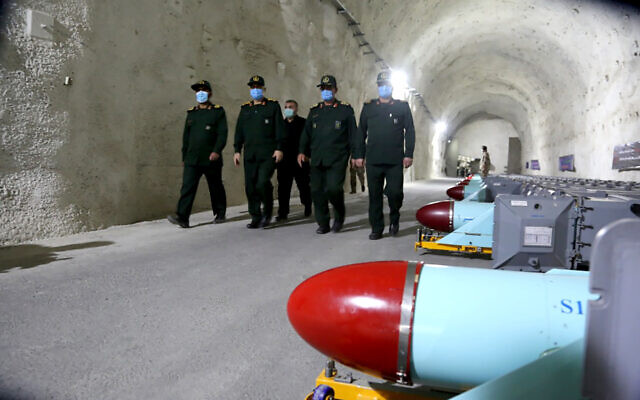
The IRGC unveiled last week one of its “strategic missile bases” located on the “shores of the Persian Gulf,” according to the corps’ Sepahnews website.

Iranian state television showed underground tunnels and depots of missiles in the south of the country near the strategic Strait of Hormuz.

“Our logic in defending the territorial integrity, the independence of the country, and the achievements of the Islamic Revolution is strengthening,” said the top commander of the IRGC, Gen. Hossein Salami, according to Mehr News. “What you see today is one of several IRGC Naval Strategic Missile facilities.”

The IRGC is designated a terrorist organization by the US.

In this photo released Jan. 8, 2021, by Sepahnews, the website of the Iranian Revolutionary Guard, commanders of Iran’s paramilitary Revolutionary Guard walk past missiles during a visit to a new military base in an undisclosed location in Persian Gulf in Iran. (Sepahnews via AP)

Tensions have again been rising in the waning days of the administration of US President Donald Trump, as Iran ramps up pressure on the West over the US sanctions campaign against the Islamic Republic.

Iran resumed enriching uranium to 20 percent last week, well in excess of the threshold set out in its landmark 2015 nuclear deal with world powers.

In 2018, Trump withdrew from the deal, known as the Joint Comprehensive Plan of Action, and reinstated US sanctions that had been lifted against Iran, plunging it into recession.

The decision to enrich uranium to 20% — below the 90% required for an atomic bomb, but a relatively short technical step from that benchmark — was not initiated by President Hassan Rouhani’s relatively moderate government, but by parliament, which conservatives have dominated since last year.

After the assassination of top scientist Mohsen Fakhrizadeh on November 27, which Tehran blamed on Israel, deputies approved a bill requiring Iran to resume uranium enrichment to 20% purity, as it had been doing before the JCPOA, and to stock 120 kilograms (265 pounds) of uranium each year.
