Israel officially joins regional gas forum

Despite Israel’s key role in founding the EMGF, its official membership in the organization was held up due to opposition from Environmental Protection Minister Gila Gamliel.

The meeting of the third East Mediterranean Gas Forum, which is hosted by Egypt and brings together Cyprus, Greece, Israel, Italy, Jordan and the Palestinians, in Cairo. (photo credit: REUTERS)
The meeting of the third East Mediterranean Gas Forum, which is hosted by Egypt and brings together Cyprus, Greece, Israel, Italy, Jordan and the Palestinians, in Cairo.
(photo credit: REUTERS)
The cabinet authorized Israel’s membership in the new East Mediterranean Gas Forum (EMGF) on Tuesday, after resolving a dispute between ministers on the matter.

“The vision became a reality!” Energy Minister Yuval Steinitz tweeted, pointing out that he and his and Egyptian counterpart Tarek al-Mulla initiated the EMGF.

“The blessing of gas leads us to historic cooperation with Arab and European states that will only broaden, along with contracts to export natural gas to Jordan and Egypt worth tens of billions of dollars, and more to come,” Steinitz added.

Despite Israel’s key role in founding the EMGF, which held its first meeting via video conference in September, its official membership in the organization was held up due to opposition from Environmental Protection Minister Gila Gamliel.

Gamliel only lifted her objection after Prime Minister Benjamin Netanyahu intervened, and told Israel Hayom that Steinitz reassured her he planned to raise environmental issues in the forum’s first meeting.

Steinitz’s spokesman, however, said that he “already raised the topic of the environment and the climate crisis a number of times, as did representatives of other countries and the EU, and there is no doubt these topics will continues to be part of the discussions going forward.

“It is strange that no European or Middle Eastern members of the forum had to clarify the obvious and no members of the organization tried to take advantage of the matter for media exposure, such as what happened in Israel,” the spokesman added, in an apparent accusation that Gamliel was using the matter for political gain.

A source in the Energy Ministry aslo pointed out that natural gas is an environmentally-friendly energy and, thanks to gas finds in the Mediterranean Sea, Israel no longer burns coal, a major pollutant, for energy.

Gamliel wrote in her letter of objection that, earlier this month, Netanyahu promised that Israel would only use renewable energy sources by 2050. She said “Israel’s commitment must be given clear expression in the organization’s constitution.”

She also opposed the Palestinian Authority being given full membership in the EMGF, saying “it cannot be that the PA, which funds terror and is hostile to Israel, will have equal standing to member states in the forum and could even head it.”

The EMGF held its first meeting in September, via video conference, with Greece, Cyprus, Jordan, the Palestinian Authority and Italy joining. France has also expressed interest in membership, and the US and EU seek to be observers.

Steinitz and al-Mulla first came up with the EMGF in 2017, following natural gas discoveries off the coasts of Israel and Egypt.

The joint declaration on the EMGF’s launch said it “aims to serve as a platform that brings together gas producers, consumers and transit countries to create a shared vision and establish a structured systematic policy dialogue on natural gas, leading to the development of a sustainable regional gas market and unlocking the full gas resource potential in the region for the benefit and welfare of its people.”

The forum also includes a Gas Industry Advisory Committee, an ongoing dialogue between governments and business partners, to help monetize the gas reserves.

The Energy Ministry said Israel’s membership in the forum will give it major advantages in promoting shared goals in the natural gas market’s development and help Israel export gas to its neighbors and to Europe.

On a diplomatic level, it could contribute to further normalization and ties between Israel and countries in the region, and improve Israel’s standing with countries with which it already has diplomatic relations.


Amid COVID-19, aliyah to Israel continues

Whether it’s because the global economic situation is so dismal due to the COVID-19 pandemic or because Israel has truly become a desirable alternative for world Jewry, the numbers are impressive.

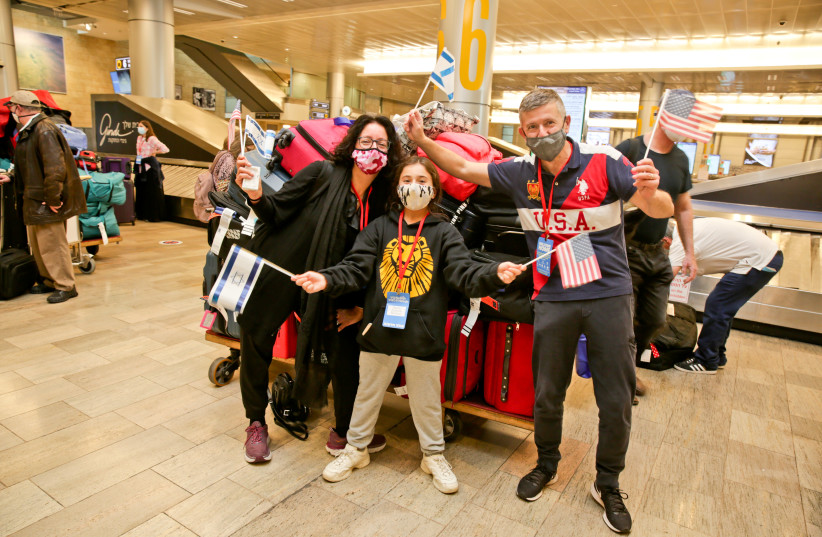
Aliyah has been continuing throughout the pandemic (photo credit: YONIT SCHILLER)
Aliyah has been continuing throughout the pandemic
(photo credit: YONIT SCHILLER)
According to data provided by the Jewish Agency for Israel (JAFI), more than 20,000 new immigrants from almost 70 countries made aliyah in 2020.

Whether it’s because the global economic situation is so dismal due to the COVID-19 pandemic or because Israel has truly become a desirable alternative for world Jewry, the numbers are impressive.

“A wonderful thing happened to us: Twenty thousand Jews immigrated to the State of Israel during this pandemic year,” JAFI chairman Isaac Herzog said in a meeting with children who immigrated to Israel during the pandemic from all over the world. “Twenty thousand people who were ready to leave everything behind, in a challenging period of global turmoil, to come build a new life in Israel.”

Some 10,200 came from the Commonwealth of Independent States, including 6,260 from Ukraine and 2,660 from Russia. Another 3,120 arrived from Western Europe, including 2,220 from France and 460 from Britain. By the end of November, some 2,850 immigrants arrived from North America, 2,550 from the US and the rest from Canada. Another 1,500 came from Latin America, including 510 from Argentina and 460 from Brazil.

Aliyah from Ethiopia is set to surpass 1,200, mostly Falash Mura brought to Israel in a special operation dubbed “Rock of Israel” run jointly by the Jewish Agency and the Aliyah and Integration Ministry. Another 219 arrived on a flight on December 22, while an estimated 1,000 more remain in the country.

In addition, there were 280 immigrants from South Africa and 90 from Australia and New Zealand.

The Jewish Agency says it has received about 160,000 inquiries from potential immigrants, while more than 41,000 aliyah files have been opened, including 28,000 from Western countries – twice the number opened in 2019. There was also a 41% increase in files opened for young adults aged 18-35 from Western countries.

Immigration officials estimate that another quarter of a million immigrants could come to Israel in the next three to five years, assuming the government implements a national plan for such a large wave of immigration and absorption. This would represent a sharp rise over previous years; in normal times, Israel absorbs an average of 30,000 immigrants a year. Some 34,000 people made aliyah in 2019, the largest annual number in a decade.

Organizations that help fund aliyah are all reporting a surge in aliyah requests. Following the outbreak of the coronavirus pandemic, JAFI also partnered with the United Israel Appeal and Jewish Federations of North America to provide millions of dollars in much-needed funding to Jewish communities in North America, including interest-free loans to organizations that provide vital services.

There are an estimated 14.7 million Jews in the world, more than 6.8 million of whom live in Israel. The outgoing government needs to make good on its pledge to complete the aliyah from Ethiopia to Israel as soon as possible. As Aliyah and Integration Minister Pnina Tamano-Shata said: “The Israeli government cannot abandon and neglect our brothers and sisters waiting in Ethiopia for years upon years. This injustice that cries out to heaven must come to an end.”

It’s true that Israel is undergoing political turmoil, facing its fourth election in two years, and the medical, economic and psychological hardships of COVID-19 are profound and painful. Although the country is at the start of its third lockdown, Israel is leading the world in its coronavirus vaccination program, having inoculated some 400,000 of its nine million residents in just one week.

This is impressive, and Israel needs to ensure that its borders remain open and its bureaucratic regulations remain easy to overcome for potential new olim. Israel’s ability to continue absorbing new olim during the pandemic is a testament to the importance of aliyah and of Israel remaining the Jewish state and a home to all Jews.

It also illustrates a quality that Michael Dickson and Dr. Naomi L. Baum call “IsResilience” in their new book of that title. They argue that Israel, and Israelis, possess a special resilience that enables them to thrive against all odds.

Those from Western countries who are moving here hoping to improve their financial situation or overcome personal problems may find that Israel is not the answer – no matter how much resilience they possess. But those arriving to participate in the Zionist experience and who are aiming to contribute to the country will find a truly meaningful and rewarding experience. Welcome. You make us all proud.


Russian To Aid Iran In Major Sanction-Skirting Energy Megaprojects

Alongside the continued development of its huge West Karoun oil fields, the completion of the supergiant South Pars non-associated gas offshore sector (including the implementation of Phase 11 operations), and the finalisation of the crude oil transfer pipeline from Guriyeh to Jask, Iran’s core focus in the current sanctions environment is to optimise the output and revenues from its already world-scale petrochemicals sector. This has always played a key role in Iran’s ‘resistance economy’ model – the concept of generating value-added returns by leveraging intellectual capital into business development wherever possible. In the last week or so, Iran has launched another three major petchems projects and discussed further co-operation with Russia in the sector.

In sanctions terms, Iran’s petchems sector has always occupied a somewhat grey area from the legal perspective. “When the previous set of major sanctions were at their height [2011/12], Iran’s petrochemical industry was the subject of U.S. and E.U. sanctions, and the only way for Iran to sell such products ‘legally’ was to customers outside the U.S. and E.U.,” a Washington DC-based senior lawyer with an international litigation and arbitration specialist legal firm, told OilPrice.com. At that time, secondary sanctions were in place in the U.S. on any person worldwide that purchased, acquired, sold, transported, or marketed Iranian-origin petrochemical products, or provided goods or services valued at US$250,000 or more (or US$1 million over a 12-month period) for use in Iran’s production of petrochemical products. In the E.U. there was a ban on the import, purchase, or transportation of Iran-origin petrochemical products, and on the export to Iran of certain equipment for use in the petrochemical industry. In stark contrast to the previous sanctions era, there are currently no E.U. sanctions specifically on Iran’s petchems sector and nor are there plans to impose them. From the U.S. perspective, it cannot currently exert jurisdiction for ‘primary’ sanctions unless U.S. persons are involved – notably U.S. banks and U.S. employees.

Given this backdrop, then, Iran has aggressively developed its petchems sector over the years towards the goal of producing at least 100 million tons per year (mtpy) by the original target year of 2025. Last week, though, Iran’s Petroleum Minister, Bijan Zanganeh, stated that the country’s petrochemical production capacity would reach the 100 mtpy figure three years early – in 2022 – by which time the sector would be generating at least US$25 billion per year. He added that plans were also underway to increase the yearly revenues from petchems to at least US$37 billion per year by the end of 2026, while production at that point would be around 133 mtpy. Even more specifically, according to a comment last week from the chief executive officer of Iran’s National Petrochemical Company (NPC), Behzad Mohammadi, so far this Iranian calendar year (ending on 20 March 2021), nine petrochemical projects have come online in Iran and eight others are expected to become operational by the end of the year. These new projects, he added, will lift the total production capacity of the Islamic Republic’s petchems industry from around 66 mtpy to at least 77 mtpy by 20 March 2021.Related: Will Batteries Kill Off Traditional Power Plants?

Three of these major projects were officially inaugurated last week alone, specifically the olefin and sulphur recovery units of Ilam Petrochemical Plant (IPP), the potassium sulphate unit of Urmia Petrochemical Plant (UPP), and the Hegmataneh Petrochemical Plant (HPP). The new units at IPP have come on stream with a total annual production capacity of 750,000 mtpy and an investment of €866 million, with the IPP’s chief executive officer, Hassan Najafi-Semnani, stating last week that with the inauguration of the olefin unit, the feedstock of the heavy polyethylene unit (which links in to the game-changing West Ethylene Pipeline) will be supplied from this unit. He added that overall the unit is designed to yield 458,000 mtpy of ethylene, 124,000 mtpy of propylene, 132,000 mtpy of pyrolysis gasoline, and 33,000 mtpy of liquid fuel. Interestingly in the context of the aforementioned grey area in which petchems sits in sanctions law, the sulphur recovery unit is licensed by France’s Axens (albeit built by Iran’s Energy Industries Engineering and Design).

This licensing (and later indigenisation) of equipment, processes, and technology by Iran from foreign suppliers has long been a feature of co-operation and contracts on offer from Tehran and has been focussed on expanding its exports of four key products – ethylene, polyethylene (PE), monoethylene glycol (MEG), and methanol. Each of these is in high demand from China, especially the ethylene products, and Iran has a natural advantage in the production of these, as its natural gas is unusually rich in ethane, and the government has kept the price of ethane low. So, ethylene production costs based on ethane feedstock in Iran are comparable to the lowest cost ethylene producers of Saudi Arabia, the U.S., and Canada, at a time when demand for polypropylene and polyethylene – the two most utilised plastics products in the world – from China is expected to increase by around five percent per year for the next five years at least.Related: The Worst Performing Energy Stocks Of 2020

This view on licensing and indigenisation was re-iterated after the signing of the Joint Comprehensive Plan of Action deal by then-Deputy Petroleum Minister for International Affairs and Commerce, Amir-Hossein Zamani-Nia, who said: “Direct investment is highly favoured by Iran’s petroleum ministry but before that, Iran’s [hydrocarbons] industry is in need of technologies and project management.” The Urmia Petrochemical Plant, meanwhile, is a subsidiary of the Iranian Investment Petrochemical Group and the Persian Gulf Petrochemical Industries Company (PGPIC) and is the first producer of medical-grade granulation powder and PVC in the country, with an annual capacity of 45,000 tons. Finally, the licence to establish the HPP was issued by the NPC in September 2002 but was only able to secure the full financing required to begin full operations in the past few months and, again, the technical side of the plant came from Italy’s IGS (although built by the NPC).

Aside from the ongoing direct and indirect help for its petchems’ expansion programme coming from Western European companies, the tension between Tehran and Moscow that grew after the disastrous ‘renegotiation’ of Iran’s share in Caspian hydrocarbons revenues (and Russia making way for China’s burgeoning interests in Iran) appears to have diminished again, opening the way for a re-emergence of earlier in-principle agreements between the two countries, which includes boosting the petchems sector. Just over a week ago, Iran’s Zanganeh met with Russia’s Energy Minister, Alexander Novak, with both reiterating the need for deepening cooperation between the two countries in various fields, especially energy. For Russia, this has always centred on gas and related petchems, with oil figuring closely after those, following a series of memoranda of understanding (MoUs) signed in 2017.

These were initially centred on verbal promises made between former National Iranian Oil Company managing director, Ali Kardor, and Gazprom’s chief executive officer, Alexei Miller, that Russian state gas giant would replace Linde on the Iran’s planned mega-liquefied natural gas complex as a natural adjunct to the range of gas exploration and development projects to be undertaken by Russia in the Kish, North Pars, and the Farzad fields to begin with. Repayment of the finances for developing these projects were to have been made by selling the produced natural gas via Gazprom-controlled pipelines or in LNG produced from Gazprom-financed LNG plants or the petchems products that were produced from the gas. The key to all of this, though, is that Russia has always wanted a much more definitive say on where Iranian gas goes in the future as its volume begins to grow because if Iranian gas started to make its way in size into Europe then it would undermine Russia’s power over the continent that is based on the ability to turn off the gas taps. Additionally, Russia and Iran acting together in the gas sector would significantly influence global pricing, which is a idea in line with the original concept behind the ‘Gas Troika’ (often termed ‘Gas OPEC’) of Russia, Iran, and Qatar.

By Simon Watkins for Oilprice.com


https://oilprice.com/Energy/Energy-General/Russian-To-Aid-Iran-In-Major-Sanction-Skirting-Energy-Megaprojects.html?fbclid=IwAR3jjBHeAz6wg7lF9iQ6jYKtsrBUZQSxvzcbXSPA2k9MZjCYjRvYS1pyAOA