i24NEWS

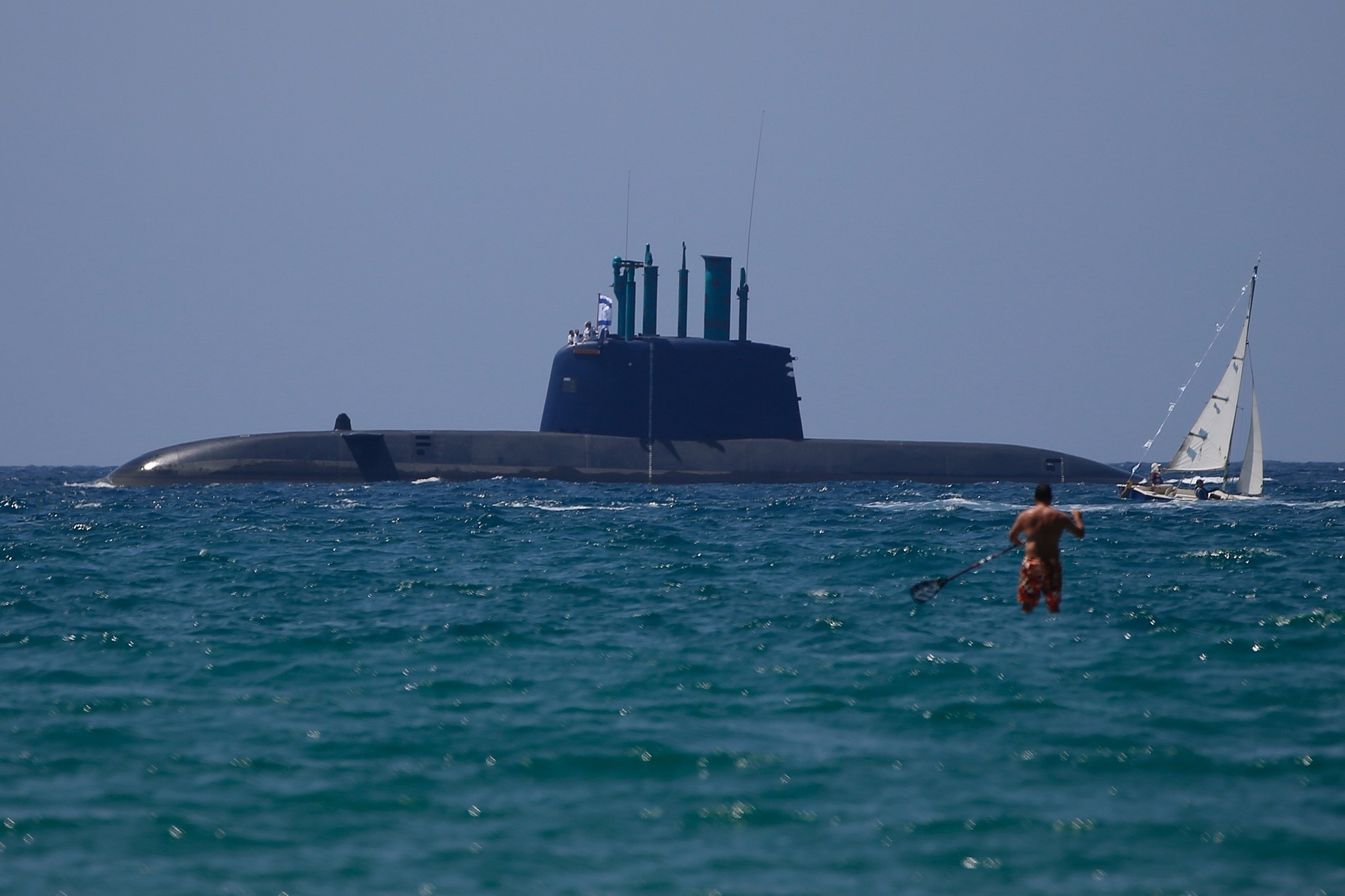
Israel's Prime Minister Benjamin Netanyahu speaks during a ceremony following the arrival of the INS Tanin, a Dolphin AIP class submarine, to a naval base in the northern city of Haifa - Sept. 2014
(AP Photo/Amir Cohen, Pool)Israel’s Prime Minister Benjamin Netanyahu speaks during a ceremony following the arrival of the INS Tanin, a Dolphin AIP class submarine, to a naval base in the northern city of Haifa – Sept. 2014

Amoui’s remarks come just days after an Israeli submarine reportedly crossed into the Suez Canal

Iran warned on Sunday that if an Israeli submarine is found lurking inside the Persian Gulf, it will not hesitate to meet such aggression with a “strong and massive” response.

“Israel must know that our response to aggression against our national security will be strong and massive,” Abu al-Fadl Amoui, a spokesman for the National Security and Foreign Policy Committee of the Iranian Parliament, told Al-Jazeera Arabic during a recent interview.

“Israel is looking for excuses to drag the region into a tension that creates chaos in the last days of the Trump presidency,” the official added.

The spokesman also threatened neighboring Arab nations who have normalized ties with Israel or have clandestine relations, warning that bringing Jerusalem too close to Iran’s borders would spark a dangerous reaction.

Amoui’s remarks come just days after an Israeli submarine reportedly crossed into the Suez Canal in what security experts say was a show of force directed at Iran, according to The Washington Post.

Citing Arab intelligence sources, the report said the move was conducted with Egypt’s approval and in the midst of seething tensions between Jerusalem and Tehran.

The sources estimated that the vessel was heading toward the Persian Gulf, and by exposing itself above sea level it was sending a warning message to the Islamic Republic.

Meanwhile, Israeli military spokesman, Haidai Zilberman, had said that he did not rule out that Iran would attack Israel from Iraq or Yemen. He explained that Tehran is working to develop drones and smart missiles in those two countries.

Tensions between Israel and Iran rose to new heights following the targeted killing of Iranian nuclear scientist Mohsen Fakhrizadeh near Tehran in November.

Comments

No comments have been written yet. Be the first!

Write a comment…


Will Israel and the US succeed in preventing war with Iran?

In recent weeks, the US and Israeli militaries have sent a series of messages and signals to the Iranians.

IDF CHIEF OF STAFF Lt. Gen. Aviv Kochavi  – not the war he imagined he’d be fighting.  (photo credit: OLIVIER FITOUSSI/FLASH90)
IDF CHIEF OF STAFF Lt. Gen. Aviv Kochavi – not the war he imagined he’d be fighting.
(photo credit: OLIVIER FITOUSSI/FLASH90)
Israel and the United States are working hard to prevent a war with Iran. It is not certain that they will succeed.

In recent weeks, the US and Israeli militaries have sent a series of messages and signals to the Iranians, warning the ayatollahs of the consequences of an attack launched directly by the Revolutionary Guard Corps or by one of the Islamic Republic’s terrorist proxies, in Lebanon, Iraq or Yemen.

The rise in tensions is due to intelligence assessments in Israel and the US that Iran is plotting to avenge a string of attacks against it over the last year – the US bombing that killed Qassem Soleimani in January, the bombing of the Natanz nuclear facility over the summer and the assassination last month of its top nuclear scientist Mohsen Fakhrizadeh outside Tehran.

The attacks are an embarrassment for the regime and there is concern in Israel and the US that Iran will want to retaliate before President-elect Joe Biden takes office on January 20. This way, it will get the retaliation out of the way and then be able to open a new page with the Democratic administration.

In recent weeks, US and Israeli submarines were either seen or reported to have been seen sailing in the Persian Gulf. The US sent two B-52 bombers to the region last month, for the first time since 2019, in what the US military said was aimed to “deter aggression and reassure US partners and allies.”

President Donald Trump threatened Iran last week after a number of rockets were fired at the US embassy in Iraq. “Now we hear chatter of additional attacks against Americans in Iraq,” Trump tweeted. “Some friendly health advice to Iran: If one American is killed, I will hold Iran responsible. Think it over.”

In Israel, IDF Chief of Staff Lt.-Gen. Aviv Kochavi issued a strong threat against Iran, saying that if it or its proxies try to carry out attacks against Israel or Israeli targets, they will pay a heavy price.

His threat came just days after US Chairman of the Joint Chiefs Gen. Mark Milley visited Israel for talks with Kochavi, largely believed to be focused on the Iranian threat.

“We are hearing more and more threats against Israel coming from Iran,” he said at an awards ceremony. “If Iran and its partners… attack the State of Israel, they will [pay] a heavy price.”

“I am simplifying things and describing the situation to our enemies as it is,” he added. “Our retaliation plans are prepared, and they already have been practiced.”

On Saturday, Israel issued another warning via IDF Spokesman Brig.-Gen. Hidai Zilberman in an interview with the Saudi newspaper Elaph.

He stressed that everyone should be on high alert regarding the Iranian threat, which he described as a “powder keg liable to explode,” considering the many blows Iran has received in the past year without being able to properly respond.

While we hope that war will be avoided, it is important that Iran understands that it cannot get away with aggressive and terrorist action it takes throughout the Middle East and beyond. This is particularly important as Biden prepares to take office; he has already expressed a desire to resume negotiations with the Iranians over a new nuclear deal.

Returning to the same deal reached in 2015 would be a grave mistake. Iran needs to be stopped and contained. The last deal did not apply to its development and production of long-range ballistic missiles or to its regional terrorist activity. Another flaw was the sunset clause that would allow the Iranians to up their enrichment of uranium and nuclear production once the deal expired in 2025.

Vigilance is important and Tehran needs to be constantly reminded that there is a price to pay for illicit and terrorist activity. Biden needs to keep all of this in mind as he takes office and considers next steps with Iran.

Don’t reward the ayatollahs and don’t reward terrorist activity. Isolate, pressure and contain – and if necessary, be prepared to use military action as the US and Israel have warned over the last week. It is important that Iran understand that the threat is real.


Army spokesman tells Saudi paper Israel is tracking Iran movements in region, days after Israeli submarine said to cross Suez Canal; Revolutionary Guard says ready for any scenario


An Israeli submarine sails during Independence Day celebrations marking 70 years since the founding of the state in 1948, in Tel Aviv, April 19, 2018. (AP/Ariel Schalit)

Illustrative: An Israeli submarine sails during Independence Day celebrations marking 70 years since the founding of the state in 1948, in Tel Aviv, April 19, 2018. (AP/Ariel Schalit)

After an Israel Defense Forces spokesman told a Saudi newspaper on Friday that Israeli submarines were quietly operating “everywhere,” an unnamed Iranian official told Al Jazeera Saturday that “Tehran’s response to any attack on national security will be strong and wide.”

The anonymous source claimed that Israel “is looking for excuses to drag the region into tension that will create chaos” in the final days of US President Donald Trump’s term.

And the top naval commander in the Islamic Revolutionary Guard Corps warned that Iran was ready to defend itself and was prepared for any scenario.

“Forces, systems and equipment are at the desired level of readiness to defend the water borders, the interests and security of our country,” said IRGC Navy Commander Admiral Alireza Tangsiri.

Tangsiri’s comments came after IDF Spokesperson Hidai Zilberman told the Saudi Arabian Elaph news outlet that Israel was tracking Iranian movements around the region, and that Israeli submarines were quietly “sailing everywhere.”

Zilberman gave the interview after an Israeli submarine reportedly openly crossed the Suez Canal last week in a show of force directed at Iran. The move was approved by Egypt, according to the Kan public broadcaster, which cited Arab intelligence sources. The submarine reportedly surfaced and faced the Persian Gulf, which lies on the other side of Saudi Arabia. The intelligence sources said the move was meant to “send a message” to Iran.

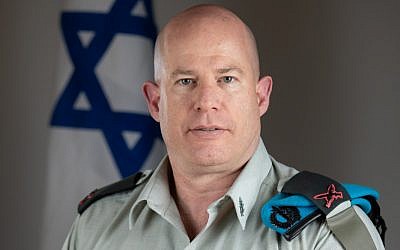
Brig. Gen. Hidai Zilberman, who was nominated to take over as the next IDF spokesperson on June 13, 2019. (Israel Defense Forces)

Zilberman additionally said that although Israel was not aware of any specific plans by Iran to attack the Jewish state, Iranian forces could carry out an attack from Iraq or Yemen, according to a translation of the interview by the Ynet news site.

He said Israel had information indicating Iran was developing unmanned aerial vehicles and “smart missiles” in Iraq and Yemen, and that the weapons could have the ability to strike Israel.

Zilberman said Israel had attacked targets in Syria in the past year, and used 500 smart missiles, without any response from Iran or the Syrian regime. He added that Israel had no intention of letting up its pressure campaign against Iran in Syria.

The IDF has launched hundreds of strikes in Syria since the start of the civil war in 2011 against moves by Iran to establish a permanent military presence in the country and efforts to transport advanced, game-changing weapons to terrorist groups in the region, principally Hezbollah.

Zilberman’s comments were not immediately available in English and the interview contained few direct quotes.

On Monday, IDF Chief of Staff Aviv Kohavi warned Iran against attacking Israel, saying that the Jewish state will retaliate forcefully against any aggression.

Iran has threatened to attack Israel since the assassination of its top nuclear scientist, Mohsen Fakhrizadeh, in late November, in a raid blamed on the Jewish state.

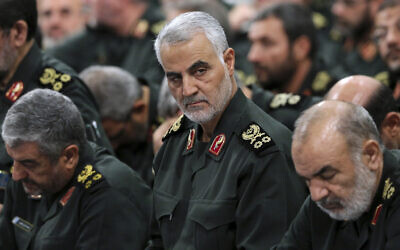
In this Sept. 18, 2016 file photo Revolutionary Guard Gen. Qassem Soleimani, center, attends a meeting with Supreme Leader Ayatollah Ali Khamenei and Revolutionary Guard commanders in Tehran, Iran. (Office of the Iranian Supreme Leader via AP)

In a strikingly similar move to the reported Israeli submarine crossing of the Suez Canal, a US nuclear submarine crossed the Strait of Hormuz on Monday as the anniversary of the killing of Iranian General Qassem Soleimani by a US drone approached.

US military officials fear an attack by Tehran to avenge the powerful Soleimani, leader of the IRGC’s elite Quds force, who was assassinated on January 3, 2020, in a US drone strike near Baghdad airport in Iraq.

Agencies contributed to this report.