
Olive grove where Jesus spent a night of agony, accepted his betrayal, and was arrested ahead of his crucifixion has until now had no physical link to Second Temple era

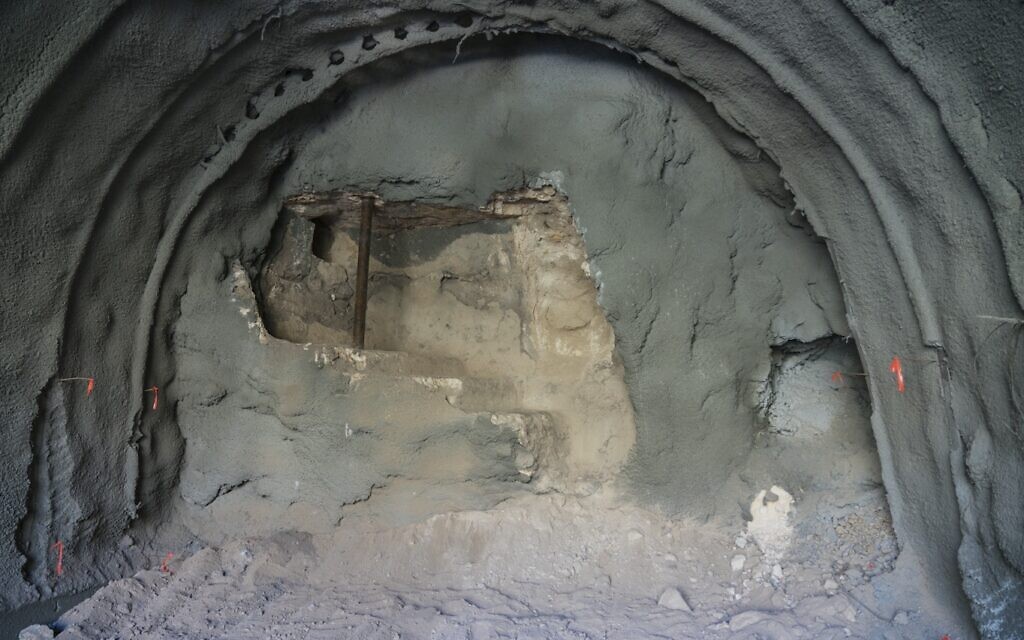
  • Second Temple-era ritual bath that was discovered during construction work on a modern tunnel under the 1920 Catholic Church of All Nations. (Yaniv Berman, Israel Antiquities Authority)
    Second Temple-era ritual bath that was discovered during construction work on a modern tunnel under the 1920 Catholic Church of All Nations. (Yaniv Berman, Israel Antiquities Authority)
  • Archaeologist Amit Reem next to the ritual bath at Gethsemane on Jerusalem's Mount of Olives. (Yaniv Berman/ Israel Antiquities Authority)
    Archaeologist Amit Reem next to the ritual bath at Gethsemane on Jerusalem’s Mount of Olives. (Yaniv Berman/ Israel Antiquities Authority)
  • Fr. Francesco Patton, Custos of the Holy Land, next to the ancient ritual bath. (Yoli Schwartz/ Israel Antiquities Authority)
    Fr. Francesco Patton, Custos of the Holy Land, next to the ancient ritual bath. (Yoli Schwartz/ Israel Antiquities Authority)
  • David Yeger, director of the excavation at Gethsemane in Jerusalem, in the Byzantine church. (Yoli Schwartz, Israel Antiquities Authority)
    David Yeger, director of the excavation at Gethsemane in Jerusalem, in the Byzantine church. (Yoli Schwartz, Israel Antiquities Authority)
  • Israel Antiquities Authority excavations at the Byzantine church. (Yoli Schwartz/ Israel Antiquities Authority)
    Israel Antiquities Authority excavations at the Byzantine church. (Yoli Schwartz/ Israel Antiquities Authority)
  • Israel Antiquities Authority excavations at a 6th century Byzantine church at Gethsemane in Jerusalem's Mount of Olives. (Yoli Schwartz/ Israel Antiquities Authority)
    Israel Antiquities Authority excavations at a 6th century Byzantine church at Gethsemane in Jerusalem’s Mount of Olives. (Yoli Schwartz/ Israel Antiquities Authority)

A Second Temple-era ritual bath that was recently uncovered on Jerusalem’s Mount of Olives at the site believed to be the New Testament’s Gethsemane is being touted as the first evidence that links the pilgrimage site to the period in which Jesus lived.

According to all four Gospels, it is at Gethsemane — which idiomatically means “olive press” in Hebrew — that Jesus spent a night of agony following the Last Supper, accepted his eventual betrayal and execution, and was arrested by the Temple guards of the Sanhedrin.

“For the first time, we have archaeological evidence that something was here in the Second Temple period, in the days of Jesus,” said Israel Antiquities Authority’s Jerusalem district head Amit Re’em on Monday.

While the find does not lend any physical credence to the Gospels, it does point to the possibility of there having been an oil press at the site, which would appear to align with the New Testament name of the site where Jesus spent his final night before the crucifixion.

Second Temple-era ritual baths are not particularly unusual for archaeologists to uncover: there are dozens of similar baths dotting the Land of Israel — if not hundreds, Re’em told The Times of Israel. But this ritual bath, also known as a mikveh, represents the first time there is any physical archaeological evidence at the traditional site of Gethsemane, where Christians have made pilgrimages for centuries, to connect it to the New Testament era.

“It is not from the mikveh that we are so excited, rather the interpretation, the meaning, of it. Because despite there being several excavations in the place since 1919 and beyond, and that there were several findings — from the Byzantine and Crusader eras, and others — there has not been one piece of evidence from the time of Jesus. Nothing! And then, as an archaeologist, there arises the question: Is there evidence of the New Testament story, or maybe it happened elsewhere?” said Re’em.

Archaeologist Amit Re’em next to the ritual bath at Gethsemane on Jerusalem’s Mount of Olives. (Yaniv Berman/ Israel Antiquities Authority)

During the era in which Jesus walked in Jerusalem, Gethsemane would have been a field outside the walls of Jerusalem full of olive trees.

According to Re’em, there was likely some kind of olive press, for making oil, in the middle of the field, though no sign of such a thing had been discovered. Re’em said, tentatively, that the discovery of the ritual bath outside the walls of Jerusalem — meaning, not in a residential settlement — points to an implicit need for ritual purity in an agricultural context.

Volume 90%


Most ritual baths from the period have been excavated in the homes of wealthy individuals, inside settlements for public use, near cemeteries, or in agricultural areas, where they were used to ritually purify those involved in the production of wine and olive oil, according to Re’em.

Second Temple-era ritual bath that was discovered during construction work on a modern tunnel under the 1920 Catholic Church of All Nations. (Yaniv Berman, Israel Antiquities Authority)

“According to the Jewish law, when you are producing wine or olive oil, you need to be purified,” said Re’em. “So there is a high probability that during the time of Jesus, at this place was an oil press.”

Archaeologists used stratigraphical context and typological comparisons to date the bath to the Second Temple era, though the research has not yet been scientifically peer-reviewed or published.

The next step for researching the mikveh, he said, will be to take plaster samples and send them to micro-archaeologists who will look for minuscule olive pollen grains, among other substances.

Second Temple-era ritual bath that was discovered during construction work on a modern tunnel under the 1920 Catholic Church of All Nations. (Yaniv Berman, Israel Antiquities Authority)

If these are discovered, then the connection to oil production will become more certain, said Re’em.

But he cautioned that such testing is time-consuming and answers will not be immediate. Nor will they definitively prove the beliefs of pilgrims who have associated the site with Gethsemane for at least 1,500 years.

“Let’s not get carried away,” said Re’em. Even with this ritual bath, “there’s no evidence to the truth of the Gospels.”

A gift from God

The existence of the bath — the first and so far only evidence of the Second Temple period at the site — came during a chance cave-in during construction of a tunnel to link the modern Church of the Nations to the Kidron Valley ahead of a new visitors center. Since then, the Israel Antiquities Authority and students from the Studium Biblicum Franciscanum have carried out and completed salvage excavations at the location.

Israel Antiquities Authority excavations at a 6th century Byzantine church at Gethsemane in Jerusalem’s Mount of Olives. (Yoli Schwartz/ Israel Antiquities Authority)

Excavations were also undertaken at the foot of the 1920s church in the Kidron Valley, where remains of a Byzantine church and a Crusader-era monastery were unearthed. According to an IAA press release, the church was used from circa 6th century CE through the 8th century, which was after the Muslim conquest.

On the church’s floor, a Greek inscription was discovered, stating, “For the memory and repose of the lovers of Christ (cross) God who have received the sacrifice of Abraham, accept the offering of your servants and give them remission of sins. (cross) Amen.” The inscription was jointly deciphered by Dr. Leah Di Segni of the Hebrew University of Jerusalem and Dr. Rosario Pierri of the Franciscan Institute.

According to IAA excavation director David Yeger, “It is interesting to see that the [Byzantine-era] church was being used, and may even have been founded, at the time when Jerusalem was under Muslim rule, showing that Christian pilgrimages to Jerusalem continued during this period as well.”

David Yeger, director of the excavation at Gethsemane in Jerusalem, in the Byzantine church. (Yoli Schwartz, Israel Antiquities Authority)

Regarding the newly discovered Byzantine-era church, Re’em said there is no documentation of this particular church, but he believes that the area must have been at one time a compound that included several churches, each documenting a different facet of Jesus’s trials at the location.

The medieval monastery, or hospice or visitors’ center, had several chambers and a “sophisticated” water system, which included two large, cross-decorated cisterns, according to the IAA. Re’em said that it was likely destroyed by the Ayyubid Sultan Salah-a-Din in 1187 CE, according to debris found at the site, and that there is textual documentation that the sultan ordered that stones from razed Mount of Olives churches be used to fortify city walls.

Fr. Francesco Patton, custos of the Holy Land, next to the ancient ritual bath. (Yoli Schwartz/ Israel Antiquities Authority)

The findings were presented on Monday at a small conference attended by Custos of the Holy Land Fr Francesco Patton, Israel Antiquities Authority archaeologists, and scholars from the Studium Biblicum Franciscanum, including Studium Biblicum Franciscanum archaeologist Father Eugenio Alliata.

The Church of the Nations, built between 1919-1924, is one of multiple Franciscan holdings in the Holy Land. The seat of the Franciscan custos is located adjacent to the Old City’s New Gate, and since 1217, a succession of custos have overseen the order’s work in the Holy Land, including the territories of Israel, Palestine, Jordan, Lebanon, Egypt (in part), Cyprus, and Rhodes.

Israel Antiquities Authority excavations at the Byzantine church. (Yoli Schwartz/ Israel Antiquities Authority)

Members of the Franciscan order were among the pioneering archeologists in the Holy Land and its Terra Sancta Museum, in continuous operation since 1902 in Jerusalem’s Old City, has served as a sanctuary for archaeology from war-torn areas, including the Islamic State-ravaged Palmyra, Syria.

The order maintains that eight olive trees on the site date back to the time of Jesus, which would make them the oldest in the world.

Fr. Francesco Patton, custos of the Holy Land, said in an IAA press release, “Gethsemane is one of the most important sanctuaries in the Holy Land, because in this place the tradition remembers the confident prayer of Jesus and his betrayal and because every year millions of pilgrims visit and pray in this place.

“Even the latest excavations conducted on this site have confirmed the antiquity of the Christian memory and tradition linked to the place, and this is very important for us and for the spiritual meaning connected with the archeological findings,” said Patton.


Lawmakers vote 49 to 47 against legislation that would have given Likud, Blue and White extra time to reach compromise; Knesset will dissolve on Tuesday night

Lawmakers vote against a bill to delay the budget deadline on December 22, 2020 (Danny Shem Tov/ Knesset Spokesperson)

Lawmakers vote against a bill to delay the budget deadline on December 22, 2020 (Danny Shem Tov/ Knesset Spokesperson)

The Knesset rejected a bill that would defer new elections by briefly delaying Tuesday night’s deadline, almost certainly sending Israel to a fourth vote in two years.

Lawmakers voting after midnight Monday rejected the bill that would have given the rival coalition parties a last-ditch chance to reconcile their stark differences, by a vote of 49 to 47.

Speaking at the end of an hours-long debate, Prime Minister Benjamin Netanyahu again sought to put the blame on his rival Benny Gantz.

Netanyahu told the Knesset that he had spent recent hours trying to secure additional vaccines for Israel and that fighting the virus should be lawmakers’ focus, not fresh elections.

“At this time we should have been uniting forces to prevent these unnecessary elections. At the last moment Benny Gantz backed out of the agreements we had,” Netanyahu said.

Had the bill passed, it would have delayed the deadline to pass a budget for this year from December 23 to December 31. The deadline for approving a budget covering 2021 would be January 5.

The coalition’s Blue and White party has said that if the budgets aren’t passed by those deadlines, the Knesset will dissolve and elections will be held on March 23, even though analysts have suggested Israeli law doesn’t allow for elections to be held less than three months after the Knesset dissolves.

Earlier Monday evening both Likud and Blue and White said that their negotiations on delaying the deadline to pass a state budget had broken down and blamed each other for the failure to reach an agreement.

Blue and White has walked back all the agreements it reached with Likud, Prime Minister Benjamin Netanyahu’s party said in a statement after Gantz appeared to increase his demands just hours after the bill to delay the budget passed its first Knesset committee reading.

“Due to an internal fight in Blue and White, Gantz has retracted all the agreements reached in negotiations between Blue and White and Likud,” Likud said. “It’s unfortunate that Gantz has decided to drag the country to unnecessary elections at the height of the coronavirus crisis.”

The accusation came after Gantz, speaking to his Blue and White MKs, said he had laid out five demands to Netanyahu for his party to support the bill to delay the budget in the plenary: passing a 2020-2021 budget; approving all the senior appointments that have been held up; closing all loopholes that would allow Netanyahu to avoid handing over power to Gantz as part of their rotation agreement; keeping Avi Nissenkorn as justice minister; and approving the Knesset rules of procedure.

“If they want it, they’ll take it. If they don’t, there will be elections,” he said.

Benny Gantz, left, and Benjamin Netanyahu in the Knesset during a vote for the parliament to dissolve itself, on December 2, 2020. (Danny Shem Tov/ Knesset Spokesperson)

According to the Walla news site, Gantz told his party members that he thinks elections will be called on Tuesday.

“I gave Netanyahu my final offer and he’s supposed to get back to me,” Gantz was quoted saying. “I think he’ll say no and the Knesset will be dissolved tomorrow.”

“If I hear tonight that something can be done on this matter, I will update you. If not, the Knesset will turn into a pumpkin tomorrow night,” he reportedly said, referring to the midnight deadline for the state budget that will see the parliament automatically dissolved if no action is taken to postpone it.

Even with Gantz’s approval, however, the bill’s passage in the plenum was undermined due to a rebellion from a number of coalition MKs, and several supporting lawmakers going into coronavirus quarantine.

Blue and White MK Hila Shay Vazan in Jerusalem, November 9, 2020 (Hadas Parush/Flash90)

Hours before the committee meeting started, the Knesset spokesperson announced that Blue and White MK Hila Shay Vazan, a member of the committee, had been diagnosed with the coronavirus, putting her into quarantine. As a result, committee chair and fellow party member MK Eitan Ginzburg was advised to also quarantine because he had met with Shay Vazan last week.

Late Monday afternoon, it was announced that Gantz himself would also be going into quarantine due to contact with Shay Vazan.

Additionally, Blue and White MKs Asaf Zamir, Miki Haimovich and Ram Shefa  also did not support to it.

All three have previously publicly expressed their unease at their party remaining in partnership with Netanyahu.

Blue and White MK Michal Cotler-Wunsh (Avishai Finkelstein)

On Monday afternoon, a fourth Blue and White MK, Michal Cotler-Wunsh, joined the rebellion, saying the “lousy” possibility of new elections would need to be considered “in the face of the intolerable reality of a dysfunctional government.”

Before the disagreements within Blue and White, it was already unclear whether there was a majority to pass the bill. The potential rebel Blue and White MKs, coupled with Likud members who have formed a new rival party under MK Gideon Sa’ar, mean that even if a compromise was reached, it would not necessarily have sufficient support in the Knesset to pass.

Added to that is Likud MK David Bitan, who is seriously ill with COVID-19.

Reports of an agreement on delaying the deadline between Likud and Blue and White came on Sunday evening after the latter party appeared to waver in its ultimatum to Netanyahu’s party to pass the budget by Tuesday’s deadline or face a fresh vote.

Under the power-sharing deal between Likud and Blue and White, a failure to pass a budget is the lone loophole that would let Netanyahu avoid having to give up the premiership to Gantz. Likud has been holding up the budget for months in an effort to renegotiate a more favorable coalition agreement that would see Netanyahu’s one-and-half-year term extended at the expense of Gantz’s equivalent allotment of time as premier, which is currently set to begin in November 2021. Likud is also seeking to curb the power of Justice Minister Avi Nissenkorn.

https://www.timesofisrael.com/knesset-rejects-bill-to-delay-budget-deadline-israel-heading-to-elections/?fbclid=IwAR0uhf5cuVhvoWFdQ3l9_3O8nzxuM2gGs7paayaWMbJNop21iABw3Qf3z80


Yoav Zitun|
Published: 12.21.20 , 17:55
IDF Chief of Staff Lt. Gen. Aviv Kochavi on Monday warned that Israel would respond harshly against any acts of belligerence from Iran.
If Iran and its cronies carry out attacks against Israel, they will find out the cost of their cooperation,” he said.