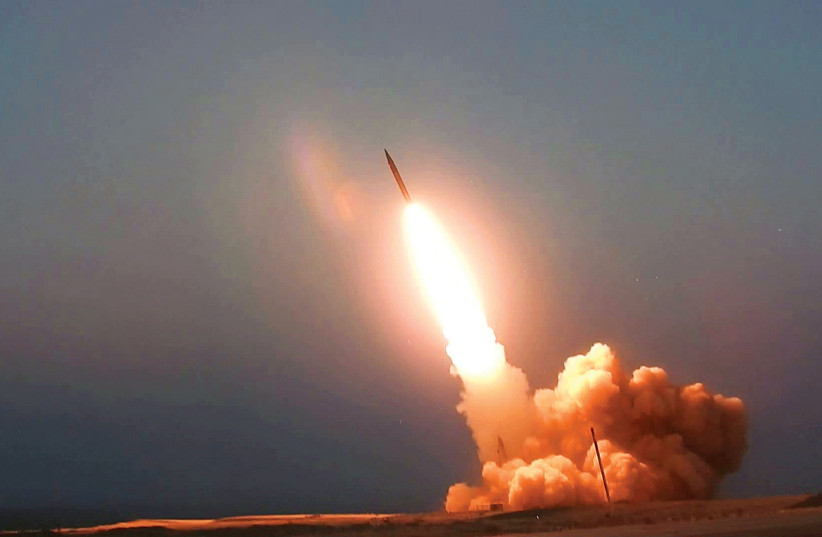
A little noticed comment by Iran’s President Hassan Rouhani about
Iran’s missile program should have raised eyes abroad. He said that the country’s missile program is non-negotiable. Iran’s President had a larger point. He said that US President-elect Joe Biden is “aware” of how Iran feels about its missiles.
This is an example of how Iran’s nuclear program became such a topic that it obscured what Iran was really up to. Iran’s nuclear program has been seen as important by western countries for decades and Israel has warned about Iran’s threats. The nuclear program is indeed a threat and Iran has sophisticated sites designed to hide the program and its military elements. However, the program is only one part of a much more sophisticated Iranian military industrial complex that threatens the region and stability of many countries.
What is Iran’s real goal with the nuclear option? It appears that it is quite different from the nuclear weapons obtained by Pakistan or India, or the US and Soviet Union, which were generally seen to create a kind of parity of threats between rival countries. Once parity was achieved the actual threat of nuclear conflict was reduced. Actually, these countries may have become more responsible actors once they had nuclear weapons.
Iran’s goal is more complex. Its nuclear program is not the end game, it is only part of a much wider military industrial complex and the tip of that spear is actually the drone and missile program. Iran has invested heavily in missiles, probably more per capita than many other countries. Why missiles? Missiles don’t win wars. Never in history has a country won a war with missiles. Strategic bombing might have won wars, but not missiles. Iran decided long ago that while its conventional military forces could not face down all its adversaries, it could invest in missiles to spread havoc. Missiles give you an ability to project power without an air force. Iran’s air force is based on planes inherited from the Shah which are themselves US military equipment. Iran had trouble getting parts for these planes, and they have been aging. So if you’re Tehran what you can do, in the absence of being able to get more military imports, you create an indigenous weapons industry.
Missiles were a way for Iran to build a real arsenal and to export it to its militia allies. Iran likes to partner with sub-state entities, including militias. Iran has learned it can festoon Hezbollah, the Houthis and even Iraqi-based militias, with missiles and now drone technology. That is why the Iranian missile program is non-negotiable for the regime. The regime like to negotiate the nuclear program, because it knows creating an actual nuclear weapon is complex. So it can basically slow-play the international community regarding the nuclear issue while using the missiles as a bait-and-switch.
Iran has improved its long range precision ballistic missiles. Since 2017 it has made real strides on a variety of liquid and solid fuel rockets. It has used missiles to target Kurdish dissidents in Iraq and ISIS in Syria, as well as US bases in Iraq. It used cruise missiles and drones to target Saudi Arabia and has exported technology to Yemen to target Saudi Arabia. Iran is constructing larger and larger missiles and has worked with North Korean experts to share information. It has constructed a variety of family of missiles, such as the Qiam that was derived from the Shahab, which itself is derived from Scud and North Korean variants. It also built the Zulfiqar, which is derived from the Fateh 110 which itself is based on early models dating to the Soviet-era. Iran has launched a military satellite this year and continues to build new facilities for missiles. One of those facilities, at Khojar, may have been a victim of some kind of sabotage in June. Iran is clear that its missiles are a red line. It wants to keep them, and it is happy to discuss nuclear issues until the cows come home, but the missile program will continue.
As the program grows in complexity and precision Iran believes it has an asymmetric threat that can somehow deter the US or Israel from any kind of action and also project power that will somehow neutralize the capabilities of its adversaries, such as the hi-tech F-35 warplane that the US and Israel have been training with. The missile program is Iran’s game changer in its view, the weapon system that will make it one of the most powerful in the region. That power is built on a relatively weak economy. But in terms of technology its investment has paid off in the missile and drone sphere.