
If his last-minute effort to resolve the “Gulf crisis” yields a positive result, his reputation as a surprising and unexpected peace-maker will be further enhanced.
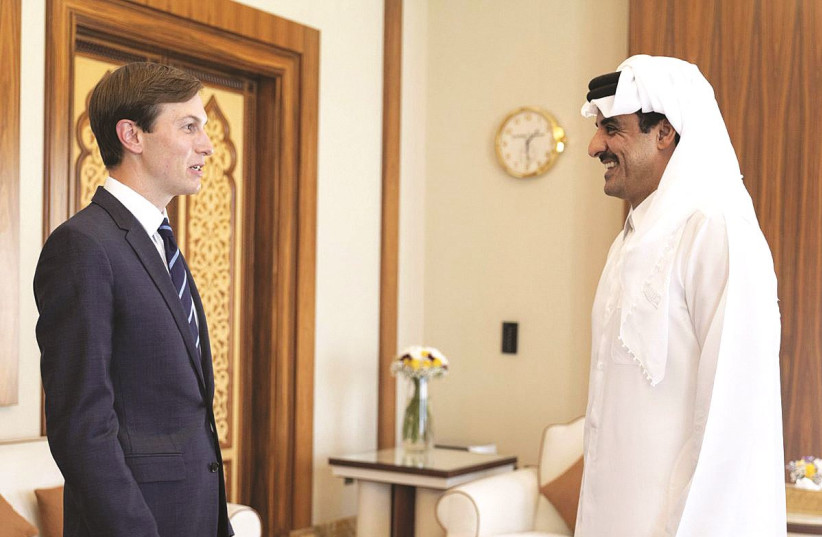
QATAR’S RULER, Emir Sheikh Tamim bin Hamad al-Thani, meets with US President Donald Trump’s senior adviser Jared Kushner in Doha in September. (photo credit: QATAR NEWS AGENCY/HANDOUT VIA REUTERS)
QATAR’S RULER, Emir Sheikh Tamim bin Hamad al-Thani, meets with US President Donald Trump’s senior adviser Jared Kushner in Doha in September.
(photo credit: QATAR NEWS AGENCY/HANDOUT VIA REUTERS)
It seems as if US President Donald Trump, intent now on securing his presidential legacy, sees the chance of a last-minute achievement in the Gulf. Having apparently lost the glittering prize of Saudi Arabia joining the Abraham Accords before he leaves office, Trump has grasped at another possible opportunity. Back in 2017, following years of dissension, Saudi Arabia and neighboring states severed all relations with Qatar. Could Trump bring an end to what has become known as the “Gulf crisis?” Why else would Trump’s son-in-law and special adviser, Jared Kushner, have visited the Gulf region on November 30?

Kushner met Saudi Crown Prince Mohammed bin Salman in Riyadh, and then traveled to Qatar on December 2 for a meeting with the Emir of Qatar Sheikh Tamim bin Hamad Al Thani. Following these discussions, media reports suggested that Qatar and Saudi Arabia were close to striking an agreement to end the dispute.

Qatar is a stand-alone Middle Eastern state in more ways than one − geographically, politically, economically, influentially. Itself a small peninsula projecting into the Persian Gulf from the vast Arabian Peninsula, Qatar clearly aspires to become a major player in the region and beyond. In pursuit of this objective, its tactics have sometimes puzzled, sometimes infuriated its neighbors. But then, as one of the world’s wealthiest nations – and certainly number one on a per capita basis – Qatar has reckoned that it could afford the luxury of proceeding along its own preferred path without too much concern for what others think.

For example, Qatar’s strategy of backing Islamists − from Hamas in Gaza, to the Muslim Brotherhood in Egypt, to hard-line Syrian opposition fighters − while also offering itself as a key US ally, was rooted in pragmatism. Qatar wanted to extend its influence in the region by being friends with everybody. “We don’t do enemies,” Qatar’s one-time foreign minister is reported to have said, “we talk to everyone.” And talk they certainly do, through the Qatari-owned Al Jazeera worldwide media network.

But Qatar’s wayward policies, especially with regard to Islamist groups, had long infuriated its neighboring Arab states. Back in January 2014, when Qatar’s 33-year-old emir, Sheikh al-Thani, had been in power for less than a year, Gulf states suddenly pressured Qatar to sign an agreement undertaking not to support extremist groups, not to interfere in the affairs of other Gulf states and to cooperate on regional issues.

When the Qatari government flatly refused to comply, Saudi Arabia, the United Arab Emirates and Bahrain broke off diplomatic relations. The inexperienced Al-Thani was unable to withstand the pressure. In April 2014, at a meeting in Saudi Arabia, his arm was twisted, and the Qataris signed an undertaking known as the Riyadh agreement.

Saudi Arabia, the UAE and Bahrain clearly took away a very different view of what had been agreed than the Qataris. They expected Qatar to curtail its support for extreme Islamism, particularly the Muslim Brotherhood and its supporters. They believed that Qatar had agreed to remove, or at least reduce, the appearance of Islamists on Al Jazeera and other Qatari media, and especially to eliminate the constant Muslim Brotherhood-based criticism of Egypt’s government and its president, Abdel Fattah el-Sisi.

They soon discovered that Qatar had no intention of meeting their expectations. It simply continued its support of Islamist extremists intent on undermining the stability of the region. Finally, their patience exhausted, the Gulf states and Egypt took drastic action. On June 5, 2017, without any sort of warning, they broke off diplomatic relations with Qatar, suspended all land, air and sea traffic and virtually imposed a trade blockade.

This bombshell initiative had been preceded by Trump’s visit to Saudi Arabia for a meeting with some 50 leaders of the Arab world. On the subject of Islamist extremism ,Trump had been characteristically blunt. “A better future is only possible if your nations drive out the terrorists and extremists… Drive them out of your communities. Drive them out of your holy lands. And drive them out of this Earth.”

Qatar has been under siege for more than three years. Although most major trade routes into and out of the country have been closed off, Qatar has been sustained by continuous shiploads of food and other goods sent in by Iran and Turkey. As for exports, Qatar is the largest global exporter of liquefied natural gas, and this has been maintained. As a result, the country seems to have weathered the blockade and to be reasonably well placed to sustain itself indefinitely.

According to most media comment the Trump initiative has yielded positive results. On December 4, Qatar’s foreign affairs minister, Mohammed Al-Thani, said “We are optimistic about a resolution to the Gulf crisis, but we cannot say that all problems will be solved in one day.”

The New York Times sees a connection between ending the dispute and Trump’s aim of weakening the regime in Iran, which has been sustaining Qatar’s economy. The paper reported that high among the proposed first steps, Trump is pressing Saudi Arabia to open its airspace for Qatari flights. Over the past three years, Qatar has been paying millions of dollars to use Iran’s airspace.

The Abraham Accords will surely be added to the credit side of Trump’s account when his years in office are eventually submitted to the judgment of history. If his last-minute effort to resolve the “Gulf crisis” yields a positive result, his reputation as a surprising and unexpected peace-maker will be further enhanced.

The writer is Middle East correspondent for Eurasia Review. His latest book Trump and the Holy Land: 2016-2020. He blogs at www.a-mid-east-journal.blogspot.com.



Syria makes command changes to 1st Corps following Israeli threats

The report named Maj.-Gen. Ramadan Ramadan as incoming commander of the 1st Corps, replacing Lua’a Ali Ahmad Asa’ad.

Supporters of Lebanon's Hezbollah leader Sayyed Hassan Nasrallah carry flags and pictures of Syria's President Bashar al-Assad during a rally marking al-Quds Day in Maroun Al-Ras village, near the border with Israel, southern Lebanon June 8, 2018 (photo credit: REUTERS/AZIZ TAHER)
Supporters of Lebanon’s Hezbollah leader Sayyed Hassan Nasrallah carry flags and pictures of Syria’s President Bashar al-Assad during a rally marking al-Quds Day in Maroun Al-Ras village, near the border with Israel, southern Lebanon June 8, 2018
(photo credit: REUTERS/AZIZ TAHER)
The Syrian Arab Army has made changes to the leadership of the 1st Corps and its operations center in the southern part of the country, following threats to its leadership by the Israeli military.

The IDF, which has accused the SAA of helping Lebanon’s Hezbollah establish a permanent military presence on the Golan Heights, has been dropping leaflets along the Israeli-Syrian border in recent weeks warning the SAA’s 1st Corps not to work with the Iranian proxy group.

According to Lebanon’s Al-Modon online newspaper, the SAA has made changes to the division and brigade leadership after the leaflets dropped by Israel specifically threatened them.

The report named Maj.-Gen. Ramadan Ramadan as incoming commander of the 1st Corps, replacing Lua’a Ali Ahmad Asa’ad.

In April the IDF released a short video showing a visit by Asa’ad to Hezbollah positions in the country. “We see you. Consider this a warning,” the Israeli military said in a tweet, releasing the footage.

Quoting an opposition military source, Ramadan is “not qualified in terms of seniority and military rank” to be promoted to commander of the 1st Corps and did not occupy any previous command positions in it.

“It is clear that the only reason for appointing Maj.-Gen. Ramadan to his new position is his close ties to Hezbollah and Iran, as he is from the Shiite community and has been known since the beginning of the revolution to push the army into confronting it,” the source was quoted by Al-Modon as saying.

The source added that Iran has “depended” on him since it entered the civil war on the side of Syrian President Bashar Assad and that Ramadan “previously led an important part of the military operations in the southern and eastern countryside of Idlib.”

Other changes include the commanders of the 7th Division, 5th Division, 90th Brigade, 12th Brigade and others.

Following the return of regime forces to the south of the country and the rebuilding of the SAA, which was decimated over the course of the ongoing civil war, the influence of Lebanon’s Hezbollah and Iran on the army has increased dramatically.

Though Israel usually refrains from targeting terror operatives in an attempt to avoid retaliation, several strikes blamed on the Jewish State have killed several Hezbollah operatives in southern Syria on the Golan Heights, where the group has been trying to establish a permanent military presence.

In addition to the 1st Corps, Hezbollah forces have been deployed to 28 locations as part of the Southern Command unit, as well as to another 30 locations where there is a presence of cells operating under the Golan Project.

The Southern Command, led by Munir Ali Na’im Shaiti, is the Hezbollah unit in charge of southern Syria. Its main function is to create a Hezbollah infrastructure in the area and not only gather intelligence on the IDF but also train the 1st Corps for war with Israel.

Should the Lebanese terror group decide to carry out an attack from the Golan Heights, the IDF believes that Hezbollah will use the 1st Corps, which has significant weaponry and logistics available to them, against Israel. This will not only provide Hezbollah with better mobility and firepower, but it will also provide the manpower.

The Golan Project is under the command of Ali Mussa Daqduq and has its headquarters in Damascus and the Lebanese capital of Beirut.  A portion of the operatives have undergone training by Hezbollah in sabotage, sharpshooting and firing Grad rockets. The project has been accused of launching attacks against Israel.


BEIRUT, LEBANON (6:20 P.M.) -The Iranian army announced that it is monitoring the movements of foreign forces in the region and that its air defenses are monitoring the movements of American B-52 bombers.

The deputy commander of the Iranian army’s Khatam al-Anbia Air Defense headquarters, Brigadier-General Qadir Rahimzadeh, said that the army is monitoring all movements of foreign forces in the area, including US B-52 bombers.

“All foreign forces’ movements in the region, including B-52 bombers, are monitored at a distance of more than 150 km from the country’s air borders in the southern Gulf,” Rahimzadeh said.

“Iranian air defenses monitor their movements moment by moment,” adding that, “We are aware of all the movements of neighboring countries and we are watching them moment by moment in the intelligence and operations centers of the country’s air defense.”

This announcement comes just a day after it was revealed that the US military had sent its B-52 strategic bombers to the Persian Gulf, in what was described as a powerful message to Iran and a renewed commitment to protecting American allies and interests in the Middle East.

Tensions in the Persian Gulf have been incredibly high this month, following the assassination of the Iranian nuclear scientist Mohsen Fakhrizadeh near the capital, Tehran, on November 29th.

Iran has vowed to respond to the assassination, which they said was carried out by the Israeli Mossad and elements of the opposition group, the People’s Mujahedin of Iran (MEK).

The MEK has denied the allegations, while Israel has refused to comment.