Israel normalizes ties with Bhutan

I want to thank the Kingdom of Bhutan and praise the decision to establish full diplomatic relations with Israel,” Ashkenazi said.

Israeli Ambassador Ron Malka, Bhutanese Ambassador Vetsop Namgyel, and delegations. December 12, 2020 (photo credit: ISRAELI EMBASSY IN NEW DELHI)
Israeli Ambassador Ron Malka, Bhutanese Ambassador Vetsop Namgyel, and delegations. December 12, 2020
(photo credit: ISRAELI EMBASSY IN NEW DELHI)
Israel established full diplomatic relations with Bhutan for the first time on Saturday night.

Israeli Ambassador to India Ron Malka and his Bhutanese counterpart Vetsop Namgyel signed the final agreement normalizing ties on Saturday night.

The countries’ foreign ministries held secret talks over the past year towards the goal of forging official ties, which included delegations from Jerusalem to Thimphu, Bhutan’s capital, and Thimphu to Jerusalem.

The effort to make relations between Thimphu and Jerusalem was separate from the Abraham Accords, in which four Arab countries – United Arab Emirates, Bahrain, Sudan and Morocco – normalized ties with Israel in as many months, with American mediation. In fact, Bhutan does not have official diplomatic relations with the US.

Bhutan is a Buddhist kingdom in the Himalayas, bordering on India and the Tibet Autonomous Region of China, which has gone to great lengths to keep itself isolated from the rest of the world in order to avoid outside influences. Bhutan has formal diplomatic relations with only 53 other countries, a list that does not include the US, UK, France or Russia, and embassies in seven.

The country does not have ties with China, either, having closed its border to the country on its north after its 1959 invasion of Tibet.

Malka said in an exclusive interview with The Jerusalem Post that the ceremony marking official diplomatic relations between Israel and Bhutan was “exciting…modest, but very special.”

The ambassador said that in recent years, Bhutanese governments have reached out to Israel.

“They have been impressed by Israel’s abilities for many years, and their prime minister wanted relations,” he said. “We advise them on topics that are important to them like water management, agriculture and technology…education and professional training, as well. They’re very interested in the topic of medicine.”

Bhutan’s government “thinks of Israel as a leading country in technology and innovation that can help them progress and use more advanced technology and train their youth.”

Another area in which Bhutan has sought Israel’s advice is in building a national service program for its youth.

As for tourism, the country that limits the number of outsiders who can enter will now likely be more open to Israelis, Malka said, though no precise numbers have been discussed.

“They let very few people visit, even though it is very attractive, because they want to preserve its history and its nature and environment. It was very hard before, but now Israelis will be more accepted and they will want to develop [Israeli] tourism,” Malka said.

Malka has visited Bhutan twice and said that it is “a very special place that is different from anywhere else. They really preserved their culture and their natural resources. There is not even one traffic light. It is very natural.”

It is still unclear if Israel will open an embassy in Thimphu; Malka may be nonresident ambassador to Bhutan, just as he is to Sri Lanka in addition to residing in Delhi, from which Thimphu is a two-hour flight.

Foreign Minister Gabi Ashkenazi and Foreign Minister of Bhutan Tandy Dorji spoke on the phone last weekend.

“I want to thank the Kingdom of Bhutan and praise the decision to establish full diplomatic relations with Israel,” Ashkenazi said. “I invite my friend Foreign Minister Dorji to visit Israel to promote cooperation between the countries. I hope that in the next year we will host the King of Bhutan in the next year for his first official visit [to Israel].”

Ashkenazi also thanked Malka and the embassy staff for working to strengthen Israel’s ties to Bhutan and bringing them to fruition.

Prime Minister Benjamin Netanyahu praised the new relations and called it “another fruit of the peace agreements,” adding that Israel is in touch with more countries that want to establish ties with Israel.

Hundreds of Bhutanese citizens have participated in agricultural training programs through MASHAV, Israel’s development agency.

Israel briefly had a nonresident ambassador to Bhutan in 2010, Mark Sofer, who was Israel’s ambassador to Israel and Sri Lanka at the time.

In 2017, Gilad Cohen, the head of Israel’s Asia-Pacific division, became the most senior Israeli official to visit Bhutan. During his trip, he met the country’s prime minister.

Bhutan, which is about twice as large as Israel, but with only 800,000 residents, is thought to be one of the most beautiful countries in the world, but limits tourism, especially from outside South Asia, and only allowed television and the Internet in 1999, in an attempt to preserve its culture and natural resources.

It uniquely measures its quality of life by “Gross National Happiness” instead of gross domestic product (GDP), and in fact, the World Happiness Report was a joint initiative of the Bhutanese prime minister and UN secretary-general in 2011. That metric emphasizes sustainable development, environmental conservation, preservation of culture and good governance, as well as mental and physical health, among other values.

The Bhutanese are thought to be among the happiest people in the world, and the happiest in Asia, but they are also among the poorest in the world.

Its main export is hydroelectric energy, to India.

Bhutan became a constitutional monarchy, holding its first general election, in 2008. Before that, it was an absolute monarchy. Its king’s official title is Dragon King.

While Lebanese terror group may be keen to stay out of the fight, precision rocket tech is reaching Gaza and accurate cruise missiles are within the grasp of groups in Iraq


Military personnel stand near the flag-draped coffin of Mohsen Fakhrizadeh, an assassinated top nuclear scientist during his funeral ceremony in Tehran, Iran, November 30, 2020. (Iranian Defense Ministry via AP)

Military personnel stand near the flag-draped coffin of Mohsen Fakhrizadeh, an assassinated top nuclear scientist during his funeral ceremony in Tehran, Iran, November 30, 2020. (Iranian Defense Ministry via AP)

Two weeks have passed since the mysterious assassination outside Tehran of Mohsen Fakhrizadeh, long regarded by Israel and the US as the head of Iran’s rogue nuclear weapons program. A number of versions of what actually happened during the few minutes of the shooting attack have come out since then, some of which seem taken directly from Hollywood.

According to the official Iranian version, a satellite-operated machine gun opened fire at Fakhrizadeh, killing him and several of his bodyguards. Other unconfirmed reports have claimed there was a shootout involving several gunmen, though all versions agree there was also an explosion, the purpose and timing of which is disputed.

Although Israel has not officially taken responsibility, Iran has blamed the Jewish state, whose security establishment is now trying to figure out if, and how, Iran will react to the assassination.

Initial alerts warned of attacks against Israelis in the Gulf’s United Arab Emirates or Bahrain (which has a distinct Shi’ite majority, like Iran), countries with whom Israel only recently established ties. Alternative scenarios are of attacks against Israeli targets in other countries, similar to the deadly attacks in Buenos Aires during the 1990s in retaliation for the assassination of Abbas al-Musawi, one-time leader of the Iran-backed Lebanese terror group Hezbollah.

Yet these are not the only options for Iranian retaliation. Currently, Tehran has quite a few allies in the region standing by to offer immediate assistance should Iran require it. Is a precision-guided missile attack from Gaza an impossible scenario? How about cruise missiles launched from Western Iraq, where Iran-backed militias operate, in a repeat of the Gulf War and its notoriously imprecise Scud missile attacks on Israel — but this time with far more accurate targeting?

Tehran now has the ability to react through such means.

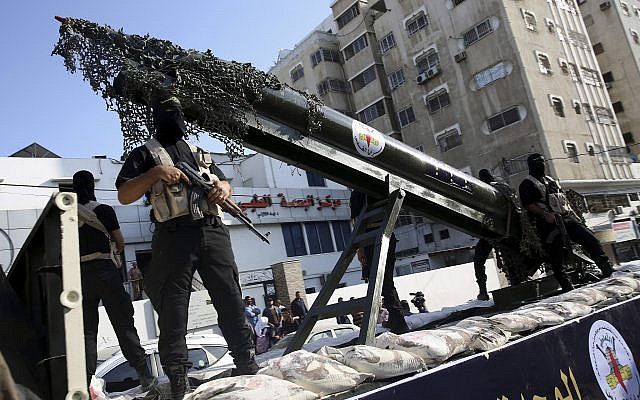
Palestinian members of the Al-Quds Brigades, the military wing of the Islamic Jihad terror group, parade with a replica rocket on a truck during a march in Gaza on October 4, 2018. (AP Photo/Adel Hana)

In Gaza, for example, the Iranian regime has been investing a lot of time and money to develop the Islamic Jihad terror group’s military capabilities. The organization’s operatives are sent to training camps throughout the Middle East where they are schooled in various military skills, from urban warfare to launching precision-guided missiles.

They are also taught how to self-produce more accurate rockets — the technology required used to be extremely sophisticated and advanced, but nowadays is relatively easy to acquire. The actual components required for accuracy are not bulky or heavy — smuggling a handful of computer chips can help produce an entire array of precision-guided missiles. It isn’t clear what level of accuracy the Gazan terrorist organizations are capable of right now, but there is no doubt that the utmost efforts are being invested by Hamas and Jihad to acquire such capabilities.

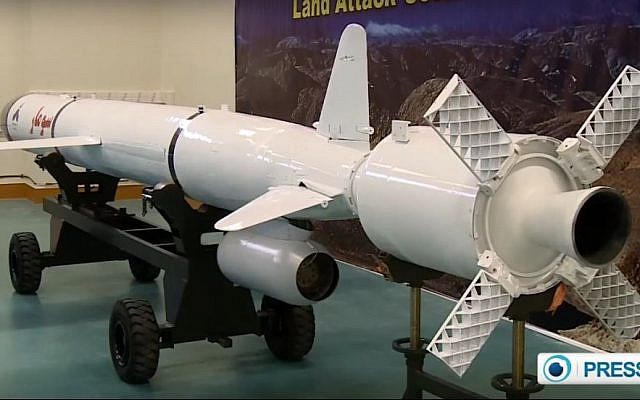
Not so long ago, the scenario of a cruise missile or precision-guided rocket attack against Israel from Gaza, guided and directed by Iran, seemed completely far-fetched. But Iran demonstrated the ability to carry out advanced attacks on September 14, 2019, when it used unmanned aerial vehicles (UAVs) and cruise missiles to attack the Aramco oil-processing facilities in Abqaiq and Khurais in Saudi Arabia. The attack, launched from Yemen, was in revenge for Saudi Arabia’s involvement in the war against the Houthis rebels in that country.

In other words, the Iranians are now capable of accurate long-distance attacks using a range of weapons. And the lack of any American, Saudi, or Western reaction to that September attack may have whet Iran’s appetite to try these weapons out again.

Iran‘s Soumar cruise missile, unveiled in March 2016. (YouTube screenshot)

Last month the Houthis launched another cruise missile attack on Saudi Arabia and threatened to one day fire at Israel’s southern resort city of Eilat. But if Tehran decides to use a cruise missile attack to react to Fakhrizadeh’s assassination, it probably won’t be from Yemen, and certainly not from Lebanon. Gaza’s abilities in the field are currently limited, though it is possible Islamic Jihad could be tempted to have a go — thus dragging all of Gaza into a war in the midst of the COVID-19 outbreak and a failing economy.

However, the most likely option for a cruise missile revenge attack would be from Western Iraq. Iran manages a wealth of Shi’ite militias in the area, under the tutelage of the Islamic Revolutionary Guard Corps and the Quds Force headed by Esmail Qaani, who replaced the slain Qassem Soleimani. Such an attack on Israel would leave the decision-makers in Jerusalem without a return address. The question is if these militias have the ability to carry out such an operation or not.

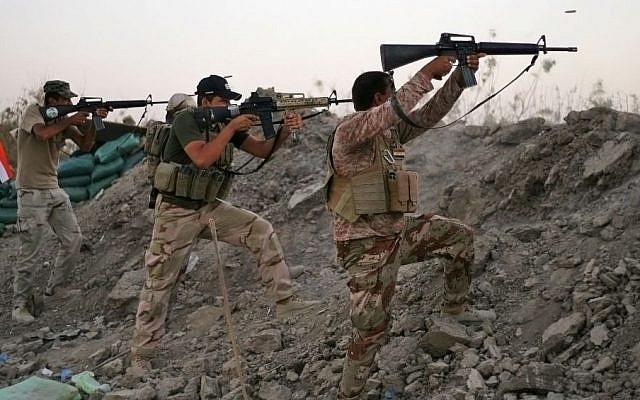
Generally speaking, Iranian influence in the area is pretty extensive even though it is not yet at the scope and rate Tehran is aiming for. Twenty-five years ago the only export of Iran’s Islamic revolution was Hezbollah in Lebanon. Today, Iranian fingerprints can be found throughout the region: Yemen, of course, Iraq, Syria, Lebanon, and even Bahrain. The Shi’ite militias include not only Iraqis and Iranians, but also mercenaries from Afghanistan and Pakistan, who were shipped in to fight the Islamic State group in the Syrian civil war and remained, highly motivated to face the familiar old enemy – Israel.

Iraqi Shi’ite militiamen fire their weapons during clashes with terrorists from the Islamic State group, in Jurf al-Sakhar, September 28, 2014. (photo credit: AP, File)

The Iranian nuclear project, despite Fakhrizadeh’s untimely demise and despite a mysterious explosion in the uranium enrichment facility in Natanz earlier this year, is far from grinding to a halt. This week The New York Times reported that massive work is being carried out in Natanz, most likely in order to move the entire facility underground.

The Trump administration’s decision to exit the nuclear agreement between Iran and world powers also did not slow down the Iranian project – just the opposite, it speeded it up. The Iranians are already purposely exceeding the limitations placed on them under that agreement to prove they do not cave to American pressure. Some analysts say that the time Iran would need to break out and acquire a nuclear bomb has now been reduced from a year to just six months.

It should be noted, though, that Tehran is not going ahead with the military nuclear track and is being extremely careful not to cross certain boundaries. Iran has continued to enrich larger amounts of uranium than it is permitted. According to data from the Israeli side, Tehran has some two tons of uranium at an enrichment purity of 4.5 percent, yet this level of enrichment is still considered permissible and suitable for civilian purposes and not above – or even close to – weapons-grade enrichment.

In the meantime, there is also no sign that Iran’s plan of entrenching itself in Syria has been especially successful. This is both good news and bad news.

The bad news is that Iran is not planning on quitting Syria. Just this week Iranian President Hassan Rouhani met with Syrian Foreign Minister Faisal Mekdad and announced that his country will continue to support Syria and its people in their confrontation with the Zionists. The bombs discovered several weeks ago on the Israeli side of the Golan Heights border with Syria indicate that Iran and its emissaries – sometimes through Syrians/Lebanese/Shi’ite militias – are continuing their efforts to strike at Israeli targets.

The good news is that no increased Iranian presence has been identified in Syria. In fact, the opposite is true – Iran has recently reduced its presence in Syria.

Footage of Israeli strikes on Iranian and Syrian targets in southern Syria following an attempted explosive attack by Iranian-backed operatives against Israeli troops on the Golan Heights, November 18, 2020 (Israel Defense Forces)

The crucial question still left unanswered is Hezbollah’s role in an Iranian retaliation, if there will be one at all. The organization remains Israel’s greatest threat. Only this week the Institute for National Security Studies published a comprehensive study of the next battle in the north of Israel. The document includes a pretty realistic scenario of Israel coping with hundreds of rocket attacks a day, including precision-guided missiles, which will be launched not only from Lebanon but also from Western Iraq and possibly also from Syria. This battle will be different to any we have previously known and the threat to the Home Front will be especially great.

That scenario is still quite some way away. Currently, Hezbollah is very careful to avoid any escalation along the border between Israel and Lebanon. It is even taking its time retaliating against the killing of one of its men in an Israeli attack in Syria, possibly because it understands the implications of such a move — meaning, the fear of all-out war is a deterrent on Hezbollah’s side as well.

Possibly more than anything else, the negotiations between Israel and Lebanon concerning the maritime boundaries between the two states proves that even an extreme Shi’ite organization calling for the destruction of the “Zionist entity,” understands that there are certain advantages to doing business with the “Zionist enemy.” Only a few short years ago Hezbollah most probably would not have permitted the Lebanese government to conduct any discussions at all with Israel. Yet here Hezbollah is not calling a halt to the talks. It may be criticizing them to a certain extent, but it is doing no more than that.

The ramifications of a deal with Israel regarding the drawing of the maritime border can mean billions of dollars from offshore gas that Lebanon is desperate for. This is a bankrupt state in a very difficult political situation. The combination of a global pandemic, the national disaster of the Beirut port explosion, the political dead-end and the increasing enmity among the different religious sectors, all contribute to the feeling – among Hezbollah as well – that war against “the Jews” is something to avoid at this stage.

In the meantime, the talks are continuing even though recently the American go-between has been doing a lot of to-ing and fro-ing, as both sides are avoiding holding their fourth meeting. Also, the Lebanese have attempted to draw the border significantly southwards from its estimated location, causing Israel to retaliate by drawing the border much higher north. Still, both sides remain committed to these talks and it is clear that Lebanon wants an agreement, even more than Israel.


U.S. Army Put on Highest Alert - Iran moves missiles for attack upon Israel

The American army has been put on high alert due to Iran’s deployment of missile systems.  An attack by Iran against Israel is now considered “imminent.”

The situation in the Middle East turned very tense after the American troops stationed on the territory of the states of the region were brought to the highest level of combat readiness. The reason for this was the deployment by Iran of  missile systems, which are DESIGNED to be used to launch strikes on Israeli territory, in retaliation for the murder of Iranian nuclear scientist Fahrizadeh.

“The US military in the Middle East has increased its combat readiness due to fears in the event of a possible attack from Iran. The Pentagon is also closely monitoring “alarming indicators of a potential attack” by Iranian militias in Iraq.

Two days earlier, the command of the Iran Revolutionary Guard Corps (IRGC) of Iran announced the beginning of preparations for a response to the elimination of its scientist by the Israeli special services, while Tehran did not find any involvement in this from Washington, in connection with which the main targets will be the objects and cities of Israel.

It is noteworthy that two days ago Iran began deploying radars, air defense systems, and missile systems into Syria to strike Israel from close range.

Now that you have read this story, please COVER THE COST for what your visit cost this site by clicking one or more of the ads below which generates Advertiser revenue of two to three cents per click – no purchase necessary by you — and helps offset operating costs for this web site.

https://halturnerradioshow.com/index.php/en/news-page/world/u-s-army-put-on-highest-alert-iran-moves-missiles-for-attack-upon-israel?fbclid=IwAR0OEU9YSeJK9N66jkpO-oBfEUCEtCoxw0-Nenlz18K1r3DFsJ4Z2QjOP3U