In recent years, Jordan has repeatedly called on Israel to “stop its violations and provocations and respect the legal and historical status quo” at the al-Aqsa mosque compound.

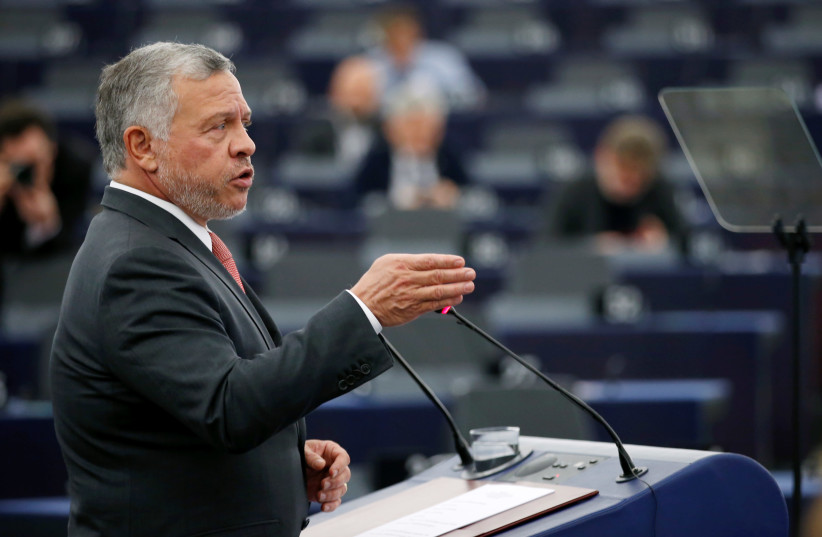
King of Jordan Abdullah II addresses the European Parliament in Strasbourg, France January 15, 2020. (photo credit: VINCENT KESSLER/ REUTERS)
King of Jordan Abdullah II addresses the European Parliament in Strasbourg, France January 15, 2020.
(photo credit: VINCENT KESSLER/ REUTERS)
Jordan will not accept any attempts to change Jerusalem’s historical and legal status quo, Jordan’s King Abdullah said on Thursday, adding that the kingdom would not give up its status as custodian of the Islamic and Christian holy sites in the city.

“The Hashemite Custodianship of Jerusalem’s Islamic and Christian holy sites is a duty, a commitment, a firm belief, and a responsibility we have profoundly undertaken for more than a hundred years,” King Abdullah said in a speech during the inauguration of the new parliament. “Jerusalem is a symbol of peace, and we will not accept any attempts to alter its historical and legal status quo, nor attempts of temporal or spatial division of al-Aqsa mosque/al-Haram al-Sharif.”

The Jordanian monarch’s statement came in wake of reports that the Jordanians are worried of losing their status as custodians of the Islamic and Christian holy sites in Jerusalem, which dates back to 1924, when the Supreme Muslim Council, the highest body in charge of Muslim community affairs in Mandatory Palestine, accepted Hussein bin Ali (Hashemite Sharif of Mecca) as custodian of al-Aqsa Mosque.

According to the unconfirmed reports, Prime Minister Benjamin Netanyahu and senior officials of the Trump administration have offered Saudi Arabia a role in managing al-Aqsa mosque if Riyadh agrees to establish relations with Israel.

In recent years, Jordan has repeatedly called on Israel to “stop its violations and provocations and respect the legal and historical status quo” at the al-Aqsa mosque compound.

In his speech, King Abdullah said that Jordan “will never waver from defending Jerusalem, its holy sites, its identity, and its history.”

He repeated his call for achieving a just and comprehensive peace on the basis of the two-state solution and the establishment of “an independent, sovereign, and viable Palestinian state on the June 4, 1967 lines, with east Jerusalem as its capital.” Denying the Palestinians their just and legitimate rights, he added, “is the very reason our region continues to suffer conflict and instability.”


And then there were four: US, MidEast officials welcome Morocco deal

From the US to the UAE to Egypt, Israel and Morocco saw plenty of praise for their newly-announced normalization agreement.

Prime Minister Benjamin Netanyahu, his wife Sara Netanyahu, US Ambassador to Israel David Friedman and his wife Tammy Deborah Sand, as Nentanyahu addresses the people on the historic normalization deal with Morocco at the Western Wall Hanukkah candle lighting. December 10, 2020. (photo credit: KOBI GIDEON/GPO)
Prime Minister Benjamin Netanyahu, his wife Sara Netanyahu, US Ambassador to Israel David Friedman and his wife Tammy Deborah Sand, as Nentanyahu addresses the people on the historic normalization deal with Morocco at the Western Wall Hanukkah candle lighting. December 10, 2020.
(photo credit: KOBI GIDEON/GPO)
United States officials, Israeli officials and notable figures throughout the Middle East welcomed the historic normalization agreement between Morocco and Israel on Thursday evening. Many Israeli officials spoke of symbolism of signing the agreement on the first night of Hanukkah.

Netanyahu first thanked President Donald Trump for his efforts to “bring peace to the people of Israel and the Middle East,” and continued to thank Morocco King Mohammed VI in a live broadcast.

“The people of Morocco and the Jewish people have had a warm relationship in the modern period. Everybody knows the tremendous friendship shown by the kings and the people of Morocco to the Jewish community there. Hundreds of thousands of these Moroccan Jews came to Israel, and they formed a human bridge between our two countries of sympathy, respect, of fondness and love, and I think this is the foundation that we can now build this peace between Morocco and Israel,” Netanyahu said.

He noted that direct flights would be established between Israel and Morocco in order to strengthen relations.

“The light of peace on this Hanukkah day has never shown brighter than today in the Middle East,” Netanyahu said.

Defense Minister Benny Gantz welcomed the agreement on his Twitter account.

“I applaud the anticipated establishment of official ties with Morocco, which presents an opportunity to anchor the long-standing relationship between our peoples, and formalize a rich and deep shared history that goes back centuries,” Gantz wrote. He thanked the US officials who worked tirelessly to make the agreement happen.

On Thursday, Israel’s Ambassador to the United Nations Gilad Erdan spoke to his Moroccan counterpart Omar Hilale offering his congratulations.

“Together with the US administration and under Prime Minister Netanyahu’s leadership, we are all building a better future for our children and for the world,” Erdan said.

“And then there was 4,” wrote Israeli Ambassador to the United States Ron Dermer on his Twitter account shortly after Morocco became the fourth country this year to normalize relations with Israel. He then thanked US President Donald Trump and Prime Minister Benjamin Netanyahu.

Middle Eastern leaders, too, recognized the historic agreement and commended the two countries on reaching the normalization deal.

The United Arab Emirates (UAE), which Israel reached a normalization deal with a few months prior, commended the agreement on the Ministry of Foreign Affairs’ Twitter page, stating, “The UAE commends the US’ recognition of Moroccan sovereignty over all of its territories and welcomes the Kingdom’s decision to resume official contacts and diplomatic relations with Israel.”

Egyptian President Abdel Fattah al-Sisi wrote on Twitter on Thursday that he values the important step of normalizing ties between Morocco and Israel.

Bahrain King Hamad bin Isa Al Khalifa praised Moroccan King Mohammed VI’s decision to establish diplomatic relations and official connections with Israel, state news agency BNA reported on Thursday.

The statement also welcomed US recognition of Morocco’s sovereignty over the Western Sahara region.

Earlier on Thursday, Israel and Morocco agreed to normalize relations in a deal brokered with US help, making Morocco the fourth Arab country to set aside hostilities with Israel in the past four months.

US Ambassador to the UN Kelly Craft congratulated “Israel and the Kingdom of Morocco on their historic agreement to establish full diplomatic relations. Following similar agreements between Israel and UAE, Bahrain & Sudan, President Trump has again delivered on his commitment to peace in the Middle East.”

The Israel American Public Affairs Committee (AIPAC) praised the agreement. “We commend the leadership of both countries in achieving this breakthrough, and we thank President Trump and his administration for facilitating this diplomatic development,” AIPAC said in a statement.

“A new era has arrived in relations between Israelis and citizens of the Islamic world. These diplomatic breakthroughs offer the promise of not only peaceful relations but also fostering economic prosperity and people-to-people cooperation,” the statement reads.

The American Jewish Committee applauded Israel and Morocco, “the North African country, a close ally of the United States and home to a Jewish community for more than 2,000 years” in becoming the sixth Arab state to normalize relations with Israel.

“Morocco’s announcement is further affirmation of the growing recognition by Arab leaders that establishing relations with Israel will be mutually beneficial,” said AJC CEO David Harris.

Reuters contributed to this report.


Abbas: Palestinians ready to resume peace talks with Israel

Egypt steps up pressure on Abbas to revive peace process

Palestinian President Mahmoud Abbas speaks during a Security Council meeting at the United Nations in New York, U.S., February 11, 2020 (photo credit: REUTERS/SHANNON STAPLETON)
Palestinian President Mahmoud Abbas speaks during a Security Council meeting at the United Nations in New York, U.S., February 11, 2020
(photo credit: REUTERS/SHANNON STAPLETON)
The Palestinians are ready to return to the negotiating table with Israel under the auspices of the Quartet, which consists of the US, United Nations, Russia and European Union, Palestinian Authority President Mahmoud Abbas said on Thursday.

Abbas told visiting Spanish Foreign Minister Arancha González during a meeting in his office in Ramallah that the negotiations should be based on “international legitimacy resolutions,” a reference to UN resolutions pertaining to the Israeli-Arab conflict.

Abbas’s statement came amid reports that Egypt has been exerting pressure on the Palestinian leadership to renew the peace talks with Israel.

The Egyptian envoy to Ramallah, Tarek Tayel, met in the past week with a number of senior Palestinian officials in the context of Cairo’s efforts to resume the peace negotiations between the Palestinians and Israel.

The Egyptian envoy told the Palestinian officials that Egyptian President Abdel Fattah al-Sisi was determined to see the Palestinians and Israel return to the negotiating table in the coming weeks, Palestinian sources said.

The sources noted that Abbas, who visited Cairo two weeks ago, was told by Sisi that Egypt was working to revive the peace process “on the basis of a two-state solution” shortly after US President-elect Joe Biden assumes office.

At the meeting in Ramallah, Abbas briefed the Spanish foreign minister on the latest developments in the Palestinian arena and thanked Spain for its support for achieving peace in the region.

Abbas pointed out that Spain had played a role in the Middle East peace process by hosting the Madrid Conference in 1991. Hosted by Spain and co-sponsored by the US and the Soviet Union, the Madrid Conference was an attempt by the international community to revive the Israeli-Palestinian peace process through negotiations.

The Spanish foreign minister delivered to Abbas a letter from Spanish Prime Minister Pedro Sánchez in which he “affirmed the distinguished bilateral relations between the two countries and his country’s keenness to strengthen them, and to continue to provide support to the political process based on the principle of the two-state solution,” according to the PA’s official news agency WAFA.

González “affirmed her country’s support of achieving peace on the principle of the two-state solution and international law, noting that Spain will continue to support the Palestinian people to build the institutions of the Palestinian state,” the agency said.

González also met in Ramallah with PA Foreign Minister Riad Malki and discussed with him ways of resuming the Israeli-Palestinian peace process on the basis of the two-state solution. After the meeting, she told reporters that Spain has decided to provide $5 million in urgent aid to the United Nations Relief and Work Agency for Palestine Refugees (UNRWA).