US flies massive bombers in Mideast again in message to Iran

Second such mission in less than a month designed to underscore America’s continuing commitment to region, even as Trump withdraws thousands of troops from Iraq and Afghanistan
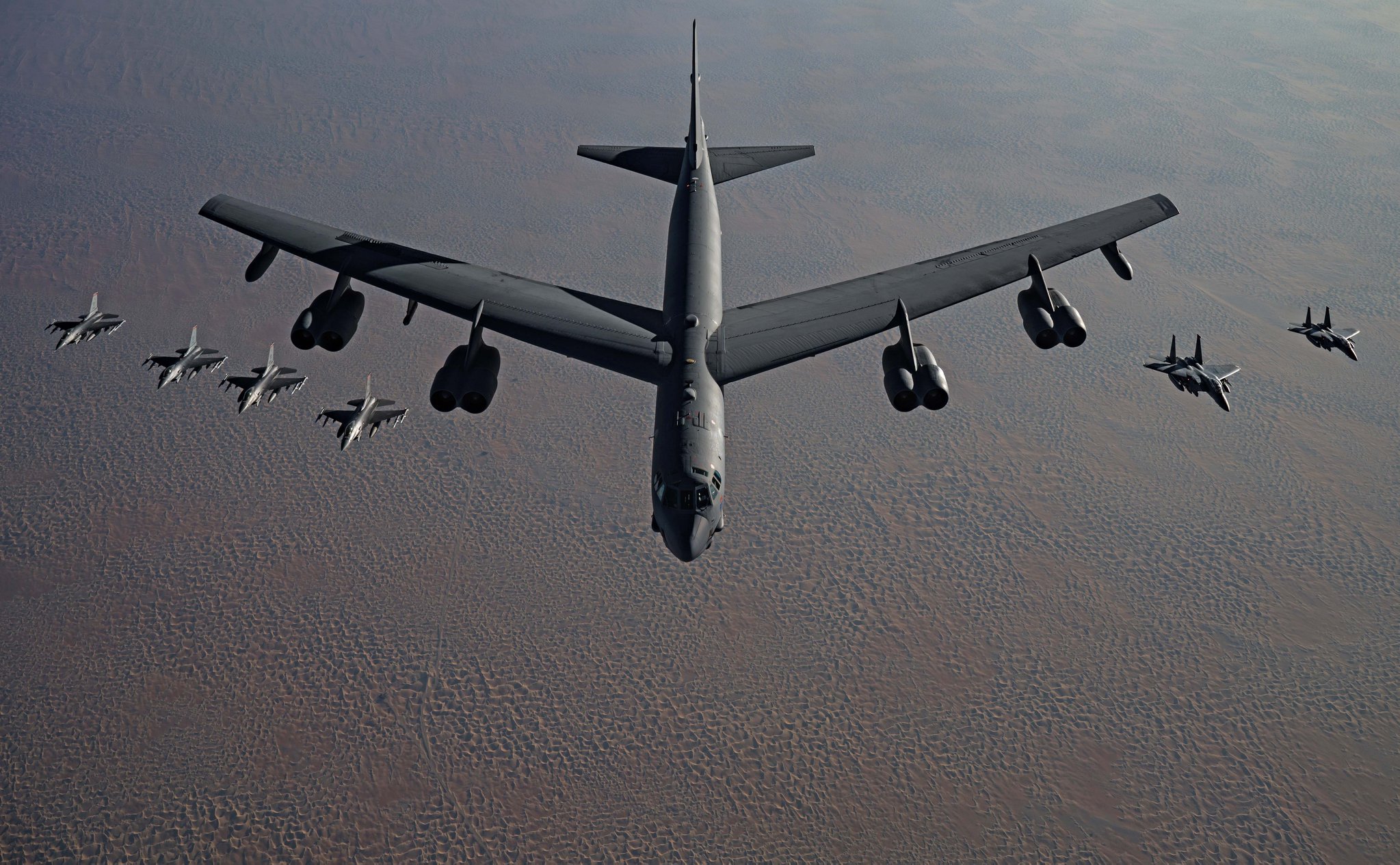
 

A B-52 heavy bomber, flanked by fighter jets, flies to the Middle East in a tacit threat to Iran on November 21, 2020. (US Air Force/Facebook)

A B-52 heavy bomber, flanked by fighter jets, flies to the Middle East in a tacit threat to Iran on November 21, 2020. (US Air Force/Facebook)

WASHINGTON (AP) — In a new show of military might, two American bomber aircraft took off from the United States and flew over a swath of the Middle East on Thursday, sending what US officials said was a direct message of deterrence to Iran.

The flight of the two massive B-52H Stratofortress bombers over the region, the second such mission in less than a month, was designed to underscore America’s continuing commitment to the Middle East even as US President Donald Trump’s administration withdraws thousands of troops from Iraq and Afghanistan.

The long-range heavy bombers, which are capable of carrying both conventional and nuclear weapons, are a formidable sight and are flown less frequently in the Middle East than smaller combat aircraft, such as American fighter jets. Adversaries often complain about bomber flights in their region, deeming them a provocative show of force.

“The ability to fly strategic bombers halfway across the world in a non-stop mission and to rapidly integrate them with multiple regional partners demonstrates our close working relationships and our shared commitment to regional security and stability,” Gen. Frank McKenzie, the top US commander for the Middle East, said in a statement.

The troop cuts coupled with the impending departure of the USS Nimitz aircraft carrier strike group in the Gulf have fueled allies’ concerns that the US is abandoning the region. Those worries are compounded by fears that Iran may strike out at the US or allies in retaliation for the assassination of Iranian nuclear scientist Mohsen Fakhrizadeh.

A B-52 heavy bomber prepares for takeoff before flying to the Middle East in tacit threat to Iran, at Minot Air Base in North Dakota, US, on November 21, 2020. (Jesse Jenny/US Air Force)

Iran has blamed the death on Israel, which has been suspected in previous killings of Iranian nuclear scientists.

US officials are also worried about a possible Iranian retaliatory strike on the first anniversary of the US airstrike that killed Iran’s top general, Qassem Soleimani, and senior Iraqi militia leaders near Baghdad’s airport in early January.

Iranian-backed militias routinely launch rockets near installations in Iraq where US and Iraqi troops are based, and officials worry about a larger, more deadly assault.

“We do not seek conflict,” McKenzie said, “but we must remain postured and committed to respond to any contingency or in opposition to any aggression.”

A senior military official, who spoke to a small group of reporters on the condition of anonymity to provide details of the mission, said the administration believes that the risk of an Iranian attack on US or allied interests in the region is a bit higher than normal now, and the Pentagon wants to ensure that Tehran thinks twice before doing anything. Adding to the concerns is the presidential transition in the US following Joe Biden’s November victory over Trump. The official said Iran or other adversaries often believe the US may be weaker or slower to respond during a political transition, which American officials flatly deny.

A US Air Force B-52 bomber flies over Osan Air Base in Pyeongtaek, South Korea, January 10, 2016. (AP Photo/Ahn Young-joon)

Bomber deployments and short-term flights to the Middle East and Europe have been used in the past to message Iran, a few times in the last two years.

According to officials, the bombers flew out of Barksdale Air Force Base in Louisiana on Wednesday and conducted the flight into Thursday. Officially nicknamed the Stratofortress and informally known as the Big Ugly Fat Fellow, the B-52 gained lasting fame in Vietnam as an aerial terror.

The two bombers were expected to fly a roughly 36-hour mission, across the Atlantic Ocean and Europe, then cross the Arabian Peninsula and fly down the Persian Gulf, making a wide loop near Qatar and staying a safe distance from Iran’s coastline before returning home, said the military official. The flight was coordinated with US allies in the region, and aircraft from Saudi Arabia, Bahrain and Qatar flew with the bombers as they traveled through the airspace, according to the official.

US Bombers from Minot Air Force Base in North Dakota flew a similar mission in late November.

The USS Nimitz, and as many as three other warships in its strike group, had been scheduled to head home by the end of the year, but they have been held in the region and no new timeline on the departure has been given. Officials, however, have made it clear that the ships’ return hasn’t been decided and the additional time in the Gulf area is open-ended.

The Pentagon announced last month that the US will reduce troop levels in Iraq and Afghanistan by mid-January, asserting that the decision fulfills Trump’s pledge to bring forces home from America’s long wars. Under the accelerated pullout, the US will cut the number of troops in Afghanistan from more than 4,500 to 2,500 and in Iraq from about 3,000 to 2,500.


US move to recognize Rabat’s claim over Western Sahara paves way for fourth in series of Trump-brokered Israel normalization accords, will include embassies and direct flights


(L-R) Prime Minister Benjamin Netanyahu, US President Donald Trump and Moroccan King Mohammed VI (Abir Sultan, Evan Vucci and Moroccan Royal Palace/AP)

(L-R) Prime Minister Benjamin Netanyahu, US President Donald Trump and Moroccan King Mohammed VI (Abir Sultan, Evan Vucci and Moroccan Royal Palace/AP)

Israel and Morocco have agreed to reestablish diplomatic relations, US President Donald Trump announced Thursday, marking the fourth Arab-Israel agreement in four months.

As part of the announcement, Trump said that the US would recognize Morocco’s claim over the disputed Western Sahara region.

As his time in office winds down, Trump said Israel and Morocco would restore diplomatic and other relations, including the immediate opening of liaison offices in Rabat and Tel Aviv and the eventual opening of embassies. US officials said it would also include joint overflight rights for airlines.

Channel 13 news reported that the White House is aiming to hold a ceremony to make the agreement official before Trump leaves office on January 20.

In their first reactions to Trump’s announcement later Thursday, Prime Minister Benjamin Netanyahu and Moroccan King Mohammed VI lauded the latest normalization agreement.

“This will be a very warm peace. On this Hannukah, the light of peace has never shone brighter than today in the Middle East,” said Netanyahu at a Hanukkah candle-lighting ceremony at the Western Wall. He said the relationship of the peoples of both countries “has long been characterized by sympathy, respect, fondness and love,” and praised King Mohammed’s “historic decision” to make peace.

Prime Minister Benjamin Netanyahu, left, and US Ambassador David Friedman at the Western Wall on December 10, 2020, the first night of Hanukkah. Netanyahu hailed the “light” of US President Donald Trump’s announcement that Morocco and Israel are to establish full relations, issued hours earlier. (Kobi Gideon/GPO)

“I always believed in this peace, and now it’s happening before our eyes. I want to thank President Trump for his extraordinary efforts to expand peace to bring peace to Israel and the Middle East,” he said while standing alongside US Ambassador to Israel David Friedman. Netanyahu said direct flights between the countries would move ahead soon.

King Mohammed said in a statement that Morocco would take three moves in the near future to advance relations.

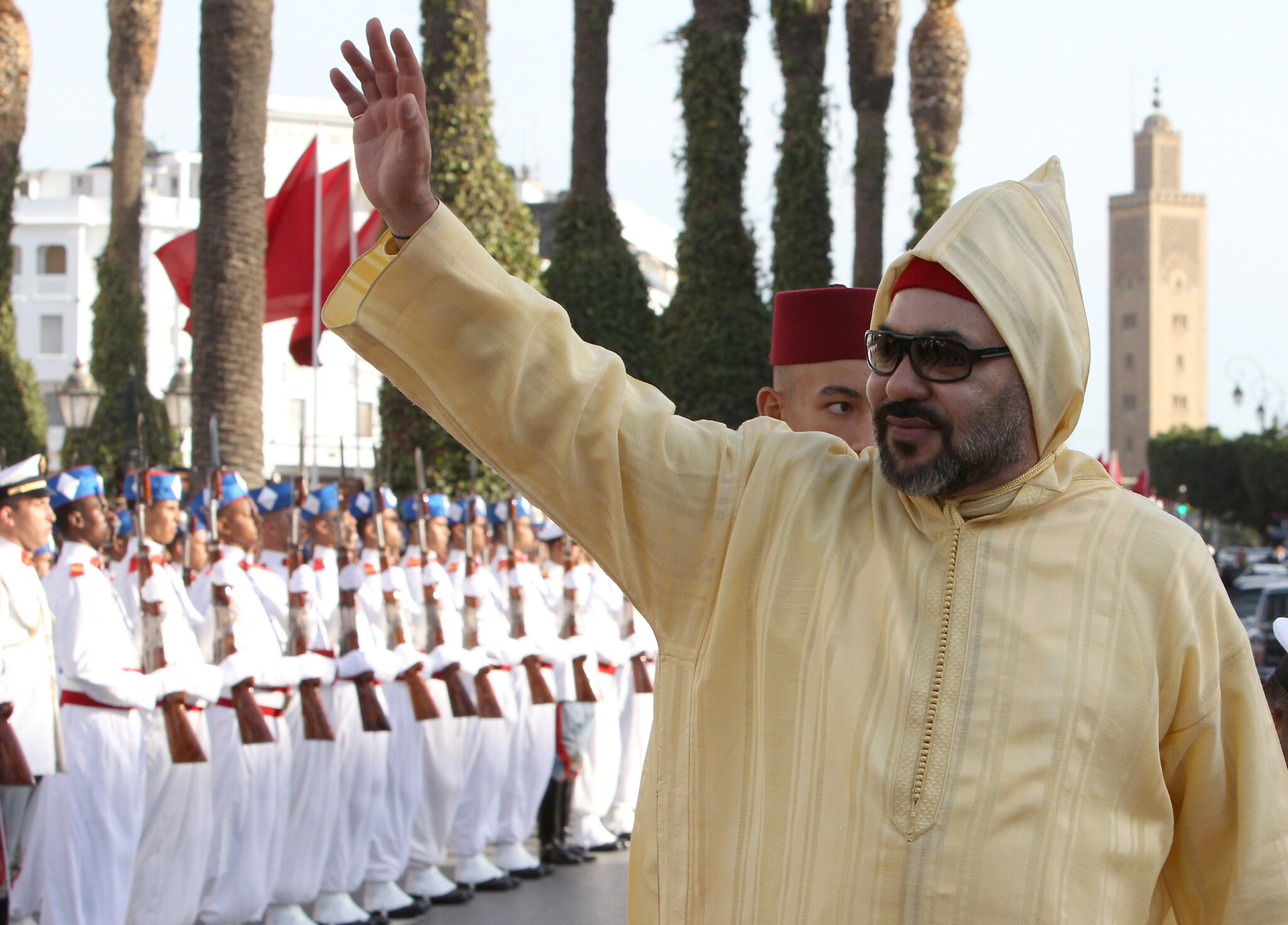
Moroccan King Mohammed VI flanked (with Crown Prince Moulay Hassan) waves to the crowd as he arrives for the opening session of the Moroccon Parliament in Rabat, on Friday, Oct. 12, 2018. (AP Photo/Abdeljalil Bounhar)

First, there would be moves to facilitate direct flights to transport Jews of Moroccan origin and Israeli tourists to and from Morocco, he said.

Second, the North African nation will also seek to “resume official bilateral ties and diplomatic relations [with Israel] as soon as possible.”

Morocco will also seek “to develop innovative relationships in the economic and technological fields. As part of this goal, there will be work on renewing liaison offices in the two countries, as was the case in the past for many years, until 2002,” King Mohammed said.

The king thanked Trump for recognizing Moroccan sovereignty over the disputed region of Western Sahara.

Explaining the decision to normalize, King Mohammed cited among other reasons “the historical role that Morocco has played in bringing the peoples of the region together and supporting security and stability in the Middle East, and given the special ties that bind the Jewish community of Moroccan origin, including those in Israel, to the person of His Majesty the King.”

Israel and Morocco established low-level diplomatic relations during the 1990s following Israel’s interim peace accords with the Palestinians, but those ties were suspended after the outbreak of the second Palestinian uprising in 2000. Since then, however, the informal ties have continued, and an estimated 50,000 Israelis travel to Morocco each year on trips, learning about the Jewish community and retracing family histories.

Announcing the breakthrough, the White House said Trump and King Mohammed VI had agreed in a conversation that Morocco would “resume diplomatic relations between Morocco and Israel and expand economic and cultural cooperation to advance regional stability.”

In a separate but likely closely-tied statement, the US said it would recognize Morocco’s claim over Western Sahara, the former Spanish North African territory which has been the focus of a long-running dispute that has confounded international negotiators for decades.

In a subsequent briefing with reporters, Trump’s son-in-law and senior adviser Jared Kushner said the decision on Western Sara was a “recognition of an inevitability” after there had “quite frankly… been no progress” for decades.

He expressed hope that the move would make the region more stable, calling the Moroccan Kingdom a “tolerant society.”

Morocco is the fourth Arab nation to recognize Israel as the administration seeks to expand its “Abraham Accords” framework, which began over the summer with an agreement between the Jewish state and the United Arab Emirates.

Bahrain and Sudan have followed suit and administration officials have also been trying to bring Saudi Arabia into the fold.

“The president reaffirmed his support for Morocco’s serious, credible, and realistic autonomy proposal as the only basis for a just and lasting solution to the dispute over the Western Sahara territory and as such the president recognized Moroccan sovereignty over the entire Western Sahara territory,” the White House said.

Foreign Minister Gabi Ashkenazi also welcomed the move in a statement, thanking Trump for “promoting peace and stability in the Middle East and supporting Israel.”

“This is another great day for Israeli diplomacy — a day of light — as befits the holiday of Hanukkah,” he added, referencing the Jewish holiday that began on Thursday evening.

According to Channel 13, Ashkenazi and Defense Minister Benny Gantz were updated regarding progress on the deal several weeks ago, but only by the White House and not Netanyahu’s office. Channel 12 said Netanyahu spoke on the phone with Gantz earlier Thursday, and did not mention the imminent announcement.

The two Blue and White ministers were also kept out of the loop ahead of the normalization agreements with the UAE and Bahrain, which they only learned about after the fact.

Kushner told reporters that Israel and Morocco would “reopen their liaison offices in Rabat and Tel Aviv immediately with the intention to open embassies.

“And they are going to promote economic cooperation between Israeli and Moroccan companies,” he added.

“Through this historic step, Morocco is building on its longstanding bond with the Moroccan Jewish community living in Morocco and throughout the world, including in Israel. This is a significant step forward for the people of Israel and Morocco,” he said.

Kushner also insisted that it was only a matter of time before Saudi Arabia would agree to follow suit.

“Israel and Saudi Arabia coming together and having full normalization at this point is an inevitability, but the timeframe, obviously, will come — is something that has to be worked out,” Kushner told reporters, adding that it would require “strong US leadership in the region.”

“If you look at where we’ve come in last six months, the region has essentially gone from a solid to a liquid and it feels like there’s a lot more fluidity,” he said.

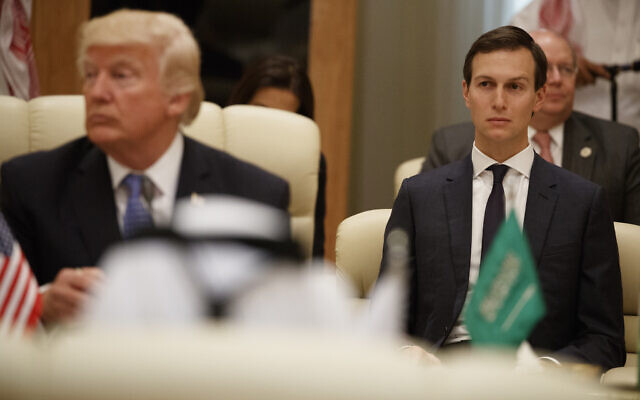
White House senior adviser Jared Kushner, right, looks on during a meeting between US President Donald Trump, left, and leaders at the Gulf Cooperation Council Summit, at the King Abdulaziz Conference Center, Sunday, May 21, 2017, in Riyadh, Saudi Arabia. (AP/Evan Vucci)

Asked during the briefing to address alleged human rights abuses in the countries the US has pushed to agree to normalization agreements with Israel, Kushner said” “We recognize that some of these countries share our values more than others do.”

He went on to argue that in forging better relations with such countries, the US is in a better position “to get what we want” on other issues while pointing out that the Islamic State “was not too good with human rights” either.

The Freedom house labels Morocco as “partly free,” pointing out that while the country holds parliamentary elections, “King Mohammed VI maintains dominance through a combination of substantial formal powers and informal lines of influence in the state and society. Many civil liberties are constrained in practice.”

While the deal is expected to be welcomed warmly in Israel, it was not immediately clear how the Moroccan public would react. In September, hundreds demonstrated in Rabat against the normalization deals with the “treacherous countries” UAE and Bahrain.


ARCHAEOLOGY‘BELONGING TO SHEMA THE SERVANT/MINISTER OF JEROBOAM’

Bought for a pittance at a market in 1980, 8th century BCE paleo-Hebrew inscription is the earliest writing found on a clay seal impression in the Land of Israel, study shows

2,700-year-old clay sealing from a stamp from the Israelite King Jeroboam II in the 8th century BCE. (Dani Machlis/Ben Gurion University)

2,700-year-old clay sealing from a stamp from the Israelite King Jeroboam II in the 8th century BCE. (Dani Machlis/Ben Gurion University)

What is arguably the earliest inscribed clay seal impression from the Land of Israel — used at the court of Israelite King Jeroboam II — has been authenticated after years of strict laboratory testing under the supervision of Ben-Gurion University Prof. Yuval Goren. The inscribed clay, known as a bulla, was purchased without provenance from a Bedouin antiquities merchant in the 1980s and is now thought to be from Jeroboam II’s 8th century BCE reign.

“This bulla is one of the earliest, if not the earliest, inscribed bulla in the Land of Israel,” Goren told The Times of Israel ahead of the publication of a scientific study in Hebrew in a special edition of the Eretz Yisrael journal dedicated to epigrapher Ada Yardeni. It will later appear in English in the Israel Exploration Journal.

The oval bulla is almost identical to a rare — and now lost — much larger jasper stone seal that was found in 1904 by an archaeological excavation at Tel Megiddo led by Gottlieb Schumacher. Both the remarkable lost seal and the newly authenticated seal impression are adorned by a roaring lion that stands with his tail raised, over which is a paleo-Hebrew inscription, “l’Shema eved Yerov’am” (Belonging to Shema the servant/minister of Jeroboam). Jeroboam II is historically understood to have ruled from 788 BCE to 748 BCE.

The bulla has only a partial impression of the inscription, but Goren said it is clearly the same as what was incised on the jasper seal. The fact that the royal seal came in varied sizes is noteworthy and novel to this study, according to a Ben-Gurion University press release.

Goren told The Times of Israel that he became aware of the seal impression over 10 years ago. It had been purchased from a Bedouin market near Beersheba by Yigal Ronen, a former professor of nuclear engineering and a certified antiquities collector, for a mere 10 old Israeli shekels in the 1980s, equivalent to a few cents. Because of the extremely strange circumstances and inexpensive price, Ronen initially disregarded the possibility that the small, 23.4 millimeter (1 inch) by 19.3 mm (.75 inch) bulla could be authentic, and thought it a clever forgery or replica, said Goren.

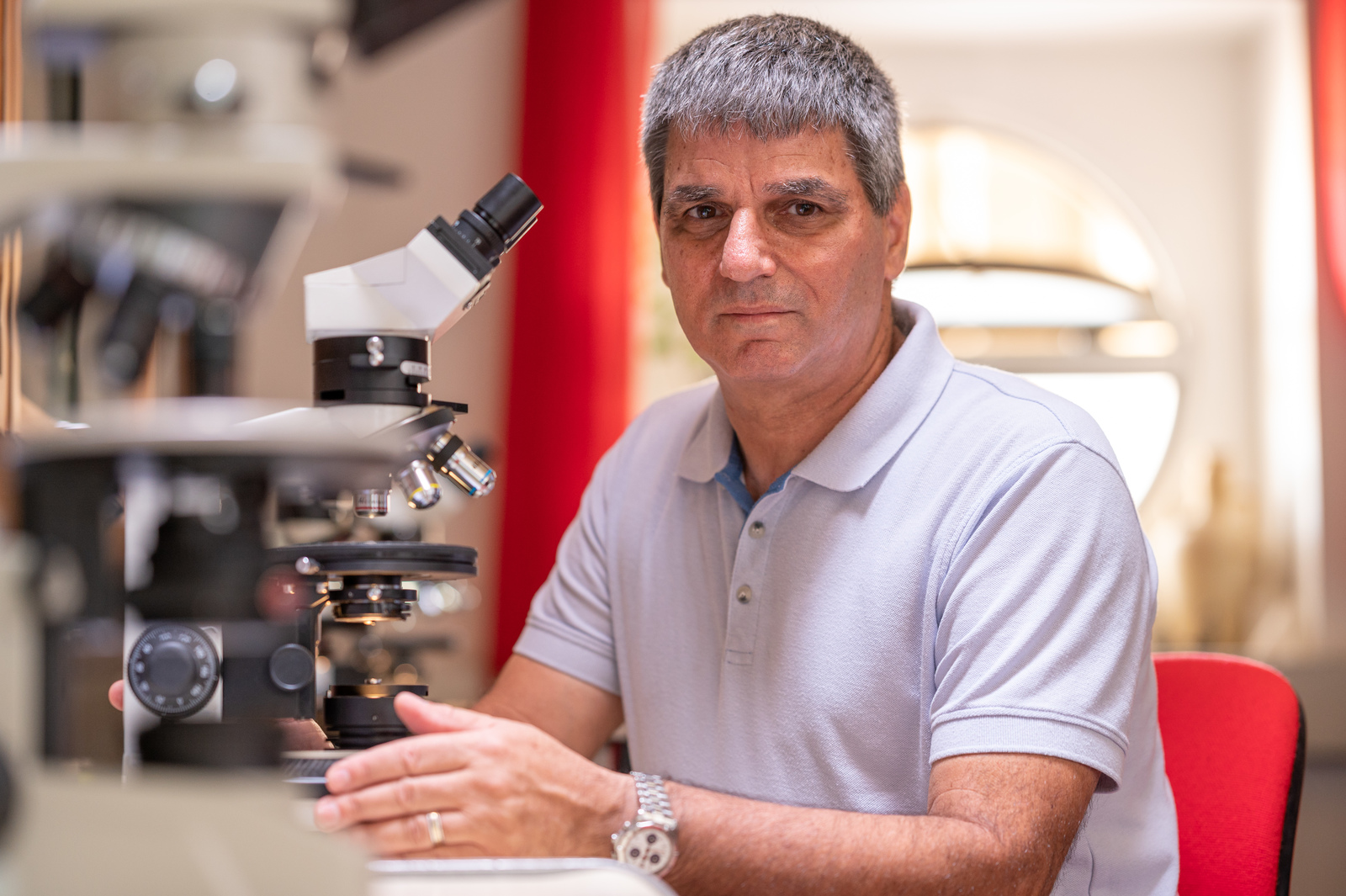
Ben-Gurion University’s Prof. Yuval Goren (Dani Machlis/BGU)

About five years ago, the secret in-depth testing of the seal impression began, Goren said. It followed a protocol he had forged over the past decade, which includes a series of overlapping tests from varied scientific disciplines.

Using this testing protocol, Goren has provided expert testimony in high-profile cases of alleged forgery, such as the James Ossuary trial. He has analyzed numerous seals for the Israel Police and the Israel Antiquities Authority, he said.

The impetus for the testing of the new bulla came after Ronen’s friend and neighbor, the archaeologist and Ben-Gurion University professor emeritus Eliezar Oren had repeatedly visited Ronen’s collection. Oren, the founder of Ben-Gurion University’s archaeology program, suspected the sealing was indeed from the Iron Age and urged the Ronen family to give permission for high-tech testing.

Goren said he agreed to oversee the procedures completed by his laboratory and those of an interdisciplinary team of scientists — on the condition that the artifact be turned over to the Israel Antiquities Authority if authenticated. (Spoiler: The bulla will shortly make its way to the IAA.)

It takes an academic village

Goren does not work in a vacuum and repeatedly emphasized that the long series of analytical tests were formed after working with a team of researchers. “We studied — not the royal we; I had partners — many seal impressions and tried to understand the techniques in making them and tried to understand what kind of documents they sealed, or if they sealed documents,” he said.

“Because the technology was never examined before, there were a lot of assumptions, but no one had checked, for example, the consistency of the clay, how they assembled the strings within the bulla if it was used to seal documents,” Goren said. He and other researchers studied hundreds of securely identified bullae from legal excavations to get a reference point. He can now, he said, more easily spot a fake artifact if, for example, the clay was not of the type standardly used by scribes.

A collection of bullae (sealings). (Eliyahu Yanai, City of David)

Among the researchers who participated in the new sealing study were Ben-Gurion University epigrapher Prof. Shmuel Ahituv, geologists Dr. Avner Ayalon and Dr. Mira Bar-Matthews from the Geological Survey of Israel, and IAA archaeologist Orit Shamir, who specializes in textiles.

Goren specializes in researching the provenance of ceramic artifacts — including seal impressions and cuneiform tablets — and uncovering the technology used to create them through mineralogy. For the new bulla study, he said he had to remove a tiny fragment of the clay to examine the mineral makeup.

“My hands didn’t shake,” he joked, saying he has done similar testing to other priceless, provenanced seals from the famed Amarna archives in Egypt, and elsewhere. “You always take a small fragment from a hidden or broken place. You don’t disturb the sealing or its impression.”

Another series of tests analyzed the isotopic composition of the bulla’s patina, a thin layer of tarnish, which occurs through exposure to air over time and can be faked by forgers — up to a point. “You can imitate patina in a laboratory, but this test would discover a forgery,” said Goren.

King Hezekiah Bulla on show at the Armstrong Auditorium in Edmond, Oklahoma, June 2018. (Courtesy Israel Antiquities Authority, Photo: Reese Zoellner/Watch Jerusalem)

The testing, he said, took several years, not because the tests themselves are so time consuming, but due to the checklist protocol of examinations.

“Each time we try to date the clay, it’s always a conflict between acting non-intrusively, but you want to use several methods to be sure of the result,” he said. “We are never sure,” he corrected himself, adding, “It’s like in a court — beyond any reasonable doubt. So we need several overlapping tests.”

What were these clay sealings used for?

While it is extremely rare to find a sealing from the Kingdom of Israel, such as this new bulla, there are hundreds that have been discovered in the Kingdom of Judah. Some, said Goren, have signs of being sealed upon papyrus, sometimes fabrics, and sometimes wood — maybe boxes, maybe sacks, he said.

However, there are indications that some of these seal impressions didn’t actually seal anything at all, he said, citing the work of archaeologist Nachman Avigad who called these “fiscal bulla.” These tokens, he said, may have been created as a reference of an official agreement or transaction.

A Mississippi State University team found this bulla, or ancient clay seal, on a dig site in southern Israel last summer. It offers evidence of government activity in the 10th century BCE, a time when many scholars said a kingdom could not exist in the region. (Photo credit: University of Wisconsin/Nathaniel Greene)

Interestingly, said Goren, often those seal impressions that show signs of having been upon papyrus or cloth were later fired. It is his theory that a transaction was witnessed through the creation of the wet seal impression, which was later removed from the paper or cloth it ceremonially bound and fired at a high temperature of circa 750 degrees Celsius, the temperature at which the new bulla was fired.

“We believe they were fired or baked after removal from the document, and therefore preserved,” he said. Goren said that 1950s excavations at Tel Lachish found an Iron Age building in which a small, stoppered juglet filled with such bullae was discovered.

A collection of bullae (sealings). (Clara Amit, Antiquities Authority)

“Why would anybody keep the bullae,” he asked, answering, “because they were still used as references even after the document was opened.”

“Therefore, we believe the sealings were acting as the signatures of today,” said Goren.

https://www.timesofisrael.com/2700-years-ago-tiny-clay-piece-sealed-deal-for-bibles-king-jeroboam-ii/?fbclid=IwAR3TJMVamA3TGN7x2PtFRUhWon2P2RuCiMMZZEV5C0-nE2Ljs_2T9mfO1sU