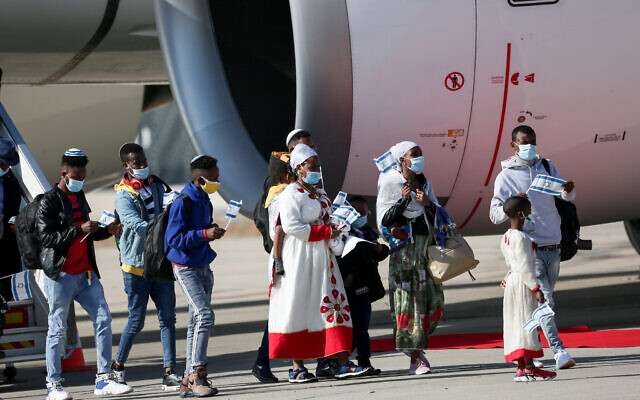
Waving Israeli flags as they came down the steps of the aircraft, over 300 members of Ethiopia’s Jewish community arrived in Israel on Thursday in a special airlift from Gondar headed by Absorption and Immigration Minister Pnina Tamano-Shata.
The celebratory arrival, attended by several of Israel’s leaders, marked the opening phase of a plan to bring some 2,000 members of the community to Israel from Ethiopia in what has been dubbed Operation Tzur Israel.
Critics have urged the government to speed the arrival of all 2,000, as well as thousands more community members estimated to be waiting to emigrate from the war-torn country.
Get The Times of Israel’s Daily Edition by email and never miss our top storiesFREE SIGN UP
The first of the 316 immigrants to emerge from the Ethiopian Airlines jet led a young girl with one hand and with his other blew a ram’s horn, or shofar, that in Jewish tradition is used to signal a moment of redemption.
Some of the passengers kissed the ground as soon as they reached the tarmac, another tradition for those arriving for their first time in the Holy Land. Many were dressed in traditional Ethiopian robes, and many women held babies in their arms. Festive Hebrew songs were blasted over loudspeakers.
The arrivals, some of whom have waited 15 years or more to emigrate and many of whom have family here, will not be able to be reunited with their relatives immediately, due to coronavirus guidelines that require all arrivals to isolate for two weeks. They are slated to spend their first several months in Israel at an absorption center in the north, where they will learn Hebrew.
Another plane is set to arrive on Friday, bringing the number of new immigrants to 500.
The rest are expected to arrive by the end of January.
The new arrivals were greeted at Ben Gurion Airport by Prime Minister Benjamin Netanyahu, Foreign Minister Gabi Ashkenazi, Defense Minister Benny Gantz and other senior government figures at an emotional welcome ceremony, reminiscent of the fanfare surrounding airlifts of Ethiopian Jews in the 1980s and 90s.

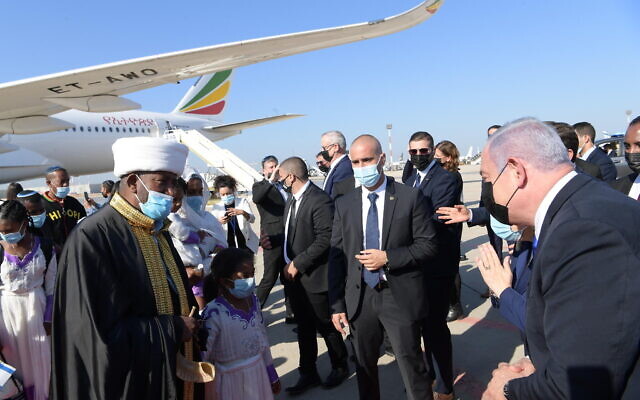
Prime Minister Benjamin Netanyahu, second left, and his wife Sarah, third left, greet members of the Ethiopian Jewish community as they arrive at Ben Gurion airport, outside Tel Aviv, on December 3, 2020. (Amos Ben Gershon/GPO)
“I don’t remember having been so moved for many years in such a clear image of Zionism,” Netanyahu said. “I had tears in my eyes.”
“This is the purpose of the Zionist story, the Jewish story,” he said.
The story of the Ethiopian immigration to Israel, with all its lethal dangers and hardships, will be taught to all Israeli schoolchildren, Netanyahu vowed, referring to journeys made by some immigrants by foot across Sudan and Egypt to reach Israel.
Israel’s determination to bring home all of the Ethiopian community also extends to Avera Avraham Mengistu, an Israeli citizen believed held captive by the Hamas terror group after crossing into the Gaza Strip, Netanyahu said.
“I am moved to be here,” said Gantz who recalled that as an officer in the Israel Defense Forces he had participated in the military’s covert 1991 Operation Solomon, an airlift that brought over 14,000 Ethiopian Jews to the country in the space of a day and a half.
Israel, he said, is committed to fulfilling the dreams and hopes of the Ethiopian community to arrive and live in Israel.
“The State of Israel was set up to be a home for the Jewish people,” Gantz said. “Welcome to Israel, welcome to those who are returning home.”
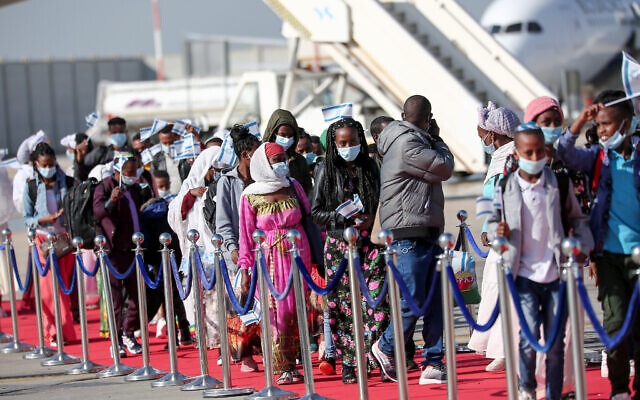
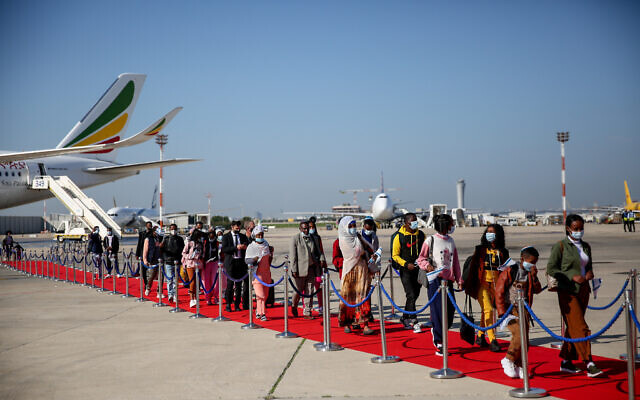
Members of the Ethiopian Jewish community arrive at Ben Gurion airport, outside Tel Aviv, on December 3, 2020. (Miriam Alster/Flash90)
Tamano-Shata, who arrived in Israel as a young girl in Operation Moses airlift, a 1984 airlift that brought 6,000 Ethiopian Jews to the country from Sudan, praised the unity government for taking the necessary action to authorize bringing more of the community to the country, despite its crippling political logjam.
“In a moment that rose above the fighting,” the unity government made decisions that saved lives, Tamano-Shata said.
“You can’t imagine how dangerous the situation is now in Ethiopia,” she said, referring to an ongoing internal conflict in the country’s northern region.
“The Jews of Ethiopia will not be forgotten,” she promised.
After years of dreams and fears, “here you now are in the Jewish state,” said chairman of the Jewish Agency Isaac Herzog to the new arrivals.
The Agency, he said, is preparing for a large influx of Ethiopian Jewish community members with the further stages of the Create Israel operation.

Screen capture from video of Defense Minister Benny Gantz at a welcoming ceremony for hundreds of Jewish Ethiopian immigrants at Ben Gurion Airport, December 3, 2020. (Facebook)
The ceremony ended with a rendition of Israel’s national anthem “Hatikva” (The hope), which speaks of the Jewish people’s yearning for return to the national homeland from its dispersal around the world.
About 140,000 Ethiopian Jews live in Israel today, most of them from the Beta Israel community, and many are integrated across all strata of society, though accusations of institutionalized racism persist.
In 2019, massive protests broke out following the police killing of Solomon Teka, 18, an unarmed man of Ethiopian descent.
Tamano-Shata, the first Israeli of Ethiopian descent to be made a minister, flew to Ethiopia on Saturday night to oversee the final stage of the airlift, including a meeting with Ethiopian President Sahle-Work Zewde.
In October Netanyahu announced plans to bring 2,000 members of the community to the country. The proposal earmarked NIS 370 million ($109 million) for the mass immigration, the Prime Minister’s Office said at the time.
Community members and activists have held several protests urging the government to approve the immigration of the rest of the community, thought to number between 7,000 and 12,000, many of whom are endangered by the recent outbreak of war in the northern Tigray region.
About 9,000 of the would-be immigrants have been waiting for 15 or more years to immigrate, local activists say. About a quarter of that number, located in the capital Addis Ababa, have been waiting for more than 20 years, they say, while the rest, in Ethiopia’s second city Gondar, have been hanging on for 15 to 20 years.
“Once again, the government led by Prime Minister Netanyahu has decided to place quotas on the immigration of Jews from Ethiopia,” said Muket Fenta, an activist who has been fighting for over a decade to bring his aunt to Israel.
“The government is celebrating a few hundred immigrants from Ethiopia, while thousands were supposed to be here and are still left behind while their fate is in question,” he said.
The coronavirus has hit the group especially hard economically, sources have told The Times of Israel. Work has dried up and food is in short supply, with prices up by 35 to 50 percent; families in Israel who had previously sent their relatives money are strapped for cash because of their own COVID-19-related problems, and philanthropic organizations are less able to raise donations due to the pandemic.
Fighting between Ethiopian Prime Minister Abiy Ahmed’s government and the Tigray People’s Liberation Front from the country’s northwest claimed its first victim from Gondar’s Jewish community on November 12 — Girmew Gete, 36. He had waited 24 years to immigrate to Israel.
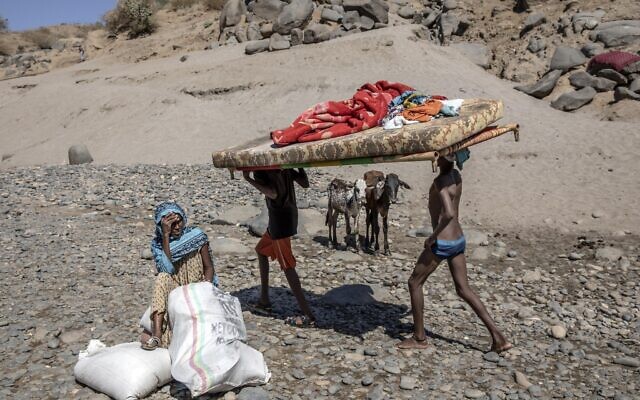
Tigray refugees who fled the conflict in the Ethiopia’s Tigray region carry their furniture on the banks of the Tekeze River on the Sudan-Ethiopia border, in Hamdayet, eastern Sudan, December 1, 2020. (Nariman El-Mofty/AP)
In 2013, the Jewish Agency declared the end of Ethiopian aliyah, prompting protests by Ethiopian lawmakers and community members in Israel.
In November 2015, the government passed a decision to airlift “the last of the community” waiting in Addis Ababa and Gondar to Israel within five years.
Since that decision, however, just 2,257 Ethiopians have been brought, in dribs and drabs, according to Jewish Agency figures.
While Ethiopian Jewish immigrants from the Beta Israel community are recognized as fully Jewish, immigrants from Ethiopia belonging to the smaller Falash Mura community are required to undergo Orthodox conversion after immigrating. The Falash Mura are Ethiopian Jews whose ancestors converted to Christianity, often under duress, generations ago. Some 30,000 of them have immigrated to Israel since 1997, according to the Prime Minister’s Office.
Because the Interior Ministry does not consider the Falash Mura to be Jewish, they cannot immigrate under the Law of Return, and therefore must get special permission from the government to move to Israel.
Sue Surkes and the Associated Press contributed to this report.