The National Security Council issued a travel advisory Thursday, warning that Iran may try to attack Israelis overseas and urging greater vigilance, citing recent threats toward Israel by Iranian officials.
In the travel advisory, the NSC did not specify the nature of the Iranian threats, but alluded to Iranian officials publicly blaming Israel for the assassination of top nuclear scientist Mohsen Fakhrizadeh over the weekend, and to Tehran’s vows of revenge. Israeli officials have refused to comment on the killing.
The NSC advisory listed countries neighboring Iran as places where Iranians could try to attack Israelis — including Georgia, Azerbaijan and Turkey, and Israel’s two new Gulf peace partners the United Arab Emirates and Bahrain — as well as Iraqi Kurdistan, the Middle East in general, and the entire African continent.
“In light of the threats that have been made recently by Iranian elements and given the past involvement of Iranian elements in terrorist attacks in various countries, there is concern that Iran will try to act in this manner against Israeli targets,” the advisory said.
The statement also said that “global jihadist organizations, with a special emphasis on the Islamic State,” are demonstrating “high motivation” to launch global attacks following the recent terror assaults in France, Austria and Germany.

A gunman points his weapon during a terror attack on multiple sites in Vienna, November 2, 2020. (Twitter screenshot)
“It’s possible that part of the current wave of Islamist terror will reach targets identified with Israel or [with] Jewish communities” such as “synagogues, Kosher restaurants, and Jewish museums,” the NSC said.
The statement also mentioned the Christmas period at the end of December and called it “attractive for hostile terrorist activity in Europe.”
Because of all this, the NSC recommended that those planning to travel abroad “be more vigilant (including near Israeli missions, synagogues, and Jewish community institutions), obey the security guidelines of local authorities, stay away from crowded areas and avoid staying in unsecured public areas or in the vicinity of government institutions.”
The statement also attached a link to the NSC website for all would-be travelers to check travel warnings regarding their specific planned destinations.
On Monday, the director-general of the Foreign Ministry sent a letter to all Israeli diplomatic missions urging them to be on alert following the assassination of Fakhrizadeh, and Tehran’s subsequent finger-pointing at Israel and vow to avenge his death.
Citing the “events over the weekend,” Alon Ushpiz called on missions to maintain “the highest possible level of preparedness and vigilance for any unusual activity in the area of the mission, at the homes of families and at Jewish and Israeli community centers,” according to Kan news.

Alon Ushpiz (YouTube screenshot)
Iranian agents and proxy groups have been known to attack Israeli or Jewish targets in the past, including diplomatic missions.
In 1992, a bomb at the Israeli embassy in Argentina killed 29 people, in an attack widely attributed to Iran. In 2012, diplomats were targeted in India, Georgia and Thailand.
Fakhrizadeh, the scientist previously said by Israel and the US to head Iran’s rogue nuclear weapons program, was killed in a military-style ambush Friday on the outskirts of Tehran. The attack reportedly saw a truck bomb explode and gunmen open fire on Fakhrizadeh.
Iranian officials have pointed the finger at Israel for the killing. Jerusalem has long been suspected of taking out scientists amid tensions over Tehran’s rogue nuclear weapons program, which Fakhrizadeh oversaw.
The slaying threatened to renew tensions between the United States and Iran in the waning days of US President Donald Trump’s term, just as President-elect Joe Biden has suggested his administration could return to Tehran’s nuclear deal with world powers from which Trump earlier withdrew. The Pentagon announced early Saturday that it sent the USS Nimitz aircraft carrier back into the Mideast.
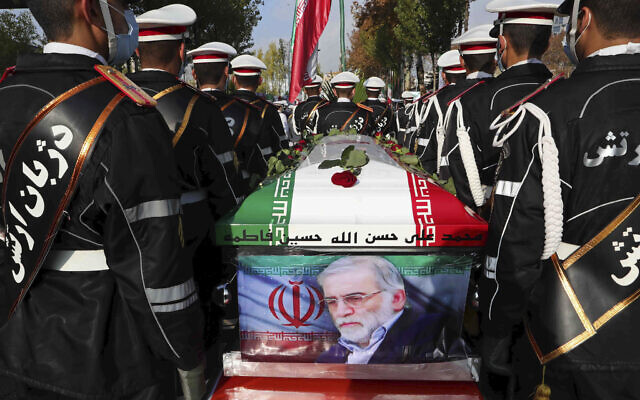
Military personnel stand near the flag-draped coffin of Mohsen Fakhrizadeh, during a funeral ceremony in Tehran, Iran, November 30, 2020. (Iranian Defense Ministry via AP)
The attack came just days before the 10-year anniversary of the killing of Iranian nuclear scientist Majid Shahriari, which Tehran also blamed on Israel. That and other targeted killings happened at the time that the so-called Stuxnet computer virus, believed to be an Israeli and American creation, destroyed Iranian centrifuges.
Those assaults occurred at the height of Western fears over Iran’s nuclear program. Fakhrizadeh led Iran’s so-called AMAD program that Israel and the West have alleged was a military operation looking at the feasibility of building a nuclear weapon.
Fakhrizadeh was named by Prime Minister Benjamin Netanyahu in 2018 as the director of Iran’s rogue nuclear weapons project. When Netanyahu revealed then that Israel had removed from a warehouse in Tehran a vast archive of Iran’s own material detailing with its nuclear weapons program, he said: “Remember that name, Fakhrizadeh.”
Agencies contributed to this report.
https://www.timesofisrael.com/national-security-council-warns-israelis-of-danger-of-iranian-attacks-overseas/



