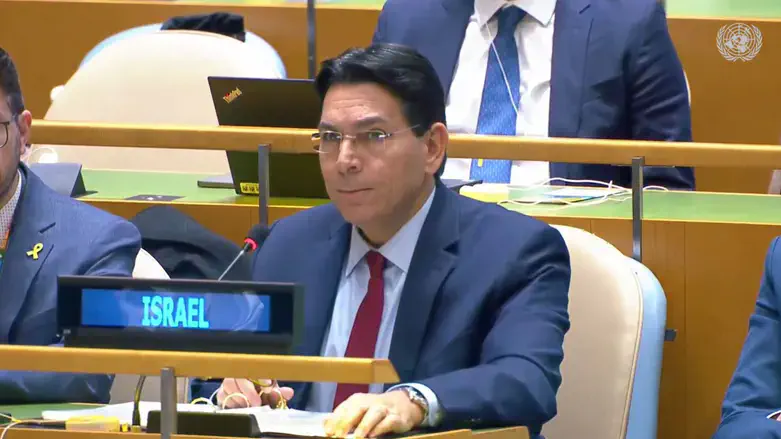
UN General Assembly votes overwhelmingly in favor of resolution demanding Israel withdraw from the Golan Heights. Danon condemns: “Israel will not return to the 1967 lines and will not abandon the Golan.”

Amb. Danon at the UN General Assembly

Amb. Danon at the UN General AssemblyIsraeli Mission to the UN

The UN General Assembly on Tuesday adopted a resolution demanding that Israel withdraw from the Golan Heights and declaring that its so-called “occupation” of the territory is “illegal.”

The resolution, submitted by Egypt, “demands once more that Israel withdraw from all the occupied Syrian Golan to the line of 4 June 1967 in implementation of the relevant Security Council resolutions,” and claims that the continued presence of Israel in the area and its de facto annexation constitute “a stumbling block in the way of achieving a just, comprehensive and lasting peace in the region.”

The measure passed with 123 countries voting in favor, seven against, and 41 abstaining. In addition to Israel, those voting against included the United States, Micronesia, Palau, Papua New Guinea, Paraguay, and Tonga.

A similar resolution is brought forward annually by Syria and other Arab states and routinely passes with a majority.

Israel’s Ambassador to the UN, Danny Danon, condemned the resolution, stating, “The UN General Assembly once again proves how disconnected it is from reality.”

“Instead of addressing the crimes of the Iranian axis and the dangerous activities of militias in Syria, it demands that Israel withdraw from the Golan Heights – a vital defense line that protects our citizens,” he added.

Danon clarified, “Israel will not return to the 1967 lines and will not abandon the Golan. Not now, not ever.”


“There is still a lot of work to be done,” Russian President Vladimir Putin’s top foreign policy aide, Yuri Ushakov, told reporters at a briefing in the Kremlin.

Russian presidential envoy Kirill Dmitriev, US President Donald Trump's special envoy Steve Witkoff and son-in-law Jared Kushner attend a meeting with Russian President Vladimir Putin at the Kremlin in Moscow, Russia, December 2, 2025.
Russian presidential envoy Kirill Dmitriev, US President Donald Trump’s special envoy Steve Witkoff and son-in-law Jared Kushner attend a meeting with Russian President Vladimir Putin at the Kremlin in Moscow, Russia, December 2, 2025.
(photo credit: Sputnik/Kristina Kormilitsyna/Pool via REUTERS)
Russia and the United States did not reach a compromise on a possible peace deal to end the war in Ukraine after a five-hour Kremlin meeting between Russian President Vladimir Putin and Donald Trump’s top envoys, the Kremlin said on Wednesday.

Trump has repeatedly complained that ending Europe’s deadliest conflict since World War Two has been one of the elusive foreign policy aims of his presidency. The US president has at times scolded both Putin and Ukrainian President Volodymyr Zelensky.

Talks in Moscow between Putin and Trump’s special envoy, Steve Witkoff, and son-in-law Jared Kushner went past midnight. Afterward, Putin’s top foreign policy aide, Yuri Ushakov, said, “Compromises have not yet been found.”

“There is still a lot of work to be done,” Ushakov told reporters at a briefing in the Kremlin.

Putin reacted negatively to some US proposals, Ushakov said. Witkoff went to the US embassy in Moscow after the talks to brief the White House, Ushakov said.

Russian President Vladimir Putin, presidential envoy Kirill Dmitriev and foreign policy aide Yuri Ushakov attend a meeting with US special envoy Steve Witkoff and Jared Kushner at the Kremlin in Moscow, Russia, December 2, 2025. (credit: Sputnik/Alexander Kazakov/Pool via REUTERS)

Ushakov added that a meeting between Putin and Trump was not currently planned, though he said the talks were constructive and that there were huge opportunities for US-Russian economic cooperation.

Advertisement

No further away from peace

Ushakov said Putin had sent a series of important signals and his greetings to Trump, but that the sides had agreed not to disclose details to the media.

He added that they had discussed the “territorial problem”, Kremlin shorthand for Russian claims to the whole of Donbas, though Ukraine controls at least 1,900 square miles of the area, which Russia claims as its own. Almost all countries recognise Donbas as part of Ukraine.

“Some American draft proposals look more or less acceptable, but they need to be discussed,” Ushakov said. “Some of the formulations that have been proposed to us are not suitable for us; that is, the work will continue.”

Witkoff and Kushner began talks in the Kremlin after a stroll across Red Square past the mausoleum of Soviet founder Vladimir Lenin to the towers of the Kremlin.

They talked with Putin, Ushakov, and Putin’s envoy Kirill Dmitriev, via interpreters.

“Our people are over in Russia right now to see if we can get it settled. Not an easy situation, let me tell you. What a mess,” Trump said on Tuesday in Washington, adding that there were casualties of 25,000 to 30,000 per month in the war.

Russia invaded Ukraine in February 2022, triggering the biggest confrontation between Moscow and the West since the depths of the Cold War.

European powers worried by US efforts

A leaked set of 28 US draft peace proposals emerged in November, alarming Ukrainian and European officials who said it bowed to Moscow’s main demands.

European powers then came up with a counter-proposal, and at talks in Geneva, the US and Ukraine said they had created an “updated and refined peace framework” to end the war.

Zelensky, speaking in Dublin, said everything would depend on the talks in Moscow but that he was afraid the US could lose interest in the peace process.

“There will be no easy solutions … It is important that everything is fair and open, so that there are no games behind Ukraine’s back,” he said.

Just before the Kremlin meeting with Witkoff, Putin said Russia did not want war with Europe, but that if Europe started one, it would end so swiftly that there would be no one left for Russia to negotiate with.

Putin threatened to sever Ukraine’s access to the sea in response to drone attacks on tankers of Russia’s “shadow fleet” in the Black Sea. Ukraine’s Foreign Minister, Andrii Sybiha, said Putin’s remarks showed he was not ready to end the war.

Ukraine’s ‘pressing financial needs’

The European Commission plans to make a legal proposal this week to use frozen Russian assets to fund Ukraine while also leaving open the possibility of borrowing on financial markets or mixing the two options, four sources told Reuters on Tuesday.

EU leaders agreed in October to meet Ukraine’s “pressing financial needs” for the next two years but stopped short of endorsing a plan to use $162 billion in frozen Russian sovereign assets in Europe as a loan for Kyiv, due to concerns raised by Belgium.

Under the Commission’s plan, Ukraine would only need to repay the loan if Russia pays reparations for damage caused by waging war against its neighbor.

A European Commission spokesperson did not comment on the substance of the proposed text, writing in response to a question from Reuters on Tuesday that commissioners “will discuss the financing options for Ukraine tomorrow at their weekly meeting” and are “due to adopt the respective legal proposals.”


November 10, 2025 4:15 pm

by Ailin Vilches Arguello

Turkey is reportedly advancing plans to send thousands of soldiers to the Gaza Strip as part of an international peacekeeping force, pushing forward despite US hesitation and Israeli resistance, as Ankara seeks to secure a role in the enclave’s post-war future.

The Turkish government has mobilized more than 2,000 troops from across the country for a potential deployment in Gaza as part of the US-backed peace plan alongside other participating countries, the Middle East Eye news outlet and Turkish media reported.

Last week, Washington sent a draft resolution to members of the United Nations Security Council, proposing the creation of an International Stabilization Force (ISF) in Gaza that would remain for at least two years.

Under US President Donald Trump’s peace plan, such a force will oversee the Gaza ceasefire between Israel and the Palestinian terrorist group Hamas and train local security forces.

Based on the proposed draft resolution, the ISF would include troops from multiple participating countries and would be responsible for securing Gaza’s borders with Israel and Egypt, while also protecting civilians and maintaining humanitarian corridors.

In addition, the ISF would seemingly be expected to take on the responsibility of disarming Hamas — a key component of Trump’s peace plan to end the war in Gaza, which the Palestinian terror group has repeatedly rejected.

In recent weeks, Washington has been working closely with regional powers to determine the composition of the peacekeeping force, with Turkey seeking to play a central role in the enclave.

However, Israel has consistently opposed any involvement of Turkish security forces in post-war Gaza.

On Sunday, the Israeli government reiterated that Turkish troops would not be allowed to enter the war-torn enclave.

“There will be no Turkish boots on the ground,” Shosh Bedrosian, a spokesperson for the Israeli Prime Minister’s Office, said during a press conference.

As Turkey moves to secure a role in Gaza’s post-war reconstruction efforts, experts have warned that Ankara, as a key backer of Hamas, could shield the Islamist group or even strengthen its terrorist infrastructure.

In the past, Turkey has provided refuge to Hamas leaders, granted diplomatic access, and allowed the group to fundraise, recruit, and plan attacks from Turkish territory.

US officials have confirmed that any participating countries in the international task force will be selected in close coordination with Israel, ensuring that no foreign troops will be included without Israel’s consent.

During the two-year Gaza conflict, relations between Turkey and Israel deteriorated rapidly, with Ankara adopting an openly hostile stance, seeking to undermine the Jewish state internationally.

Turkish President Recep Tayyip Erdogan has repeatedly praised Hamas while falsely accusing Israel of committing genocide.

This week, the Turkish government issued arrest warrants for 37 Israeli officials, including Prime Minister Benjamin Netanyahu, accusing them of “genocide” in Gaza.

Israeli leaders have strongly rejected such accusations, emphasizing that the Jewish state has been targeting terrorists who use civilians as human shields in its military operations.

Israeli Foreign Minister Gideon Saar condemned Turkey’s latest move, describing the warrants as “the latest PR stunt by the tyrant Erdogan.”

Israeli Defense Minister Israel Katz also denounced such accusations, calling them “ridiculous.”

“Take those ridiculous arrest warrants and get the hell out of here,” the Israeli official said in a post on X. “They’re more fitting for the massacres you’ve committed against the Kurds. Israel is strong and unafraid. You’ll only be able to see Gaza through binoculars.”

Meanwhile, Turkey reportedly tried to secure a side deal to allow 200 Hamas terrorists trapped in the tunnels of the southern Gaza city of Rafah to escape, allegedly using the body of Israeli Lieutenant Hadar Goldin — who was killed during Operation Protective Edge in 2014 — as leverage. However, Hamas returned Goldin’s body on Sunday, marking the latest deceased hostage to be released to Israel as part of the US-brokered ceasefire.

Hamas has reportedly demanded that the 200 terrorists be released into the part of Gaza it still controls, rather than into Israeli-held territory.

Under the first phase of Trump’s plan, Israel withdrew to a boundary dubbed the “yellow line,” still controlling 53 percent of the enclave’s territory. Within the other 47 percent, where the vast majority of Gaza’s population is located, Hamas has launched a brutal crackdown to impose full control.

However, the Israeli government announced Monday that any decision concerning the 200 terrorists would be made in coordination with the Trump administration.