Beware of Iran’s underground nuclear facility – analysis

Tehran may soon regain the ability to sneak out a weapon.
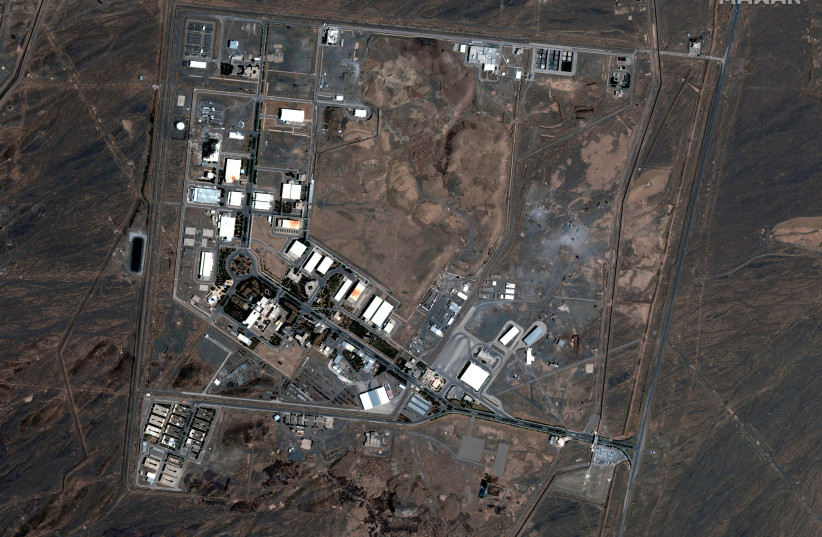
A handout satellite image shows a general view of the Natanz nuclear facility after a fire, in Natanz, Iran July 8, 2020 (photo credit: MAXAR TECHNOLOGIES/HANDOUT VIA REUTERS)
A handout satellite image shows a general view of the Natanz nuclear facility after a fire, in Natanz, Iran July 8, 2020
(photo credit: MAXAR TECHNOLOGIES/HANDOUT VIA REUTERS)
The IAEA’s and other media reports’ confirmation on Tuesday and Wednesday of Iran building a new centrifuge facility in the mountains around Natanz start a new dangerous chapter in the nuclear standoff.

The new facility is Iran’s response to attempts to block one of its potential paths to leapfrog to a nuclear weapon faster.

Building it underground will also make it much harder to strike, especially considering the ongoing debates about whether Israel has the ability to reach such a facility without US bunker-buster bombs that penetrate deep underground.

All of this is a response to the dozen or so explosions of Iranian facilities this summer, especially the one on July 2.

On July 2, the Islamic Republic’s primary advanced centrifuge facility for enriching uranium at Natanz went up in flames.

The Jerusalem Post received validation of foreign reports of Israeli involvement, though Iranian dissidents may have been on the frontlines and others may also have been involved.

The Post also reported that both government and non-government sources said the destruction of the facility would set Tehran back one to two years in its plans for advanced centrifuges.

Only in 2020 has Iran finally mastered IR-4 and IR-6 centrifuges, which can enrich uranium at much higher rates than the IR-1 and IR-2ms, which have made up nearly all of its around 20,000 centrifuges for more than a decade.

Until July 2, there was concern that Iran could sneak out to a nuclear program by using advanced centrifuges, even in smaller numbers, to weaponize uranium so fast that the US, Israel and others would not be able to prevent it either diplomatically or militarily.

Even without the advanced centrifuges, the ayatollahs currently have enough low enriched uranium for between two and three nuclear bombs, and they may be only three to four months away from a weapon, if they decided to try to start weaponizing that uranium with their older and slower centrifuges.

Iran advertised months ago that it would rebuild the destroyed Natanz facility.

Now those theoretical plans are moving forward and getting noticed.

While building the new facility will take time, especially underground, Israel, the US and others must already start to adjust to the possibility that in a year or a few years, the Islamic Republic may regain the ability to sneak out to a nuclear weapon and that hitting the facility will have become much harder.

As with every aspect of the rivalry with Tehran, they adapt with the best, and they know how to modify tactics to reach long-term goals.

All eyes will need to be on this facility going forward.

https://www.jpost.com/middle-east/iran-news/beware-of-irans-underground-nuclear-facility-analysis-647210


President claims there are 5 Middle East ‘definites’ and a similar number who are ‘pretty much’ ready to open diplomatic relations


US President Donald Trump talks to reporters before boarding Air Force One for a day of campaign rallies in Michigan, Wisconsin, and Nebraska, at Andrews Air Force Base, Maryland, October 27, 2020. (Evan Vucci/AP)

US President Donald Trump talks to reporters before boarding Air Force One for a day of campaign rallies in Michigan, Wisconsin, and Nebraska, at Andrews Air Force Base, Maryland, October 27, 2020. (Evan Vucci/AP)

US President Donald Trump said Tuesday that there are up to 10 countries that he expects to soon normalize relations with Israel, but that the developments would largely happen after next week’s presidential elections.

Asked if there were more countries in the Middle East that would follow the United Arab Emirates, Bahrain, and Sudan who all recently opened diplomatic relations with Israel, Trump said there were more on the way, without specifying exactly how many or which countries they were.

“We have five, but really have probably nine or ten that are right in the mix, we’re going to have a lot, I think we’ll have all of them eventually,” he told reporters at Andrews Air Force Base before hitting the campaign trail.

“The beauty is there’s peace in the Middle East with no money and no blood,” he continued. “There’s no blood all over the sand. We have five definites and I think we’ll have another five pretty much definites. And all of them, the big ones, the smaller ones.”

Asked if agreements would come before or after the November 3 election, Trump said “largely after.”

On Saturday, Channel 12 news reported that Israeli officials believe an agreement with Oman could come in the near future, possibly even before the US election.

The station also reported that Mossad Chief Yossi Cohen has stated he believes Saudi Arabia will normalize ties with Israel, but will do so after the US election, to capitalize fully on such a decision with whoever is the next president.

The report said Israel believes any such Saudi decision will be cushioned by a significant arms deal with Washington, similar to the US agreement to sell advanced weaponry to the United Arab Emirates, which Israel has approved, but which has proven highly controversial in Jerusalem.

On Friday, Trump announced that Israel and Sudan would be making peace, and predicted that Saudi Arabia would soon follow.

During a call with Israel’s Prime Minister Benjamin Netanyahu, Sudan Sovereign Council president General Abdel Fattah al-Burhan and Sudanese Prime Minister Abdalla Hamdok, Trump brought reporters into the Oval Office and announced: “The State of Israel and the Republic of Sudan have agreed to make peace.”

He also told reporters there were another five countries “that want to come in.”

“We expect Saudi Arabia will be one of those countries,” Trump added, as he praised the country’s “highly respected” rulers King Salman and Crown Prince Mohammed bin Salman.

In the past, Trump has also mentioned the possibility of Kuwait normalizing with Israel.

Earlier on Tuesday, Defense Minister Benny Gantz referenced a Lebanese willingness for peace, though the remarks were made within the context of technical maritime border talks taking place between the enemy countries.

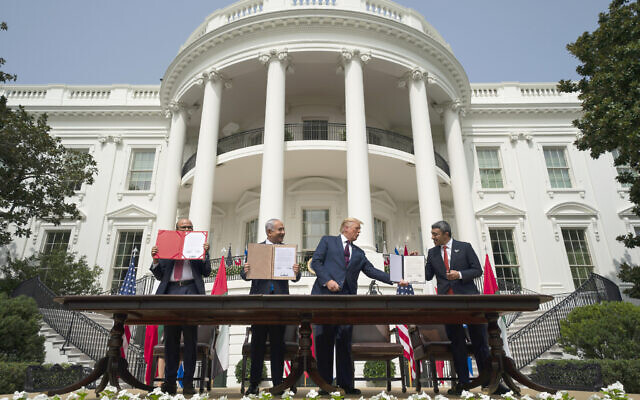
US President Donald Trump, center, with from left, Bahrain Foreign Minister Abdullatif al-Zayani, Israeli Prime Minister Benjamin Netanyahu, and United Arab Emirates Foreign Minister Abdullah bin Zayed al-Nahyan, during the Abraham Accords signing ceremony on the South Lawn of the White House, September 15, 2020, in Washington. (Alex Brandon/AP)

The last several months have seen a flurry of diplomatic activity as the US has brokered diplomatic pacts, known as the Abraham Accords, between Israel and the United Arab Emirates and Bahrain, who joining Jordan and Egypt as the only Arab countries to have official ties with Israel.

The Islamic Republic of Muaritania established diplomatic relations with Israel in 1999, but cut them off a decade later.

Netanyahu has made it a priority to forge ties with formerly hostile countries in Africa and the Arab world in the absence of any progress with the Palestinians during his more than a decade in office. Even before the Abraham Accords, Israel and the Gulf had formed a furtive united front against their common adversary Iran.

The recent normalization pacts with Israel have undermined the traditional Arab consensus that there can be no normalization with Israel before the establishment of an independent Palestinian state, angering Ramallah.

The Palestinians say the agreements amount to betrayal, while Israel says the Palestinians have lost what they have seen as their “veto” power over regional peace efforts.