
Second and third round of negotiations between enemies on solving offshore border to take place on Wednesday and Thursday in border town of Naqoura


UN peacekeeping military vehicles patrol near the post where the indirect talks between Israel and Lebanon were being held in the southern Lebanese border town of Naqoura, Lebanon, October 14, 2020. (Bilal Hussein/AP)

UN peacekeeping military vehicles patrol near the post where the indirect talks between Israel and Lebanon were being held in the southern Lebanese border town of Naqoura, Lebanon, October 14, 2020. (Bilal Hussein/AP)

Israeli and Lebanese officials will meet on Wednesday for the second round of rare talks aimed at settling a maritime border dispute between the countries, the Energy Ministry said Tuesday.

An Israeli delegation will travel to a UN peacekeeping force base in the Lebanese border town of Naqoura where negotiations will be mediated by US ambassador to Algeria John Desrocher, the ministry said in a statement.

The first round of talks was held on October 14. The US and UN said in a joint statement that the meeting was “productive.”

Israel and Lebanon, which are technically at war, are seeking to settle a long-standing dispute over the borders of their offshore exclusive economic zones, which are thought to contain large deposits of valuable natural gas.

“The purpose of the delegation in the meetings is to examine the possibility of reaching an agreement on the determination of the maritime border between the countries in a way that will enable the development of natural resources in the region,” the ministry said.

A third meeting is expected to take place on Thursday, the Energy Ministry said.

Similar to the first round of talks, Israel’s delegation will be led by Director-General of the Energy Ministry Udi Adiri, who will be accompanied by the energy minister’s chief of staff Mor Halutz, as well as Aviv Ayash, the minister’s international adviser. Deputy National Security Adviser Reuven Azar, the Foreign Ministry’s Deputy Director-General for the UN and International Organizations Alon Bar, and Brig. Gen. Oren Setter, head of the Israeli military’s Strategic Division, will also attend the talks.

They will be joined on Wednesday by Haim Srebro, an expert on international boundaries and the former head of Survey of Israel, the mapping department of the Housing Ministry.

Defense Minister Benny Gantz during a visit to northern Israel, on October 27, 2020. (David Cohen/FLASH90)

On Tuesday, Defense Minister Benny Gantz said that the talks were an encouraging sign of Beirut being willing to play ball.

“I am hearing positive voices coming out of Lebanon, who are even talking about peace with Israel, who are working with us on things like determining maritime borders,” he said while touring a drill simulating a possible war with Lebanese terror group Hezbollah.

Gantz, also Israel’s alternate prime minister, did not specify which Lebanese comments he was referring to.

But they came a day after Claudine Aoun, daughter of Lebanese President Michel Aoun, told Al Jadeed TV that peace with Israel would be conceivable if issues between the countries were resolved.

“We have the maritime border dispute, the issue of Palestinian refugees, and another topic which is more important which is the issue of natural resources: water, oil and natural gas which Lebanon is depending on to advance its economy,” she said.

When asked directly if she would object to a peace treaty with Israel, she responded: “why would I object?”

“Are we supposed to stay in a state of war?… I don’t have doctrinal differences with anyone… I have political differences.”

Claudine Aoun, the daughter of Lebanese President Michel Aoun. (Screen capture: YouTube)

The previous maritime talks lasted for around one hour and came weeks after Bahrain and the United Arab Emirates became the first Arab states to establish official relations with Israel since Egypt in 1979 and Jordan in 1994.

In a joint statement, the US and the UN said the delegates had “reaffirmed their commitment to continue negotiations later this month.”

The following day, Prime Minister Benjamin Netanyahu expressed hope that the talks may eventually lead to a peace deal between the two countries.

During his speech to open a Knesset debate on Israel’s normalization deal with the United Arab Emirates, signed in September, Netanyahu acknowledged that as long as the Hezbollah terror group “effectively controls Lebanon, there can be no real peace with this country.”

But he then segued specifically to the maritime talks, the first negotiations between the countries in 30 years, which he said carry “enormous potential and economic significance, both for them and for us.

A week earlier, Hezbollah said that the talks with Israel do not constitute normalization or peace talks with the Jewish state.

Israel and Lebanon have no diplomatic relations and are technically in a state of war. They each claim about 860 square kilometers (330 square miles) of the Mediterranean Sea as being within their own exclusive economic zones.

Israel has already developed a natural gas industry elsewhere in its economic waters, and Lebanon hopes oil and gas discoveries in its territorial waters will help it overcome the worst economic and financial crisis in its modern history.

Lebanon’s economic crisis is the result of decades of corruption and mismanagement, but it has been dramatically worsened by the coronavirus pandemic as well as a massive explosion in Beirut on August 4, which killed and wounded many and caused damage worth billions of dollars.

In recent days, France recalled their envoy to Turkey, after Turkey’s President Recep Tayip Erdogan questioned the French president’s mental health for taking a strong stance against Islamist separatists, who recently beheaded a teacher who showed students a cartoon of the Prophet Muhammed.  According to the Times of Israel, the French presidency responded: “Excess and rudeness are not a method” and “we are not accepting insults.”    Indeed, France is not the only country to suffer from Erdogan’s fiery rhetoric.

These inflammatory comments to Macron came after MEMRI (the Middle East Media Research Institute) reported that Erdogan stated: “Jerusalem is our city.  The current physical appearance of the Old City, which is the heart of Jerusalem, with its water, its market, and its many buildings, were built by Ottoman Sultan Suleiman the Magnificent.  It is possible to encounter the traces of Ottoman resistance in this city, which we were forced to abandon in tears during the First World War.  We will follow until the end, both the Palestinian cause, which is a bleeding wound on the global conscience, and the cause of Jerusalem.”  Erdogan made these remarks after he stated at the UN that Israel extends “its dirty hands” over Jerusalem, which has an uncanny resemblance to Mahmoud Abbas’s “dirty feet” speech.

When Turkey’s President issues statements such as this, it makes one ponder whether Turkish-Israeli relations have any future.  There are many commentators in the Middle East who argue that Turkey is the “next Iran” and that their threats to Israel’s energy interests alongside their aggression against the Kurds in Syria, who are strong allies of the State of Israel, make them a “destabilizing force in the region.”   According to various analysts, Turkey’s invasion of Afrin and other areas in Northern Syria have resulted in the ethnic cleansing of the area’s Kurdish inhabitants, who have been replaced by Turkish-backed jihadists.    At the same time, various analysts point to Turkey’s actions in Libya as another action that harms the security of the Mediterranean region for it complicates efforts to resolve the Libyan Civil War.

However, although Turkey’s rhetoric harms the State of Israel and their actions threaten regional security, within the past week, it was also reported that Turkish food and beverage exports to Israel have gone up in 2020, despite the pandemic.   In fact, despite the diplomatic spat between Jerusalem and Ankara, Turkey is Israel’s sixth largest trade partner and the business relations between the two countries account for six billion dollars annually.   Off the record, an Israeli government official claimed that Erdogan is all talk and no action when it comes to Israel, stressing that this alone means that they are not like Iran.  In other words, Erdogan is a hypocrite, who talks tough against Israel but at the end of the day, does nothing.  So, is there any hope that Turkish-Israeli relations can one day be different?

Mendi Safadi, who heads the Safadi Center for International Diplomacy, Research, Public Relations and Human Rights, claimed that since Erdogan came to power, he sought to be the new sultan in town and to resurrect the Ottoman Empire: “In order to win the sympathy of the Arab Muslim world, Erdogan chose to verbally clash with Israel, declaratively support the Palestinians and to side with the Syrian Opposition.  Nevertheless, he maintained Turkey’s diplomatic presence in Tel Aviv.  Erdogan declaratively supports the Palestinians as long as it serves his interests, criticizes the peace deal between Israel and the United Arab Emirates as a betrayal of the Palestinians, while maintaining full ties with Israel and being the first Muslim President to visit the grave of Theodore Herzl, the founder of modern Zionism.”

“Economic cooperation between Turkey and Israel has intensified since he became president, with dozens of Turkish-bound flights landing and taking off from Ben-Gurion International Airport and thousands of Israelis staying in Turkish resorts,” Safadi stressed.  In fact, he argued that a collapse in Israeli-Turkish business cooperation would cause the collapse of the Turkish economy or at least contribute towards it: “Erdogan will not take such a step for it will harm his chances of staying in power.”

Israel’s Former Cultural Attache to Turkey and the chairwoman of the Turkish Jewish Association in Israel Zali De Toledo thinks all his rhetoric aimed towards Israel is designed to help him win over votes from his supportive public: “The more he attacks Israel, the more they see him as a hero.”  De Toledo claimed that Erdogan was not always so harsh towards Israel policy-wise.   In her memoir titled They called him the gangster, she wrote that when she served Israel in Turkey, she used to have great relations with religious Turkish officials and she counted it as one of her greatest accomplishments: “I brought many religious officials to Israel including the Diyanet, the very respectable head of Religious Affairs Mehmet Nuri Yilmaz and the Mufti of Istanbul.  At the time and since my childhood, Islam had a positive aspect in Turkey, but unfortunately, by the end of my diplomatic tenure, political issues had devolved into a hatred of Israel and Judaism.  It is unfortunate that in the world today, I often feel that my past efforts at fostering cultural and religious relations between Israel and Turkey have been in vain.”

“I also had very courteous relations with Turkish President Recep Tayyip Erdogan,” she noted. “I was present during his official visit to Israel and had lunch with his wife Emine together with some other ladies at the King David Hotel.”   When De Toledo became the head of the Turkish Jewish Association in Israel, she received the blessing of former Turkish President Abdullah Gul, who was associated with Erdogan’s party.  According to De Toledo, “Erdogan became anti-Israel as a matter of official policy with the time when he decided to become the leader of the Arab world after getting the cold shoulder from the EU.  Since then, the Arab world was not very responsive, and Erdogan today has no friends in the world except maybe Qatar.”

However, as we speak, the Turkish lira is collapsing.  Recent polls have shown that Erdogan’s popularity is tumbling amid the pandemic.   As a result, Erdogan is now increasing his rhetoric in favor of Azerbaijan in the hopes that it will increase his dwindling popularity, for Turks consider supporting Azerbaijan to be a consensus issue within Turkey, for they view Azerbaijanis to be “’the same people, with two countries.”   At the same time, he is increasing his rhetoric against Israel, hoping that it could salvage his plummeting popularity.   Yet at the end of the day, this pandemic could ultimately lead to the demise of his government and if that were to happen, Turkey and Israel could potentially look forward to better relations.  In fact, an Israeli government official stressed: “The Turkish people are not enemies of Israel. For that reason, we did a reconciliation agreement with Turkey following the Mavi Marmara, for we knew that one day Erdogan can leave office and then things can get better once again.”

https://www.jewishpress.com/indepth/opinions/is-turkey-forever-destined-to-be-an-adversary-of-the-state-of-israel/2020/10/27/


US hits Iran’s oil sector with further sanctions

Treasury Department designates 3 state entities under a counterterrorism authority, making it more difficult for a potential Biden administration to reverse move


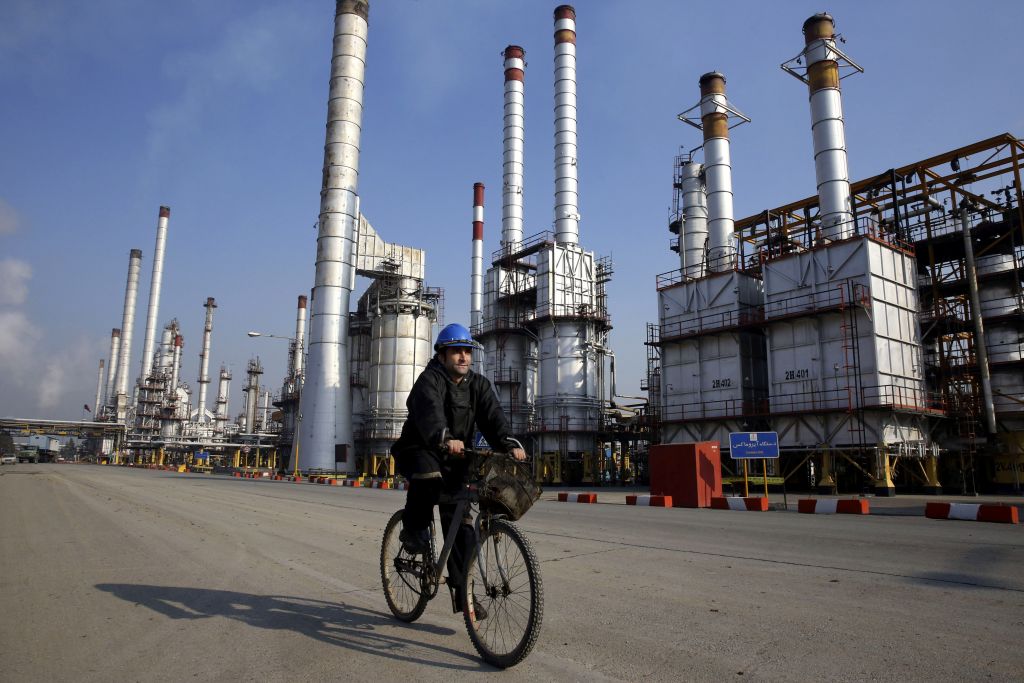
An Iranian oil worker rides his bicycle near an oil refinery south of the capital, Tehran, December 22, 2014. (AP/Vahid Salemi/File)

An Iranian oil worker rides his bicycle near an oil refinery south of the capital, Tehran, December 22, 2014. (AP/Vahid Salemi/File)

WASHINGTON — US President Donald Trump’s administration on Monday slapped fresh sanctions on Iran’s oil sector, including over sales to Syria and Venezuela, reducing Joe Biden’s room for maneuver, if he wins next week’s election.

The Trump administration since 2018 has imposed sweeping sanctions aimed at ending all of Iran’s key oil exports, punishing any country that buys oil from its adversary.

Under new measures Monday, the administration said it was designating the National Iranian Oil Company, Iran’s oil ministry, and the National Iranian Tanker Company under a counterterrorism authority, meaning that any future administration would need to take legal measures to reverse the finding.

The Treasury Department issued the sanctions by linking the three entities to the Revolutionary Guards’ elite Quds Force — which was earlier designated as a terrorist organization by the United States, and whose commander, Qassem Soleimani, was killed in a US attack at the Baghdad airport in January.

“The Iranian regime continues to prioritize its support for terrorist entities and its nuclear program over the needs of the Iranian people,” Treasury Secretary Steven Mnuchin said in a statement.

Secretary of the Treasury Steven Mnuchin talks with reporters outside the White House, October 14, 2020, in Washington. (AP Photo/Evan Vucci)

Biden, who leads in polls ahead of next Tuesday’s election, supports diplomacy with Iran and backed an accord negotiated under former president Barack Obama, under which Tehran sharply curtailed its nuclear work in exchange for promises of sanctions relief.

The Treasury Department said that a network backed by the Quds Force shipped more than one dozen tankers of oil in spring 2019 — mostly to Syria, where Iran is a top backer of President Bashar Assad, as he emerges from a brutal civil war.

Separate from the terrorism designations, the Treasury Department imposed sanctions on a British-based Iranian businessman, Mahmoud Madanipour, and related companies for transactions with Venezuela.

The Treasury Department accused him of arranging the shipment of tens of thousands of metric tons of gasoline to Venezuela, where Trump has been trying unsuccessfully to depose the leftist leader, Nicolas Maduro.

The United States has also imposed sanctions on Maduro’s government and earlier this year succeeded in seizing fuel cargo of four vessels from Iran headed to Venezuela — which suffers major electricity shortages despite its plentiful oil.
