
- The US and its allies need to do everything possible never again to be caught in a state of unpreparedness.
- The Congressional EMP Commission estimates that, given U.S. current unpreparedness, within one year of an EMP attack that causes a nationwide blackout… up to 90 percent of the U.S. population could perish from starvation, disease and societal collapse. An EMP attack, therefore, would confer upon Iran an “assured destruction” capability against the United States.
- The Congressionally created EMP Commission assesses that North Korea already has super-EMP nuclear weapons and the capability to deliver them…. Iran may also already — or soon — have the capability to deliver an EMP attack.
- “By sending a military satellite into space, Iran now has shown that it can target all American territory; the Iranian Parliament had previously warned [the U.S.] that an electromagnetic nuclear attack on the United States would likely kill 90 percent of Americans.” — Iran’s state-controlled Afkar News.
- The formal end of the UN arms embargo — at the end of September 2020 — could provide Iran with even more missile and nuclear technology possibly from Russia or China.
- “Iran should be regarded by national security decision makers as a nuclear missile state capable of posing an existential threat to the United States and its allies… The fact of Iran’s ICBM capability and their proximity to nuclear weapons necessitates that Iran be regarded as a nuclear missile state — right now.” — William R. Graham, Henry F. Cooper, Fritz Ermarth and Peter Vincent Pry, Newsmax, February 1, 2015.
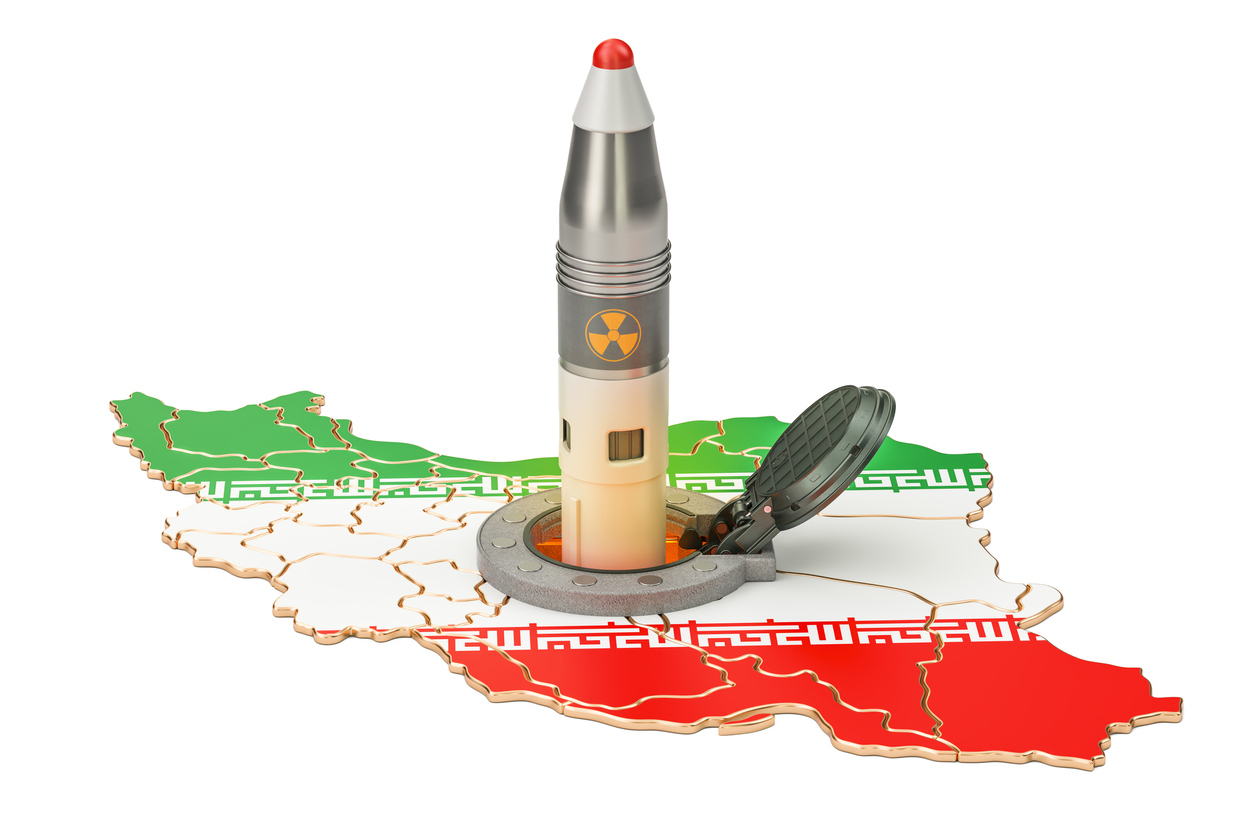 The Islamic Republic of Iran may soon have the capability, if it does not already, of carrying out electromagnetic pulse (EMP) attacks against its enemies. An EMP attack could black out not only the US national electric grid but also virtually all life-sustaining equipment that relies on electrical power and computer systems. An EMP attack could thus pose an existential threat to modern civilization. (Image source: iStock) |
The Islamic Republic of Iran may soon have the capability, if it does not already, of carrying out electromagnetic pulse (EMP) attacks against its enemies. Such an attack involves exploding a nuclear warhead some 30-400 miles above the United States, for instance, and unleashing a downward electronic pulse that can destroy the (currently unprotected) infrastructure. That would include such as critical electronic systems in virtually all civilian systems: food manufacturing and supply chains, automobiles, airplanes, trains, elevators, communications and the US electric grid — actually, just about everything on which a modern country relies.
An EMP attack could black out not only the US national electric grid but also virtually all life-sustaining equipment that relies on electrical power and computer systems. An EMP attack could thus pose an existential threat to modern civilization. This would totally alter the risk-benefit calculations for the United States and its allies for being able to defend the post-1945 world order.
Recently, the Iranian state-controlled Afkar News claimed that Iran is now able to carry out just such an EMP attack over the United States:
“By sending a military satellite into space, Iran now has shown that it can target all American territory; the Iranian Parliament had previously warned [the U.S.] that an electromagnetic nuclear attack on the United States would likely kill 90 percent of Americans.”
Does Iran Already Have Nuclear Weapons?
Washington’s conventional consensus is that Iran does not yet have nuclear weapons or missiles capable of threatening the United States with a nuclear attack. The Obama Administration assessed that Iran could develop an atomic weapon in six months to two years, prior to the Joint Comprehensive Plan of Action (JCPOA), which pretended to stop an Iranian A-bomb. Iran ostensibly agreed to the JCPOA five years ago, on July 14, 2015. Iran never signed the agreement, and started violating its terms almost immediately.
A 2020 assessment by Israel confirmed that Iran continues to cheat on its JCPOA obligations and will be able develop atomic weapons in six months to two years.
Some senior Israeli analysts and U.S. experts disagree with the “consensus view” and assess that Iran already has nuclear weapons. According to a report in Newsmax, titled “Experts: Iran Now a Nuclear-Ready State, Missiles Capable of Hitting US”:
“Regardless of intelligence uncertainties and unknowns about Iran’s nuclear weapons and missile programs, we know enough now to make a prudent judgment that Iran should be regarded by national security decision makers as a nuclear missile state capable of posing an existential threat to the United States and its allies…The fact of Iran’s ICBM capability and their proximity to nuclear weapons necessitates that Iran be regarded as a nuclear missile state—right now.”
The North Korea Connection
The Congressionally created EMP Commission estimates that North Korea already has super-EMP nuclear weapons and the capability to deliver them. North Korea and Iran are collaborating and have signed an agreement to cooperate in “science and technology.”
Iran may already — or soon — have the capability to deliver an EMP attack. It has successfully launched several civilian satellites — in 2008, 2009, 2010, and 2015 — including on southern polar trajectories, assisted by North Korean missile technology and North Korean technicians. On April 22, 2020, Iran orbited a military satellite over the United States, launched by Iran’s Islamic Revolutionary Guard Corps (IRGC) — the world’s deadliest terrorist organization. The IRGC’s Noor-1 satellite is tiny, weighing only about 30 pounds, but the Space Launch Vehicle’s third stage also went into orbit, demonstrating a capability to circle over the U.S. a net payload weighing several hundred pounds — enough for a nuclear weapon.
North Korea sold the mullahs much of the technology for Iran’s most sophisticated ballistic missile, the Shahab-III, which is an improved version of North Korea’s Nodong missile. Iran’s Shahab-III is capable of delivering a high-altitude EMP attack over America’s heartland if the missile is launched, say, from a freighter in the Gulf of Mexico. Iran has apparently already practiced launching and fusing Shahab-III missiles that could carry out a high-altitude EMP attack. Iran has also demonstrated that it is capable of launching a ballistic missile from a vessel at sea. Worse, the formal end of the UN arms embargo — at the end of September 2020 — could provide Iran with even more missile and nuclear technology possibly from Russia or China.
The Terrorist Connection
Iran, as the “world’s worst state sponsor of terrorism,” could become a conduit for giving nuclear EMP attack capabilities to terrorists. The EMP Commission warns:
“Terrorists or state actors that possess relatively unsophisticated missiles armed with nuclear weapons may well calculate that, instead of destroying a city or military base, they may obtain the greatest political-military utility from one or a few such weapons by using them — or threatening their use — in an EMP attack.”
Congressional testimony in 2004 by US President Ronald Reagan’s Science Adviser and one of the EMP Commissioners warns of the prospects of an anonymous EMP attack launched from a freighter by Iran hired terrorists:
“DR. GRAHAM: Iran, the world’s leading sponsor of international terrorism, has practiced launching a mobile ballistic missile from a vessel in the Caspian Sea. Iran has also tested high-altitude explosions of the Shahab-III, a test mode consistent with EMP attack, and described the tests as successful. Iranian military writings explicitly discuss a nuclear EMP attack that would gravely harm the United States.”
Iranian Military Doctrine Endorses EMP Attack
An official Iranian military textbook from 2010, but not released until 2017, endorses a nuclear EMP attack against the United States, as well as deception measures to conceal nuclear weapons — in violation of international agreements. The textbook is used to train officers at Iran’s prestigious military academy and think tank, the Martyr Lt. General Sayad Shirazi Center for Education and Research.
Strangely for a book titled Passive Defense, its overarching focus is offensive — how to black out electric grids — including by nuclear EMP attack.
Calculations in the book that America could be vanquished by a nuclear EMP attack appear to be correct.
Strategic Implications
The Congressional EMP Commission estimates that, given U.S. current unpreparedness, within one year of an EMP attack that causes a nationwide blackout, two-thirds or more, up to 90 percent, of the U.S. population could perish from starvation, disease and societal collapse.
An EMP attack, therefore, would confer upon Iran an “assured destruction” capability against the United States. The geopolitical consequences of this development are so grave that U.S. and global security would, in effect, go into free-fall. Where the U.S. would land, into what kind of future, is of course unknown.
If Iran and North Korea both decided to use threats to America or its allies with an EMP-generated genocide, it could destroy the foundations of the existing world order. If the US can no longer be the superpower that since 1945 has halted the cycle of world wars and sustained the global advancement of freedom, the consequences would be existential and catastrophic.
An EMP assured destruction capability changes the strategic calculus of risk for the United States in being able to uphold its role as a superpower and would necessarily erode the confidence of U.S. allies — perhaps to the point where they would feel the need to develop their own nuclear weapons.
Most alarmingly, the U.S. is fast moving to a place where, for the first time, smaller failed states such as Iran and North Korea would have the power to blackmail or destroy the largest and most successful societies on Earth. These rogue states have long perceived themselves to be at war with the United States, and have already demonstrated that they are desperate, highly dangerous characters.
The US and its allies need to do everything possible never again to be caught in a state of unpreparedness. We know how to protect our electric grid and the President of the United States has ordered the government bureaucracy to take the necessary steps to do so. Progress, however, regrettably remains slow. The emerging threats from Iran and North Korean outlined here should compel the United States to take faster action — now.
Dr. Peter Vincent Pry is Director of the Task Force on National and Homeland Security. Peter Huessy is Director of Strategic Deterrent Studies at the Mitchell Institute. He is also senior consulting analyst at Ravenna Associates, a strategic communications company.
https://www.gatestoneinstitute.org/16524/iran-emp-nuclear-attack


