Hamas demands transition to second phase of agreement

Hamas spokesman says the international force, which under Trump’s plan is to be stationed in the Gaza Strip, must separate the residents of the Strip from the IDF.

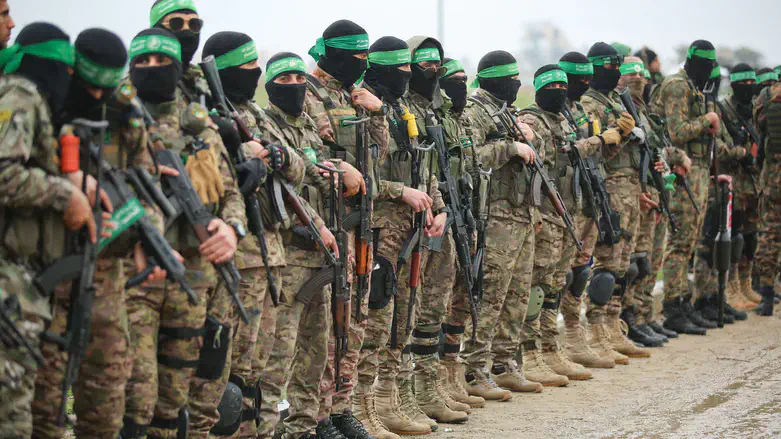
Hamas terrorists

Hamas spokesman Hazem Qassem stated that implementing the second phase of the ceasefire agreement is not simple, claiming that Hamas has fulfilled its commitments while Israel continues to violate the terms of the agreement.

Qassem told mediators involved in the Cairo talks that Israel’s alleged breaches undermine prospects for continued implementation of the agreement.

He added that the arrival of a Hamas delegation in Cairo demonstrates the organization’s seriousness in seeking progress toward the second phase of the deal.

Qassem stressed that the international force, which under President Trump’s plan is to be stationed in the Gaza Strip, must separate residents from IDF forces. He accused Israel of daily attempts to expand its security control beyond the yellow line.


Iranian FM rejects negotiations with US on its missile program, saying ‘there is no greater betrayal than this,’ while also dismissing talks with Europeans as ‘no longer useful’
By AFP
Today, 6:51 am

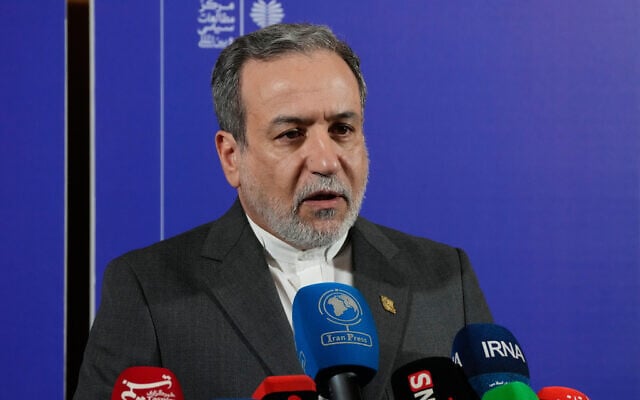
Iranian Foreign Minister Abbas Araghchi speaks in a news briefing after attending a conference titled "International Law Under Assault: Aggression and Self-Defense," in Tehran, Iran, November 16, 2025. (AP Photo/Vahid Salemi)
Iranian Foreign Minister Abbas Araghchi speaks in a news briefing after attending a conference titled “International Law Under Assault: Aggression and Self-Defense,” in Tehran, Iran, November 16, 2025. (AP Photo/Vahid Salemi)

TEHRAN, Iran — Iranian Foreign Minister Abbas Araghchi said that the UN’s nuclear watchdog would not be given access to Iranian nuclear sites attacked during its recent war with Israel without a concrete deal being agreed.

“The facilities that were attacked have their own story, and until a decision is made and a conclusion is reached between us, the IAEA and others, cooperation is not possible,” he said in an interview posted to his Telegram channel on Thursday, without elaborating on what such an agreement would entail.

The interview with the Khabar Online news agency was conducted before the International Atomic Energy Agency adopted a resolution Thursday demanding access to the sites.

In mid-June, Israel launched an unprecedented bombing campaign against Iran, triggering a 12-day war that the United States briefly joined with strikes on key Iranian nuclear facilities.

In the aftermath, Tehran suspended its cooperation with the IAEA and restricted the watchdog’s inspectors from accessing the bombed sites, accusing it of bias and failing to condemn the strikes.

“The fact that they came and attacked and left… and now the agency comes to prepare a report for them on where (was attacked) and what happened and how much damage was done is not possible, it is clearly not wise,” he added.

Footage released by the IDF on June 21, 2025, shows the aftermath of Israeli strikes on Iran’s Isfahan nuclear facility. (Israel Defense Forces)
In September, Iran and the IAEA agreed on a new cooperation framework, but weeks later Tehran deemed it invalid after Britain, France and Germany triggered the return of UN sanctions that had been lifted under a now-defunct 2015 nuclear deal.

The war derailed high-level nuclear talks between Tehran and Washington that had begun in April, during which the two sides were at odds over Iran’s right to enrich uranium, which Tehran defends as “undeniable”.

Since the war, Iran has repeatedly said it is open to restarting talks, but only if they take place on “equal footing.”

During the interview, Araghchi said that the US demands remain “detrimental to our national interests,” ruling out any talks on its missile program or other “defense capabilities.”

“Negotiating about missiles, for example, to reduce them, to reduce their range, to reduce their number, there is no greater betrayal than this,” he said.

He added talks with European governments were “no longer useful” after they triggered the snapback sanctions.


Netanyahu: No Palestinian state, even if it costs Saudi normalization

In interview with Abu Ali Express Telegram channel, PM Netanyahu says no Palestinian state will be established, even at the cost of Saudi ties. He vows to reopen Rafah after hostage remains are returned.

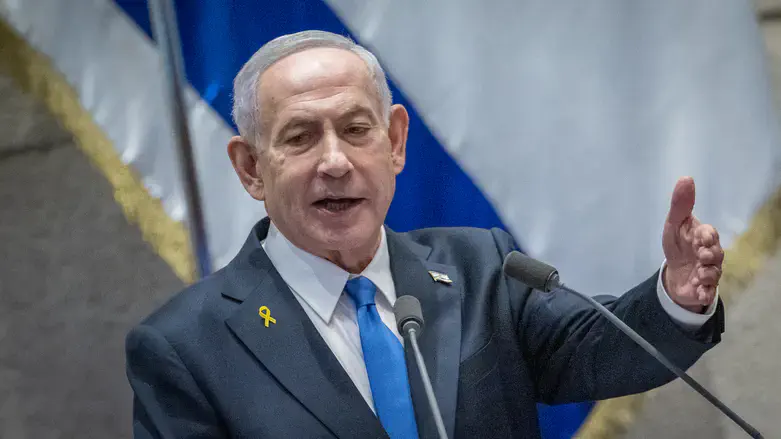
Prime Minister Benjamin NetanyahuChaim Goldberg/Flash 90

Prime Minister Benjamin Netanyahu declared Thursday that Israel will not agree to the establishment of a Palestinian state, even if it means forgoing normalization with Saudi Arabia.

“There will not be a Palestinian state. It’s very simple: it will not be established,” Netanyahu said in an interview with the Abu Ali Express Telegram channel.

When asked whether his opposition to Palestinian statehood stands even if it jeopardizes normalization with Riyadh, which has demanded a credible path to Palestinian statehood as a condition, Netanyahu replied, “The answer is: a Palestinian state will not be established. It is an existential threat to Israel.”

The Prime Minister noted that the war in Gaza had delayed progress toward normalization with Saudi Arabia, but added that “the conditions could develop” now that the war is winding down.

“But the conditions must be acceptable to both sides – terms that are good for both sides,” he said. “I know how to stand firm on our essential conditions and not endanger our security. And if this process ripens later on, excellent. And if not, we will safeguard our vital interests.”

Netanyahu also addressed the issue of the Rafah border crossing, stating that Israel will reopen it once the remains of the three remaining deceased hostages – Dror Or, Ran Gvili, and Sudthisak Rinthalak – are returned from Gaza by Hamas.

“We agreed that we will open the crossing after we receive all our hostages. We are very close to completing this process – it’s set to happen – and once that is completed, we will open the crossing,” he said.

Netanyahu added that he would welcome Egypt allowing Gazans who wish to leave to do so: “Any Gazan who wants to leave should be able to, and that right has been denied to them. Washington’s 20-point plan for Gaza included that right… If Egypt accepts that – I think that’s very positive.”

Turning to Turkey, Netanyahu said Israel seeks an arrangement with Ankara but cannot ignore the potential threat.

“I hope that threat doesn’t materialize, but we can’t rule it out,” he said, referencing Turkish President Recep Tayyip Erdogan’s support for Hamas and accusations of genocide against Israel during the two-year war in Gaza.

“We prefer a modus vivendi with Turkey,” Netanyahu said. “They’re very stubborn and speak in an extreme way, and we push back on it. But in practice, we prevented their entry into southern Syria… We also didn’t want them entering central Syria at the T-4 base – and we even struck that airfield.”

“We do not intend to relinquish our military superiority,” he said. “We’re not seeking enemies, but we won’t let any country in the region threaten us.”