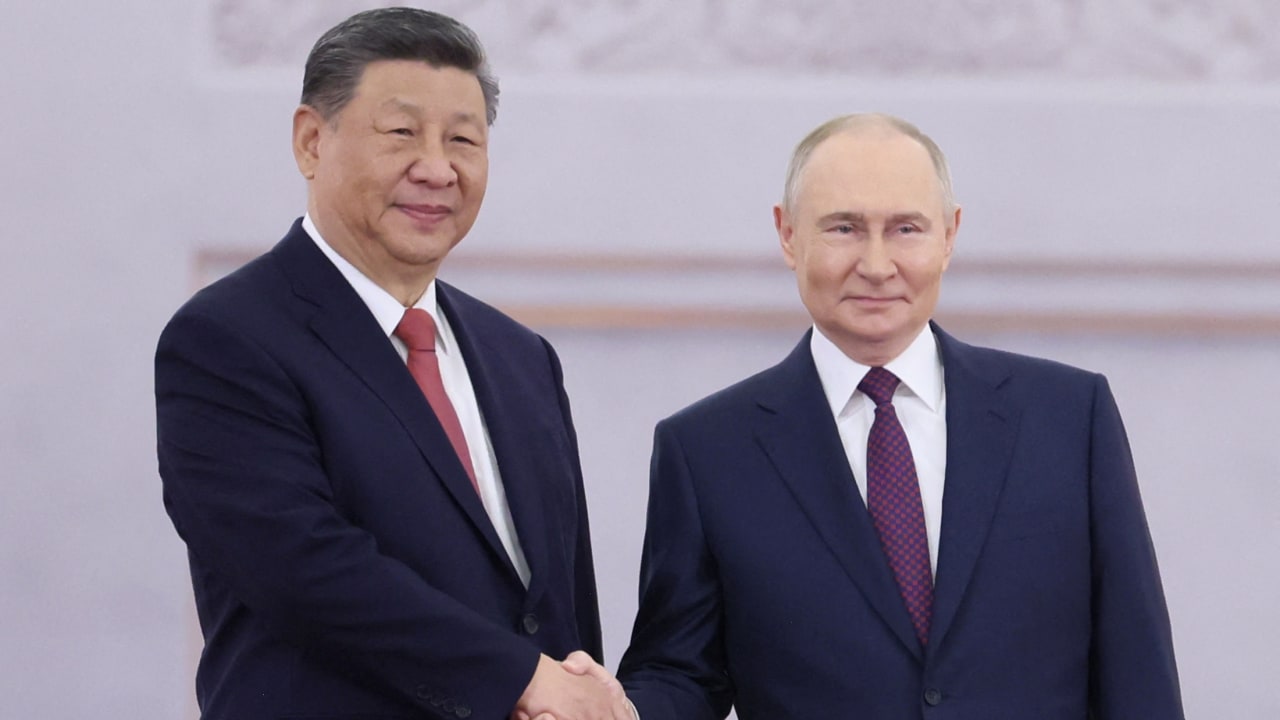
Russia and China held talks in Moscow on missile defense and agreed to strengthen cooperation.
Russian President Vladimir Putin shakes hands with his Chinese counterpart Xi Jinping during a welcoming ceremony before their talks at the Kremlin in Moscow, Russia, May 8, 2025.(photo credit: REUTERS/Sputnik/Mikhail Metzel/Pool via REUTERS)ByREUTERSRussia and China held talks in Moscow this week on missile defense and strategic stability and agreed to strengthen cooperation in those areas, the Russian Foreign Ministry said on Thursday.
“An in-depth discussion of the above-mentioned issues took place, including a joint analysis of relevant destabilizing factors creating strategic risks to global and regional security, as well as an exchange of views on ways to minimize them,” it said in a statement.
This is a developing story.
This comes after the IDF targeted a senior Hamas terrorist in a strike on a building in the Zeitoun neighborhood in Gaza City.
Palestinians walk past the rubble of destroyed buildings, amid a ceasefire between Israel and Hamas, in Gaza City, November 19, 2025.(photo credit: REUTERS/Dawoud Abu Alkas TPX IMAGES OF THE DAY)ByTAL SPUNGINSaudi Arabia and Qatar on Thursday heavily condemned recent Israeli strikes on Hamas targets across the Gaza Strip, with Doha stating such strikes “threaten to undermine the ceasefire.”
In a statement, Qatar’s Foreign Ministry “strongly condemned” the attacks, which have resulted in martyrs and injuries, and considers them a dangerous escalation that threatens to undermine the ceasefire agreement in the Strip.”
On Wednesday, the IDF targeted a senior Hamas terrorist in a strike on a building in the Zeitoun neighborhood in Gaza City. The military said that prior to the strikes, several terrorists opened fire in the area where IDF soldiers are operating in Khan Yunis. The IDF then struck Hamas terror targets across the Strip in response.
Palestinians walk among piles of rubble and damaged buildings, amid a ceasefire between Israel and Hamas, in the northern Gaza Strip November 19, 2025. (credit: REUTERS/Mahmoud Issa)
Riyadh’s condemnation of Israel’s strikes also included a denunciation of Prime Minister Benjamin Netanyahu’s visit to southern Syria on Wednesday, along with top government and defense officials such as Foreign Minister Gideon Sa’ar, Defense Minister Israel Katz, and IDF Chief of Staff Lt.-Gen. Eyal Zamir.
Middle Eastern nations slam Netanyahu’s visit to Syrian buffer zone
According to Saudi Arabia, Netanyahu violated Syria’s sovereignty via the “deliberate incursion by the prime minister…and a number of his government officials into the broader area south of Syria.”
Advertisement
On Wednesday, Netanyahu’s visit also prompted the condemnation of Damascus’s Foreign Ministry, which said it considered the prime minister’s visit “a serious violation of Syria’s sovereignty and territorial integrity.”
Syria also reiterated its demand for a full Israeli withdrawal from areas it called the occupied Syrian territories.
In recent weeks, the IDF has reported multiple cases of terrorists approaching positions beyond the Yellow Line and being targeted.
The IDF had killed several terrorists earlier who were identified crossing into IDF-controlled northern Gaza, who, according to the military, posed a threat to troops.
The military has repeatedly emphasized that the ceasefire does not prevent action against imminent threats to soldiers or Israeli civilians.
Yonah Jeremy Bob contributed to this report.
Israeli defense officials say Hamas is rebuilding and coordinating with Hezbollah and Iran to challenge the ceasefire across multiple fronts.
An Iranian cleric visits the Islamic Revolutionary Guard Corps (IRGC) Aerospace Force Museum in Tehran, Iran, November 12, 2025(photo credit: MAJID ASGARIPOUR/WANA (WEST ASIA NEWS AGENCY) VIA REUTERS)ByAMIR BOHBOTUpdated: Hamas is closely coordinating with Hezbollah and Iran to revive and rebuild the “axis of resistance,” while the IDF expanded strikes in Gaza and southern Lebanon, Israeli defense officials said on Thursday.
Their assessments followed an IDF operation that killed the Zeitoun Battalion commander in Gaza and a series of airstrikes in Lebanon, raising questions over potential rocket fire from Gaza and Israel’s next steps on the northern front.
According to the officials, US pressure is, for now, restraining a sharper Israeli response to Hezbollah’s ceasefire violations.
The group is reportedly searching for operational opportunities to launch a surprise, limited attack against IDF units inside Palestinian territory, in violation of the deal, the sources said.
Smoke rises after Israeli strikes following Israeli military’s evacuation orders, in Chehour, southern Lebanon November 19, 2025. (credit: REUTERS/ALI HANKIR)
Israeli officials say that Iran is rebuilding ‘Axis of Resistance’
The sources added that Southern Command chief Maj.-Gen. Yaniv Asor, backed by division commanders, favors more aggressive action against Hamas’s military activity.
In parallel, Hamas and Hezbollah in Lebanon, with Iranian funding and encouragement, are working to restore terror infrastructure, smuggle and move weapons into southern Lebanon and the Bekaa Valley, recruit new operatives, and intensify training for a future round against Israel.
Military sources say Hezbollah is acting in clear violation of the ceasefire understandings and is moving in the opposite direction of demilitarizing southern Lebanon and disarming.
Recent IDF strikes have targeted Hezbollah infrastructure and operatives involved in rebuilding capabilities, according to the military.
The sources added that the Northern Command commander would like to respond in a far more aggressive manner to Hezbollah’s violations. Still, at this stage, the United States is tying Israel’s hands behind its back.
Advertisement
Prime Minister Benjamin Netanyahu’s visit to Syria, accompanied by the defense minister, the foreign minister, and the Shin Bet (Israel Security Agency) director, was intended to send a message to the US and to Syrian President Ahmad al-Sharaa that Israel will not give up the security buffer on the Syrian Golan Heights.
This comes amid Sharaa’s statements about normalizing relations with Israel in exchange for an IDF withdrawal from the Syrian Golan.
Security officials are not impressed by the rapprochement between the White House and Damascus, mediated by Turkey, and argue that Sharaa’s jihadist past cannot be erased so quickly, even if the US has lifted the bounty on his head.
They said that he does not necessarily control his own country.
Jerusalem Post Staff contributed to this report.
and coordinating with Hezbollah and Iran to challenge the ceasefire across multiple fronts.