Saudi royal family said divided over possible future ties with Israel

Crown prince said to be in favor of the move as it could bring business opportunities, coordination over Iran, but king is solidly committed to Palestinian demand for state


Saudi Crown Prince Mohammed bin Salman, left, speaks to his father, King Salman, at a meeting of the Gulf Cooperation Council in Riyadh, December 9, 2018. (Saudi Press Agency via AP)

Saudi Crown Prince Mohammed bin Salman, left, speaks to his father, King Salman, at a meeting of the Gulf Cooperation Council in Riyadh, December 9, 2018. (Saudi Press Agency via AP)

The Saudi Arabian royal family is reportedly split over possible future ties with Israel following landmark agreements with the United Arab Emirates and Bahrain, the Wall Street Journal reported Friday.

According to the report, King Salman bin Abdulaziz has come into conflict with his son, de facto leader Crown Prince Mohammed bin Salman, with the latter said to be in favor of the move.

The newspaper reported that the monarch remains committed to a boycott of Israel coupled with a strong stance in favor of the Palestinian demand for an independent state, while the crown prince is open to normalization with the Jewish state and the business opportunities it could bring as well as public coordination in the struggle against Iran.

Saudi Arabia, Israel, the UAE and Bahrain share Tehran as a common foe and maintain close ties to Washington.

US President Donald Trump, left and Saudi Arabia’s King Salman bin Abdulaziz al-Saud gesture during a signing ceremony at the Saudi Royal Court in Riyadh on May 20, 2017. (AFP Photo/Mandel Ngan)

According to the report, cited by Channel 13 news, the crown prince knew in advance of Israel’s negotiations with the UAE and Bahrain, but did not tell his father for fear he would try to sabotage the efforts, a move that angered the king. Bin Salman reportedly knew that his father’s public opposition to an agreement between Israel and the UAE could make the negotiations difficult.

The king instructed his foreign minister to declare once again the kingdom’s commitment to the establishment of a Palestinian state and one of the king’s associates wrote an article in a Saudi-owned newspaper in which he reiterated the pro-Palestinian position of the royal house, the Walla news site reported, citing the Wall Street Journal report.

The article reportedly additionally hinted that the UAE should have pressured the Israelis to make further concessions vis-a-vis the Palestinians.

Under the 2002 Arab Peace Initiative, formulated by Saudi Arabia’s former king Abdullah, Arab states agreed to only forge ties with Israel after an accord is reached with the Palestinians based on the 1967 armistice lines.

Saudi Arabia remained noticeably silent following the announcement of a normalization agreement between Israel and Bahrain. But Bahrain is seen as a client state of its neighbor and close ally Saudi Arabia, and the tiny Gulf state is not likely to have moved forward with normalization without approval from Riyadh.

Prime Minister Benjamin Netanyahu and US President Donald Trump have both indicated several more countries could be in line to establish open relations in the near future and head of Israel’s Mossad spy agency Yossi Cohen indicated in an interview aired Wednesday that Saudi Arabia could be in line to normalize ties with Israel, while refusing to comment on whether he had met with the rulers of the Arab kingdom.
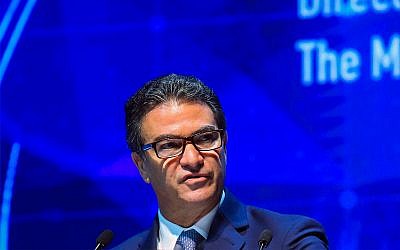
Head of the Mossad Yossi Cohen speaks at a cyber conference at Tel Aviv University on June 24, 2019. (Flash90)

Cohen has been cited as a key figure in the US-sponsored Abraham Accords with Abu Dhabi and Manama, signed at a festive White House ceremony Tuesday. Cohen reportedly shuttled to Gulf states on numerous secretive journeys in recent years to build closer clandestine ties with Arab nations.

Questioned as to whether major regional power Saudi Arabia could move to do so in the foreseeable future, Cohen answered: “I believe it could happen.” And asked if he had met with the crown prince, he smiled and said “I’d like not to comment on that point.”

Trump said Tuesday he expected Saudi Arabia to normalize relations with Israel following the diplomatic move taken by Bahrain and the UAE.

He also said he believed some five or six countries were on the path to peace with Israel, then later in the day revised that number to up to nine nations.

In this May 20, 2017, file photo, US President Donald Trump (right) shakes hands with Saudi Crown Prince Mohammed bin Salman, in Riyadh, Saudi Arabia. (AP Photo/Evan Vucci, File)

Asked if he expected Saudi Arabia to follow the UAE and Bahrain, Trump said: “I do. I spoke with the king of Saudi Arabia,” adding it would come “at the right time.”

The New York Times earlier this month quoted unnamed Trump administration officials who have been pushing the Saudis to recognize Israel saying that this possibility remains remote at best for now.

Opening official ties with Saudi Arabia would be a historic achievement for Israel, and mark a significant shift in the region. The Saudis have remained non-committal, however, despite support for normalization from Washington and shared interests with Israel.

In what was seen as a significant step forward, Saudi Arabia allowed Israeli planes to fly through their airspace last month.


Ron Dermer, ahead of his departure, says highlight of 7-year tenure in Washington was PM’s Congressional address bashing Obama-brokered Iran deal


Israeli Ambassador to the US Ron Dermer addresses a Hanukkah reception at the Washington D.C. residence of Poland’s Ambassador the US Piotr Wilczek, December 3, 2018 (screen shoot: facebook.com/ambdermer)

Israeli Ambassador to the US Ron Dermer addresses a Hanukkah reception at the Washington D.C. residence of Poland’s Ambassador the US Piotr Wilczek, December 3, 2018 (screen shoot: facebook.com/ambdermer)

Israel’s Ambassador to the US Ron Dermer predicted Friday that at least two more Arab states will follow the lead of the United Arab Emirates and Bahrain in normalizing ties with Israel in the coming months.

In an interview with the Jewish Insider news site, Dermer said Israel will sign “at least two more peace treaties” by the time he completes his seven-year tenure as ambassador on January 21.

US officials, including President Donald Trump and his senior adviser Jared Kushner, have also said they expect other Arab nations to normalize relations with Israel in the near future.

signings had been the culmination of years of work by Prime Minister Benjamin Netanyahu.

The US envoy recalled how when he first started working as an adviser to the premier nearly 20 years ago, Netanyahu showed him footage of a speech in which he highlighted his vision of “peace through strength.”

“To see this trajectory happen over 20 years now — against a lot of critics, cynics and opposition — I think is very gratifying,” Dermer said.

He said that for years Netanyahu had been “the lone voice, kind of in the wilderness,” who openly entertained the agreements that came into fruition this week.

Israeli Ambassador to the US Ron Dermer presents his credentials to President Barack Obama at the White House, December 4, 2013. (photo credit: Twitter/Amb. Ron Dermer)

Dermer speculated that the normalization deals could have been reached earlier “if there was greater understanding and recognition among policy-makers and if they understood the opportunity,” in an apparent jab at the administration of former US president Barack Obama.

“A lot of people said, ‘Well, he’s just talking about this because he doesn’t want to deal with the Palestinians,’” Dermer said, in response to a recently dug-up 2016 clip of Obama’s secretary of state John Kerry asserting that Israel would not be able to normalize relations with Arab states without making peace with the Palestinians first.

“[But] of course it was real,” Dermer said.

“We were able to keep a very close hold among a really small number of people… That’s how we were able to break this out,” he said of his own strategy in Washington.

Dermer was optimistic that the peace treaty signed with the UAE will lead to a “warmer peace” than the agreements with Egypt and Jordan have produced. “There are many forces inside those societies — political, economic and cultural forces — that militate against that. I don’t see that in the case of the Emirates.”

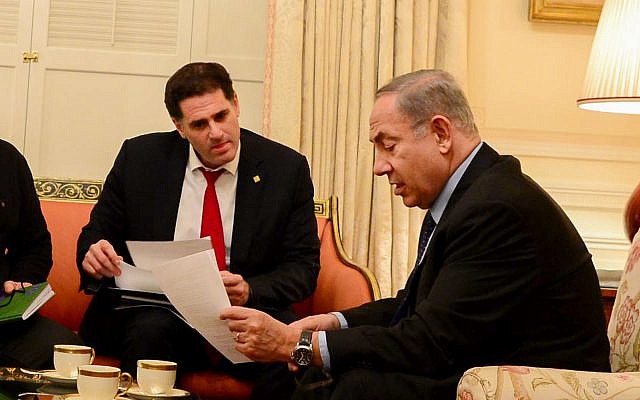
Prime Minister Benjamin Netanyahu (R) with Israel’s Ambassador to the US Ron Dermer, at the president’s guest house, in Washington, DC, February 14, 2017. (Avi Ohayon/GPO)

Little love for Obama

He echoed remarks made by Trump officials in recent days that the latest developments could mark the “beginning of the end of the Arab-Israeli conflict.”

As for the Palestinians, Dermer admitted that the Arab states making peace with Israel may not be able to bring about a solution to the Israeli-Palestinian conflict, but “it definitely weakens those who reject any kind of compromise or any peace with Israel,” he said.

In another dig at Obama, Dermer claimed there had been a “theory” in the the previous administration that creating “daylight” between the US and Israel would “achieve results.”

The ambassador pointed out how the latest agreements came after Trump had already made a series of gestures to Israel including recognizing Jerusalem as its capital, moving the US embassy there, recognizing Israel’s sovereignty over the Golan Heights and unveiling “a peace plan that Israel can live with.”

He dismissed critics who have argued that those steps would make peace more difficult to achieve, saying the policies have “helped strengthen Israel and anchored our legitimacy in the region.”

“I think the chances of ultimately seeing an Israeli-Palestinian peace are much greater. I can’t tell you whether they will cross that Rubicon, but it makes it greater.”

Secretary of State John Kerry and Israeli Ambassador to the US Ron Dermer at the signing of the US-Israel military aid deal in the State Department on September 14, 2016 (Israeli Embassy, Washington)

On annexation freeze

Asked about Netanyahu’s decision to shelve his plans to annex areas of the West Bank as part of Israel’s agreement to normalize ties with the UAE, Dermer said the move had been a compromise with the Trump administration.

The Times of Israel reported that the Trump administration gave the UAE a commitment during normalization negotiations that Washington would not recognize Israeli annexation until 2024, at the earliest.

“What we said from the beginning… [was that we] were only going to go ahead with this plan with the support of the United States,” Dermer said.

When the Trump administration approached Israel with the opportunity for a normalization agreement, Dermer said Netanyahu was forced to decide between going ahead “against the wishes of the United States, without US support and sort of barrel ahead, or do I seize this historic opportunity, stand with the United States, get a peace treaty with the Emirates and get another and another and another — and actually, hopefully begin to end the Arab-Israeli conflict.”

“I think he made the right decision for the good of the country,” Dermer told Jewish Insider.

The Israeli ambassador to the US took pride in the fact that members of Congress from both parties have expressed support for the recent normalization agreements and expressed hope that they would continue “no matter who the American people entrust with being the next administration.”

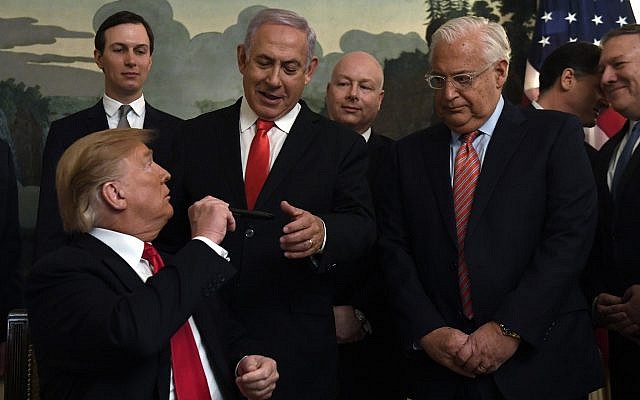
US President Donald Trump, left, turns to give a pen to Israeli Prime Minister Benjamin Netanyahu, center, at the White House in Washington, March 25, 2019 after signing the official proclamation formally recognizing Israel’s sovereignty over the Golan Heights. From left, White House adviser Jared Kushner, US special envoy Jason Greenblatt, US Ambassador to Israel David Friedman, Israeli Ambassador to the US Ron Dermer, and Secretary of State Mike Pompeo. (AP/Susan Walsh)

Career highlight

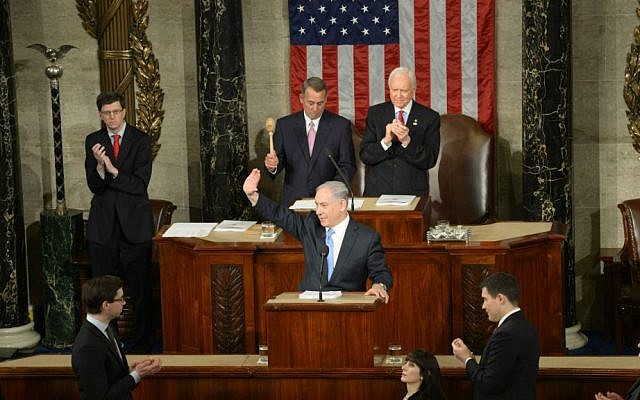
Asked for the highlight of his time in Washington, Dermer quickly cited Netanyahu’s 2015 joint Congressional address in which he warned against the Iran nuclear deal that the Obama administration had been in the midst of advancing.

Dermer had been involved in much of the behind the scenes work that led to the address, helping keep the matter a secret from Obama officials.

The ambassador referred to the speech as “one of the critical moments that most contributed to this breakthrough” with the Gulf states — many of whom align with Israel against Iran.

Dermer recalled saying at the time “that in 10 years from now or 20 years from now, people will talk about a breach of protocol in a speech because then I’ll know that Iran never developed nuclear weapons.”

“I feel that the US-Israel relationship is in a better place than when I took over, and I’m sure that my successor will bring it to the next level, because we are on this tremendous trajectory, and I’m sure he’ll do a terrific job,” he said.

Prime Minister Benjamin Netanyahu addresses a joint meeting of Congress, Washington DC, March 03, 2015. (photo credit: Amos Ben Gershom/GPO)


Qatar: Normalizing ties with Israel conditional on two-state solution

Qatar’s ambassador to US says his country has no objection to normalizing ties with Israel if “the conditions are proper”.

Elad Benari, Canada , 18/09/20 22:58


Doha, Qatar

Doha, Qatar

iStock

Qatar has no objection to normalizing ties with Israel if “the conditions are proper” and there is a commitment to a two-state solution between Israel and Palestinian Arabs, Qatar’s ambassador to Washington Sheikh Meshal Bin Hamad Al-Thani told Voice of America radio.

“Qatar is part of the Arab Peace Initiative. We believe in a two-state solution for the Palestinians and in securing Israel’s borders, and if these conditions are fulfilled, then we don’t see any reason for Qatar to not normalize relations with Israel,” said Al-Thani.

His comments came as the United Arab Emirates and Bahrain officially normalized relations with Israel during a signing ceremony Tuesday hosted by US President Donald Trump at the White House on Tuesday.

Despite ruling out complete normalization with Israel, Al-Thani told VOA that Qatar continues to mediate negotiations between the Israelis and the Palestinian Arabs, and it sends humanitarian relief to Gaza in coordination with Israel and the UN

“Qatar and the US have been working together for many years on regional issues and we were mediating at the request of the US administration, therefore we were talking with Hamas to encourage it to engage in political negotiations,” he said.

Indeed, while Qatar does not have diplomatic ties with Israel, it has heavily invested in the Gaza Strip, funding welfare payments to the enclave with Israel’s blessing.

The Qatari envoy to the region, Mohammed al-Emadi, acknowledged in an interview last year that cooperation with Israel is needed in order to improve the situation in Gaza.

Qatar’s assistant foreign minister and official spokesperson for the Ministry of Foreign Affairs, Lolwah al-Khater, told Bloomberg on Monday that her country was not joining the other two Arab states to establish diplomatic ties with Israel because “we don’t think that normalization was the core of this conflict and hence it can’t be the answer.”

In the wake of the agreements with the UAE and Bahrain, US President Donald Trump said this week that two other countries may soon recognize Israel.

“Four or five” other Arab countries “want to come in” and normalize ties with Israel following the deal with Bahrain and the United Arab Emirates, Trump told a news conference.

“I talked to two of them yesterday and they are ready to try,” Trump told reporters. “You’re going to have a whole level of peace in the Middle East without blood all over the sand.”

(Arutz Sheva’s North American desk is keeping you updated until the start of Rosh Hashanah in New York. The time posted automatically on all Arutz Sheva articles, however, is Israeli time.)

https://www.israelnationalnews.com/News/News.aspx/287571