
Egypt, UAE praise Bahrain-Israel normalization agreement

After the announcement, Jordan’s foreign minister said Israel should stop all its procedures to undermine the two-states solution, and end the illegal occupation of the Palestinian lands.
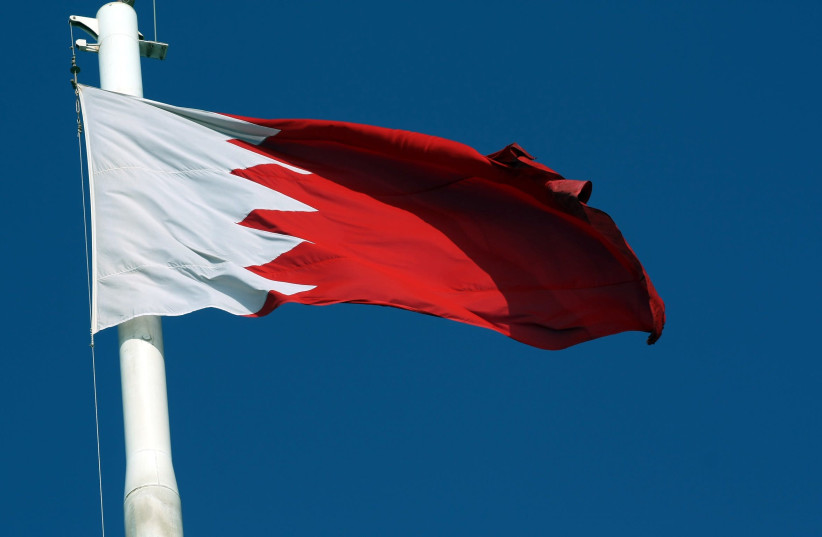
Kingdom of Bahrain flag (photo credit: Wikimedia Commons)
Kingdom of Bahrain flag
(photo credit: Wikimedia Commons)
Following the announcement of a normalization agreement between Israel and Bahrain countries throughout the Middle East reacted to the news, many praising it, while others condemned it.

The United Arab Emirates on Friday welcomed the decision by Bahrain and Israel to establish relations, which it said it hoped would have a positive effect on the climate for peace and cooperation in the region and around the world.

“The move represents a significant step towards an era of security and prosperity … (and) would expand the scope of economic, cultural, scientific, and diplomatic avenues of cooperation,” the UAE foreign ministry said in a statement.

The UAE will on September 15 normalize ties with Israel, which was announced last month. Bahrain and Israel will sign a declaration the same day.

Nabeel Al-Hamer, media advisor to the king of Bahrain, said on Friday that Bahrain normalizing relations with Israel affirms that a fair and lasting peace is the best way to guarantee Palestinian rights.

Egypt’s president on Friday said he appreciates the “important step” of Israel and Bahrain establishing diplomatic relations.

The agreement, announced on Friday, would help establish “stability and peace in the Middle East, in a way that achieves a just and permanent settlement of the Palestinian issue,” President Abdel Fattah al-Sisi said on Twitter.

Jordan’s foreign minister Ayman Safadi said in a statement on Friday, that the necessary steps to achieve a fair and comprehensive peace in the region should come from Israel.

The minister added, after the announcement of a normalization of ties between Israel and Bahrain, Israel should stop all its procedures to undermine the two-states solution, and end the illegal occupation of the Palestinian lands.

Additionally, Hossein Amir-Abdollahian, a special adviser on international affairs to the speaker of Iran’s parliament, called the agreement a great betrayal to the Islamic cause and Palestinians.

“The imprudent leaders in UAE, #Bahrain must not pave the way for the Zionist schemes. They should learn lessons from history. Tomorrow is late! The US lifeline has worn out for years” tweeted Amir-Abdollahian, also a former deputy foreign minister.

Bahrain joined the United Arab Emirates in striking an agreement to normalize relations with Israel, President Donald Trump said on Friday, a dramatic move aimed at easing tensions in the Middle East.

Trump tweeted out the news after he spoke by phone to both Bahrain’s King Hamad bin Isa Al Khalifa and Israeli Prime Minister Benjamin Netanyahu, the White House said.

Trump also tweeted: “Another HISTORIC breakthrough today! Our two GREAT friends Israel and the Kingdom of Bahrain agree to a Peace Deal – the second Arab country to make peace with Israel in 30 days!”

“This is a historic breakthrough to further peace in the Middle East,” the United States, Bahrain and Israel said in a joint statement.

“Opening direct dialog and ties between these two dynamic societies and advanced economies will continue the positive transformation of the Middle East and increase stability, security, and prosperity in the region,” it said.

Netanyahu said the agreement marks a “new era of peace.”

“For many long years, we invested in peace, and now peace will invest in us, will bring about truly major investments in Israel’s economy – and that is very important,” Netanyahu said in a video statement.

Jerusalem Post Staff contributed to this report.


The Gulf nation, which has become the 4th Arab country to agree to a peace deal with Israel, has long blamed Tehran for fomenting unrest among its Shiite population


Muslim worshippers, some wearing protective masks, perform together Friday prayers outside a mosque in Bahrain's capital Manama on February 28, 2020. (Mazen Mahdi/AFP)

Muslim worshippers, some wearing protective masks, perform together Friday prayers outside a mosque in Bahrain’s capital Manama on February 28, 2020. (Mazen Mahdi/AFP)

Bahrain on Friday became the the fourth Arab country, after Egypt, Jordan and the UAE, to agree to full diplomatic ties with Israel.

Like the UAE, Bahrain has never fought a war against Israel and doesn’t share a border with it. But Bahrain, like most of the Arab world, had long rejected diplomatic ties with Israel in the absence of a peace deal establishing a Palestinian state on lands captured by Israel in 1967.

Like the UAE agreement, Friday’s Bahrain-Israel deal will normalize diplomatic, commercial, security and other relations between the two countries.

Bahrain, along with Saudi Arabia, had already dropped a prohibition on Israeli flights using its airspace. Saudi acquiescence to the agreements has been considered key to the deals.

This combination of pictures created on September 11, 2020 shows a Bahraini man waving a national flag (L) in the capital Manama on March 22, 2011, and an Israeli man holding his country’s national flag on January 24, 2017. (JOSEPH EID and JACK GUEZ / AFP)

Other Arab nations believed to be on the cusp of fully recognizing Israel include Oman and Sudan. While tacitly blessing the deals Saudi Arabia, the regional power player, is not expected to move as quickly.

Bahrain signaled its intentions last year hosting the launch of the economic part of the Trump Peace Plan.

This picture from June 25, 2019, shows a general view of the Four Seasons Hotel (R) in the Bahraini capital Manama, where the “Peace to Prosperity” Workshop is taking place. (Stringer/AFP)

While the UAE’s population remains small and the federation has no tradition of standing up to the country’s autocracy, Bahrain represents a far-different country.

Just off the coast of Saudi Arabia, the island of Bahrain is among the world’s smallest countries, only about 760 square kilometers (290 square miles). Bahrain’s location in the Persian Gulf long has made it a trading stop and a naval defensive position. The island is home to the US Navy’s 5th Fleet and a recently built British naval base.

Bahrain is acutely aware of threats posed by Iran, an anxiety that comes from Bahrain’s majority Shiite population, despite being ruled since 1783 by the Sunni Al Khalifa family. Iran under Shah Mohammad Reza Pahlavi had pushed to take over the island after the British left, though Bahrainis in 1970 overwhelmingly supported becoming an independent nation and the UN Security Council unanimously backed that.

Since Iran’s 1979 Islamic Revolution, Bahrain’s rulers have blamed Iran for arming militants on the island. Iran denies the accusations, though weapons experts suggest explosives found there bear similarities to others linked to Iran. Israel and Iran view each other as top regional enemies.

Outside of those tensions, Bahrain’s Shiite majority has accused the government of treating them like second-class citizens. The Shiites joined pro-democracy activists in demanding more political freedoms in 2011, as Arab Spring protests swept across the wider Middle East. Saudi and Emirati troops ultimately helped violently put down the demonstrations.

Riot police fire tear gas canisters toward Bahraini anti-government protesters during clashes in Daih, Bahrain, on Friday, March 13, 2015. Protesters marched in opposition areas nationwide to mark four years since Saudi and Emirati forces arrived to help the Bahraini government crush a pro-democracy uprising.. (AP Photo/Hasan Jamali)

In recent years, Bahrain has cracked down on all dissent, imprisoned activists and hampered independent reporting on the island. While the Obama administration halted the sale of F-16 fighter jets to Bahrain over human rights concerns, the Trump administration dropped that after coming into office.

Bahrain’s royal family and officials have come out in support of the Israel-UAE agreement. However, civil society groups and others have condemned the move and warned the monarchy not to follow in UAE’s footsteps — despite Bahrain’s yearslong flirtation with Israel and Jewish leaders. Unlike the Emirates, Jews had a historical presence on the island and some still live there.

A member of the Bahraini royal family visits the country’s small Hanukah celebration every year, and the regime makes a point of treating the tiny Jewish community well.

Jews and sheikhs celebrate Hanukkah in Bahrain, December 24, 2016 (Screen capture: YouTube)

In 2017, two prominent US rabbis said Bahrain’s king told them he hoped the Arab boycott of Israel would end. An interfaith group from Bahrain that year also visited Israel, though the state-run Bahrain News Agency later said that it didn’t “represent any official entity” after an uproar erupted on social media.

Bahrain has increasingly relied on support from other nations as it struggles with its debts, particularly neighboring Saudi Arabia. In that way, Bahrain has followed in lockstep with Riyadh, meaning any normalization with Israel likely got the kingdom’s approval, though, Saudi Arabia has for its part remained silent since the Emirati announcement.

TOI Staff contributed to this report


Cabinet decides: Full lockdown to be imposed for High Holidays

Israel to enter lockdown for 2 weeks beginning on or before Rosh Hashannah, the Coronavirus Cabinet decides.

Arutz Sheva Staff , 10/09/20 22:36
coronavirus cabinet

coronavirus cabinet

Chaim Tzach/GPO

The Coronavirus Cabinet decided Thursday night to institute a full lockdown over the entire State of Israel beginning either the night of Wednesday, September 16, or the night of Friday, September 18, the first night of Rosh Hashannah. The lockdown will last for two weeks and encompass the Yom Kippur holiday as well.

Following the two-week lockdown there will be no classes for a further two weeks.

The decision will be brought to the government for final approval on Sunday.

Eight members of the Coronavirus Cabinet voted in favor of the decision, and four ministers opposed – Amir Peretz, Yisrael Katz, Yaakov Litzman and Aryeh Deri. The four are in favor of the possibility of imposing a night curfew instead of a full lockdown.

During a break from the Cabinet discussions earlier, Prime Minister Netanyahu issued a brief update to the public, saying that “Prof. Gamzu and the hospital directors came to the Corona Cabinet today and waved the red flag. They said that even though the number of severe cases in Israel is still relatively low, this could change in an instant and the hospitals will then be unable to treat them and there will be many severe cases and many deaths.

“They said that action must be taken – but we need to take action sagaciously and not recklessly; therefore, this takes many hours and, on the other hand, we must make a decision early enough so that we will all be able to get organized for the holidays, for Yom Kippur, and of course for Rosh Hashannah. I believe that a solution will be found that will stop the morbidity and allow us to emerge from the restrictions gradually and responsibly.”
