Israel sides with Greece, when its natural ally, the EU, cannot

In a clear-cut sovereignty challenge with Turkey, Greece cannot find full solidarity with its fellow members.

GREEK PRIME MINISTER Kyriakos Mitsotakis speaks during a joint press briefing with Prime Minister Benjamin Netanyahu in Jerusalem, June 2020  (photo credit: DEBBIE HILL/REUTERS)
GREEK PRIME MINISTER Kyriakos Mitsotakis speaks during a joint press briefing with Prime Minister Benjamin Netanyahu in Jerusalem, June 2020
(photo credit: DEBBIE HILL/REUTERS)
For a very long time our Holy Land suffered from covetousness from its surrounding political rivals due to its geopolitically important via maris.

In our present world, Israel treads carefully as it seeks world acceptance, being squeezed in the Eastern Mediterranean between two strategic locations, the Suez Canal, important in world trade, and the Bosporus, a key naval strait in NATO’s rivalry with Russia.

The local strongman should be the European Union. And today, it cannot gather the strength to show some form of solidarity with one of its members, a founder of European civilization, and its strategic southeastern cornerstone, namely Greece.

After Europe bled in two world wars, and having established the European Community in the hope that an economical union would stave off future conflicts, the cracks continue to seriously challenge this union.

In a clear-cut sovereignty challenge with Turkey, Greece cannot find full solidarity with its fellow members. For Israel, any hope it had that its gas fields would be secure, dwindles away as diplomatic realpolitik may change a windfall into a coming conflict.

Indeed, as neither international sovereign claims, nor solidarity, are sufficient to stand by Greece, let it be a lesson for us in Israel. Turkey benefits from owning the Bosporus, but now, understandably, feels strangulated by its lack of any clear ownership in the Eastern Mediterranean.

Awakened by China’s “nine-dash line” claims in the South China Sea, and the recent discoveries of gas by Israel, which it shares with Cyprus, Turkey decided it must have a share of the pie. But it suffices to glance at a map to realize that as Turkey benefits with the Bosporus, it is Greece that will profit largely from the Eastern Mediterranean Sea, while boxing in Turkey’s aspirations for sea exploration riches.

With the Arab Republic of Egypt sharing an exclusive economic zone (EEZ) with Cyprus, and Greece, it leaves little maneuverable space for Turkey. In recent years, despite its membership in NATO, its leadership took unilateral steps in Syria, and more important to our present discourse, Libya.

The next move in the chess board was taken by Egypt with an EEZ agreement with Greece, thus, Turkey, for now, lost much hope to obtaining those riches. Being a NATO member, gives it standing, which it abuses; being at the crossroads of Asian migration into Europe, it openly blackmails Europe; and being a force to reckon with, its determination seems to outweigh that of Europe’s leadership, shifting the “sick man of Europe,” a title the late Ottoman Empire held, back into Europe’s hands.

Despite a clear sovereign map, which would be supported by an arbitration tribunal, basing itself on the UN Convention on the Law of the Sea, a neighborhood bully freely challenges a EU member, while the European bloc turns a blind eye.

This does not bode well for our EastMed pipeline; this does not bode well for world peace. And Turkey knows this. A peaceful neighborhood is about to become a volatile keg.

I ask a question, asked countless times after World War II: What will it take for dissenting individual interests of nations, as with Germany today, with its large Turkish population, and its dream of becoming an energy hub, to show some form of unity in what seems, but a distant concept today, the European Union.

A conflict between Turkey and Greece most likely will enable Turkish gains in the Aegean Sea. And we may ask to whom would such a conflict benefit? Are we back to the old Ottoman encroachment into the Balkans, but this time its seaway?

Israel is possibly lucky for this one time to find it “straightforward” to take sides, since the Ottoman bully, once calling itself a friend, had once passed by its neighborhood, some years ago, wreaking havoc, and since, remains but a distant annoyance.

The writer is a professor at Ben-Gurion University of the Negev.

https://www.jpost.com/opinion/israel-sides-with-greece-when-its-natural-ally-the-eu-cannot-640053


Following a shooting incident on its northern border on Tuesday night, Israel is demanding that the UN Security Council make major changes to the mandate of the international peacekeeping force in southern Lebanon.

The UNFIL mandate is up for its annual renewal by the Security Council at the end of this month.

The Israeli UN Mission said on Wednesday that the mandate must be altered to “improve the UN force’s ability to fully access and monitor areas in which Hezbollah operates.”

Israeli UN Ambassador Gilad Erdan stated, “There is no justification for having an ineffective force operate in territory in which Hezbollah is using to arm itself and turn southern Lebanon into a terrorist base. Only a significant change to UNIFIL’s purpose and capabilities on the ground can justify its existence.”

The Israeli UN Mission also published a map detailing Hezbollah’s extensive presence in southern Lebanon.

Earlier this month, it was reported that US President Donald Trump’s administration was threatening to veto the extension of the UNIFIL mandate if changes were not made.

Israel Demands Improved Access for UN Peacekeepers to Hezbollah-Controlled Areas in Southern Lebanon


Roey Gilad says a dozen members of terror group have received, or are in process of receiving, Turkish passports


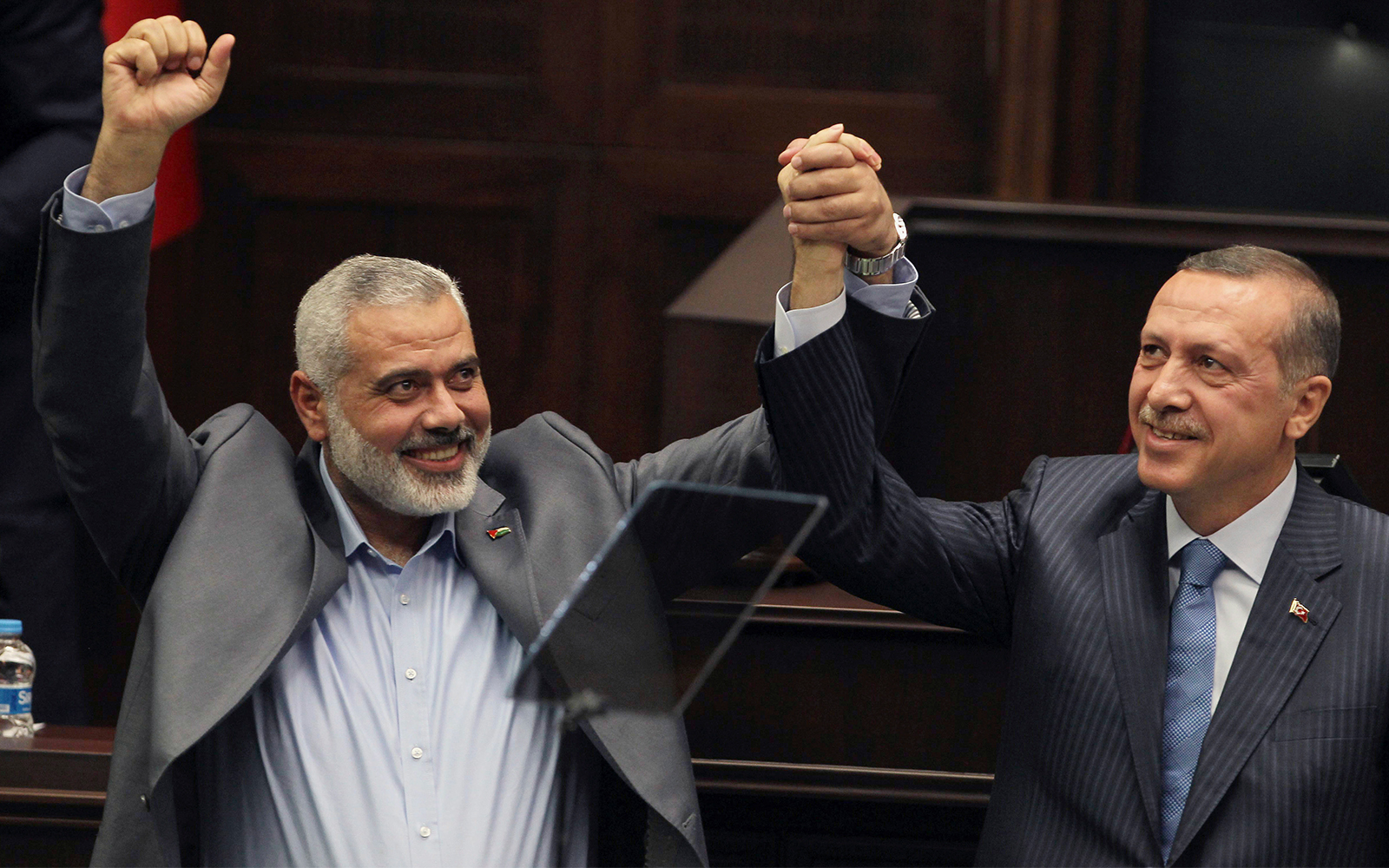
Hamas chief Ismail Haniyeh, left, and Turkish Prime Minister Recep Tayyip Erdogan, in Ankara, Turkey, January 3, 2012. (AP Photo, file)

Hamas chief Ismail Haniyeh, left, and Turkish Prime Minister Recep Tayyip Erdogan, in Ankara, Turkey, January 3, 2012. (AP Photo, file)

An Israeli diplomat on Wednesday confirmed reports that Turkey is granting citizenship to a dozen members of the Hamas terrorist group.

“Some are in the process, some already got (the documents), but we are talking about around a dozen,” Roey Gilad, chargé d’affaires at Israel’s embassy in Turkey, told the Reuters news agency.

Gilad said Israel has evidence of the phenomenon.

“We have already one document that we will present to the government in copy,” he said. “Judging by the last experience we had by presenting a well-based portfolio to the government… and getting no reply, I must say I don’t have high hopes that something will be done this time.”

Gilad asserted that the Hamas members receiving Turkish passports were financing and organizing terror operations.

Turkish President Recep Erdogan met on Saturday with a Hamas delegation that included politburo chief Ismail Haniyeh and the terror group’s No. 2, Saleh al-Arouri — a top military commander who has a $5 million US bounty on his head.

The meeting was harshly condemned by the US State Department, but the Turkish Foreign Ministry rejected the criticism, accusing Washington of “serving Israel’s interests.”

It added, “Declaring the legitimate representative of Hamas, who came to power after winning democratic elections in Gaza and is an important reality of the region, as a terrorist will not be of any contribution to efforts for peace and stability in the region.”

Earlier this month, The Telegraph reported that Turkey was in the process of granting citizenship to high-ranking Hamas members living in its territory who are suspected of involvement in directing terror attacks.

Of the 12 senior members of the cell, most have already been given citizenship, the British daily reported.

A senior source told the paper that seven have already received citizenship and passports while the other five are in the process of doing so. Some of the cell members are living in Turkey under aliases. In some cases citizenship has also been granted to the families of the Hamas members.

Israeli diplomat Roey Gilad during an interview with PBS on February 3, 2015. (Screen capture/PBS)

One of those who has apparently received citizenship is Zacharia Najib, who reportedly oversaw a plot to assassinate senior Israeli public figures, including the national police commissioner and Likud MK Nir Barkat, who at that time was mayor of Jerusalem. An East Jerusalem Palestinian who was recruited to the cause in a meeting in Istanbul was arrested, after he returned to Israel and tried to buy a pistol.

A Turkish government spokesperson declined to comment to The Telegraph about the report, describing it as a baseless claim against Turkey by a foreign government. A senior Hamas official denied the report, saying the group’s members do not operate outside of the Palestinian territories and also do not engage in terror activities.

Turkish citizens can already travel visa-free to a variety of countries, and according to The Telegraph, Turkey is working to obtain similar access to European Union countries.

Hamas is feared to be planning attacks against Israelis in Europe, The Telegraph said, and Turkish citizenship would enable its members to travel more easily.

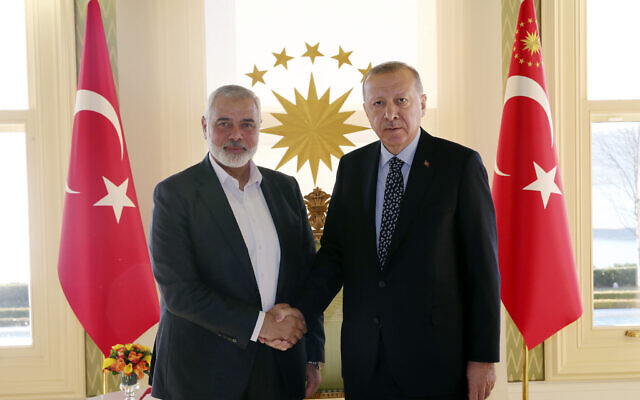
Turkey’s President Recep Tayyip Erdogan, right, shakes hands with Hamas terrorist movement chief Ismail Haniyeh, prior to their meeting in Istanbul, February 1, 2020. (Presidential Press Service via AP, Pool)

Turkey sees Hamas as a legitimate political movement. The country has long maintained warm ties with Hamas, which have grown more overt as ties with Israel have chilled over the last decade. Israel has complained to Ankara about its ties to Hamas, but to no avail, according to the report.

In December 2019, The Telegraph cited Israeli sources as saying that Turkey is allowing Hamas members to plan attacks on its soil. Israeli officials told the paper at the time that Turkey has reneged on its 2015 commitment, negotiated by the US, not to allow Hamas officials to plot terror attacks against the Jewish state from its territory.

Hamas and Erdogan’s AKP party are linked politically. Both have close ideological ties to the Egyptian Muslim Brotherhood movement.