US planning Mideast peace summit next month

Summit to take place in one of the Persian Gulf sheikdoms in the next few weeks, Arab diplomat says. US trying to secure the participation of Bahrain, Oman, Morocco, Sudan, and Chad, alongside Israel and the UAE. PM Netanyahu confident “more countries will follow UAE.”

The United States is working to convene a Middle East peace summit in the next few weeks, a senior Emirati diplomat told Israel Hayom Monday.

The Emirati official said that US Secretary of State Mike Pompeo’s five-day visit to the Middle East and Africa, which began in Jerusalem, is part of Washington’s effort to lay the groundwork for the peace summit.

Follow Israel Hayom on Facebook and Twitter

Sources familiar with the issue said that the summit is to take place in one of the Persian Gulf sheikdoms, adding that the US is trying to secure the participation of Bahrain, Oman, Morocco, Sudan, and Chad, alongside Israel and the UAE.

Other states, including Saudi Arabia, Egypt, and Jordan – the latter two already having peace treaties with Israel – have yet to confirm their participation in the summit.

The diplomat added that prior to and during Pompeo’s visit to Israel, Palestinian officials were invited to the summit. The message was also conveyed to the PA that Pompeo is willing to visit PA President Mahmoud Abbas in Ramallah to personally invite him to the summit.

Abbas and other PA officials dismissed the offer, snubbing the top American diplomat “and even sent the message that Pompeo is not wanted in Ramallah,” the UAE official said.

“The Palestinian position is very saddening. They were given an opportunity to deescalate the situation with a respectful invitation to take part in a regional peace conference, and they rejected it out of hand with no reasonable explanation,” he noted.

“The Palestinians have to come to grips with the fact that the wheels of peace have started to turn, and peace and normalization will come with or without the Palestinians even if they continue to be defiant.”


Emiratis also reportedly plan to refrain from additional high-level meetings with Jerusalem until prime minister clarifies position on prospective US arms agreement

Sheikh Mohammed bin Zayed al-Nahyan, Crown Prince of Abu Dhabi and UAE's deputy commander-in-chief of the armed forces, at the Kremlin in Moscow, March 24, 2016. (Alexander Nemenov/Pool photo via AP/File)
Sheikh Mohammed bin Zayed al-Nahyan, Crown Prince of Abu Dhabi and UAE’s deputy commander-in-chief of the armed forces, at the Kremlin in Moscow, March 24, 2016. (Alexander Nemenov/Pool photo via AP/File)

The United Arab Emirates reportedly canceled a trilateral meeting with Israel and the US last week in retaliation against Prime Minister Benjamin Netanyahu’s public opposition to Washington’s brewing sale of F-35 fighter jets to Abu Dhabi.

A New York meeting of the three countries’ UN envoys celebrating the normalization of Israel-UAE ties had been scheduled for Friday, the Walla news site said in a report Monday.

But in the lead-up to the gathering, Netanyahu spoke out against the US sale of advanced weaponry to the UAE, following reports that he had agreed to pull opposition to the deal in exchange for normalization.

Israel fears allowing the UAE to obtain the ultra-advanced stealth jet fighters will compromise its military edge in the region, which the US has pledged to uphold.

In response to Netanyahu, the UAE officials decided to send a message to Netanyahu and convey their “disappointment” by canceling their participation, Walla reported, citing three sources familiar with the matter.

The Gulf state will also hold off on other high-level meetings with Israel until Netanyahu’s position is clarified, the report said.

If true, the reports would put a damper on giddy hopes for a flourishing open friendship between Israel and the UAE, which is only the third Arab state in the region to agree to normalize ties with the Jewish state.

Israeli and American F-35 fighter jets take part in a joint exercise over southern Israel on March 29, 2020. (Israel Defense Forces)

The prime minister has denied that a prospective F-35 sale was part of the normalization agreement. Top US officials have conceded that they are in talks with Abu Dhabi regarding an arms deal and that the Israel-UAE deal makes such a sale more likely.

However, both Washington and Abu Dhabi have asserted that their respective negotiations began well before the normalization effort was launched.

Regardless, officials in the UAE involved in the matter had been under the impression that Netanyahu would avoid speaking out publicly against the deal, regardless of whether he opposed it privately, Walla reported.

Abu Dhabi was also displeased with the Israeli premier’s assertion that he had no knowledge of the deal and that he would act to oppose it — by raising the issue with members of Congress.

US Secretary of State Mike Pompeo met with Netanyahu earlier Monday and emphasized that Washington was committed to maintaining Israel’s military superiority in the region, while appearing to hint at the impending F-35 sale.

“The United States has a legal requirement with respect to qualitative military edge, and we will continue to honor that,” Pompeo said in a statement to the press delivered alongside Netanyahu in Jerusalem. “We have a 20-plus-year security relationship with the United Arab Emirates as well, where we have provided them with technical assistance and military assistance and we will now continue to review that process.”

“We are deeply committed to doing that and achieving that and will do it in a way that preserves our commitment to Israel as well,” Pompeo said.

For years, the United States has denied requests by Arab states to buy advanced American weapons systems, in part due to a longstanding political doctrine involving Israel.

Following the Yom Kippur War in 1973, the US Congress promised to preserve Israel’s “qualitative military edge” in the Middle East by considering Jerusalem’s position before selling advanced weapons to the Jewish state’s neighbors. The pledge was later codified in law, though neither Congress nor Israel can actually block the sale, only put up hurdles.

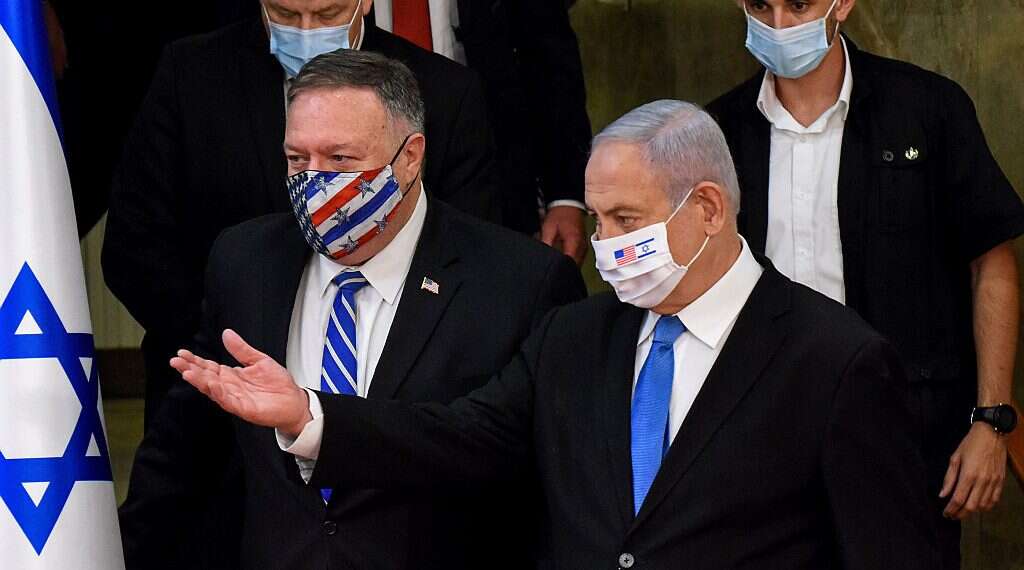
US Secretary of State Mike Pompeo and Prime Minister Benjamin Netanyahu meet in Jerusalem, on August 24, 2020. (Kobi Gideon/GPO)

The F-35 is considered one of the most advanced aircraft in the world. Israel has thus far received at least 16 of the aircraft, with dozens more set to be delivered in coming years.

Netanyahu, in his comments to reporters Monday, insisted that the agreement with the United Arab Emirates did not include “acceptance” by Jerusalem of an arms deal between Washington and Abu Dhabi.

Pompeo is in Israel before embarking on a regional swing to push more countries to normalize ties with Israel. From Tel Aviv, he will fly to Sudan and from there to Bahrain, before traveling to Abu Dhabi for talks with Emirati Foreign Minister Abdullah bin Zayed Al Nahyan on the Israel-UAE agreement and other regional issues, according to the State Department.

Officials said stops in Oman and Qatar are also possible.


Turkey’s ruling AK Party has been a leading voice against the UAE and ties with Israel.

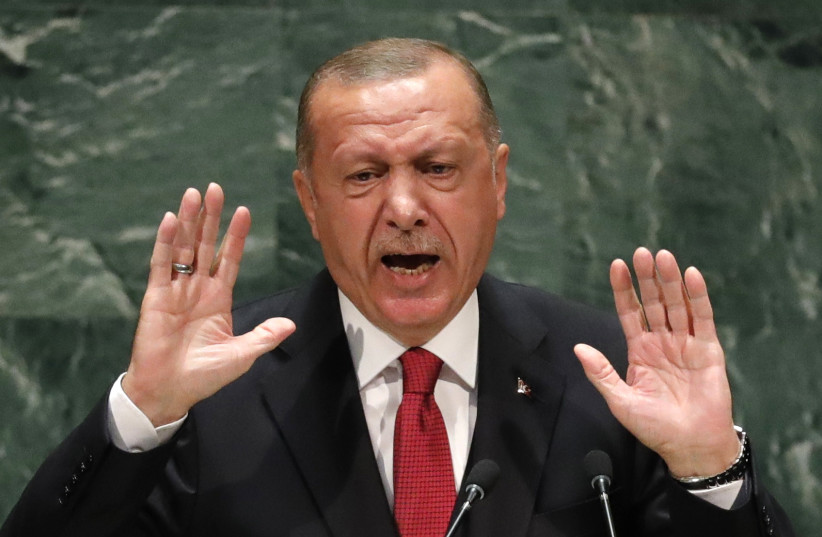
Turkey's President Recep Tayyip Erdogan addresses the 74th session of the United Nations General Assembly at U.N. headquarters in New York City, New York, U.S. (photo credit: REUTERS)
Turkey’s President Recep Tayyip Erdogan addresses the 74th session of the United Nations General Assembly at U.N. headquarters in New York City, New York, U.S.
(photo credit: REUTERS)
Turkey’s government appears to be obsessed with stopping more countries from normalizing with Israel.

This is apparent because pro-government channels such as Anadolu have been consistently pushing news about countries and political parties in the Middle East rejecting normalization.

For instance Turkey has sought to highlight opposition among Muslim Brotherhood affiliates across the region.

On Monday, Anadolu said Morocco “rejects any form of normalization with Israel.” This is based on a comment from Prime Minister Saad Eddine El Othmani, the report said. “We refuse to normalize relations with the Zionist entity [Israel] because this will embolden it to further breach the rights of the Palestinian people,” El Othmani said. He is a member of the Justice and Development Party (PJD).

Turkey is concerned because Morocco is one of the countries where there are hints of possible better ties. Ankara knows Morocco and Israel have had connections in the past.

On Saturday, Turkey’s media also highlighted Sudan’s opposition to normalization, pointing out that a spokesman had been pushed out after hinting of ties with Israel. Turkey says the Communist Party in Sudan rejected “any deal to normalize relations with Israel.”

In Turkey, the far-right regime of President Recep Tayyip Erdogan is opposed to communist views but it seems Turkey is happy to highlight communist parties so long as they oppose Israel.

The country also highlighted Kuwaiti NGOs for opposing normalization. Meanwhile, Turkey’s government broadcaster TRT had a headline on Monday claiming that the UAE has been “bombed every day since UAE-Israel normalization.” TRT also highlighted the visit by Hamas leader Ismail Haniyeh to Turkey this weekend. Haniyeh praised Turkey and Kuwait for leading opposition to normalization.

Turkey’s ruling AK Party has been a significant voice against the UAE and its ties with Israel. Even though Turkey is a NATO member and also ostensibly a US ally and has relations with Israel, it is one of the most anti-Israel countries in the world after Iran.

Turkey is moving closer now to Iran, China and Russia. It has purchased Russia’s S-400 air defense system. Ankara has threatened to cut ties with the UAE after the UAE agreement with Israel.

https://www.jpost.com/middle-east/turkish-government-obsessed-with-stopping-normalization-with-israel-639738?fbclid=IwAR1PPeI8ZGSc6ISCbQiXeVmJFexcP_x0XDMURS0TxiNv8oeLubqvqQp3gT4