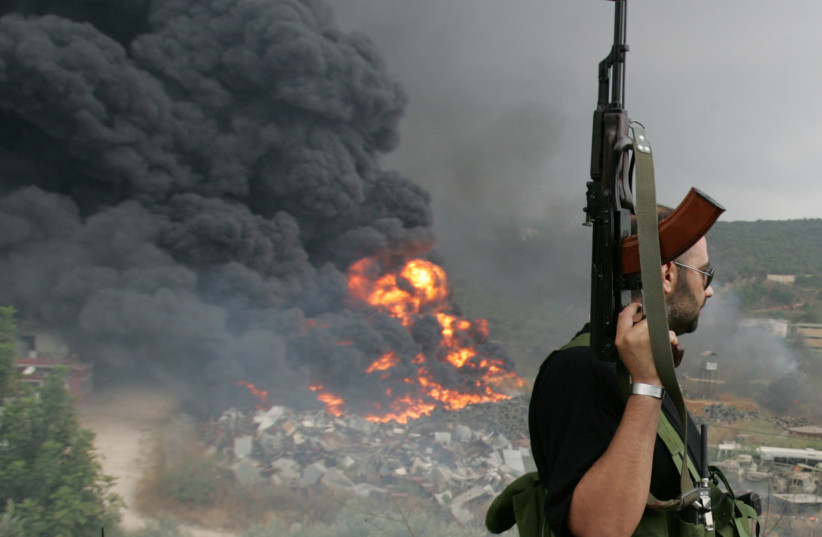
Because of the preoccupation with the Coronavirus, the blast in Beirut on Tuesday, August 4th got much less attention than it deserved. Sure, the world looked at the explosion in superficial 21st Century style but failed to understand the ramifications of the blast, which are far more important to Israel and the Jewish People than Coronavirus.
While Coronavirus is a pandemic, the Beirut blast wasn’t planned to be in Beirut. It was planned to be a Hiroshima holocaust to level the city of Haifa, all of the Haifa Bay area and kill a million Jews, Heaven forbid. Hashem prevented that just as King David said he would.
King David said in Psalm 7:16 that our enemy digs a pit but he himself falls into it. That’s exactly what Nasrallahh and Hezbollahh did.
Ler me emphasize that the Lebanese People are not our enemy. Nasrallahh and Hezbollahh are. They stored tons of highly volatile aluminum nitrate illegally in Beirut’s Port, despite Nasrallah’s denials. The corrupt Lebanese government, which Hezbollahh controls by force, blackmail and bribes, knew all about it but didn’t do anything.
Other sectors of Lebanon’s population, such as the Christians, the Druze and many of the Sunni Moslems, suffer from Hezbollahh tyranny and from their emasculated government’s lack of protection. The proof is that Hezbollah cared not at all about the safety threat to the Beirut populace.
However, what the liberal Western media doesn’t tell you is that the aluminum nitrate was destined to become the superchargers of Hezbollah’s missile warheads – tens of thousands of them – which turn conventional rockets into quasi nuclear threats as we saw in the mushroom vapor cloud that went up from the explosion in Beirut Port – it looked just like a mini Hiroshima.
Here’s a little history that the progressive media won’t tell you either. Hezbollah became world specialists in developing explosive devices and weapons enhancers through the use of aluminum nitrate. Aluminum nitrate was the explosive material used in the roadside bombs that wounded and killed so many Israeli soldiers between the First and Second Lebanon Wars.
Hezbollah exported this sinister know-how to their Afghani counterparts, the Taliban, by way of Iran. According to intel sources, Iran’s Revolutionary Guards (IRG) have been active amongst Taliban terrorists opposing the Afghan government. In fact, the same Iranian IRG military advisors that work with Hezbollah have also worked as advisors to the Taliban.
Now hear this, America – the same roadside aluminum-nitrate based bombs that wounded and killed so many Israeli soldiers are the culprits that maimed and killed so many American soldiers in Afghanistan.
\
When you put the puzzle together, it all connects to Iran.
This massive 2,750 tons of aluminum nitrate, which is 6 million pounds, had been sitting in Hangar 12 of the Port of Beirut, stockpiled by Hezbollah as the secret weapon to implement another Holocaust that Nasrallah and Khomeini had planned for the Jewish People.
In 2016, with a nasty smirk on his face, Nasrallah promised that a “nuclear explosion” just might detonate in Israel in the near future. Ever since, he and the IRG have been promising that Israel’s demise is near. While the blast on Tuesday was “accidental”, the damage would have been megatimes greater if only a few kilograms of aluminum nitrate were placed at the tips of 150,000 Hezbollah warheads fired with deadly precision all over Israel, Such a supercharger on a warhead makes it tens of times more devastating, depending on the rocket and its payload capacity.
Israel knew all about the stockpile. The Mossad even tipped off Britain’s MI5 recently about 3 tons of the deadly material the Hezbollah stockpiled in the UK, where they were planning a hit similar to their devastating terror attack in Burgas, Bulgaria in July of 2012, when a Hezbollah suicide bomber blew up a bus carrying 42 Israeli tourists. The same was being planned for Golder’s Green or Stamford Hill.
Israel cares more about Beirut’s citizens than Hezbollah and Iran do – much more.
Contrary to the attempts to pin the blame on Israel, it is easy to prove that Israel had nothing to do with the blast. Hezbollah stockpiled the aluminum nitrate in warehouses that held shipments of Iranian missiles that Hezbollah was also stockpiling.
But Israel goes deep inside Syria and Shiite-controlled portions of Iraq to prevent weapons transfers to Hezbollah in Lebanon by ground routes. Israel’s Navy also monitors Beirut Port to prevent weapons shipments by sea. In fact, as soon as Israel discovers missile shipments and stockpiles intended for Hezbollah – no matter where they are, in Syria, in Lebanon or in Iraq – Israel attacks and blows them up. There is, however, one exception – the Port of Beirut.
Israel could have easily blown up the weapons stockpiles in the Port of Beirut, but refrained from doing so, despite the terrible threat to its citizens, because Israel knew that the aluminum nitrate stockpiles stored next to them would also blow up, causing devastation to a civilian population.
Israel cared about preventing damage to the people of Beirut whereas Nasrallah, Hezbollah, Iran and Khomeini could not have cared less. The arch-terrorist criminal Nasrallah connived that if he stockpiled his weapons where the aluminum nitrate was, they’d be safe from Israel. He was right; he knows that Israel risks its own soldiers to avoid damage to civilian populations of enemy countries. The reason Israel doesn’t destroy Hezbollah’s weapons depots in Beirut Port and in South Lebanon is because they’re all in the midst of the civilian population, not just in warehouses but in mosques and hospitals.
But Nasrallah was wrong about something else – he didn’t take God’s Hand in historical events into account. No matter what the human or natural cause of the ignition is found to be, the timing and placement of the event that destroyed Hezbollah’s doomsday weapon of aluminum nitrate and ignited the fire in Beirut Port is the result of the Hand of God. Even more telling, while less than 160 people were killed in the blast, the number of fatalities according to nature should have been a hundred times greater.
This is not conventional news but faith-based news. The purpose is not to present the news, to discuss politics or to analyze military strategy and scenarios. The purpose is to show that the fact that the blast when and where it occurred means that Hashem is acting for us without our knowledge.
In Psalm 117, King David calls upon all nations, including our enemies, to praise Hashem, because His mercy on the Jewish People is so great. This really sounds weird at face value: why should Hamas, Hezbollah and Iran praise Hashem for His mercy on the Jews, when their hate for us knows no bounds? The answer is simple – only they know what they have been planning for us and only they know the extent to which Hashem has spoiled their plans.
The least we can do – every Jew or peace-loving human whoever you are and wherever you are – is to thank Hashem, from morning until night. We can never take for granted every new day when the sun shines on is. Thank You, Hashem. G-d bless and warmest regards from the Land of Israel.
Rabbi Lazer Brody was born in Washington, D.C and is a graduate of the U. of Maryland in agriculture. He moved to Israel in 1970 and joined the IDF, where he spent 19 years in regular and reserve combat service before becoming a military chaplain until his discharge after 29 years of service. He was ordained as a rabbi by Rabbi Noach Weinberg of Aish HaTora in Jerusalem and others. Author of 3 Words of Emuna“, “Old Isaac’s Trail to Tranquility“, “The Path to Your Peak,” “Worry Worm” and Nafshi Tidom” about dealing with verbal abuse, he is a sought-after inspirational and motivational speaker to audiences of all backgrounds, both in Israel and abroad, as well as a renowned spiritual guide and life coach and certified personal fitness trainer, health coach and holistic nutritionist with a classical Rambam-based approach. His award-winning daily web journal “Emuna Beams” podcast at emunabeams.com, is a beacon of emuna, encouragement and body-soul health that people around the globe enjoy daily.
The Beirut blast wasn’t supposed to take place in Beirut

 ost a week after the explosion that shattered Beirut, which ended more than 150 lives and ruined hundreds of thousands more, the shock has not worn off. At times it feels as though it never will. Phone calls, conversations with waiters, cashiers and taxi drivers begin the same way, with questions about health, family, home. Strangers greet each other with “hamdellah ’al salama” – thank God for your safety – a phrase that in happier times might be used to welcome someone back from a trip.