Israeli archaeology destroys Palestinian myths

Important Israeli archaeological discoveries make the case for ancient Jewish rights to the Land of Israel.

On July 22, 2020, a stunning announcement was reported by the Jerusalem Post about a new archaeological discovery by the Israel Antiquities Authority (IAA) in Arnona near the US Embassy in Jerusalem.

It was the uncovering of a vast administrative center in Judea built during the reign of King Hezekiah with seals attesting to the ancient Jewish presence during the First Temple period between the eighth and the middle of the seventh century B.C.E. IAA archaeologist Benyamin Storchan noted:

“We found about 120 stamped seal impressions on jar handles written in ancient Hebrew script, which translate as ‘belonging to the king.’ These stamped jars were usually related to tax collection. Up to this day, 1,000 similar items have been found in over a century of excavations in Israel, which gives us an idea of the importance of this area”.

In 2019, the City of David Foundation announced discovery of seals of legendary King David’s son. Lawrence Franklin noted in a Gatestone Institute article:

“On September 9, 2019 , the foundation’s leading archaeologist, Eli Shukron, announced the discovery of a 2,600-year-old royal seal, found near the Western Wall in the Old City of Jerusalem, which bears the name (in Hebrew) of Adenyahu, a son of King David mentioned in the biblical book of Kings”.

As has been true with previous archaeological discoveries in Israel, however, this one is unlikely to put a dent in the long-term international campaign to delegitimize the Jewish state by rewriting and distorting its history, even by renaming the Jewish sites Rachel’s Tomb near Bethlehem to “Bilal ibn Rabah mosque” (it was never a mosque) and Hebron’s Tomb of the Patriarchs the Ibrahimi Mosque.

The delegitimizations of the ancient Jewish presence in Jerusalem began in the Seventh Century C.E. by Abd al-Malik ibn Marwan – the fifth caliph of the Umayyad dynasty of Syria— who built the Dome of the Rock on the Temple Mount. That was placed over the legendary site where Jews believe Abraham was poised to sacrifice his son Isaac. Fast forward to July 2000 and the Camp David Peace Talks under the auspices of former President Clinton between then Israeli PM Ehud Barak and the late PA President Yasser Arafat. Arafat disputed the Jews building the First and Second Temples in Jerusalem, instead suggesting they may have been in Nablus.

These important Israeli archaeological discoveries make the case for ancient Jewish rights to the Land of Israel. It is the major theme of a new book published by the NER Press written by University of Central Florida Professor Dr. Kenneth L. Hanson, Whose Holy Land? Archaeology Meets Geopolitics in Today’s Middle East, which was the subject of a wide-ranging Israel News Talk Radio – Beyond the Matrix interview with Jerry Gordon and Rod Reuven Dovid Bryant.

Dr. Ken Hanson is the coordinator of the Interdisciplinary Program and Judaic Studies at the University of Central Florida. He has taught the history, literature, and cultural legacy of the Jewish people from antiquity to the modern rise of the State of Israel. He has lived in Jerusalem and the Northern Galilee. He earned a master’s degree in International Intercultural Communications and went on to earn a doctorate in Hebrew and Literature from the University of Texas at Austin. He has published multiple books on these topics. He has been on national television and syndicated radio, History Channel, Travel Channel, and the Gaia Network. He holds unique insights on the question of why Israeli Jewish heritage is proven by archaeology.

Dr. Ken Hanson’s new book uniquely covers two “Holy Lands,” two Israels, two Jerusalems. The one above ground, that pilgrims see on tour, boasts historic buildings and majestic architecture. Another is below ground and is much more mysterious. This is where we find evidence of who lived in this land thousands of years ago and a “narrative in stone,” supporting the Jewish people who lay claim to it today. As the Middle East continues to be the flashpoint of global conflict, the “facts underground” could hardly be more relevant.

When asked how significant the archaeological evidence of the three Millennia Jewish presence in Israel is, Dr. Hanson replied:

“It is everywhere. Somebody said, “You want to learn about America, take a book. You want to learn about the land of Israel, take a shovel.” You dig down and from Jericho to Shechem to Nablus, which is currently a Palestinian city, that is sitting on top of an area that was Jewish. Joseph’s Tomb, Rachel’s tomb, Bethlehem, it is everywhere. All you must do is look. There are ongoing archaeological digs, that are controversial. Beyond that, there are Jews who desire to live in these places where you have an historical Jewish presence for thousands of years. Settlements have gone up, some of which have been deemed illegal by the international community. What? It is illegal for Jews to live in their own land. If you are Jewish, you cannot live in Hebron”.

“It is not an exaggeration to say that this is the goal of the Palestinian Authority. When a Palestinian state should ever arise in this land, all Jews must leave. The Jewish settlers and settlements must be dismantled. They must leave. Palestine must be judenrein. If they do not leave, what would be the fate of the settlers who have the audacity simply to want to live near the Tomb of the Patriarchs, where Abraham, at least in tradition, is buried, the other patriarchs and the matriarchs, Abraham, Isaac, Jacob? Not a pleasant one. It would not be possible”.

“That is what is so terribly controversial because there are many on the Palestinian side who do not acknowledge that Jews ever lived in the land of Israel. This is the extent of the propaganda that goes forth, even to school children who grow up in the Palestinian Authority. They argue: “The Jews came here as colonialists in the 19th and 20th centuries C.E., there were no Jews in this land prior to that”.
Israeli archaeology destroys Palestinian myths


Diab made the comments Tuesday prior to a Higher Defense Council meeting in Beirut’s Baabda Presidential Palace for talks on the events, Lebanon’s Naharnet News reported.

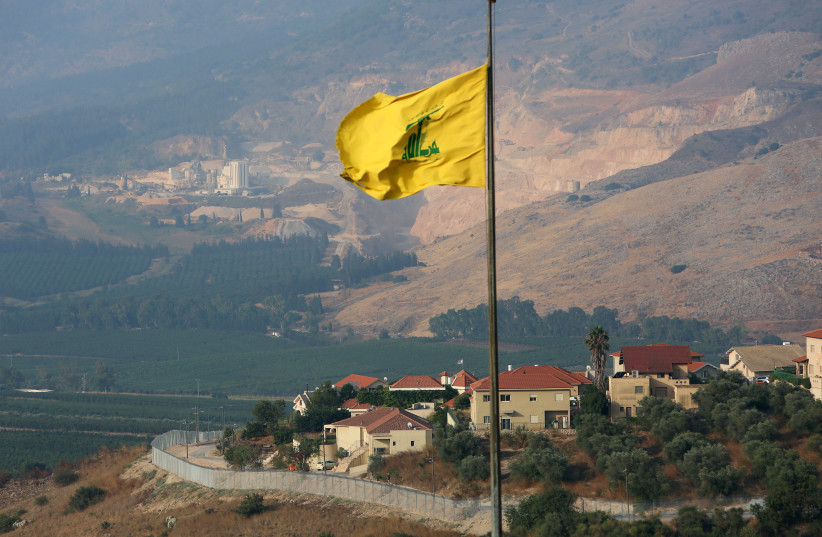
A Hezbollah flag flutters in the southern Lebanese village of Khiam, near the border with Israel, Lebanon July 28, 2020 (photo credit: REUTERS/AZIZ TAHER)
A Hezbollah flag flutters in the southern Lebanese village of Khiam, near the border with Israel, Lebanon July 28, 2020
(photo credit: REUTERS/AZIZ TAHER)

Lebanese Prime Minister Hassan Diab warned that Israel had “assaulted Lebanon’s sovereignty again” in a “dangerous military escalation,” during a meeting of Lebanon’s Supreme Council of Defense on Tuesday, following an attempted infiltration by Hezbollah terrorists on Monday that was thwarted by the IDF.

Israel is “seeking to amend the tasks of UNIFIL and the rules of engagement with us,” added Diab. “I call for caution in the coming days because I fear that things will slip for the worse in light of the severe tension on our borders.”

Diab made the comments Tuesday prior to a Higher Defense Council meeting in Beirut’s Baabda Presidential Palace for talks on the events, Lebanon’s Naharnet News reported.

Chaired by Lebanon’s President Michel Aoun, the meeting was also attended by Defense Zeina Akar, Foreign Ministry Nasif Hitti, Lebanese Army chief Gen. Joseph Aoun, General Security chief Abbas Ibrahim, Internal Security Forces chief Maj. Gen. Imad Othman and several other military and security officials. Several other Lebanese ministers also joined the talks.

On Monday afternoon a Hezbollah cell, which numbered between three and five operatives, crossed the border – also known as the Blue Line – several meters into sovereign Israeli territory and were identified by the IDF, which opened fire on them causing them to flee back into Lebanon without firing at IDF troops.

There were no IDF injuries or casualties and Hezbollah later denied such a clash occurred and warned that its response to the death of its member in Syria “is definitely coming” and that the damage to one of the houses in the village of Al-Habariyah “will not pass quietly.”

Prior to the incident Iran’s Ambassador to Lebanon Mohammed Jalal Firouznia met with Lebanon’s Grand Mufti and “confirmed Iran’s support for Lebanon,” and warned against an Israeli strike on Lebanon.

“The Israeli enemy has not forgotten its defeat in the July war (2006). If it does such madness, there is no doubt that it will receive a harder blow in return. The axis of the resistance is stronger than ever, and we are convinced that more victories await this axis” he was quoted by Lebanon’s MTV News as saying.


Lebanese PM accuses Israel of ‘dangerous escalation,’ calls for caution; Lebanese media reports intensive Israeli drone flights; IDF maintains roadblocks in north

Israeli army forces seen stationed near the border between Israel and Lebanon in the Golan Heights on July 27, 2020. (David Cohen/Flash90)

The Israeli military on Tuesday remained on high alert along the northern border amid fears that the Lebanese Hezbollah terror group would try to carry out an attack, following an alleged attempted assault the day before in a contested area on the frontier.

Also Tuesday, Lebanese Prime Minister Hassan Diab accused Israel of carrying out a “dangerous military escalation” the previous day and thereby violating United Nations Resolution 1701, which ended the 2006 Second Lebanon War.

“I fear that the situation will deteriorate in light of the severe tension on our borders with occupied Palestine,” Diab wrote in a statement, calling for caution.

The Lebanese prime minister, who is supported by Hezbollah, also accused Israel of seeking to give the international peacekeepers in Lebanon, known by the acronym UNIFIL, additional powers in the country and change the “rules of engagement.” UNIFIL’s mandate to operate in Lebanon is due to be reviewed and renewed next month by the UN Security Council.

Lebanese Prime Minister Hassan Diab speaks during a news conference after his government was announced, at the Presidential Palace in Baabda, east of Beirut, Lebanon, January 21, 2020. (AP/Bilal Hussein)

According to the Israel Defense Forces, on Monday afternoon a group of Hezbollah operatives infiltrated a short distance into the Israeli-controlled Mount Dov region, also known as Shebaa Farms, before IDF troops opened fire at them — apparently not hitting them, but forcing them back across the border.

The incident appeared to be an attempt by the Iran-backed Hezbollah to exact revenge for the killing of one of its members in Syria last week in an airstrike it attributed to Israel.

Following the alleged failed assault, Hezbollah officially denied that an attack had taken place, but did not explicitly dispute that its members had crossed into the Israeli-controlled enclave.

Israeli defense officials scoffed at the terror group’s denial, saying the infiltration attempt had been filmed by military security cameras and that the operatives who took part in it were armed. The Israel Defense Forces said it was considering releasing the footage from the incident.

The terror group said a reprisal for its fallen operative in Syria was still to come.

However, Lebanese news outlets affiliated with or directly controlled by the terror group appeared to indicate that Hezbollah considered the fact that it forced the IDF into a state of high alert to be sufficient retaliation for the time being.

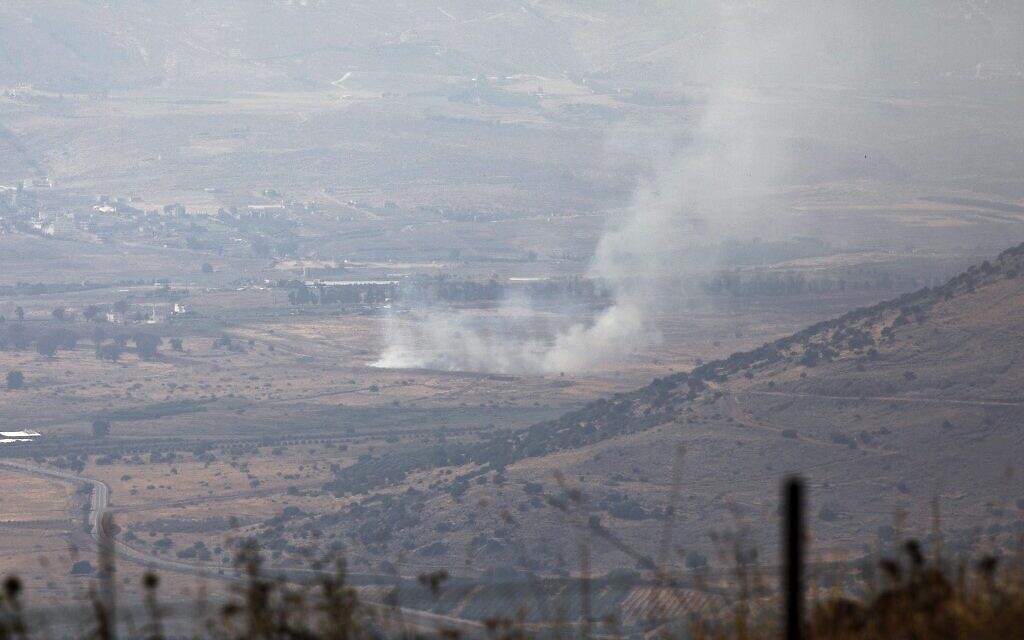
A picture taken from the Israeli side of the Blue Line that separates Israel and Lebanon shows smoke billowing above the Shebaa Farms sector after clashes in the border area, on July 27, 2020. (Jalaa MAREY / AFP)

Nevertheless, the Israeli military remained on high alert out of concern that Hezbollah would try to carry out an attack along the border, as it threatened to do Monday.

Lebanese media reported intensive Israeli drone flights over southern Lebanon throughout Tuesday morning. The military also maintained its own roadblocks in the area, preventing IDF vehicles from traveling on certain highways along the border that were considered vulnerable to attack from Lebanon.

“Tense and complicated days are before us,” IDF Spokesperson Hidai Zilberman told reporters on Monday afternoon.

Following the incident, Israel conveyed messages to Lebanon, through third parties, that it did not want Monday’s border altercation to descend into a war with the country’s Hezbollah terror group.

Defense Minister Benny Gantz (left) and Prime Minister Benjamin Netanyahu at a press briefing, July 27, 2020 (Gobi Gideon/GPO)

In a joint press conference, Prime Minister Benjamin Netanyahu and Defense Minister Benny Gantz issued clear warnings to Hezbollah and to the countries of Lebanon and Syria that Israel would respond harshly to any attacks.

“Hezbollah needs to know that it is playing with fire,” Netanyahu said, also making clear that Israel holds Lebanon accountable for the actions of the terror group based on its soil.

Speaking after the premier, Gantz said, “Israel is more determined than ever to prevent any harm to its sovereignty, its soldiers, and certainly to its citizens.”

Syrian Air defenses respond to alleged Israeli missiles targeting south of the capital Damascus, on July 20, 2020 (AFP)

He added that Israeli security forces would continue operating “wherever necessary — however near or far,” in an apparent reference to the military’s fight against Iran and its proxies in the Middle East.

In the past, Hezbollah has vowed to retaliate for losses of its fighters in Syria with attacks on Israel. This was the case in September, when the terror group fired three anti-tank guided missiles at Israeli military targets along the Lebanese border, narrowly missing an IDF armored ambulance with five soldiers inside, after the IDF killed two of its fighters in Syria the month before.

On Friday, the IDF began clearing out unnecessary personnel from the frontier and barring military vehicles from traveling on roads that were exposed to anti-tank guided missile fire from Lebanon. No such restrictions were placed on civilians at the time, who were encouraged to go about their lives as normal despite the heightened tensions.

Times of Israel staff contributed to this report.

As tense calm returns after dust-up with Hezbollah, IDF stays on high alert