Hazam Qassem affirmed that the terror group wants a resolution that prevents Israel from “encroaching on Gaza, the West Bank, or Jerusalem.”
Hamas terrorists pictured in Gaza City, October 15, 2025; illustrative.(photo credit: REUTERS/DAWOUD ABU ALKAS)ByJERUSALEM POST STAFFThe US draft resolution to the United Nations Security Council does not “serve the stability of the situation in Gaza,” Hamas spokesperson Hazem Qassem said on Sunday.
Hamas wants a UNSC resolution “that prevents the occupation [Israel] from encroaching on Gaza, the West Bank, or Jerusalem,” Qassem said in a press statement shared by Hamas’s official media SAFA.
“We want a Security Council resolution that protects our people’s right to self-determination and prevents war on the Gaza Strip,” Qassem added.
day on Gaza Strip multinational force
The UNSC will vote on Monday evening on the draft resolution regarding the International Stabilization Force (ISF) that is expected to be deployed to the Gaza Strip.
The draft resolution is identical to the version presented to UNSC on Thursday, which states that the multinational force will work to secure the borders, destroy military infrastructure, and demilitarize the Strip. In addition, a Palestinian police force will be trained to join the multinational force.
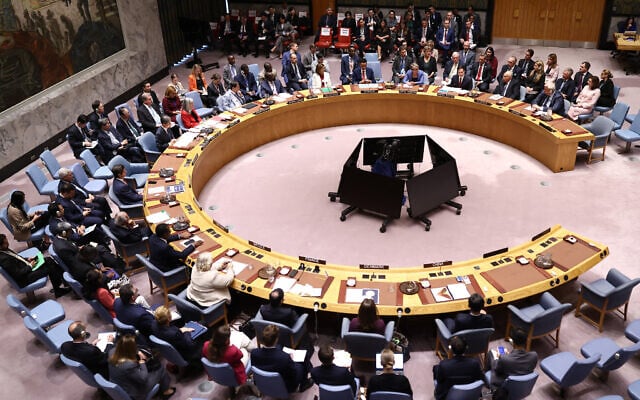
Members of the United Nations Security Council vote against a resolution by Russia and China to delay by six months the reimposition of sanctions on Iran during the 80th U.N. General Assembly in New York City, US, September 26, 2025. (credit: REUTERS/EDUARDO MUNOZ)
The proposal stipulates that decisions will be made together with Egypt and Israel, as members of the force, and that Israel’s withdrawal from the Gaza Strip will depend on its deployment throughout the territory (except for the perimeter zone, where the United States will remain for an extended period).
Israeli TV says Trump team pushing ‘interim solutions, unacceptable to Israel’; ahead of imminent UN vote, Israel said readying for deployment of foreign troops; PM speaks to Putin
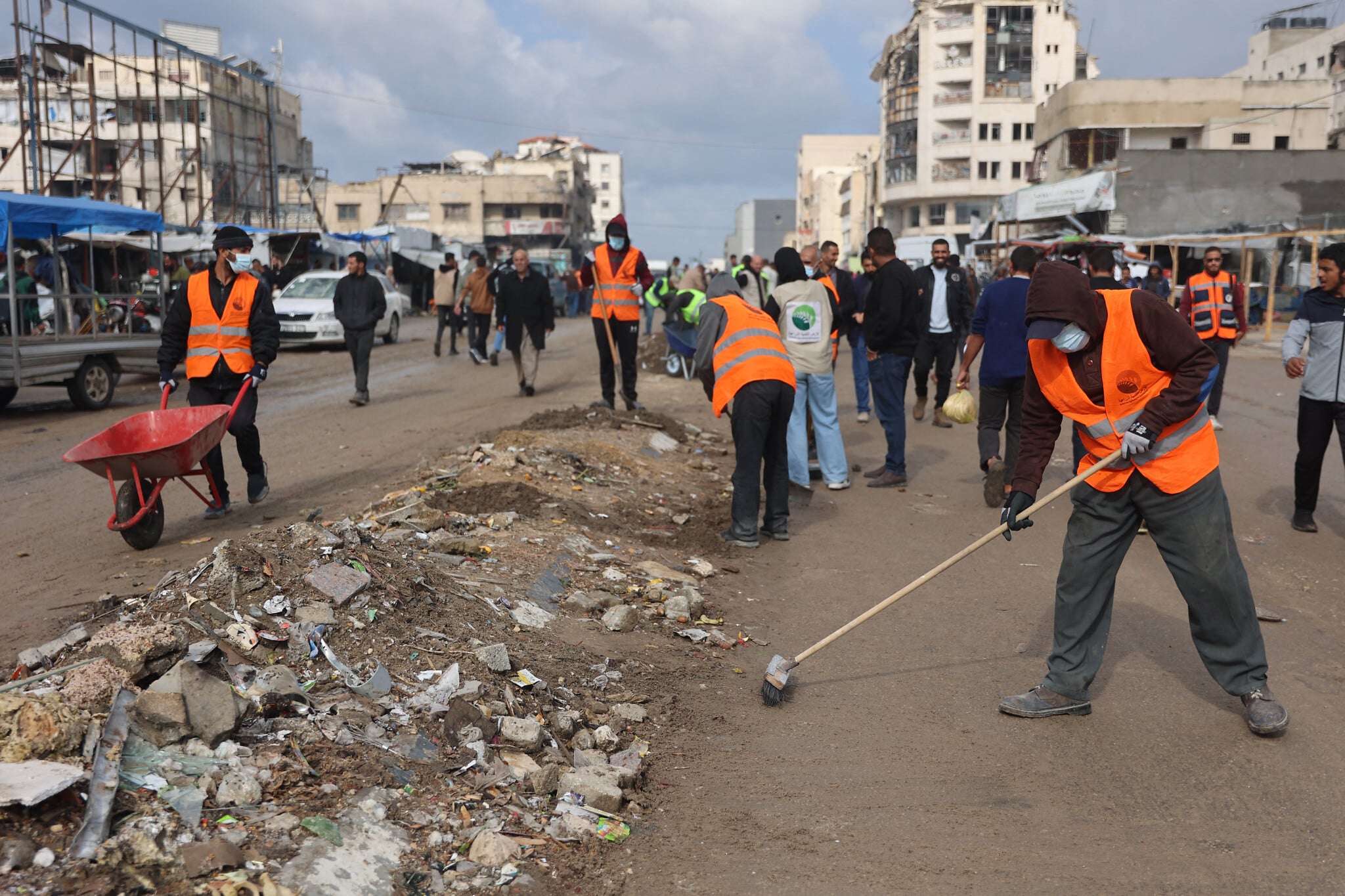
Palestinians clean the streets of Gaza City on November 15, 2025. (Omar AL-QATTAA / AFP)
The Trump administration is looking to forgo the stage in its peace plan calling for the deployment of a stabilization force to Gaza to disarm Hamas, so that it can move ahead with starting to rebuild the enclave, according to an Israeli television report Saturday.
The current ceasefire, which has been in place since early October, is still only in its first phase, as talks on further steps have stalled over the details of Hamas’s demilitarization and the future governance of the Gaza Strip.
However, the potential change in the White House’s direction is causing talks with Israel on Gaza’s future to “deadlock,” a source told Channel 13 news.
An Israeli security source said that since the White House is having trouble getting commitments from third-party countries to participate in disarming Hamas, it has since begun pursuing “interim solutions, which are currently unacceptable to Israel.”
“This interim situation is the worst there is,” a senior Israeli source told the outlet. “Hamas has been strengthening in recent weeks since the end of the war.”
“There can be no rehabilitation before demilitarization. It is contrary to Trump’s plan. Gaza must be demilitarized,” a security official said.
US President Donald Trump speaks to reporters aboard Air Force One en route to Palm Beach, Florida, on November 14, 2025 (Jim WATSON / AFP)
The US, which has acted as the guarantor of the agreement, is pushing a resolution to a vote at the UN Security Council on Monday, a draft of which was obtained and verified by The Times of Israel last week. The draft included the entirety of US President Donald Trump’s 20-point plan, which Prime Minister Benjamin Netanyahu also endorsed in a joint press conference with the president in September.
The draft authorized member states to “establish a temporary International Stabilization Force,” and indicated the mandate would run through 2027. Countries that expressed willingness to contribute troops have said they would need a UN resolution enshrining the force.
According to a report published Saturday by the Kan public broadcaster, Israel in recent days has begun initial preparations for the influx of thousands of foreign soldiers into Gaza, anticipating that the UN Security Council will pass the resolution.
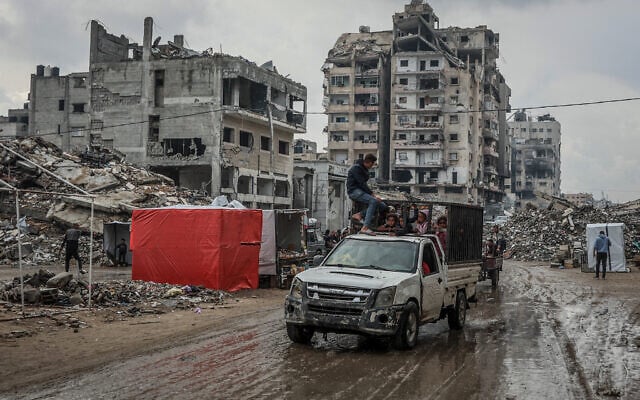
Palestinians drive down a muddy road after the first winter rainfall on a displacement camp in Gaza City on November 14, 2025 (Omar AL-QATTAA / AFP)
Israel is looking for the foreign forces to be given broad powers to disarm Hamas, the report said, though most countries that have expressed interest in participating in the ISF have said they would not be willing to enforce the disarmament of terror groups in the Strip, and would only act as a peacekeeping force.
In a joint statement arranged by the US on Friday, multiple countries working toward an end to the Gaza conflict voiced backing for Washington’s UN Security Council resolution.
The statement, supported by Qatar, Egypt, the United Arab Emirates, Saudi Arabia, Indonesia, Pakistan, Jordan and Turkey, noted that the process “offers a pathway to Palestinian self-determination and statehood.”
Meanwhile, Russia — a veto-wielding member of the Security Council — circulated a competing draft resolution to council members that does not authorize the creation of a board of peace or the immediate deployment of an international force in Gaza, according to the text seen Friday by AFP.
US Secretary of State Marco Rubio (seated at table, 3R) speaks during a United Nations Security Council ministerial meeting on Ukraine at UN headquarters in New York on September 23, 2025. (Charly Triballeau/Pool/AFP)
The Russian version welcomes “the initiative that led to the ceasefire,” but does not name Trump. It also only calls on the UN secretary-general to submit a report that addresses the possibilities of deploying an international stabilization force in war-ravaged Gaza.
Ahead of the vote, Russian President Vladimir Putin and Netanyahu held a phone call Saturday evening, the Kremlin said, adding that the two discussed the situation in the Middle East, including developments in Gaza, Iran’s nuclear program, and Syria.
Putin initiated the phone conversation with Netanyahu, according to the Israeli readout.
The call was the latest in a series of recent conversations, according to Netanyahu’s office. The calls “dealt with regional issues,” the PMO added, without elaborating.
According to the report, the IRGC disclosed that in recent months, Israel has established a network of Iranian individuals who have been compromising Iranian security.
(Illustrative) A silhouette over an Iranian flag.(photo credit: SHUTTERSTOCK)ByJERUSALEM POST STAFFThe IRGC has dismantled a US-Israeli anti-security network operating in Iran, the Islamic Republic News Agency reported on Tuesday.
The network was successfully dismantled following several rounds of surveillance and intelligence gathering, and it was taken down in a coordinated operation across many provinces, according to the IRNA.
The IRGC claimed that all of the network’s members have been arrested.
blished a network of compromised Iranian citizens
According to the report, the IRGC disclosed that in recent months, Israel has established a network of Iranian individuals who have been compromising Iranian security.
The IRGC highlighted that following Israel’s ‘defeat’ in the Israel-Iran war, Israel shifted its focus to destabilizing public security in Iran by recruiting Iranians to “deceive and betray their own country.”
Iranian President Masoud Pezeshkian and Islamic Revolutionary Guard Corps (IRGC) Commander-in-Chief Major General, Hossein Salami and Brigadier General Esmail Qaani, the head of the Revolutionary Guards’ Quds Force, attend a ceremony. (credit: MAJID ASGARIPOUR/WANA (WEST ASIA NEWS AGENCY) VIA REUTERS)
A senior Israeli official told KAN NEWS that Israel should overthrow the Iranian regime before the end of President Donald Trump’s administration.
Trump’s second term as US president is due to end in January 2029.
Iran has been resupplying their stockpile of advanced missiles, the official told KAN News.
Regional officials and analysts believe it’s “only a matter of time” until there will be another outbreak of war between Iran and Israel.