
Washington calls off all engagements with General Rodolphe Haykal after LAF refers to Israel as an ‘enemy’, prompting congressional outrage and aid reassessment.
LebanoniStock

The United States administration has canceled all scheduled meetings with Lebanese Armed Forces (LAF) Commander General Rodolphe Haykal, according to a report by Lebanon’s MTV. The report states that the Lebanese Embassy in Washington also canceled a reception that was planned in his honor.

MTV‘s correspondent in Washington cited American discontent with a recent statement issued by the LAF, which, according to US officials, referred to Israel as an “enemy” and blamed it for escalating tensions while failing to criticize Hezbollah. The US considers Israel a key ally and is the principal provider of support to the Lebanese military.

The LAF statement, released following an incident on November 16, read: “The Israeli enemy insists on violating Lebanese sovereignty, destabilizing Lebanon, and obstructing the army’s deployment in the south. The latest of these condemned attacks was its targeting of a UNIFIL patrol.” The statement added that the army is working with friendly nations to halt these violations, which it described as “a serious escalation.”

According to MTV, this message sparked outrage among several members of the US Congress and prompted internal debate about the future of American military assistance to Lebanon. As a result, the US administration informed the Lebanese Embassy of its decision to suspend the scheduled meetings with General Haykal, including his planned gathering with members of the Lebanese-American community, some of whom had traveled from other states to attend.

Senator Lindsey Graham strongly criticized the Lebanese military leadership, stating, “It is clear that the Lebanese Chief Head of Defense — because of a reference to Israel as the enemy and his weak, almost non-existent effort to disarm Hezbollah — is a giant setback for efforts to move Lebanon forward. This combination makes the Lebanese Armed Forces not a very good investment for America.”

Senator Joni Ernst also expressed her disappointment, saying, “The LAF is a strategic partner, and – as I discussed with the CHOD in August – Israel has given Lebanon a real opportunity to free itself from Iran-backed Hezbollah terrorists. Instead of seizing that opportunity and working together to disarm Hezbollah, the CHOD is shamefully directing blame at Israel.”

MTV further reported that the issue has now been referred directly to US Secretary of State Marco Rubio, who has taken custody of the case within the State Department and the relevant congressional committees. Rubio plays a central role in shaping US policy toward Lebanon, particularly in military aid. According to MTV‘s sources, continued US cooperation with the LAF will now hinge directly on its future positions, especially regarding the border situation and the disarmament of Hezbollah. Any rhetoric conflicting with US policy toward Israel is expected to have immediate consequences for the relationship.
Officials deny Al Jazeera report the terror group handed over one of remaining three bodies; IDF sends back dozens of Gazans who finished receiving medical treatment in Israel

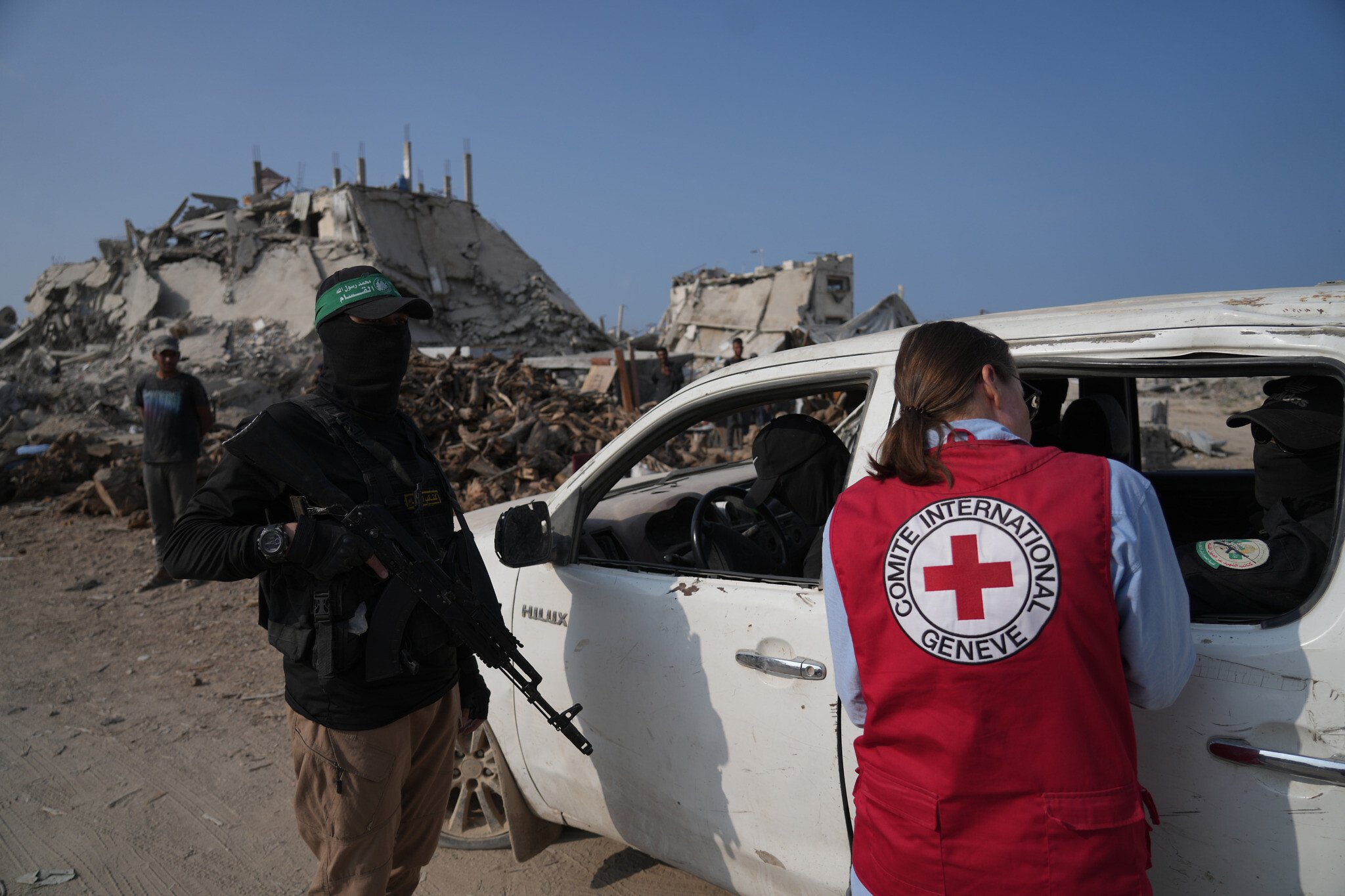
Illustrative: Hamas operatives accompanied by members of the International Committee of the Red Cross (ICRC) head to east of Gaza City to search for the bodies of hostages, November 13, 2025. (AP Photo/ Jehand Alshrafi)

Illustrative: Hamas operatives accompanied by members of the International Committee of the Red Cross (ICRC) head to east of Gaza City to search for the bodies of hostages, November 13, 2025. (AP Photo/ Jehand Alshrafi)

Israeli officials said Monday that Hamas had handed over unspecified “findings,” clarifying that the terror group did not return the body of one of the last three deceased hostages still being held in Gaza.

The officials did not elaborate on what those findings were, but said that Israel requested that they be handed over in order for them to be examined.

One of the Israeli officials said that Hamas uncovered findings on Sunday in Gaza City’s Zeitoun neighborhood and that Jerusalem subsequently asked for them to be transferred to the Red Cross so that they could be examined inside Israel.

The clarification from Israeli officials came after Al Jazeera reported earlier in the day that Hamas had handed over the body of another hostage to the Red Cross. No statement was issued by the terror group corroborating the report. The group has publicized its return of deceased hostages in recent weeks. The Red Cross did not issue a statement on Monday confirming receipt of the findings.

Late last month, at Israel’s request, Hamas handed over partial remains of three bodies, which were not identified as belonging to any hostages.

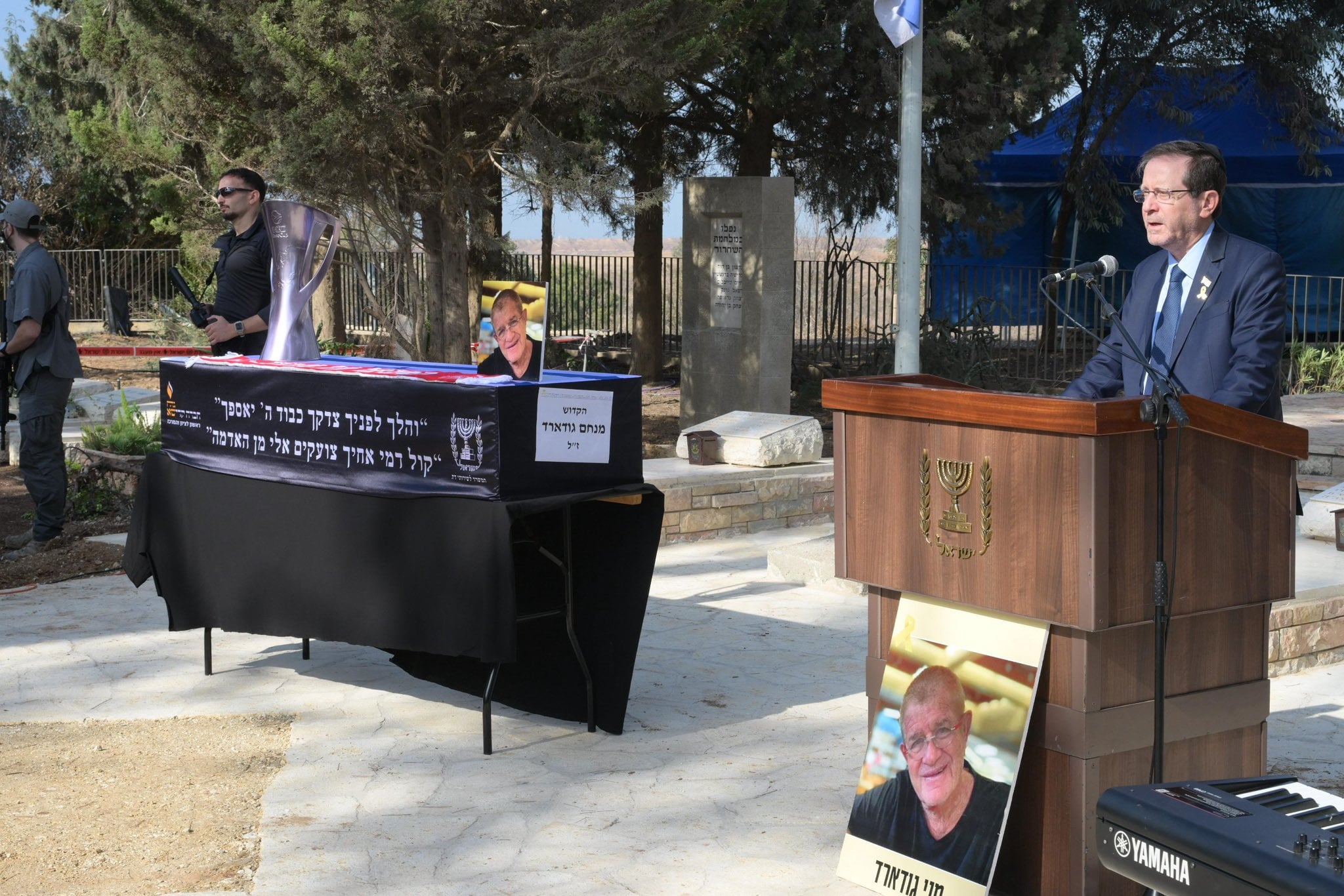
Also on Monday, members of the southern border town of Kibbutz Be’eri held a funeral for its longtime swimming pool manager, Meny Godard, who was killed in the Hamas-led October 7, 2023, attack, and whose body was returned last week after over two years in captivity.

President Isaac Herzog eulogizes slain hostage Meny Godard, at Kibbutz Be’eri, November 17, 2025. (President Isaac Herzog/X)

The bodies of three slain hostages now remain held in the Strip — two Israelis and one Thai national: Master Sgt. Ran GviliDror Or, and Sudthisak Rinthalak.

IDF says it killed two who crossed Gaza Yellow Line

Meanwhile, in Gaza on Monday, the IDF said it killed two Palestinians who crossed the Yellow Line demarcating the military’s withdrawal and approached troops in two separate incidents.

In the first incident in the Strip’s north, several operatives were identified crossing the Yellow Line and “planting suspicious objects in the ground adjacent to IDF troops” in a way that “posed an immediate threat,” the military said.

The Israeli Air Force struck one of the suspects, and the others withdrew from the area back over the Yellow Line, according to the IDF.

In a separate event in northern Gaza, a suspect was identified crossing the Yellow Line and approaching troops, the military said.

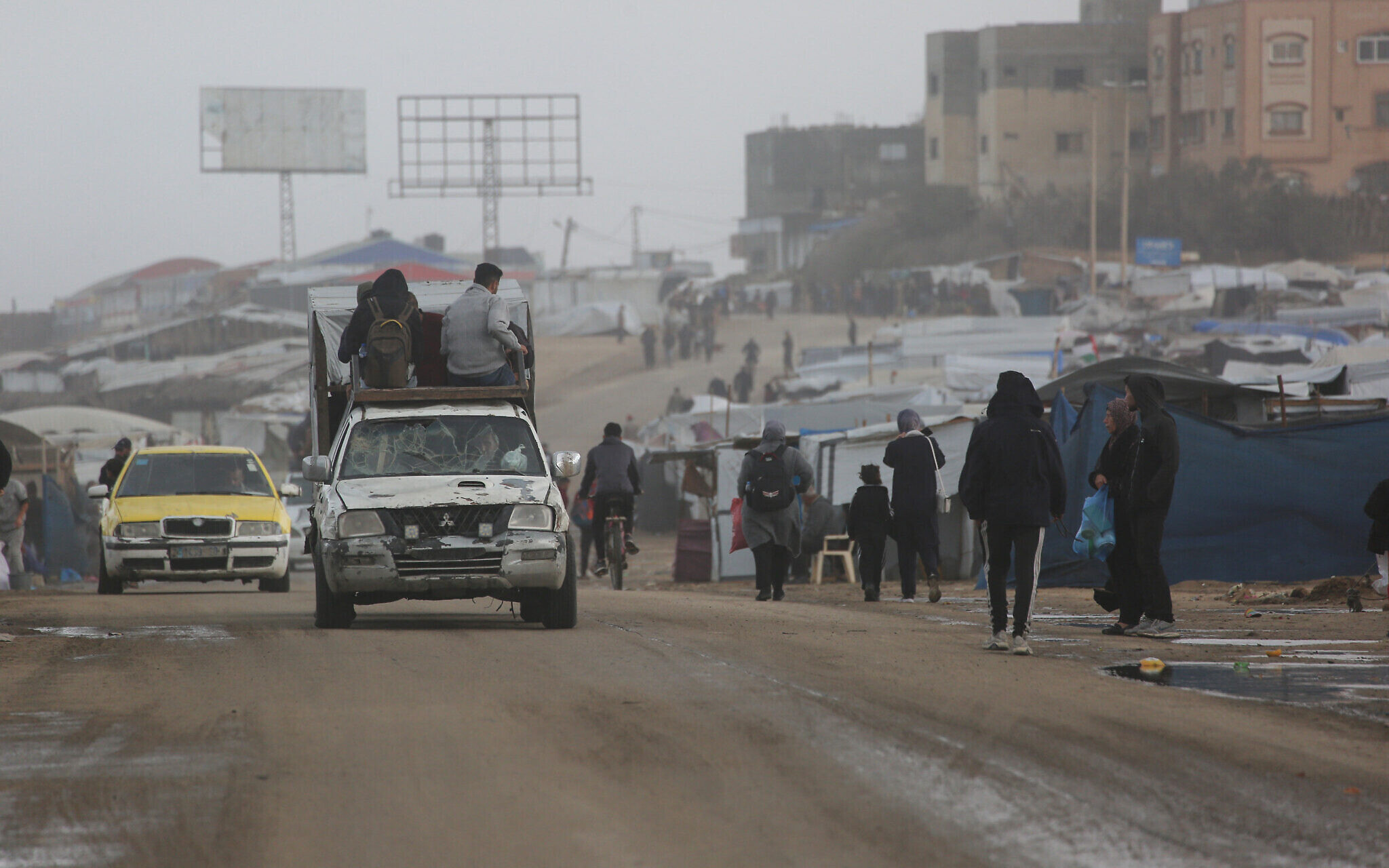
Displaced Palestinians walk past a vehicle carrying others west of Deir al-Balah city in the central Gaza Strip, on November 15, 2025. (Bashar TALEB / AFP)

The forces opened fire and “eliminated the terrorist to remove the threat,” the IDF said.

The IDF says it remains deployed in Gaza “in accordance with the ceasefire agreement and will continue to operate to remove any immediate threat.”

Hamas-aligned group says Israel killed one of its leaders in undercover op

Separately, the Popular Resistance Committees (PRC), a Gazan terror group allied with Hamas, said one of its local leaders had been killed by what it described as an Israeli undercover force near Deir Al-Balah city in the central Gaza Strip.

The group said Waseem Abdel-Hadi, a commander of its armed wing, was killed in a “cowardly and treacherous assassination operation.”

The PRC, whose members joined the Hamas-led October 7, 2023, onslaught in Israel at a later stage, said Abdel-Hadi played a role in developing its armed wing. It did not issue any direct threat of retaliation.

There was no immediate Israeli comment on the alleged killing.

The PRC is considered the third-largest terror organization operating in the Gaza Strip, after Hamas and Islamic Jihad. In recent years, the group has operated under Hamas’s directives.

In May, it had also said a prominent member was killed in an Israeli commando raid.

Israel sends back Gazans who received medical treatment

Also on Monday, Israel sent dozens of Gazans who had been in Israel since before October 7 in order to receive special medical treatment — some of them with guardians — back to the Strip, a source familiar with the matter said.

Israel allowed the group of over 80 Gazans to remain in Israel after the war broke out over two years ago, though those who were receiving medical care had since completed their treatment, mostly in two East Jerusalem hospitals.

They all signed forms accepting their return to the Strip.

A smaller group of roughly 30 Gazans who are either still receiving treatment or did not want to return to the Strip were allowed to remain in Israel for the time being, the source said.


Among Jewish Israelis, opposition is even higher at 79%, up from 76% in the previous JCFA poll. This marks the highest level of Jewish-Israeli opposition in its tracking since the war began.

 Dr. Dan Diker, President of the Jerusalem Center for Security and Foreign Affairs (JCFA)
Dr. Dan Diker, President of the Jerusalem Center for Security and Foreign Affairs (JCFA)
(photo credit: Guy Sidi)
Seventy percent of Israelis oppose the establishment of a Palestinian state along the 1967 lines in the wake of the October 7 attacks, a new survey by the Jerusalem Center for Security and Foreign Affairs (JCFA) found on Monday, ahead of a key UN Security Council vote on a US proposal that would open a pathway to Palestinian statehood. The poll, conducted on November 16–17 by Dr. Menachem Lazar of the Lazar Research Institute among a representative sample of 698 Jewish and Arab Israelis, has a margin of error of ±3.7%. The findings come as international momentum grows for recognizing a Palestinian state, even as multiple polls show Israeli public opinion moving in the opposite direction.

According to the JCFA, the level of opposition recorded in this latest survey is the highest in its ongoing series since the war began. Similar national polls earlier this year also found large majorities of Israelis rejecting the creation of a Palestinian state after October 7.

The survey found that 70% of Israelis oppose the establishment of a Palestinian state on the 1967 lines at this time. Only 8% support such a state unconditionally, 13% said they would support it only if the prospective state fully recognizes Israel as the nation-state of the Jewish people and is completely demilitarized, and 9% are undecided.

Among Jewish Israelis, opposition is even higher at 79%, up from 76% in the previous JCFA poll. The center said this marks the highest level of Jewish-Israeli opposition in its tracking since the war began, reinforcing earlier The Jerusalem Post reporting that around seven in ten Israelis have opposed Palestinian statehood since February.

The findings contrast sharply with international moves to formalize Palestinian statehood, including recent steps at the UN General Assembly and in several Western capitals to outline an “irreversible” path toward recognition.

Japanese Foreign Minister Iwaya Takeshi addresses delegates during a high-level meeting of heads of state on a two-state solution between Israel and the Palestinians at United Nations headquarters in New York City, US, September 22, 2025.  (credit: REUTERS/EDUARDO MUNOZ)
Japanese Foreign Minister Iwaya Takeshi addresses delegates during a high-level meeting of heads of state on a two-state solution between Israel and the Palestinians at United Nations headquarters in New York City, US, September 22, 2025. (credit: REUTERS/EDUARDO MUNOZ)

Saudi normalization fails to sway majority

The JCFA survey also tested whether prospective normalization with Saudi Arabia would change attitudes toward a Palestinian state. Sixty-two percent of Israelis said they would still oppose the establishment of a Palestinian state even if it were part of a normalization deal with Riyadh.

Advertisement
Among Jewish Israelis, opposition to tying statehood to a Saudi deal rose from 67% in a previous survey to 73%. By contrast, 56% of Arab Israelis support the idea of a Palestinian state in return for normalization, including 34% who back it unconditionally. Previously, a separate survey reported by The Jerusalem Post found that 64% of Israelis opposed including a Palestinian state in a Saudi deal, indicating that opposition has remained strong over time.

QME and F-35 jets at center of Saudi debate

On the question of normalization with Saudi Arabia in exchange for Riyadh receiving advanced F-35 fighter jets, if it drops its demand for a Palestinian state, the public is sharply divided. Forty-three percent of respondents oppose any such deal, while 40% support it.

However, 34% of the total public condition their support on an explicit American guarantee to maintain Israel’s Qualitative Military Edge, leaving only 6% who back the deal with no conditions. Among those opposed, 22% explicitly cited a lack of trust in Saudi Arabia’s ability to honor long-term commitments. The issue mirrors long-running debates in Israel over US sales of F-35 jets to Arab states and their possible impact on Israel’s military edge, concerns that have resurfaced in recent discussions over a potential sale to Riyadh.

Israelis reject the US Security Council formulation on statehood

Regarding the US proposal now before the UN Security Council, 49% of the overall public and 57% of Jewish Israelis oppose any Israeli declaration of future support for a Palestinian state, even if the Palestinians carry out governance and security reforms. Twenty percent of respondents said they would only consider such a declaration if any future Palestinian state were fully demilitarized and formally recognized Israel as the Jewish state.

The question reflects a growing gap between diplomatic initiatives in Washington, European capitals, and the UN, which increasingly focus on recognition of Palestinian statehood, and an Israeli public that remains profoundly skeptical about the security implications of such a move after October 7.

On post-war security arrangements in the Gaza Strip, the survey points to more flexibility. Sixty-two percent of Israelis support deploying an international force in Gaza to stabilize security after the fighting ends.

Of those backing an international presence, 52% said they would prefer a US-only or Western-only force, while only 10% would accept including Turkey and Qatar. At the same time, 26% of all respondents insist that security in Gaza should remain under exclusive Israeli military control, echoing a previous JCFA-commissioned poll that found majority support for a temporary IDF occupation of the Strip after the war.

The JCFA said the new findings show that, even as debates intensify at the UN and in Western capitals over recognizing a Palestinian state, only 8% of Israelis currently support establishing a Palestinian state along the 1967 lines without conditions.