
Why did a Four Star General land in Israel during a pandemic?

US Army General and Chairman of the Joint Chiefs of Staff Gen. Mark Milley’s visit comes amid a rise in tensions between Israel, the US, and the Islamic Republic.

US Gen. Mark Milley visits Israel in July 2020 (photo credit: IDF SPOKESPERSON'S UNIT)
US Gen. Mark Milley visits Israel in July 2020
(photo credit: IDF SPOKESPERSON’S UNIT)
It’s not every day that the Chairman of the US Joint Chiefs of Staff lands in Israel. It’s even rarer for such a visit to occur during a global pandemic, and even stranger when Israel seems to be the only stop on the trip.

On Friday ‪US Army General and Chairman of the Joint Chiefs of Staff Gen. Mark Milley landed at Nevatim Air Base in southern Israel and met with IDF Chief of Staff Lt.-Gen. Aviv Kochavi and other senior defense officials like Defense Minister and Alternate PM Benny Gantz and the head of the Mossad Yossi Cohen.

Milley also spoke with Israel Prime Minister Benjamin Netanyahu along with Kochavi over a videoconference call due to the ongoing coronavirus pandemic and discussed the ongoing threats posed by Iran and the various security challenges in the region.

His visit comes amid a rise in tensions between Israel, the US, and the Islamic Republic.

Over a dozen mysterious explosions and fires targeting Iran’s missile and nuclear program have rocked Iran in recent weeks. But Tehran has not pinned the blamed on Israel and have tried to downplay the incidents.

Nevertheless, it has apparently attempted a number of cyberattacks against Israel-similar to an attack on the country’s water infrastructure facilities in April. They were all thwarted.

Iran’s nuclear and missile program top the list of threats to the Jewish State and has long been a target of Israel’s national intelligence agency, the Mossad. The United States and Israel have been reported to have carried out joint cyberattacks against Iran in the past, including “Operation Olympic Games”- one of the first known uses of offensive cyber attacks.

The attack, which unleashed a wave of computer malware using the Stuxnet worm in an attempt to slow Iran’s nuclear program, was considered one of the most ambitious attempts with some estimates putting the destruction of over a thousand centrifuges.

But Milley’s trip, a trip that seems like it was a one-stop kind of deal, during such a busy period in the Middle East, makes one wonder. The last time such visits occurred was in 2012 when US officials used to come to Israel on a regular basis in an attempt to walk Israel back from carrying out a military strike on Iran.

Israeli Prime Minister Benjamin Netanyahu is in a tight political bind and knows that there might be only a few more months left of the most pro-Israeli American administration in years. US President Donald Trump might not win the upcoming American elections and facing indictments and nightly protests over a crumbling economy following his mismanagement of the coronavirus crisis, Netanyahu might not survive another election if he calls one.

Could he maybe be wanting to take the chance to strike Iran, which is in the midst of a devastating economic crisis compounded with the deadly coronavirus?

Did he come to discuss these mysterious explosions? Or did he come to walk Israel back from any future action, perhaps non-cyber kinetic attacks?

Though it was likely not tied to his visit, Israel’s military was placed on high alert Friday evening over concerns that Hezbollah might attack in retaliation for the death of one of its fighters in an alleged Israeli airstrike targeting Damascus International Airport on Monday night.

Both Kochavi and Gantz stressed to the General that the IDF will continue to defend the State of Israel and “is preparing for a variety of scenarios.”

“The IDF and the US military have a common interest in maintaining regional stability and preventing its violation by Iran or its proxies,” Kochavi said.

That common interest-Iran-has been on everyone’s lips and has topped the list of threats of both countries. Has the threat they posed increased? Or has Washington and Jerusalem identified a window of opportunity to good to pass up?

The summer is getting hot. We might soon find out if Milley’s visit means it will get even hotter.

What was the source of the sound of an explosion on Iran’s Qeshm Island on Saturday night?

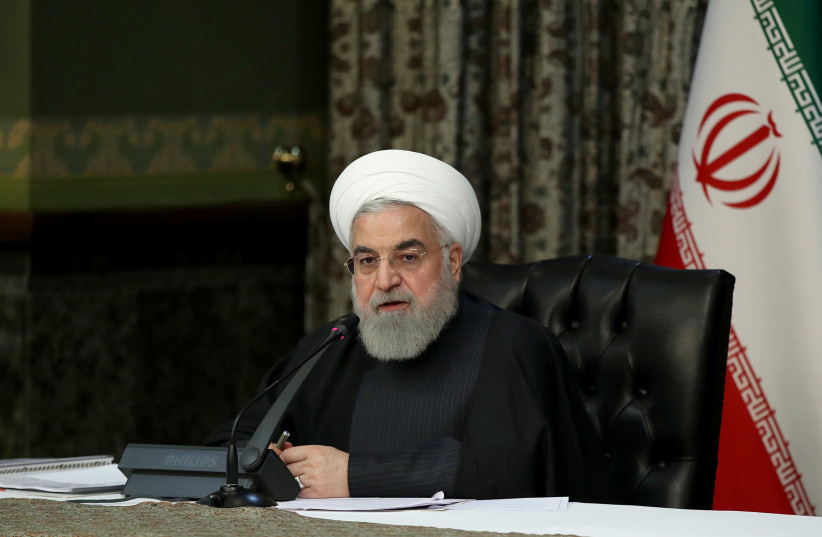
Iranian President Hassan Rouhani speaks during the cabinet meeting in Tehran, Iran, March 4, 2020 (photo credit: OFFICIAL PRESIDENT WEBSITE/HANDOUT VIA REUTERS)
Iranian President Hassan Rouhani speaks during the cabinet meeting in Tehran, Iran, March 4, 2020
(photo credit: OFFICIAL PRESIDENT WEBSITE/HANDOUT VIA REUTERS)
Iranians on Qeshm Island in southern Iran reported the sound of an explosion on Saturday, at just after ten in the evening local time. It caused concern as the electricity went off. Officials tried to claim there was an earthquake, but many did not believe it.

Rumors pointed to other concerns. Qeshm is known for fishing and also tourism. It is a pretty long island off the important port of Bandar Abbas. Illicit oil trading takes place off some of the islands between Iran and the Gulf. The tanker Gulf Sky, at the center of an international case involving IRGC front companies, was anchored off the island in mid-July after being allegedly hijacked from near the UAE. It is also of strategic value. The Islamic Revolutionary Guard Corps has a naval base on the island.

It is in this context that social media accounts and some local Arabic and Persian media accounts claimed there was mysterious explosion. This would be in line with another dozen mysterious explosions that have impacted Iran since late June. One destroyed a surface-to-surface missile facility at Khojir and another harmed centrifuges at Natanz nuclear enrichment facility. This has left many Iranians on edge over concerns that they may be targeted by cyber attacks or other acts that the government is not admitting.

There are other controversies on Qeshm. Fishermen want more support and some believe the island will form part of a free trade zone nexus, along with Kish Island, and that China will have a growing role here. “Iran is not for sale,” say some nationalist and populist social media accounts, challenging China’s alleged upcoming role. Fishermen held a meeting on Friday about facing issues in transporting their catch. Could an explosion be some sort of sabotage? People say it could be human error or an IRGC secret maneuver. Fishermen say they were told not to go out fishing yesterday and link this to the supposed explosion. There are questions over whether it might be linked to an ammunition storage on the island.

In the absence of any real evidence that something happened at Qeshm island, the incident will likely come and go without further details. What it shows is how Iran has been jarred by all the recent explosions and locals are quick to report any rumors of what they think is another incident.


Prime Minister Benjamin Netanyahu says Syria and Lebanon will bear responsibility for any attack against Israel emanating from its territory.

Speaking at the weekly cabinet meeting, he says Israel “won’t allow Iran to entrench militarily on our northern border.

“Lebanon and Syria are responsible for any attack from its territory against Israel. We will not allow anyone to upend our security or threaten our citizens; we won’t tolerate an attack on our forces,” adds Netanyahu.

“The IDF is prepared to respond to any threat,” he adds.

The comment comes amid heightened tensions between Israel and the Iran-backed Hezbollah terrorist group along the northern border.

Netanyahu says Israel won’t tolerate any attack from Syria, Lebanon