
Iran’s Zarif arrives in Iraq to pressure Baghdad to stay in Iran’s orbit

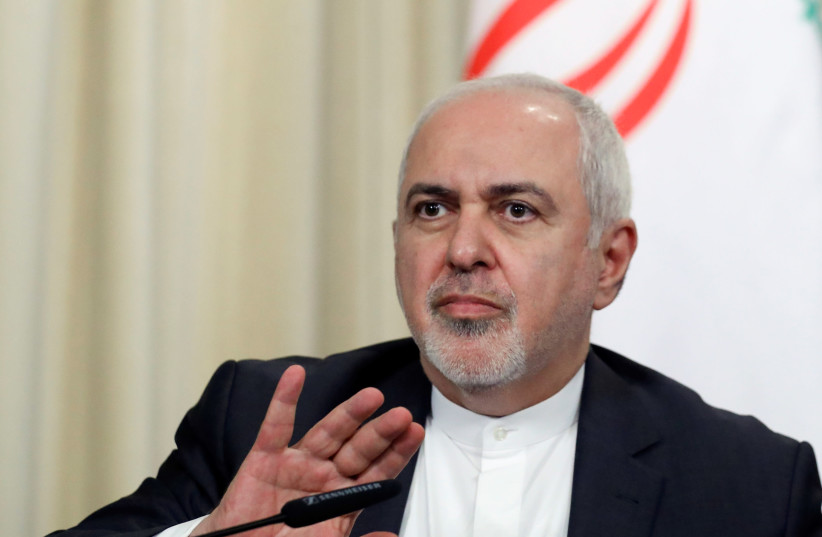
Iranian Foreign Minister Javad Zarif said on Thursday any U.S. or Saudi military strike against Iran would result in “all-out war”
(photo credit: REUTERS/EVGENIA NOVOZHENINA)
Iranian Foreign Minister Javad Zarif is travelling to Iraq to try to pressure Baghdad to keep its strategic alliance with Iran amid US-Iran tensions. In the last months the US and Iraq have also engaged in strategic dialogue. Iraq has been a battlefield between the US and Iran, with Iranian-backed militias which are part of Iraq’s government attacking US forces and the US killing a top Iranian commander.

Zarif is in contact daily with the Islamic Revolutionary Guard Corps and his visit comes after at least two visits by Esmail Ghaani, the IRGC Quds Force commander. Ghaani took over for Qasem Soleimani when the US killed  Soleimani next to Baghdad International Airport in January. The Iranian ambassador in Baghdad Iraq Masjidi spoke over the weekend and said that Zarif’s visit is aimed at strengthening strategic relations.
The Iranian Foreign Ministry on Saturday said Zarif will arrive Sunday, July 19. It is supposed to be a trip that comes just before Iraq’s Prime Minister Mustafa Kadhimi travels to Iran and to other countries, possibly Saudi Arabia. That means that Iran’s message will be to pressure Baghdad to stay close to Tehran. Iran has also signed a deal with Syria to provide air defense for the regime and Iran is trying to provide support for Lebanon’s economy as both Iran and Hezbollah say it is trying to work more closely with China.

Zarif is expected also to meet with Kurdistan Regional Government officials, including Kurdistan Region President Nechirvan Barzani. Zarif may also meet with the head of the Hashd al-Shaabi, a group of pro-Iranian militias and Ammar al-Hakim. He will also express condolences for the death of Abu Mahdi al-Muhandis, an Iraqi militia leader the US killed in January.

Iran’s Ali Shamkhani, Secretary of the Supreme National Security Council, went to Iraq in March of this year. In March 2019 Iranian President Hassan Rouhani signed a series of important bilateral trade deals with Iraq. Iran supplies Iraq with electricity and other goods and Iran sees Iraq as its “near abroad” trying to control it with a network of political parties and intelligence agents. In August 2018 Iran transferred ballistic missiles to Iraq and it did so again in the fall of 2019. Iran has carried out attacks on US forces in January with ballistic missiles fired from Iran and also used missiles to target Kurdish dissidents in September 2018. Iran is seeking to raise the profile of pro-Iranian militias, called Hashd al-Shaabi, which it seeks to empower the way it does Hezbollah and turn the into a kind of local IRGC in Iraq.
he IRGC Quds Force commander.


Government to approve EastMed gas pipeline project on Sunday

(180 miles) will be the longest in the world.

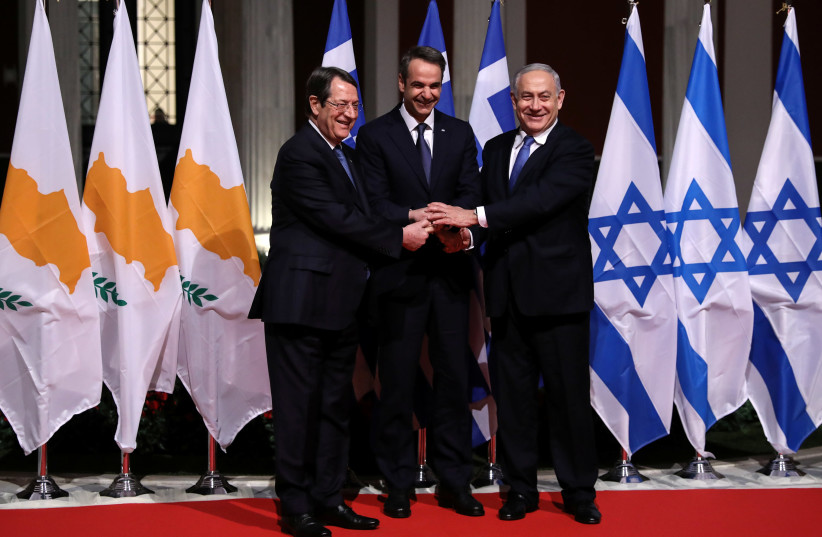
Cypriot President Nicos Anastasiades, Greek Prime Minister Kyriakos Mitsotakis and Israeli Prime Minister Benjamin Netanyahu pose for a photo before signing a deal to build the EastMed subsea pipeline to carry natural gas from the eastern Mediterranean to Europe, at the Zappeion Hall in Athens, Gree (photo credit: REUTERS/ALKIS KONSTANTINIDIS)
Cypriot President Nicos Anastasiades, Greek Prime Minister Kyriakos Mitsotakis and Israeli Prime Minister Benjamin Netanyahu pose for a photo before signing a deal to build the EastMed subsea pipeline to carry natural gas from the eastern Mediterranean to Europe, at the Zappeion Hall in Athens, Gree
(photo credit: REUTERS/ALKIS KONSTANTINIDIS)
The government is set Sunday to approve the agreement Israel signed in January with Cyprus and Greece to advance the EastMed gas pipeline project.

Once completed the 1,900 kilometer pipeline (1,180 miles) will be the longest in the world. The bulk of it will be under the sea, but some portions will be on land. The pipeline will allow for natural gas from Israeli and Cypriot fields to flow to western and eastern Europe. The pipeline will start in Israel and then go via Cyprus and Greece and through Italy.

The project is expected to transform Israel into an energy powerhouse that will place it at the center of a new geopolitical alignment with respect to. energy in the Middle East.

During the last election cycle Prime Minister Benjamin Netanyahu traveled to Athens to sign an accord with regard to the EastMed pipeline with Greek Prime Minister Kyriakos Mitsotakis and Cypriot President Nicos Anastasiades. At the time Israel had an interim government that could not ratify the deal. Now that a new government is in place, the deal is coming before it for approval.

Italy will also be part of the deal, but was not in Athens to sign the document.

Mitsotakis was in Israel last month in advance of the government’s ratification of the deal.

At the time Netanyahu said of his meeting with Mitsotakis, “we have substantial findings of gas offshore. Cyprus has that too. And our most important project which we discussed at length.. is the laying of the EastMed pipeline that will connect the gas fields of Israel and Cyprus through Greece, through Cyprus to Greece, to Europe. This would be the longest underwater pipeline in the world. We’re committed to it.

The project is expected to cost upwards of 5.2 billion Euros and is expected to be completed in 2025. In Israel the project will be under the auspices of Energy Minister Yuval Steinitz (Likud) and his ministry.

Among the complicating issues regarding the project, is the objection of Turkey which has an accord with Libya with regard to exclusive economic zones in the Mediterranean. Its a pact that has created a wartime dispute with with Cyprus and Greece.

Analysts say the Turkey Libya pact could present a barrier to the propose pipeline which would have to cross the planned Turkey-Libya economic zone.

Greece and Cyprus, which have long had maritime and territorial disputes with Turkey, say the accord is void and violates the international law of the sea. They see it as a cynical resource-grab designed to scupper the development of East Mediterranean gas and destabilize rivals.

Reuters contributed to this report.

https://www.jpost.com/middle-east/government-to-approve-eastmed-gas-pipeline-project-on-sunday-635525


In latest in series of blasts, explosion reported at Iranian oil pipeline

In latest in series of blasts, explosion

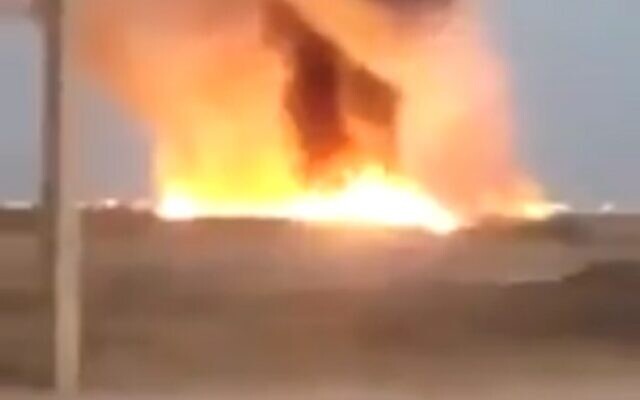
LargeFootage from a reported blast in an oil pipeline in southern Iran, on July 18, 2020 (video screenshot)fire rages at scene of incident in south of nation; no reports of casualties

 

Footage from a reported blast in an oil pipeline in southern Iran, on July 18, 2020 (video screenshot)

An explosion was reported in an oil pipeline in Iran Saturday, the latest in a mysterious series of blasts and blazes that have occurred throughout the country.

Several of the recent disasters have struck sensitive Iranian sites, leading to speculation that they could be part of a sabotage campaign engineered by Israel or another Tehran foe.

The latest mishap occurred in a pipeline in the Ahvaz region in the south of the country, according to reports in local and social media.

Video shared on social media showed a large fire at the scene. There were no reports of casualties in the incident, and it was not immediately clear what the cause was.

The last odd incident came on Wednesday, when seven traditional wooden vessels caught fire in a factory in the southern Iranian port city of Bushehr. Others have included gas blasts and explosions in Tehran, as well as in the vicinity of military facilities.

A July 2 explosion damaged Iran’s Natanz nuclear facility. A week before that, a large blast was felt in Tehran, apparently caused by an explosion at the Parchin military complex, which defense analysts believe holds an underground tunnel system and missile production facilities.

A Middle Eastern intelligence official was quoted earlier this month by The New York Times as saying the fire that badly damaged a building used for producing centrifuges at Natanz was sparked by Israel and was caused by a powerful bomb.

But the unidentified official said Israel was not linked to several other recent mysterious fires in Iran over the past week.

Iran last week called for action against Israel following the damage to the Natanz facility, and appeared to acknowledge the fire there was not an accident.

Israeli TV reports, without naming sources, have said the blast destroyed the laboratory in which Iran developed faster centrifuges and set back the Iranian nuclear program by one or two years.

AFP contributed to this report.

In latest in series of blasts, explosion reported at Iranian oil pipeline