
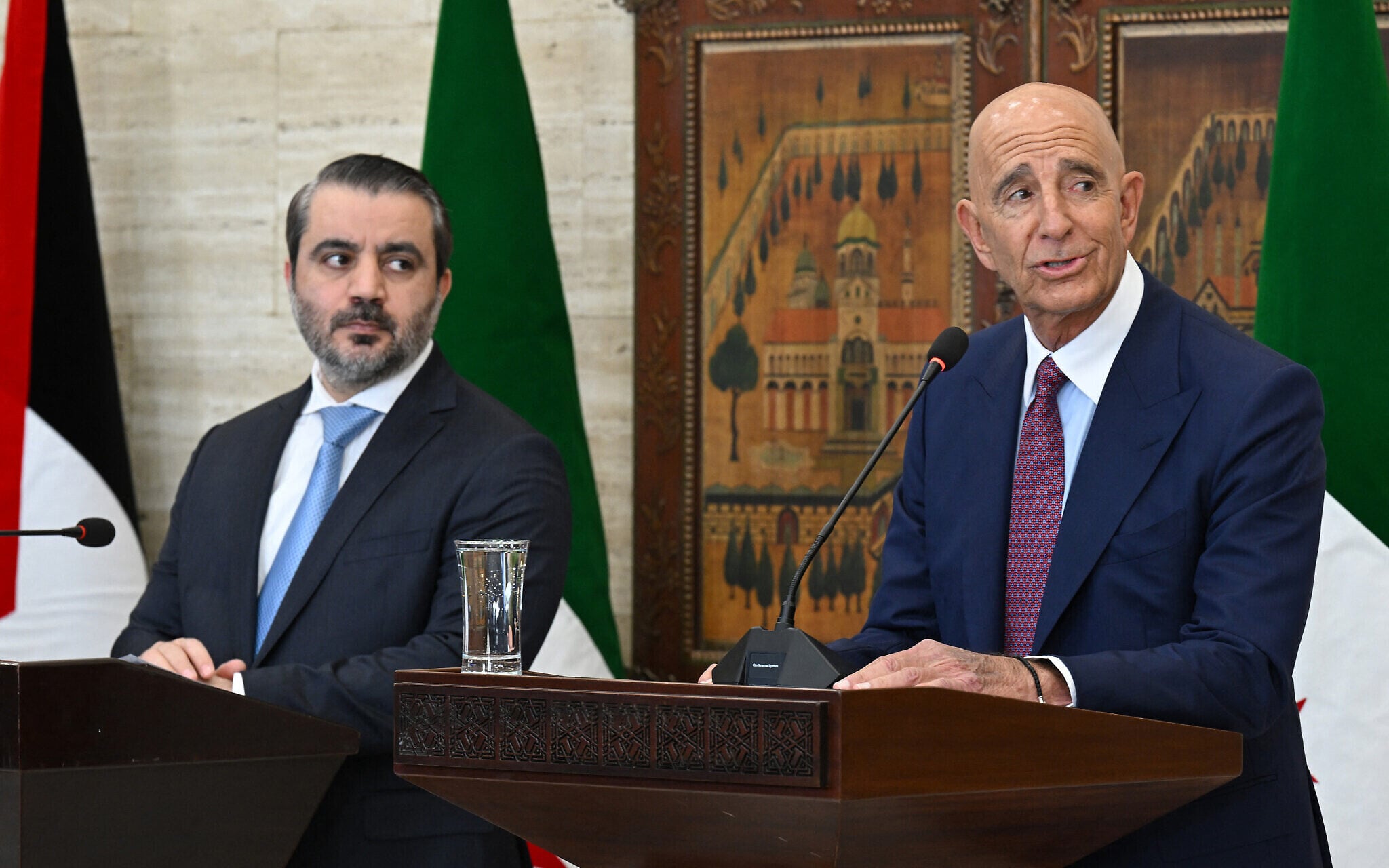
Syrian Foreign Minister Asaad al-Shaibani (L) watches as US special envoy for Syria Tom Barrack speaks during a press conference in Damascus on September 16, 2025. (Louai Beshara/AFP)

Syrian Foreign Minister Asaad al-Shaibani (L) watches as US special envoy for Syria Tom Barrack speaks during a press conference in Damascus on September 16, 2025. (Louai Beshara/AFP)

Tom Barrack, the US ambassador to Turkey and special envoy for Syria, writes in a lengthy social media post following Syrian President Ahmed al-Sharaa’s White House visit that the next steps after the meeting include a new stage in relations between Israel, Turkey and Syria.

Barrack writes that among the topics discussed at a meeting between US Secretary of State Marco Rubio, Turkish Foreign Minister Hakan Fidan and Syrian Foreign Minister Asaad al-Shaibani were “redefining Turkish-Syrian-Israeli relations, and advancing the alignment that underpins the Israel-Hamas ceasefire, as well as various Lebanese border issues.”

He also calls on the US Congress to lift sanctions on Syria.

Barrack, who has reserved harsh criticism for Lebanon in the past, has pushed Middle Eastern countries to join the Abraham Accords and normalize ties with Israel. Israeli-Turkish ties are likewise at something of a nadir after collapsing during the Gaza war.

After his meeting on Monday with US President Donald Trump at the White House, the first ever by a Syrian leader, Sharaa threw cold water on the prospect of Syria normalizing ties with Israel.


‘The UAE has not yet seen a clear framework for the stabilization force, and under such circumstances, it is unlikely to participate,’ said Anwar Gargash, the UAE Presidential Advisor.

Turkish charities operating in the southern Gaza Strip, October 23, 2025
(photo credit: ABED RAHIM KHATIB/FLASH90)
The United Arab Emirates is concerned about Qatar and Turkey playing a central role in the proposed plan to rebuild the Gaza Strip.

In general, the UAE views Doha and Ankara as “Hamas enablers. These states will make it possible for the terrorist organization to continue existing,” a source familiar with its stance told The Jerusalem Post.

“There are interested parties affiliated with the Muslim Brotherhood who are currently embedding themselves in key positions in the Gaza reconstruction plan,” the source said.

This concern led the UAE to officially announce this week that it will not take part in the International Stabilization Force (ISF) expected to deploy in Gaza.

“The UAE has not yet seen a clear framework for the stabilization force, and under such circumstances, it is unlikely to participate,” Dr. Anwar Mohammed Gargash, an adviser to the UAE’s presidency, said at a summit in Abu Dhabi.

A UAE AID tent stands in front of a collapsed building at Saftawi street in Jabalia in the northern Gaza Strip on February 5, 2025 (credit: OMAR AL-QATTAA/AFP via Getty Images)

Established in coordination with the US, the ISF is expected to include troops from Egypt, Qatar, and Turkey.

The Trump administration said it hoped that this task force would enter Gaza “very soon,” and is currently working on a United Nations Security Council resolution to authorize its deployment.

Day after in Gaza

Over the past two years, the UAE has been involved in discussions regarding “the day after” in Gaza. Strategic Affairs Minister Ron Dermer (Likud) has visited the UAE several times, and the idea of a multinational force stationed in Gaza was developed in part through talks among senior Israeli, US, and Emirati officials.

While the UAE still intends to partake in post-war efforts in Gaza, its role will focus more on the humanitarian aspect.

“The Emirates will focus on humanitarian aid, reconstruction, and supporting the establishment of effective governance,” one source said.

He added that the UAE may assist the ISF logistically, saying that “despite the concerns over the involvement of Hamas-aligned actors, the goal in the UAE is to help create something fresh in Gaza – to jump-start a different chapter there.”

Meanwhile, discussions regarding the 200 Hamas terrorists currently in Rafah are ongoing. While the US and Israel agree on the idea of exiling them if they lay down their arms, Hamas has conveyed to mediators that it currently rejects this proposal.

“Hamas fears setting a precedent where Israel would grant full immunity only to those who disarm and agree to exile. That’s not what was agreed upon in [US President Donald] Trump’s plan,” a source familiar with the details told the Post.

Despite these challenges and Israel’s public refusal to allow safe passage for armed terrorists into Hamas-controlled territory, even if they do disarm, the US administration believes a solution will soon be reached.

“This issue threatens the ceasefire – and that’s exactly how the Trump administration sees it. It will do everything possible to resolve this,” said another source familiar with the talks.

Israel is preparing for the possibility that the ceasefire agreement might collapse.

IDF Chief of Staff Lt.-Gen. Eyal Zamir told cabinet ministers in a meeting last Thursday that the defense establishment is preparing for other options in case the Trump plan fails. Alternatives will be presented to the political leadership and ministers soon.


Amid tensions with Israel and the US, Iran is ramping up diplomacy to build a “multipolar order,” strengthening ties with Iraq, the UAE, and Uzbekistan to safeguard its regional influence.

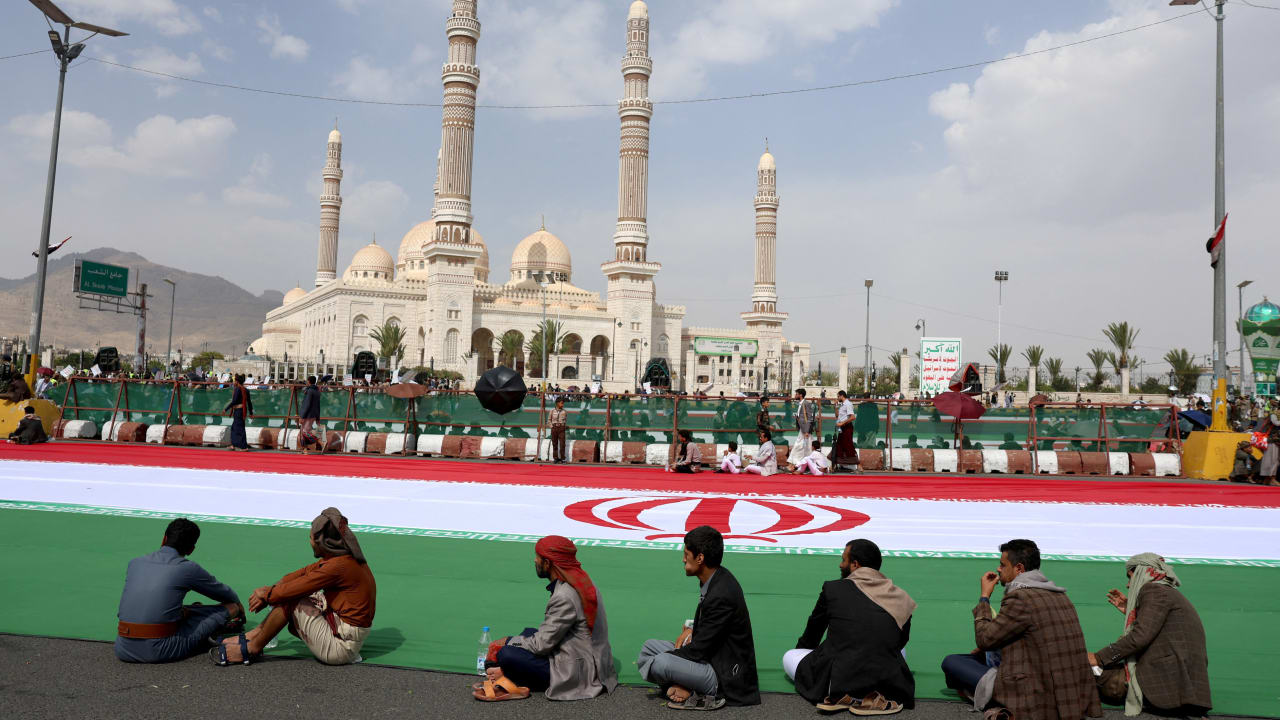
 PROTESTERS, MOSTLY Houthi supporters, sit along an Iranian flag at a demonstration in support of Palestinians and Iran, in Sanaa last week. Aggression by proxies such as the Houthis must be treated as direct Iranian attacks, says the writer.
PROTESTERS, MOSTLY Houthi supporters, sit along an Iranian flag at a demonstration in support of Palestinians and Iran, in Sanaa last week. Aggression by proxies such as the Houthis must be treated as direct Iranian attacks, says the writer.
(photo credit: KHALED ABDULLAH/REUTERS)
Iran is working the phones of diplomacy. Over the past days, Iranian state media have described a flurry of activity on the diplomatic front. This comes as Iran is also concerned about tensions with Israel and is weighing whether it will re-enter talks with the US. This is part of a larger agenda.

Advisor to the Leader of the Islamic Revolution, Ali Akbar Velayati, said that the “era of the United States’ dominance has come to an end and the world is now transitioning from a unipolar to a multipolar and equitable order,” Iranian state media noted.

What is Iran’s foreign ministry doing? “Iraq’s Deputy Foreign Minister Mohammed Hussein Mohammed Bahr Al Uloom has commanded the recent remarks by Esmaeil Baqaei, the Iranian Foreign Ministry spokesperson, regarding the sixth parliamentary elections in the Arab country,” Iran’s state media IRNA said.

The Islamic Republic views ties positively and has praised the political and electoral atmosphere in Iraq. “Bahr Al Uloom added that Baqaei also expressed hope that the Iraqi people’s participation in the electoral process will help outline the political future of the country,” IRNA added.

Iran's Supreme Leader Ayatollah Ali Khamenei attends a meeting with students in Tehran, Iran, November 3, 2025 (credit:  Office of the Iranian Supreme Leader/WANA (West Asia News Agency)/Handout via REUTERS)
Iran’s Supreme Leader Ayatollah Ali Khamenei attends a meeting with students in Tehran, Iran, November 3, 2025 (credit: Office of the Iranian Supreme Leader/WANA (West Asia News Agency)/Handout via REUTERS)

Iran is also improving ties with Uzbekistan. “Iran and Uzbekistan have reached new agreements to expand cooperation and investment in the mining and mineral industries, marking a significant step toward strengthening bilateral economic relations,” IRNA noted.

This comes days after US President Donald Trump hosted Central Asian countries and also after Kazakhstan announced it would join the Abraham Accords. Iran also wants to maintain its position in Central Asia. “During his visit to Tashkent, Uzbekistan, Iran’s Minister of Industry, Mine and Trade Mohammad Atabak held talks with Uzbekistan’s Minister of Mining and Geology, Islamov Bobur Farxodovich, and Minister of Investment, Industry and Trade, Laziz Kudratov, on Tuesday,” IRNA noted.

“The Iranian delegation, headed by Minister Atabak, arrived in Tashkent on November 9. He is accompanied by senior officials from Iran’s industrial and mining sectors.”

The ambassadors of Iran and Russia in Baghdad have discussed the latest developments in Iraq ahead of the country’s parliamentary elections, emphasizing the importance of the vote for Iraq’s stability and development.

Meanwhile, Iranian Ambassador Mohammad Kazem Al Sadegh and Russian Ambassador Elbrus Kutrashev exchanged views on Iraq’s situation during the election period, the Iranian media said. “Both diplomats underlined that the elections could play a vital role in strengthening stability and advancing development in the country.

Tehran deepens diplomatic ties with Russia and the UAE

During the meeting, Al Sadegh thanked Russia for its positions and support for the Islamic Republic of Iran regarding Resolution 2231 and stressed the need for constructive cooperation between the two countries at the bilateral and international levels.”

At the same time, in the UAE, Al-Ain media said that the UAE’s Dr. Anwar Mohammed Gargash, Diplomatic Advisor to the President of the UAE, “met on Tuesday with Saeed Khatibzadeh, Iranian Deputy Foreign Minister and Head of the Center for Political and International Studies.”

The information follows an Emirates News Agency report “that the meeting discussed relations between the United Arab Emirates and Iran and ways to strengthen them. The meeting also reviewed regional and international developments and issues of common interest and exchanged views on them.”

Al-Ain added that “Dr. Anwar Gargash stressed the priority of dealing with regional developments through dialogue and diplomacy in a way that achieves the stability and prosperity that the countries and peoples of the region aspire to. The meeting comes on the sidelines of the Iranian official’s participation in the twelfth edition of the ‘Abu Dhabi Strategic Forum’ organized by the Emirates Policy Center.”