A senior Israeli official suggests the need to act before Trump’s presidency concludes, as tensions rise over Iran’s nuclear and missile programs.
An illustration of Israel Air Force F-35s conducting airstrikes on Iran.(photo credit: Khanchangezi/Shutterstock)ByJERUSALEM POST STAFFUpdated: Israel should seek to overthrow the Iranian regime before the end of US President Donald Trump’s administration, a senior official told Israeli public broadcaster KAN News on Monday.
Trump’s second term as US president is due to end in January 2029.
Iran has been seeking to reproduce its stockpile of advanced missiles, and Israel is closely monitoring Tehran’s efforts, a senior security source told KAN.
The New York Times, on Sunday, cited regional officials and analysts who view another outbreak of war between Israel and Iran as “only a matter of time.”
Iran’s new Pickaxe Mountain enrichment site, located approximately one kilometer south of the Natanz enrichment facility, is underway, and inspectors have not been permitted to access it, the NYT noted.
A satellite image shows airstrike craters covered with dirt at the Natanz Enrichment Facility, following US airstrikes, in Natanz County, Iran, June 24, 2025 (credit: MAXAR TECHNOLOGIES/HANDOUT VIA REUTERS)
However, inspectors of the UN nuclear watchdog IAEA visited Iranian nuclear sites last week, Iran’s foreign ministry spokesperson said on Monday, according to state media, a week after the IAEA urged Iran to “seriously improve” cooperation.
The IAEA has carried out about a dozen inspections in Iran since hostilities with Israel in June, but last week highlighted it had not been given access to nuclear facilities such as Fordow, Natanz, and Isfahan, which the United States bombed.
“As long as we are a member of the NPT (Treaty on the Non-Proliferation of Nuclear Weapons), we will abide by our commitments, and just last week, IAEA inspectors visited several nuclear facilities, including the Tehran Research Reactor,” Esmaeil Baghaei said, without naming the facilities.
Iran’s Pezeshkian says Tehran seeks peace, but will not bow to coercion
Iranian President Masoud Pezeshkian claimed on Friday that Iran seeks peace, but will not be coerced into abandoning its nuclear and missile programs, state media reported.
Trump said on Thursday that Iran had been asking if US sanctions against the country could be lifted.
“We are willing to hold talks under international frameworks, but not if they say you can’t have a (nuclear) science, or the right to defend yourself (with missiles), or else we will bomb you,” Pezeshkian said.
Last month, Pezeshkian warned that Iran may have no choice but to relocate its capital from Tehran to the south, possibly to a city in Hormozgan province, due to ongoing droughts.
Trump says Iran has been asking if US sanctions can be lifted
Trump said on Thursday that Iran has been asking if Washington’s sanctions against the country can be lifted.
“Iran has been asking if the sanctions could be lifted. Iran has got very heavy US sanctions, and it makes it really hard for them to do what they’d like to be able to do. And I’m open to hearing that, and we’ll see what happens, but I would be open to it,” Trump told reporters late on Thursday at the White House.
Iran’s mission to the United Nations in New York did not immediately respond to a request for comment.
Reuters contributed to this report.
Syrian President Ahmed al-Sharaa told Fox News that one of the issues preventing talks is Israel’s “occupation” of the Golan Heights.
President of Syria Ahmed al-Shara arrives for the 80th session of the UN’s General Assembly (UNGA) at UN Headquarters on September 23, 2025 in New York City.(photo credit: Alexi J. Rosenfeld/Getty Images)ByJERUSALEM POST STAFFUpdated: Syrian President Ahmed al-Sharaa said in a Monday interview with Fox News that Syria would not at this time enter into talks to join the Abraham Accords, but that perhaps US President Donald Trump’s administration would help in making such negotiations possible.
Sharaa cited Israel’s “occupation” of the Golan Heights as a reason Syria would not enter such talks.
“I believe that this situation in Syria is different from the situation of the countries who went on with the Abrahamic agreement,” Sharaa told Fox’s Gillian Turner. “Syria has borders with Israel, and Israel has occupied the Golan Heights since 1967. We are not going to enter into a negotiation directly right now.”
Sharaa’s answer came after Gillian noted that “Trump would like Syria to join the Abraham Accords.” She then asked whether Sharaa agreed with the accords’ “foundational principle,” which is that Israel had “the right to exist as a sovereign Jewish state.”
While Sharaa stated that Syria would not enter talks to join the Abraham Accords at this time, he floated the possibility that “Maybe the United States administration, with President Trump, will help us reach this kind of negotiation.”
Syrian President Ahmed al-Sharaa seen with the background of Syrian and Israeli flags (illustrative) (credit: REUTERS/KHALIL ASHAWI, SHUTTERSTOCK)
Sharaa’s nom de guerre while active in terror organizations, including al-Qaeda and Hay’at Tahrir al-Sham, was “al-Jolani,” honoring his parents, who were residents of the Golan Heights until 1967, when they fled due to the Six-Day War. Sharaa was born in Saudi Arabia.
Advertisement
Sharaa’s interview with Fox followed a historic meeting between the Syrian president and President Trump at the White House. The event was the first such visit by a Syrian leader.
Israel-Syria agreement to be achieved before year’s end, Syrian official believes
Prime Minister Benjamin Netanyahu also confirmed that negotiations are underway on September 24.
The United States is preparing to establish a military presence at an airbase in Damascus to help enable a security pact that Washington is brokering between Syria and Israel, six sources familiar with the matter told Reuters last week.
The US plans for the presence in the Syrian capital, which have not previously been reported, would be a sign of Syria’s strategic realignment with the US following the fall last year of longtime leader Bashar al-Assad, an ally of Iran.
The base sits at the gateway to parts of southern Syria that are expected to make up a demilitarized zone as part of a non-aggression pact between Israel and Syria mediated by the Trump administration.
Shaibani: ‘Israel pursuing expansionist projects’
Syrian Foreign Minister Asaad Hassan al-Shaibani warned that, in his view, Israel is “pursuing expansionist projects, exploiting recent changes in Syria and destabilizing the region,” during an interview with state-run Al Ikhbariyah TV in October.
“Israel wanted to impose a new reality and an expansionist project, exploiting the change that took place in Syria,” he said.
He also affirmed his view that Israel’s actions are reinforcing Syria’s instability.
His comments came amid the clashes in southern Syria between Bedouin and Druze populations, with Israel assisting the Druze with military strikes.
Sam Halpern, James Genn, and Reuters contributed to this report.
According to the source, Riyadh anticipates a return to the type of indirect communication with Israel that was facilitated by the US prior to the October 7 massacre.
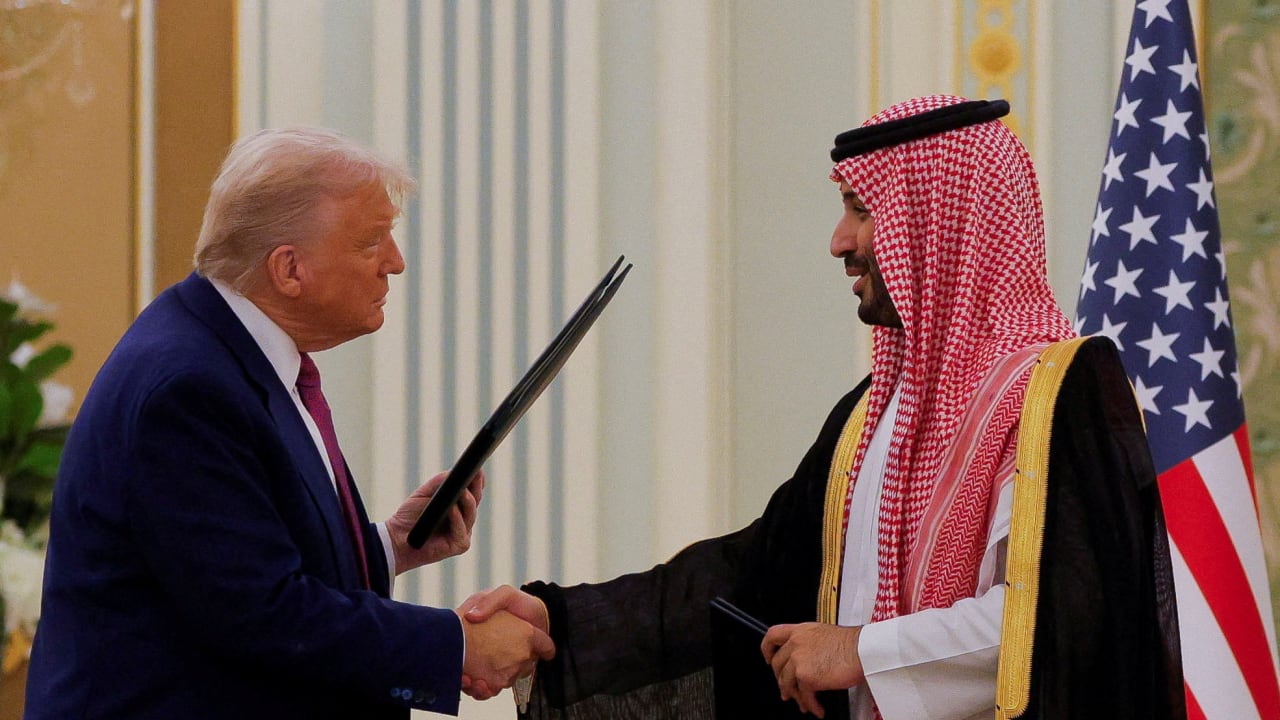
US President Donald Trump and Saudi Crown Prince and Prime Minister Mohammed Bin Salman shake hands during a Memorandum of Understanding (MOU) signing ceremony at the Royal Court in Riyadh, Saudi Arabia, May 13, 2025.(photo credit: REUTERS/BRIAN SNYDER)ByJERUSALEM POST STAFFUpdated: While normalization between Saudi Arabia and Israel is not yet imminent, efforts to lay the groundwork are underway, a source within the Saudi royal family told Kan News on Saturday.
The comment came as Saudi Crown Prince Mohammed bin Salman is expected to visit Washington in 10 days for a meeting with US President Donald Trump.
According to the source, Riyadh anticipates a return to the type of indirect communication with Israel that was facilitated by the US prior to the October 7 massacre.
US PRESIDENT Donald Trump and Saudi Crown Prince Mohammed bin Salman Al Saud attend the Saudi-US Investment Forum in Riyadh in May. The deeper the Saudi-American partnership becomes, the less incentive Riyadh will have to normalize ties with Israel, the writer asserts. (credit: BRIAN SNYDER/REUTERS)
Thawing the ice between Israel and Saudi Arabia
Kan reported that the talks would aim to “thaw the ice” between the two countries and help bridge positions that had grown more distant during the war.
Saudi sources stressed that normalization with Israel will not move forward without a two-state agreement between Israel and the Palestinians.
Advertisement
Saudi officials viewed Kazakhstan’s recent decision to join the Abraham Accords as a positive development, Kan also reported.
Kazakhstan officially joined the Abraham Accords on Thursday following a trilateral phone call between US President Donald Trump, Prime Minister Benjamin Netanyahu, and Kazakh President Kassym-Jomart Tokayev, Trump confirmed.
Kazakhstan’s signature of the accords will be the “first of many” of Trump’s second term, Trump said.
“This is a major step forward in building bridges across the World. Today, more Nations are lining up to embrace Peace and Prosperity through my Abraham Accords.”