Mexican authorities thwarted an attempted attack on Ambassador Einat Kranz-Neiger.
Israel’s Ambassador to Mexico, Einat Kranz Neiger.(photo credit: MINISTRY OF FOREIGN AFFAIRS)ByJERUSALEM POST STAFF, IDAN KWELLER, REUTERSUpdated: Mexico thwarted an Iran-directed terror attack aimed at harming the Israeli ambassador to the country, the Foreign Ministry shared on Friday.The announcement by the ministry came hours after N12 published that American and Israeli officials confirmed the IRGC planned an attack against Ambassador Einat Kranz-Neiger as part of a wider attack on Israeli and American interests in the region.“We are in the line of fire at this time, diplomats are literally standing at the forefront as they represent the State of Israel in a climate that is not always simple. We are well aware of the history of Iran and its attacks in Latin America, and this is a good opportunity to thank the authorities and security services here in Mexico for their assistance in thwarting it,” said Kranz-Neiger to Walla.“Since the news was published, I have been interviewing the media in Mexico and conveying the messages to reflect the complexity of this time, and especially the Iranian threat in the form of attacks of this type that, as mentioned, we have seen in the world in the past,” she added.Planned throughout 2024, the IRGC planned to kill the ambassador in early 2025 in a now-thwarted plot. American officials assured N12 that there is no longer an active threat.A man holds a candle as he attends a demonstration in support of Palestinians and the Global Sumud Flotilla, amid the ongoing conflict in Gaza, outside the U.S. Consulate in Ciudad Juarez, Mexico, September 20, 2025. (credit: JOSE LUIS GONZALEZ/REUTERS)
Israel’s Foreign Ministry, in a statement, thanked the security and law enforcement services in Mexico for “thwarting a terrorist network directed by Iran that sought to attack Israel’s ambassador in Mexico.”
Advertisement
The Iranian Embassy in Mexico said the accusation was “entirely false,” the semi-official Mehr news agency reported.“We will never tarnish the good reputation of Mexicans, our friends. We consider betrayal of Mexico’s interests as betrayal of our own interests, and respecting Mexico’s laws is our highest priority,” Mehr cited the embassy as saying.
Iran’s attacks on Israeli and Jewish targets
American sources told N12 that large components of the attacks were planned from the Iranian embassy in Venezuela and were led by Hassan Izadi.
After spending years recruiting from the Venezuelan embassy, Izada was relocated to a new position in Tehran, where he was said to have continued his plots against the Israeli ambassador. The same IRGC unit, the Quds Force’s Unit 11000, was also behind a number of recently thwarted attacks on Jewish and Israeli targets in Australia and Europe, according to Axios.“This is just the latest example in a long history of assassination attempts by Iran around the world against diplomats, journalists, dissidents, and anyone who disagrees with it – something that should raise deep concern in any country where there is an Iranian presence,” the American official said.Foreign Ministry Spokesman Oren Marmorstein confirmed that, “The Israeli intelligence and security community will continue to work tirelessly, in full cooperation with security and intelligence agencies around the world, to thwart terror threats from Iran and its proxies against Israeli and Jewish targets worldwide.”Security services in Britain and Sweden warned last year that Tehran was using criminal proxies to carry out violent attacks in those countries, with London saying it had disrupted 20 Iran-linked plots since 2022.A dozen other countries have condemned what they called a surge in assassination, kidnapping, and harassment plots by Iranian intelligence services.Britain’s domestic spy chief, MI5 Director General Ken McCallum, said last month that Iran was “frantically” trying to silence its critics around the world, and cited how Australia had exposed Iranian involvement in antisemitic plots and Dutch authorities had revealed a failed assassination attempt.
The United Nations Security Council also lifted sanctions on Syrian President Ahmed al-Sharaa earlier this week.
US Secretary of State Marco Rubio shakes hands with Syrian President Ahmed al-Sharaa at the Lotte New York Palace Hotel, on the sidelines of the 80th United Nations General Assembly in New York City, US, September 22, 2025.(photo credit: REUTERS/BING GUAN/POOL)ByREUTERSUpdated: The United States and Britain removed sanctions on Syrian President Ahmed al-Sharaa on Friday, a day after the United Nations Security Council did the same ahead of his meeting with US President Donald Trump next week, with the European Union confirming it would follow suit.
Washington and London also lifted sanctions on Syria‘s Interior Minister Anas Khattab, according to notices on their websites.
“These actions are being taken in recognition of the progress demonstrated by the Syrian leadership after the departure of (former President) Bashar al-Assad,” the State Department said in a statement that cited work on countering narcotics, eliminating chemical weapons and promoting regional security.
A European Union spokesperson said on Friday the UN decision would be reflected in EU measures.
Syrian President Ahmed al-Sharaa attends the 80th United Nations General Assembly, at the U.N. headquarters in New York City, US, September 23, 2025 (credit: REUTERS/JEENAH MOON)
Britain lifted some sanctions on Syria in April, while the bloc lifted its economic sanctions in May, but restrictions related to arms and security remain in place.
“We remain committed to supporting a peaceful and inclusive Syrian-led and Syrian-owned transition to help build a better future for all Syrians,” a European Commission spokesperson said.
Washington has been urging the 15-member Security Council for months to ease Syria sanctions. Trump announced a major US policy shift in May when he said he would lift US sanctions on Syria.
Meeting at the White House
The Republican president is due to meet al-Sharaa at the White House on Monday, the first such visit by a Syrian head of state.
Trump has sought good relations with al-Sharaa. In June, he revoked most US sanctions against Syria, and Trump met with the Syrian leader when he visited Saudi Arabia last May.
Since seizing power from Bashar al-Assad last December, al-Sharaa has made a series of foreign trips as his transitional government seeks to re-establish Syria’s ties with world powers that had shunned Damascus during Assad’s rule.
Al-Sharaa, formerly known as Abu Mohammad al-Julani, became Syria’s president in January after insurgent forces led by Hayat Tahrir al-Sham ousted Assad in a lightning offensive.
Al-Sharaa, once a senior figure in HTS and previously affiliated with al Qaeda, was sanctioned by the US in 2013 and the UN and Britain in 2014, which included a travel ban, asset freeze, and arms embargo.
The UN Security Council lifted those measures on Thursday, citing a lack of active ties between HTS and al Qaeda.
The Syrian government did not immediately respond to a request for comment on Friday, which is not a working day in Syria.
US special envoy confirms US pushing Israel to allow Hamas fighters holed up under Rafah to hand over their weapons in exchange for amnesty, calls it model for larger peace process
US special envoy Steve Witkoff speaks at the America Business Forum, on November 6, 2025, in Miami. (AP Photo/Rebecca Blackwell)
White House Mideast envoy Steve Witkoff claimed Thursday that Hamas officials told him and fellow Trump aide Jared Kushner that the terror group wanted to disarm during their “famous meeting” hours before the ceasefire was inked on October 9.
“Hamas has always indicated that they would disarm. They’ve said so — they said it to us directly during that famous meeting that Jared had with them,” Witkoff recalled, speaking to the America Business Forum conference in Miami.
“I hope that they keep their word because if they do, they’ll understand that the development plan that we have for Gaza is really terrific — a lot better than anyone has ever discussed before,” he continued, adding that it will include a “tremendous jobs program.”
Hamas officials have publicly taken a different stance, insisting either that the group will not disarm or have dodged the question entirely when pressed.
Privately, Arab diplomats familiar with the matter have told The Times of Israel that Hamas has indicated openness to give up their heavy weaponry, while holding on to lighter arms, in what likely would be a non-starter for Israel given that those same guns were used to mow down Israelis on October 7, while they have also been used to suppress internal dissent within the Strip.
Still, Witkoff told a conference in Miami that the US was “in the middle of standing up a decommissioning process [for] weapons — a demilitarization and amnesty program.”
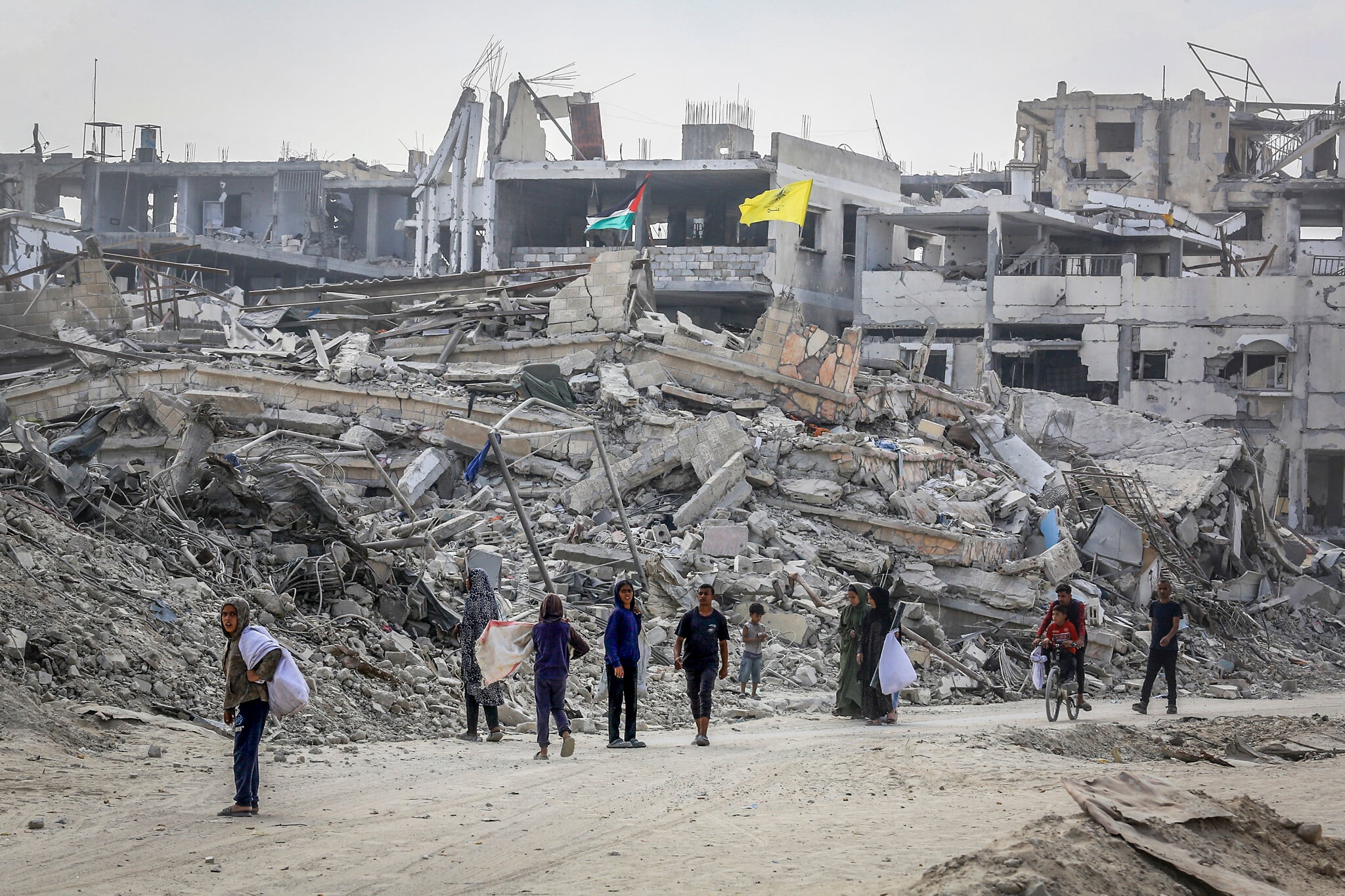
Palestinians walk past buildings destroyed in the recent war, in Khan Younis, in the southern Gaza Strip, November 6, 2025. (Abed Rahim Khatib/Flash90)
“Hamas has always said that we’re going to need the international security force to come in here and be the layer [that] they give the weapons to,” Witkoff said, adding that he hopes to muster that force in the next three weeks.
“That’ll be the inflection point where we see if everyone’s going to do as they say and demilitarize,” he said.
Witkoff’s comments came despite Hamas’s repeated expressions of opposition to the prospect of foreign troops entering Gaza.
US wants Israel to grant holed-up Hamas fighters safe passage
In his remarks, the US envoy also confirmed The Times of Israel’s reporting that Washington is leaning on Israel to grant safe passage to 100 to 200 Hamas operatives who are currently holed up in tunnels beneath the city of Rafah, in exchange for them giving up their weapons.
Witkoff said the initiative focused on those fighters who are located within an area that Israel controls in accordance with the ceasefire agreement, will serve as a “model” for the broader decommissioning and amnesty program.
“We may see the model of what we’re trying to do here… with these 200 fighters who are trapped in Rafah and whether they’re going to be able to raise their hands, walk out, turn over their weapons. This will be one of the tests,” Witkoff said, adding that he has been on the phone with Turkish Foreign Minister Hakan Fidan and Strategic Affairs Minister Ron Dermer.
Prime Minister Benjamin Netanyahu’s office has publicly pushed back against the idea of granting safe passage to the Hamas operatives, though a Middle East diplomat told The Times of Israel that Jerusalem has not ruled out the idea in private.
Still, Israel is arguing that at least some of the Hamas terrorists will have to be taken into Israeli custody at the very least, as they’re responsible for attacks on Israelis, the diplomat said.
Apparently recognizing the pressure from Washington, Defense Minister Israel Katz proposed exiling the Hamas fighters outside of Gaza, but received pushback from IDF Chief of Staff Eyal Zamir who said the terror operatives can either surrender or die.
For its part, the US fears that allowing Israel to kill all of those Hamas fighters would risk collapsing the fragile ceasefire in Gaza.
Witkoff said that if the US manages to “hold it together, then we’ll have even more credibility around the world. I’m very confident we will hold it together and we will complete the mission.”
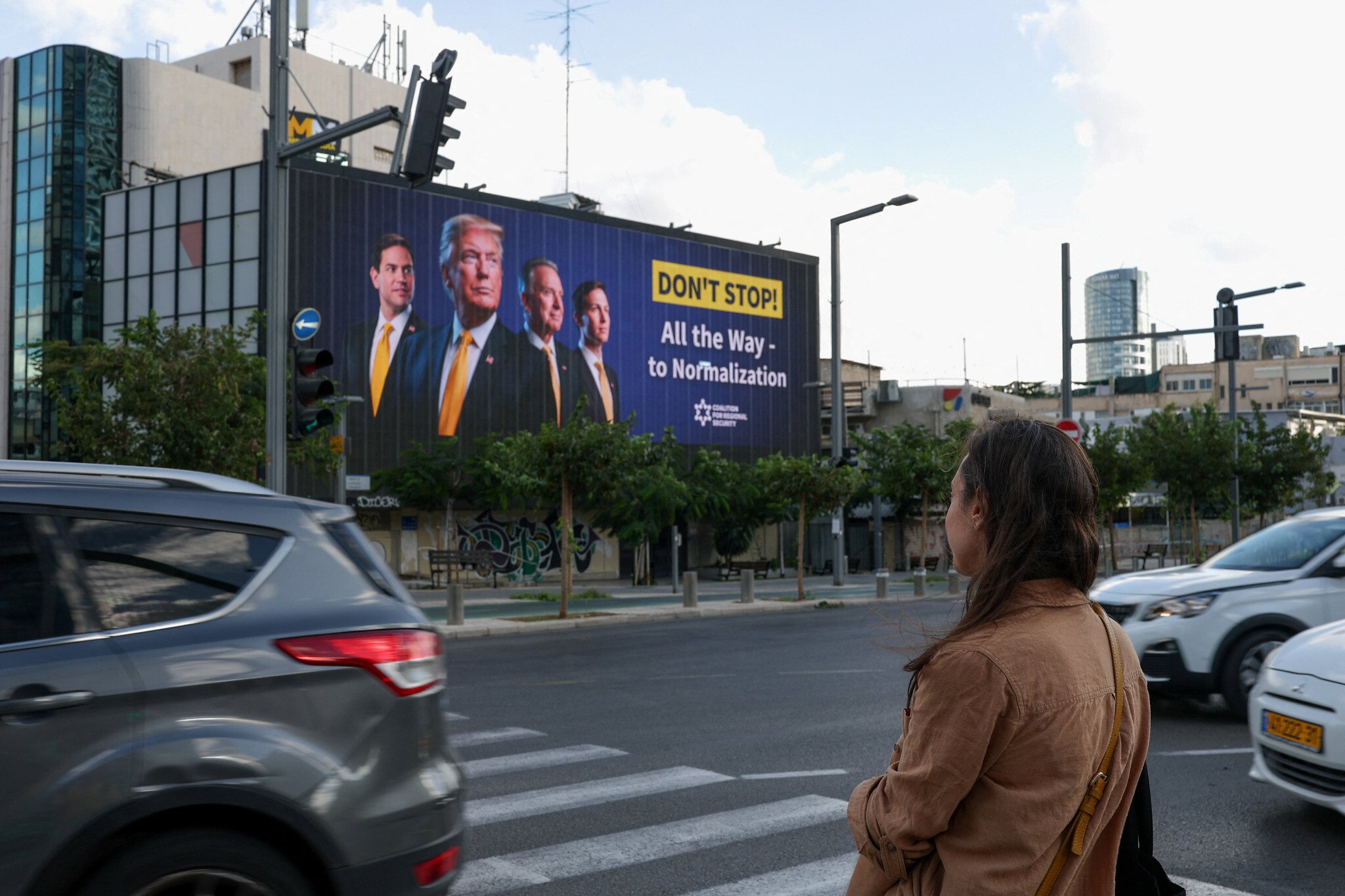
A billboard shows images of US Secretary of State Marco Rubio, US President Donald Trump, US Special Envoy to the Middle East Steve Witkoff and Jared Kushner, amid a ceasefire between Israel and Hamas in Gaza, in Tel Aviv on October 12, 2025. (REUTERS/Hannah McKay)
The Trump administration’s 20-point peace plan, unveiled in late September, calls for Hamas to disarm and Gaza to be demilitarized, and for a temporary, technocratic government to be placed in charge of the Strip, which could eventually hand power to the Palestinian Authority.
Netanyahu backed the proposal when it was presented, but no agreement has been signed beyond the initial ceasefire deal, which secured the return of all living hostages and obligated Hamas to return the bodies of all dead hostages, in exchange for 250 Palestinian security prisoners serving life sentences and some 1,700 Palestinians detained in Gaza over the course of the war.
Ministers oppose ‘model’ Gazan city on Israeli side of Yellow Line
One of the main proposals for rebuilding the Gaza Strip that the Trump administration has presented to potential Gulf donor countries envisions the construction of roughly half a dozen residential regions on the eastern half of the Strip, which is currently under Israeli control, two Arab diplomats familiar with the matter told The Times of Israel last week.
Netanyahu appeared to present elements of the proposal during the cabinet meeting on Thursday night, explaining that the idea was to build a “model city” on the Israeli side of the Yellow Line.
Netanyahu said the goal of the city is to separate Hamas from the civilian population, who will be screened before being allowed to move into the newly constructed town, Ynet reported, relying on leaks from the cabinet meeting.
But several ministers pushed back on the idea, including Gila Gamliel, Orit Strock, Ze’ev Elkin and Miri Regev, claiming that it wouldn’t be safe for such a city to exist on the Israeli side of the Yellow Line, according to Ynet.
Netanyahu reportedly replied that the ISF would first be deployed in the Mawasi coastal area on the side of the Yellow Line that is de facto run by Hamas.
Arab diplomats have told The Times of Israel that the US is indeed looking to deploy the ISF on the Hamas side of the Yellow Line, but it’s unclear whether countries will be willing to contribute troops if the mandate of the force will be disarming Hamas through kinetic force.