Resolution slated for debate in Security Council aims to see first troops in International Stabilization Force, who’ll coordinate with Egypt and Israel, deployed in Strip by January
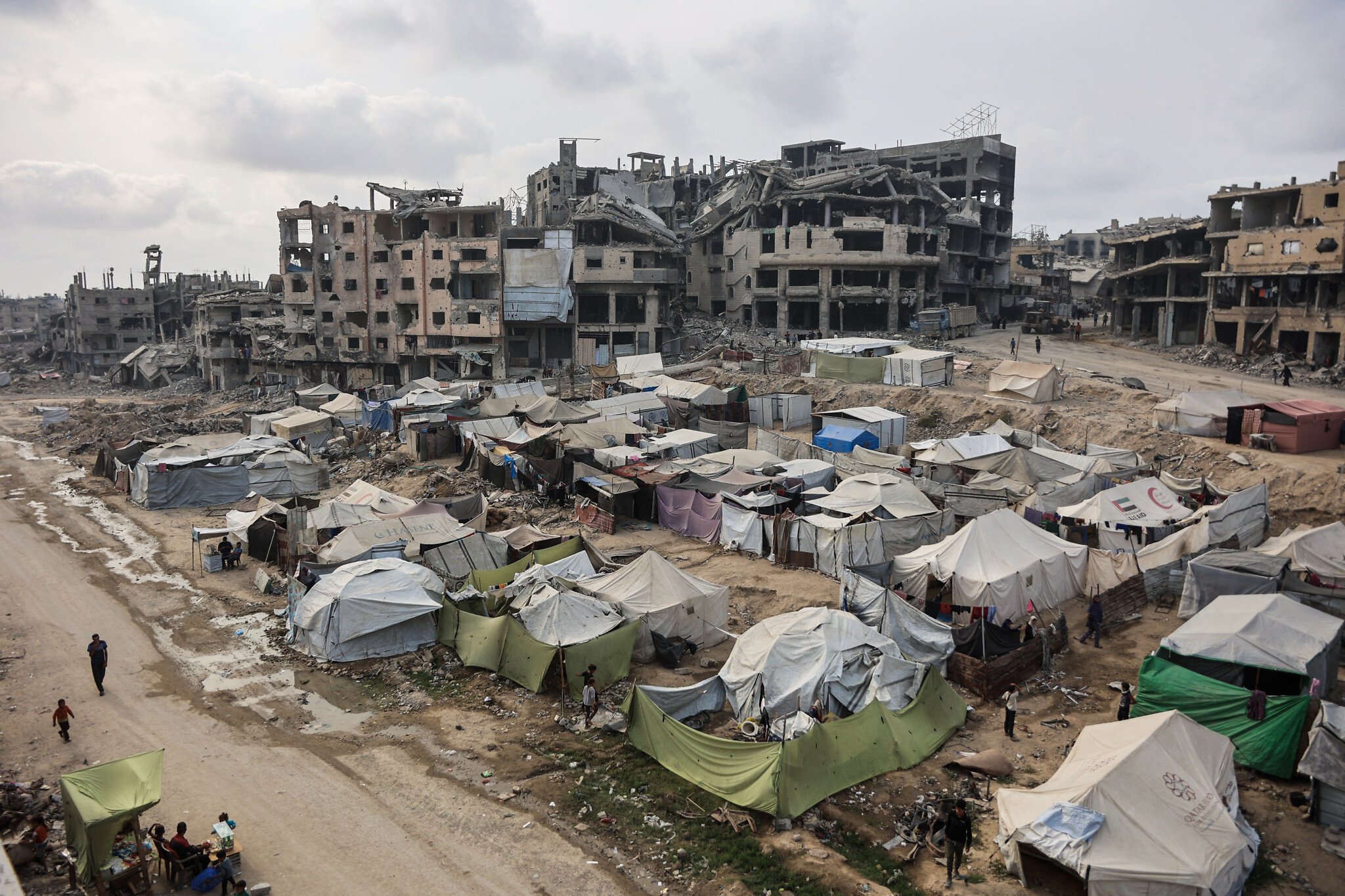
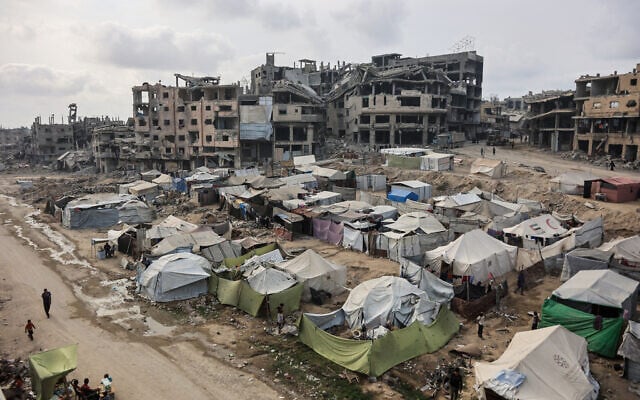
Palestinians walk around their tents in Gaza City on November 3, 2025. (Omar AL-QATTAA / AFP)

Palestinians walk around their tents in Gaza City on November 3, 2025. (Omar AL-QATTAA / AFP)

The Trump administration’s draft United Nations Security Council resolution on establishing an international force in Gaza would reportedly give the US and other participating countries a broad two-year mandate to govern Gaza and be in charge of security there.

According to a copy of the draft published by the Axios news site on Monday, the so-called International Stabilization Force will be in charge of securing the Gaza Strip’s borders with Israel and Egypt, ensuring the safety of civilians and humanitarian zones, and training and partnering new Palestinian police officers.

The force’s mandate will apparently include disarming Hamas, with the draft saying that the ISF will “stabilize the security environment in Gaza by ensuring the process of demilitarizing the Gaza Strip, including the destruction and prevention of rebuilding of military, terror, and offensive infrastructure, as well as the permanent decommissioning of weapons from non-state armed groups.”

The draft resolution also states that the ISF will perform “additional tasks as may be necessary in support of the Gaza agreement,” and that it will be established and operate “in close consultation and cooperation with Egypt and Israel.”

Additionally, the resolution calls for granting US President Donald Trump’s proposed “Board of Peace” the powers of “a transitional governance administration with international legal personality that will set the framework and coordinate funding for the redevelopment of Gaza pursuant to the Comprehensive Plan, until such time as the Palestinian Authority has satisfactorily completed its reform program.”

A US official told Axios that the goal is to deploy the first ISF troops to Gaza by January. Washington is reportedly aiming to negotiate the terms of the resolution within days and hold a vote on it within weeks.

Currently, the next stages of Trump’s 20-point peace plan have been on hold, with Hamas failing to hand all of the hostages’ bodies it continues to hold. The terror group returned the remains of three hostages on Sunday night, leaving eight still in Gaza — six Israelis, one Thai and one Tanzanian.

Since the sides remain in the first stage of the deal, Israel is still in control of approximately 53 percent of the Strip, demarcated by the Yellow Line. In a future stage, once the ISF is deployed, Israeli troops are slated to withdraw further “based on standards, milestones, and timeframes linked to demilitarization that will be agreed upon between the IDF, ISF, the guarantors, and the United States,” according to Trump’s plan.

The proposal envisions Israeli forces gradually withdrawing as the ISF deploys, “until they are withdrawn completely from Gaza, save for a security perimeter presence that will remain until Gaza is properly secure from any resurgent terror threat.”

Hamas officials have pushed back in recent weeks on the idea of fully disarming, with Trump suggesting last month that if the group won’t hand over its weapons, “we will disarm them, and it’ll happen quickly and perhaps violently, but they will disarm.”
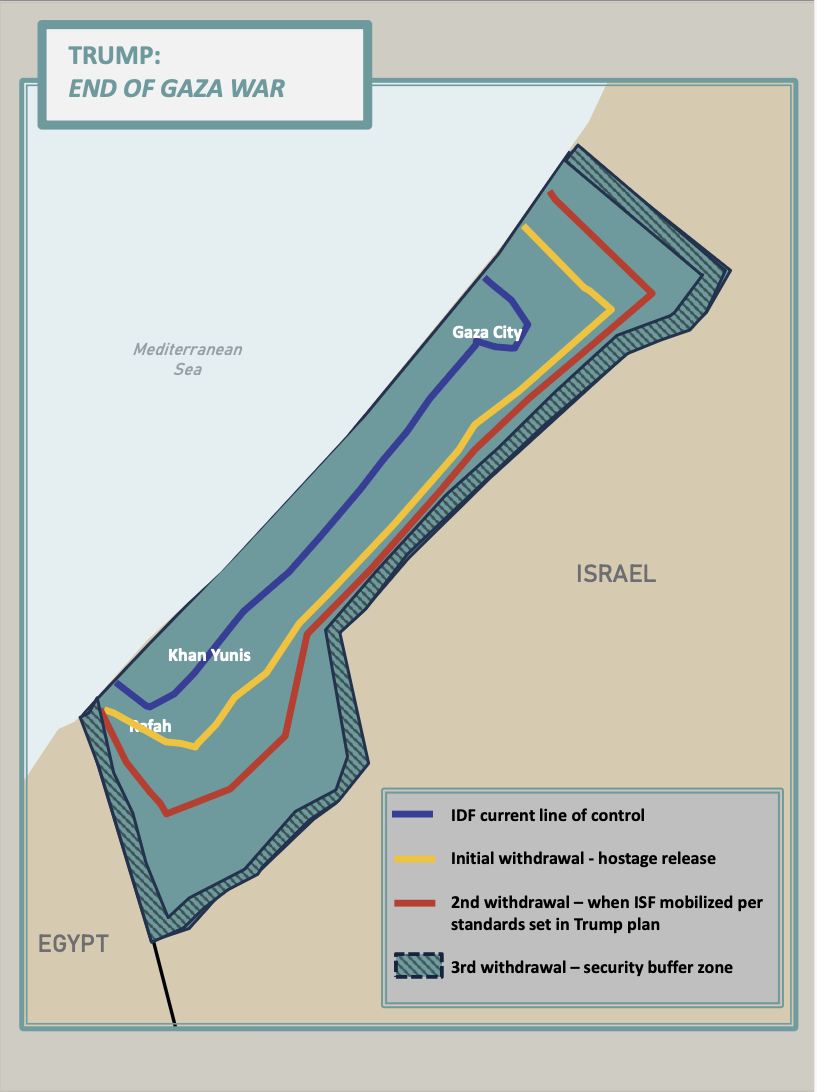
A map of a proposed withdrawal of IDF troops as part of a deal to end the war in Gaza, published on September 29, 2025. (White House)

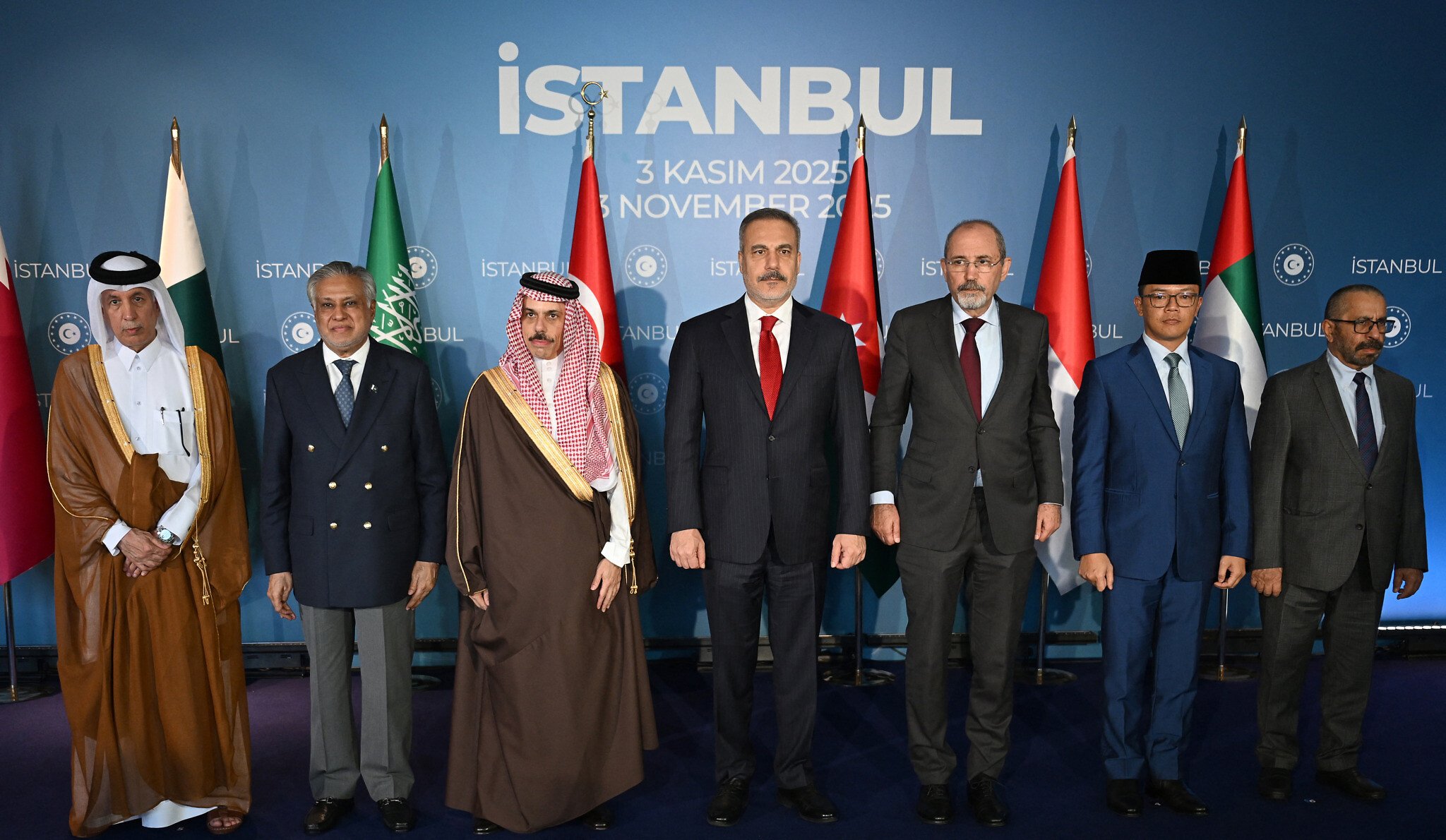
Six Muslim countries met with Turkish officials in Istanbul on Monday to discuss the future of Gaza, with diplomats from Saudi Arabia, Qatar, the United Arab Emirates, Jordan, Pakistan and Indonesia in attendance.

Israel has pushed back against Turkey playing any major role in Gaza’s postwar governance, and rejected the idea that Ankara would supply troops to the ISF.

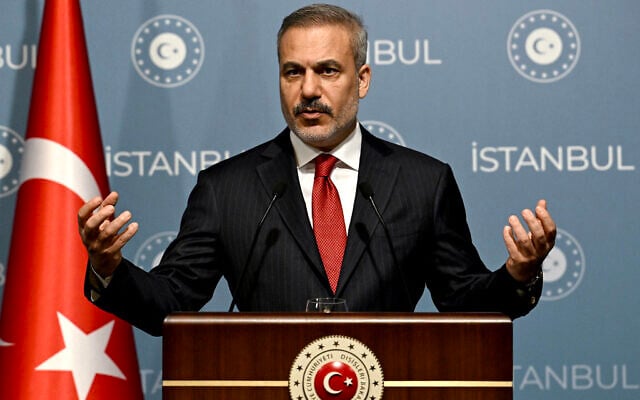
Turkish Foreign Minister Hakan Fidan told reporters following the meeting that “the countries we’ve spoken with say they will decide whether to send troops based on… the ISF’s mandate and authority.”

Fidan said that “first, a general consensus needs to be reached on a draft, then it needs to be approved by the members of the Security Council.”

A report in the Ynet news site last week said that members of the Knesset Foreign Affairs and Defense Committee were told during a closed-door briefing that the ISF will be made up of soldiers from Indonesia, Azerbaijan and Pakistan.

Saudi Crown Prince Mohammed bin Salman is slated to meet with Trump at the  White House on November 18, with the future and reconstruction of Gaza likely to be a major topic of discussion.

A diplomat told The Times of Israel that Washington is hoping to put forward the UN Security Council resolution establishing the ISF before bin Salman’s visit.

Agencies contributed to this report.

Turkish foreign minister also says International Stabilization Force must be backed up by a UN mandate; Israel wary of letting Turkey have a role in Gaza

(From left) Officials from Qatar, Pakistan, Saudi Arabia, Turkey, Jordan, Indonesia and the United Arab Emirates pose for a photo during a meeting to discuss the US-backed Gaza peace plan in Istanbul on November 3, 2025. (Ozan KOSE / AFP)

(From left) Officials from Qatar, Pakistan, Saudi Arabia, Turkey, Jordan, Indonesia and the United Arab Emirates pose for a photo during a meeting to discuss the US-backed Gaza peace plan in Istanbul on November 3, 2025. (Ozan KOSE / AFP)

Gaza’s future must be Palestinian-led and avoid any new system of foreign hegemony, Turkey and six of its top Muslim allies said Monday, after talks in Istanbul.

Turkey’s relations with Israel collapsed during the Gaza war, and it has been a harsh critic of Jerusalem, but it also served as a key mediator of the tenuous three-week-old ceasefire. Now, it is pushing for Muslim nations to bring their influence to bear on the reconstruction and future governance of the embattled Strip.

“Our principle is that Palestinians should govern the Palestinians and ensure their own security. The international community should support this in the best possible way — diplomatically, institutionally, and economically,” Turkish Foreign Minister Hakan Fidan said after the talks.

“Nobody wants to see a new system of tutelage emerge,” he told a news conference, using a term meaning foreign supremacy over a territory.

Brokered by US President Donald Trump, the October 10 ceasefire — which halted two years of war sparked by the Hamas-led October 7, 2023, attack — has been tested by Hamas attacks on Israeli soldiers and fresh Israeli strikes.

Turkish Foreign Minister Hakan Fidan gestures as he speaks during a press conference after a meeting with his counterparts from Saudi Arabia, Qatar, the United Arab Emirates, Jordan, Pakistan and Indonesia in Istanbul on November 3, 2025. (Ozan KOSE / AFP)

All of them were called to a meeting with Trump in September on the margins of the United Nations General Assembly, just days before he unveiled his plan to end the Gaza war. Trump has credited their support with helping build momentum for his peace proposal.

“We’ve now reached an extremely critical stage: We do not want the genocide in Gaza to resume,” Fidan added, saying all seven nations supported plans for the Palestinians to take control of Gaza’s security and governance. Israel adamantly rejects the accusation that it has committed genocide in Gaza.

Fidan, who held talks at the weekend with a Hamas delegation led by its chief negotiator Khalil al-Hayya, said the terror group was “ready to hand Gaza to a committee of Palestinians.”

Palestinians walk around their tents in Gaza City on November 3, 2025. (Omar AL-QATTAA / AFP)

The future makeup of Gaza’s government has been a sticking point in the talks about the enclave. Israel has insisted that neither Hamas nor the Palestinian Authority play a part in running Gaza after the war, but Muslim countries have favored a postwar role for the PA, which currently governs daily life in Palestinian population centers in the West Bank.

Trump’s peace plan calls for a “technocratic, apolitical Palestinian committee” to run Gaza under the supervision of an international body chaired by Trump called the “Board of Peace.” The plan says the PA can assume control of the territory after undergoing reforms, but does not lay out a timeline.

The territory is now split between a region controlled by the IDF in the east and one effectively run by Hamas in the west. The peace plan calls for Hamas to disarm, which Trump has repeatedly demanded, but which the terror group has not agreed to do.

Fidan expressed hope that long-running reconciliation efforts between Hamas and the PA “will bear fruit as soon as possible,” saying inter-Palestinian unity would “strengthen Palestine’s representation in the international community.” Multiple previous attempts at PA-Hamas unity have failed.

Armed Hamas members are seen guarding an area in Gaza City on November 3, 2025. (Omar AL-QATTAA / AFP)

Earlier, Turkish President Recep Tayyip Erdogan, who has praised Hamas, said the group was “determined to adhere to the (truce) agreement” and urged Muslim states to play “a leading role” in Gaza’s recovery.

“We believe the reconstruction plan prepared by the Arab League and the OIC [Organization of Islamic Cooperation] should be implemented immediately,” he said of the plan unveiled in March.

Regarding security in the Strip, Fidan said it was crucial that the planned International Stabilization Force, which will oversee the Gaza ceasefire under Trump’s plan, have a “mandate defined by a UN Security Council resolution and a framework for legitimacy.”

Washington is currently working with Arab and international partners to decide on the composition of the force, with Turkey hoping to play a role. Israel has long viewed Turkey’s diplomatic overtures with suspicion over Ankara’s close ties with Hamas, and adamantly opposes its joining the force.

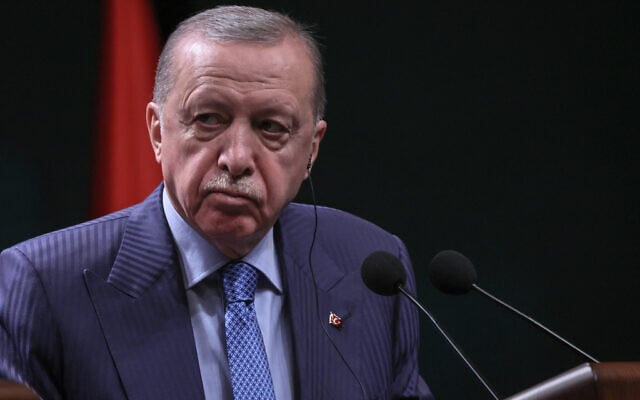
Turkey’s President Recep Tayyip Erdogan (R) attends a joint press conference with the German chancellor at the Presidential Complex in Ankara, on October 30, 2025. (Adem Altan/AFP)

A Turkish disaster relief team, sent to help efforts to recover the remains of those trapped under the rubble — including deceased Israeli hostages kidnapped in the October 7 attack and held by Hamas — has been stuck at the border because of Israel’s refusal to let them in, according to Ankara.

Azerbaijan is said to have expressed interest in participating in the ISF, and Indonesia has offered to do so.

“The countries we’ve spoken with say they will decide whether to send troops based on … the ISF’s mandate and authority,” Fidan said. “First, a general consensus needs to be reached on a draft, then it needs to be approved by the members of the Security Council.

“And it needs to be free from vetoes by any of the permanent [UNSC] members,” he added, referring to the US, a permanent Security Council member, which frequently vetoes resolutions in alignment with Israel.


Supreme leader says US military bases, Washington’s regional ‘interference’ another block, but if removed, along with backing of ‘accursed Zionist regime,’ he would consider it

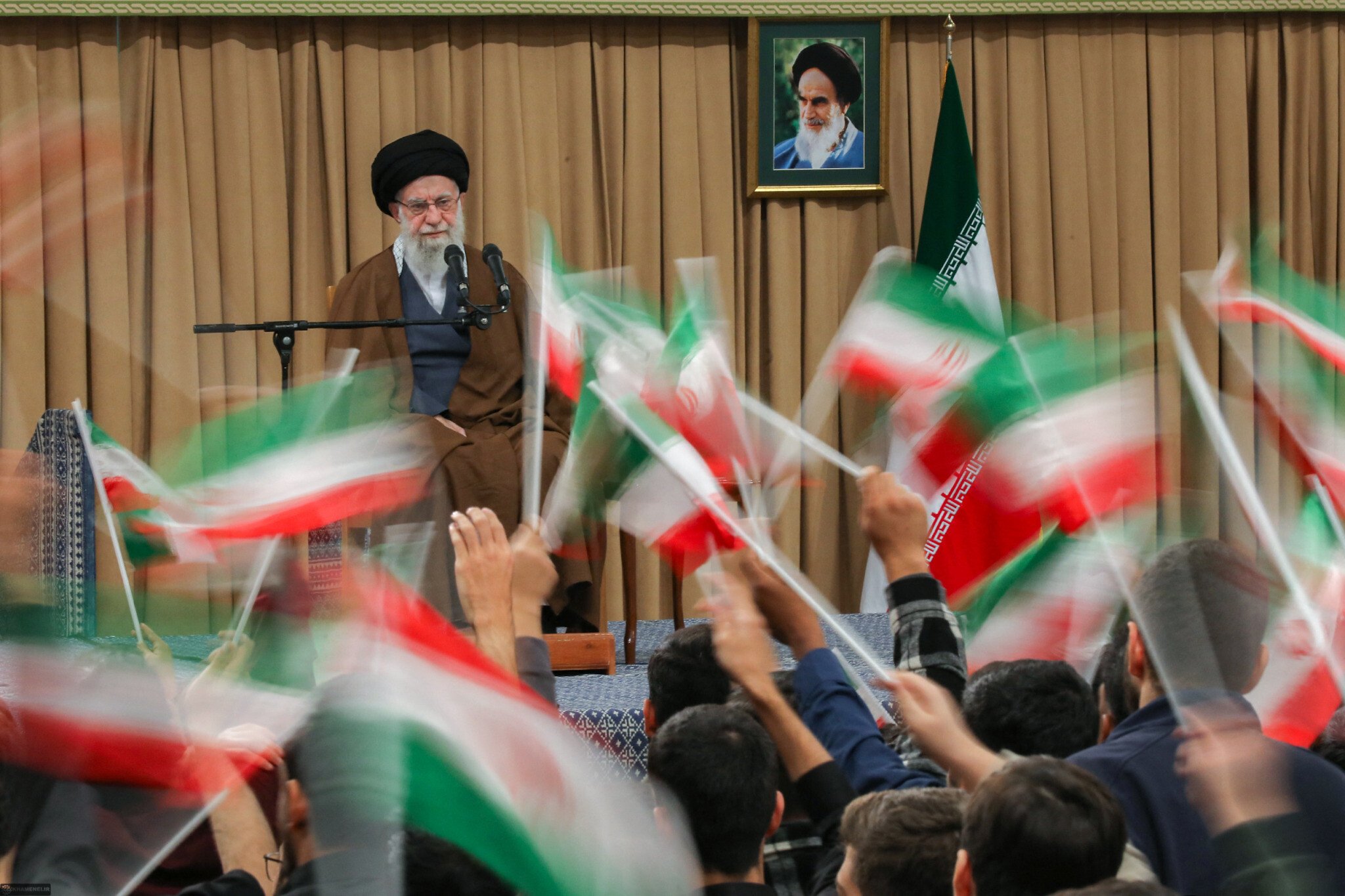
Iran's Supreme Leader Ayatollah Ali Khamenei addresses a meeting with students in Tehran on November 3, 2025. (Photo by KHAMENEI.IR / AFP)

Iran’s Supreme Leader Ayatollah Ali Khamenei addresses a meeting with students in Tehran on November 3, 2025. (Photo by KHAMENEI.IR / AFP)

Cooperation between Iran and the United States is not possible as long as Washington continues to support Israel and to maintain military bases and interfere in the Middle East region, Iran’s Supreme Leader Ayatollah Ali Khamenei said on Monday.

Khamenei’s comments came as US President Donald Trump’s administration seeks to increase pressure on Iran.

“The Americans sometimes say they would like to cooperate with Iran. Cooperation with Iran is not possible as long as the US continues to support the accursed Zionist regime, maintains military bases, and interferes in the region,” Khamenei said, according to state media.

“If they completely abandon support for the Zionist regime, withdraw their military bases from here (the region), and refrain from interfering in this region, then it (cooperation) can be considered,” said Khamenei.

“The arrogant nature of the United States accepts nothing other than submission.”

The remarks came during a gathering with students in Tehran marking the anniversary of the 1979 takeover of the US embassy following the Islamic Revolution, which toppled the Western-backed Shah.

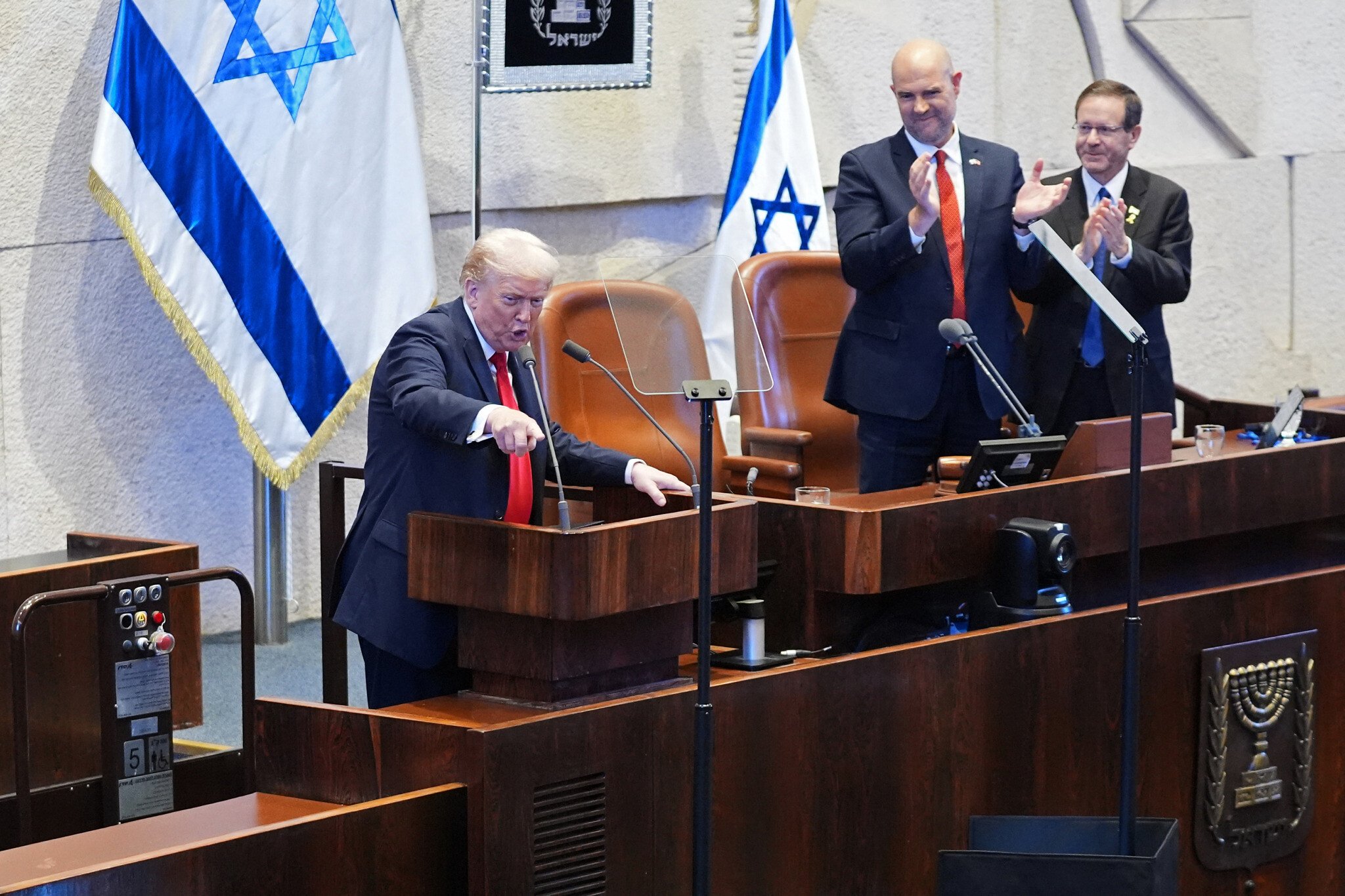
US President Donald Trump (L) speaks as Speaker Amir Ohana and Israel’s President Isaac Herzog applause at the Israeli parliament, the Knesset, in Jerusalem on October 13, 2025. (Photo by Evan Vucci / POOL / AFP)

Trump, during a visit to Israel in October, told the Knesset that the US is prepared to make a deal with Iran when Tehran is ready to do so, saying: “The hand of friendship and cooperation [with Iran] is open.”

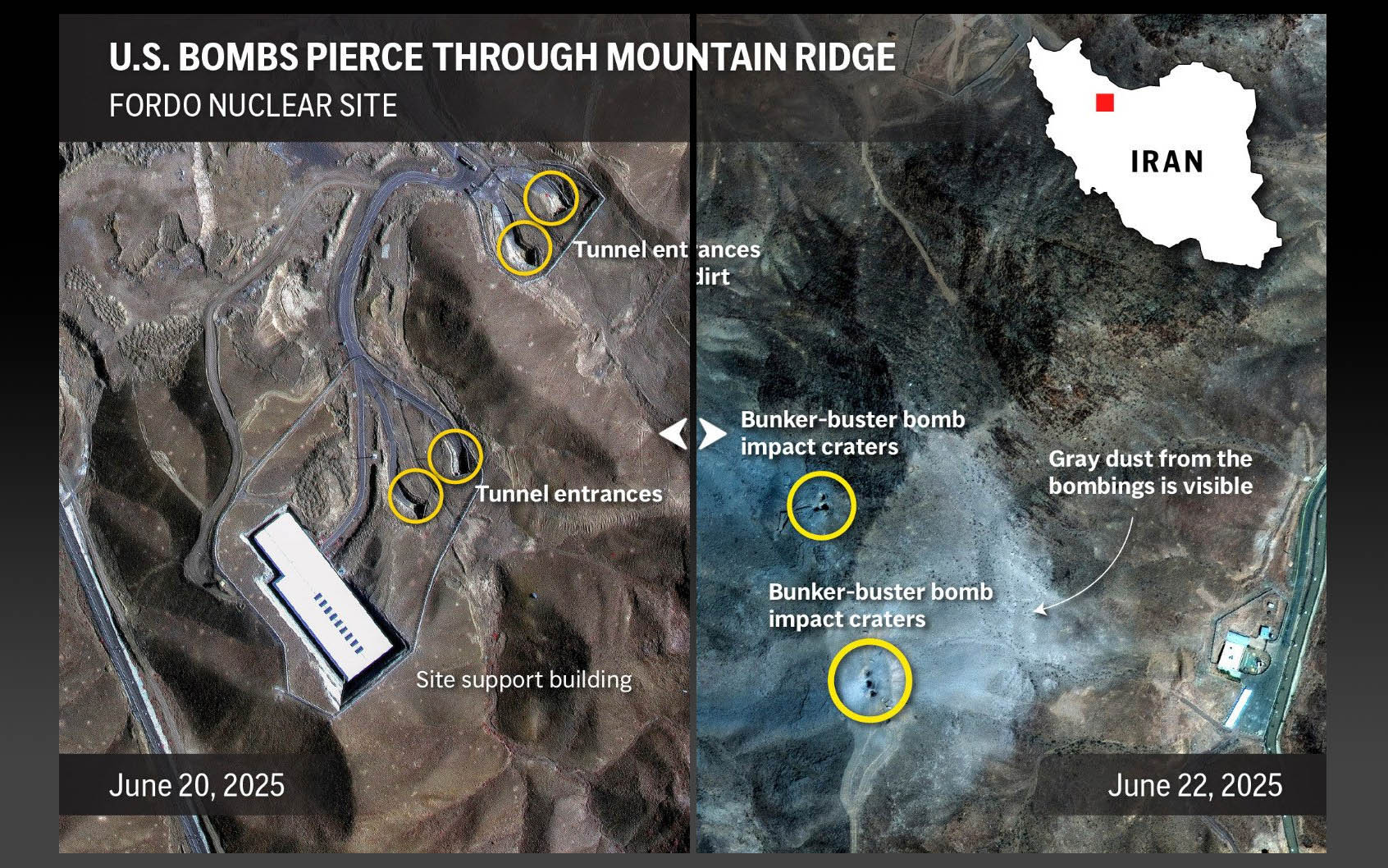
Washington and Tehran held five rounds of nuclear talks, prior to a 12-day war between Iran and Israel in June, which Washington joined by striking key Iranian nuclear sites long suspected to be part of a program geared toward developing nuclear weapons.

Tehran, which routinely calls for the destruction of Israel, maintains that its nuclear program is for purely civilian purposes. However, before the war, Iran had been enriching uranium to levels just below weapons-grade, which has no peaceful application.

Israel launched strikes, saying it was facing an immediate existential threat. Iran responded with missile and drone attacks on Israeli military sites and cities.

A ceasefire between Iran and Israel has been in place since June 24.

Iran, which has also funded a network of terror groups that seek Israel’s destruction, has rejected the notion of normalizing its relations with Jerusalem.

This graphic image compares Iran’s Fordo nuclear facility before and after the United States bombed the site on June 22, 2025. (AP Graphic/Imagery by Maxar Technologies/Graphic by Phil Holm)

Talks between Iran and the US have faced major stumbling blocks, such as the issue of uranium enrichment on Iranian soil, which Western powers want to bring down to zero to minimize any risk of weaponization, a plan that Tehran has rejected.

On Sunday, Iran’s President Masoud Pezeshkian told state media that Tehran will rebuild its nuclear facilities “with greater strength” while claiming again that the country does not seek atomic weapons.

A day earlier, Iran’s Foreign Minister Abbas Araghchi said Tehran has no desire for direct talks with the US over its nuclear or missile program and insisted that the Islamic Republic would not give up its ability to enrich uranium.

Trump has warned that he would order fresh attacks on Iran’s nuclear sites should Tehran try to restart operations at facilities that the US bombed in June.

upreme leader says US military bases,

me leader says US military bases,