
November 2, 2025 3:56 pm

by i24 News and Algemeiner Staff

The Mossad recruitment ad. Photo: Screenshot.

i24 News – Former Mossad director Yossi Cohen said in an interview with Fox News on Friday that Iran’s nuclear program had been “wiped out,” describing it as a turning point in Israel’s security posture and regional diplomacy.

Cohen claimed that Iran’s nuclear enrichment capabilities had been eliminated following joint Israeli-American strikes earlier this year.

“Iran is in a very different position,” he said. “They can no longer enrich uranium at present.” He echoed former US President Donald Trump’s earlier remarks that Iran’s nuclear facilities had been “wiped out” during the operation.

Calling the strikes a “great success,” Cohen said the mission sent two messages to Tehran: that Israel could carry out such large-scale operations in coordination with the United States, and that it was prepared to strike again if Iran sought to resume uranium enrichment.

“We destroyed their air defenses, their Revolutionary Guard bases, and hunted them down even into their bedrooms in Tehran and other cities,” Cohen said, describing the extent of the offensive.

Turning to regional diplomacy, Cohen credited the Trump administration for its role in both the strikes and broader mediation efforts in the Middle East. He said the recent ceasefire between Israel and Gaza could open the door to a “reconstruction of relations” across the region and renewed peace talks inspired by the Abraham Accords.

Cohen also mentioned Saudi Arabia’s growing engagement, noting that Crown Prince Mohammed bin Salman was expected to visit Washington soon for discussions with US officials. “Not only is this visit important for him, but also for us in the region,” he said.

He added that other Muslim-majority countries, including Indonesia, had shown interest in potential peace initiatives. “We should expect to see more peace treaties in the near future,” Cohen said. “I believe we will witness a better Middle East.”


Iran’s nuclear facilities were targeted in Operation Rising Lion in June, leaving them “obliterated” according to Yossi Cohen, former head of the Mossad.

Iran's President Masoud Pezeshkian addresses the 80th United Nations General Assembly (UNGA) at the U.N. headquarters in New York, U.S., September 24, 2025.
Iran’s President Masoud Pezeshkian addresses the 80th United Nations General Assembly (UNGA) at the U.N. headquarters in New York, U.S., September 24, 2025.(photo credit: REUTERS/JEENAH MOON)
Tehran will rebuild its nuclear facilities “with greater power,” Iran’s President Masoud Pezeshkian told state media on Sunday, adding that the country does not seek a nuclear weapon.

US President Donald Trump has warned that he would order fresh attacks on Iran’s nuclear sites should Tehran try to restart facilities that the United States bombed in June.

Pezeshkian made his comments during a visit to the country’s Atomic Energy Organization, during which he met with senior managers from Iran’s nuclear industry.

n claims program for civilian purposes

“Destroying buildings and factories will not create a problem for us; we will rebuild and with greater strength,” the Iranian president told state media.

Tehran maintains that its nuclear program is for purely civilian purposes.

“It’s all intended for solving the problems of the people, for disease, for the health of the people,” Pezeshkian said in reference to Iran’s nuclear activities.

An Iranian missile system is displayed next to a banner with a picture of Iran's Supreme Leader Ayatollah Ali Khamenei during Iranian Defence Week, in a street in Tehran, Iran, September 25, 2025. (credit: MAJID ASGARIPOUR/WANA)
An Iranian missile system is displayed next to a banner with a picture of Iran’s Supreme Leader Ayatollah Ali Khamenei during Iranian Defence Week, in a street in Tehran, Iran, September 25, 2025. (credit: MAJID ASGARIPOUR/WANA)

Iran’s nuclear facilities were targeted in Operation Rising Lion in June, leaving them “obliterated” according to Yossi Cohen, former head of the Mossad. Cohen claimed that he knows with certainty that “Iran cannot enrich any more uranium these days.”

In June, US President Trump said at a press conference that all the enriched uranium Iran had was inside sites bombed during the operation, calling Iran’s nuclear program “completely and totally obliterated.” At the time, Trump said he was unsure if the US needed to make a deal with Iran at all due to the levels of destruction at the Iranian nuclear facilities.

‘Keep dreaming,’ Ayatollah tells Trump

However, in October, Iranian Supreme Leader Ayatollah Ali Khamenei claimed that the US had not destroyed Iran’s nuclear industry, telling President Trump to “keep dreaming.

Iran has recently scrapped a cooperation deal that it signed with the UN nuclear watchdog IAEA in September, its Supreme National Security Council Secretary announced on the same day, according to state media.

This announcement comes after the US announced its intentions to resume nuclear weapons testing on Thursday, with Iranian officials condemning the decision.


Poll: Support for Hamas continues to grow among Palestinian Arabs

80% of Palestinian Arabs seek to oust PA Chairman Abbas, while a growing number want Hamas in charge.

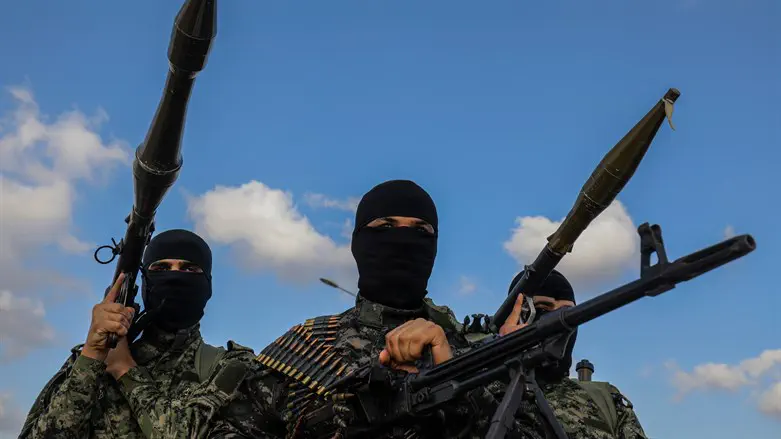
Hamas terroristsAbed Rahim Khatib/Flash90

A new opinion poll by the Ramallah-based Palestinian Center for Policy and Survey Research (PCPSR) has found a significant drop in support for Palestinian Authority Chairman Mahmoud Abbas.

According to the poll’s findings, 80% of Palestinian Arabs believe that Abbas should step down, with only 13% supporting the chairman.

77% of respondents said they believe that the PA should not be the one to control the Gaza Strip, but rather Hamas should.

Political analyst Mohsen Saleh noted that the poll results are not surprising, but rather reflect a consistent trend, especially during the last few years and after the October 7th Massacre, as six consecutive polls by the center have shown.

He added that “Abbas responded to Israeli and American pressures by excluding resistance forces, especially Hamas, from political participation, and that the decrees he issued were designed to ensure results tailored to his own and the Fatah movement’s needs.”

Saleh also stated that the Palestinian leadership’s approach after the October 7th Massacre was negative, and it persecuted resistance operatives in Judea and Samaria in collaboration with Israel during the war. “The Palestinian street now sees resistance as the only response to this reality.”