Israeli drone strikes kill six Syrian soldiers near Damascus, according to Syrian state media. The alleged attack comes amid reports of a potential security agreement between Israel and Syria. Israel has not commented.

Air strike in Damascus (archive)REUTERS

Six Syrian soldiers were killed in Israeli drone strikes in the Damascus countryside, state-run El Ekhbariya TV reported early on Wednesday.

According to the report, the attack took place in the Al-Kiswah area, a rural area southwest of the Syrian capital, but no further details were provided regarding the extent of the damage or the identity of the targets attacked.

Israel has not yet commented on the report.

The alleged Israeli strike comes amid reports that Israel and Syria are on the verge of signing a security agreement.

A report on Monday on i24NEWS stated that the Trump administration is actively working to broker a preliminary security understanding between Israel and Syria ahead of the United Nations General Assembly meeting in September.

US envoy to Syria Tom Barrack later stated that Israel and Syria are not close to signing an agreement.

Speaking to Axios’ Barak Ravid, Barrack said, “They have mutual intent and desire but at the moment, there is still more work to do.”

Even during the talks with the new Syrian government, the IDF has continued to strike targets in Syria that pose a threat to Israel.

On Sunday, the IDF revealed that soldiers from the 474th (Golan) Brigade under the command of the 210th Division conducted several raids last week to locate weapons and apprehend and interrogate suspects in southern Syria.

While searching various locations simultaneously, the forces located weapons’ storehouses containing rocket-propelled grenades, explosive devices, Kalashnikov assault rifles, and a large amount of ammunition.

The forces, together with field interrogators from Unit 504, arrested the suspects following intelligence indications gathered over the past few weeks.

Meanwhile, Defense Minister Israel Katz declared on Tuesday that the IDF will continue to hold Mount Hermon and maintain the necessary security zone to defend communities in the Golan Heights and Galilee.

“We will not allow the Israel-Syria border to become a threat to our communities,” he stressed.


Iran nuclear talks resume amid sanctions threat

Nuclear talks between Iran and Europe to resume on Tuesday, as the Europeans threaten sanctions over Iran’s uranium enrichment program.

Iran nuclear program

Iran nuclear programiStock

Amid rising tensions following a 12-day war with Israel and subsequent US strikes, nuclear talks between Iran and European powers are set to resume Tuesday in Geneva, Reuters reported.

The meeting marks the second such round of talks since the conflict began in mid-June.

Iran, which suspended its cooperation with the United Nations nuclear watchdog following the war, pointed to the International Atomic Energy Agency’s failure to condemn the Israeli and US strikes on its nuclear facilities.

The European trio – Britain, France, and Germany – have threatened to trigger the “snapback mechanism” under the 2015 nuclear deal, formally known as the Joint Comprehensive Plan of Action (JCPOA). This would reimpose UN sanctions that were lifted under the agreement unless Iran curbs its uranium enrichment and restores cooperation with IAEA inspectors.

The Foreign Ministers of Iran and the three European powers held a conversation this past Friday and announced their intention to resume discussions aimed at reviving full negotiations over curbing Iran’s uranium enrichment efforts, though an Axios report suggested the call was tense and failed to achieve progress.

Iran, which has always denied wanting a nuclear weapon, disputes the legality of invoking the clause, accusing the Europeans of not honoring their commitments under the accord.

“The Iranian nation will stand with all of its power against those who have such erroneous expectations,” Khamenei said, according to Iranian state media. “They want Iran to be obedient to America.”


August 25, 2025 3:21 pm

by David Swindle 

The prospect of Iran attacking the US homeland remains a serious threat as it maintains many avenues to pursue should the Islamic regime in Tehran seek to retaliate against Washington for bombing Iranian nuclear facilities in June, according to a new report by a top counter-terrorism analyst.

In the August 2025 issue of CTC Sentinel, a publication of West Point’s Combating Terrorism Center, Matthew Levitt, the Fromer-Wexler senior fellow and director of the Reinhard program on counterterrorism and intelligence at the Washington Institute for Near East Policy, detailed the nature of the threat.

“The 12-day Iran war [with Israel] may be over, but the threat of Iranian reprisal attacks now looms large, and will for the foreseeable future,” Levitt posted Friday on X, summarizing his findings. “Potential pathways for an Iranian attack on the US include deploying Iranian agents, criminal surrogates, terrorist proxies, or actively seeking to inspire lone offenders to carry out attacks within the homeland.”

Following the US strikes on Iran’s nuclear sites, law enforcement agencies across the country ramped up surveillance of Iran-backed operatives amid growing fears of retaliation.

Levitt explained that “Iran and its proxies have spent years investing in a ‘homeland option.’ In just the past five years, US authorities have disrupted at least 17 Iranian plots in the United States. These have included both Iranian operatives as well as criminal proxies. Other cases that fell short of plotting for a specific attack include a Hezbollah operative in Texas who purchased 300 pounds of ammonium nitrate, an explosive precursor, and another who carried out surveillance missions in New York and Canada.”

Iran has also sought to inflame anti-Israel activism.

The CTC Sentinel analysis cited a US Department of Homeland Security report from October 2024 which stated that “Iranian information operations have focused on weakening US public support for Israel and Israel’s response to the Oct. 7, 2023, Hamas terrorist attack [against southern Israel]. These efforts have included leveraging ongoing protests regarding the conflict, posing as activists online, and encouraging protests.”

Levitt noted that top targets of terrorism could include government officials, Iranian dissidents, Israelis, or Jews. “If there were ever a time Iran would want to activate its homeland option, this would be it,” he stated. “But even if the next few weeks pass without any attack, the threat will persist.”

In June, US Attorney General Pam Bondi warned in congressional testimony of the threat posed by Iran-directed terrorism. “We are working hand in hand with all of our agencies to protect Americans and to keep us safe,” she said.

Tehran’s ability to coordinate or inspire attacks on American soil has long been a concern for US law enforcement and intelligence officials — especially the role of so-called “sleeper cells,” covert operatives or terrorists embedded in rival countries who remain dormant until they receive orders to act and carry out attacks.

Levitt described terrorism as “an extension of foreign policy” for Iran, enabling strikes against enemies with superior military capabilities. He quoted a CIA report that stated, “Tehran has used terrorism increasingly to support Iranian national interests.”

However, he also noted that religious fundamentalism still guides the leaders in Tehran too, again citing the CIA which stated the country’s leaders believe Iran “has a religious duty to export its Islamic revolution and to wage, by whatever means, a constant struggle against the perceived oppressor states.”

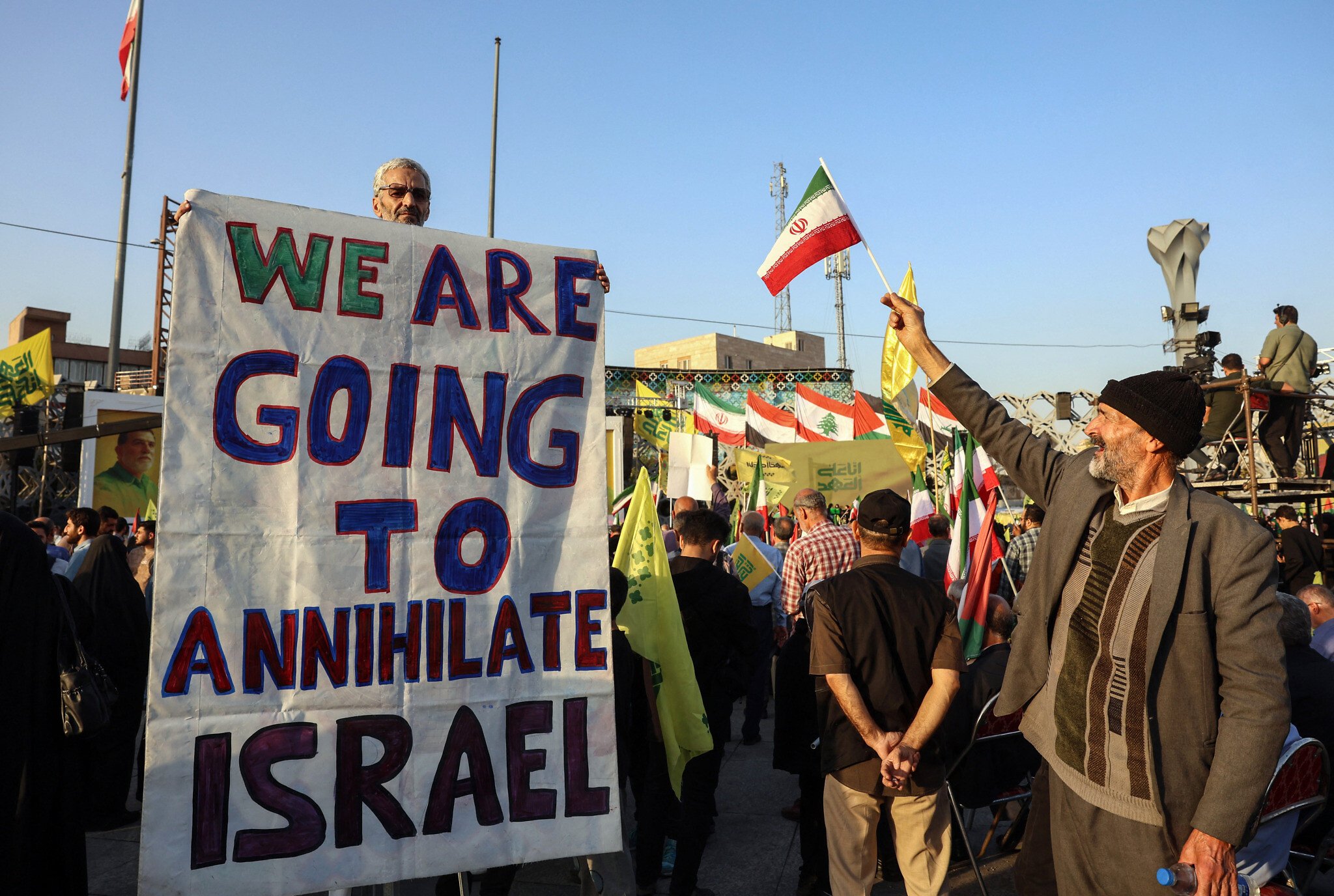
On Sunday, Iranian Supreme Leader Ayatollah Ali Khamenei expressed this theology which undergirds his regime’s genocidal quest to murder Jews and conquer Israel.

“They want Iran to be obedient to America. The Iranian nation will stand with all of its power against those who have such erroneous expectations,” Khamenei said in a speech, according to Iranian state media. “People who ask us not to issue slogans against the US … to have direct negotiations with the US only see appearances … This issue is unsolvable.”

Khamenei added that “the enemies, after facing the steadfast unity of the nation, officials, and armed forces, and after suffering heavy defeats in military attacks, have realized that Iran and the Islamic system cannot be subdued by war or forced into obedience.”

Levitt noted a Homeland Threat Assessment for 2025 from the Department of Homeland Security which stated, “We expect Iran to remain the primary sponsor of terrorism and continue its efforts to advance plots against individuals — including current and former US officials — in the United States.”

The Jan. 3, 2020, targeted killing of Qassem Soleimani, the commander of the Quds Force of Iran’s Islamic Revolutionary Guard Corps (IRGC), remains a feature of Iranian propaganda with vows to strike at the US officials involved in the decision.

Analyzing a video put out by the regime, Levitt described how “the screen soon pans to a bulletin board covered in images of US officials, including President Trump, former National Security Advisor Robert O’Brien, former Chairman of the Joint Chiefs of Staff General Mark Milley, and about a dozen others. The picture fades, the music crescendos, and text appears on a black screen: ‘The perpetrators of general Soleimani’s martyrdom will be punished for their actions.’”