Trump: Israel no longer commands Congress like it once did

President Donald Trump tells Daily Caller Israel’s once-dominant lobby in Congress has weakened: They may be winning the war, but they’re not winning the world of public relations, and it is hurting them.
Donald Trump

Donald TrumpWhite House, Joyce N. Boghosian

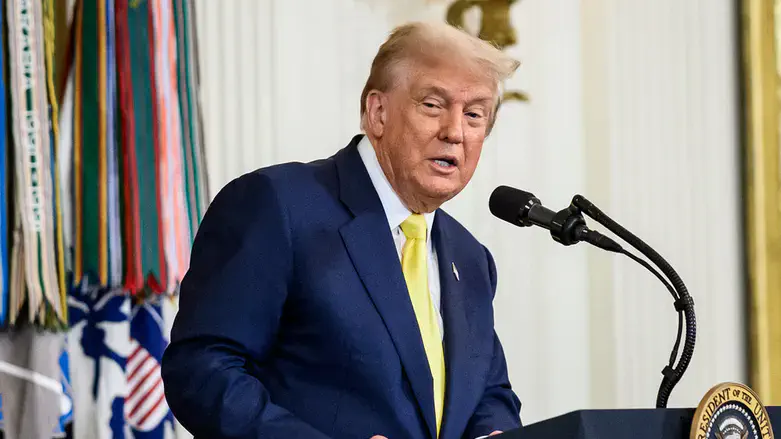
In an interview with the Daily Caller, which was conducted on Friday and of which excerpts were published on Monday, US President Donald Trump acknowledged a growing skepticism toward Israel among younger Republicans and lamented the weakening of Israel’s once-dominant influence in Congress.

Referencing a March Pew Research Center poll, Daily Caller correspondent Reagan Reese noted that 50% of Republicans under 50 now hold an unfavorable view of Israel—up from 35% in 2022.

Trump responded, “Yeah I’m aware of it. So, Israel is amazing… Look, nobody has done more for Israel than I have.”

Trump pointed to his administration’s actions against Iran and reiterated his longstanding support for Israel. At the same time, he expressed surprise at the erosion of Israel’s lobbying power, “Israel had the strongest lobby in Congress… Today, it doesn’t have that strong a lobby. It’s amazing.”

He attributed the shift to progressive voices in Congress, saying, “You have AOC plus three, and you have all these lunatics… They’ve changed it,” a reference to Rep. Alexandria Ocasio Cortez and the other members of “The Squad”, known for thei anti-Israel actions.

“And you know, you have people that deny it ever happened, they’re deniers. You have people that deny the Holocaust ever happened. So, they’re gonna have to get that war over with. But it is hurting Israel. There’s no question about it. They may be winning the war, but they’re not winning the world of public relations, you know, and it is hurting them. But Israel was the strongest lobby 15 years ago that there has ever been, and now it’s, it’s been hurt, especially in Congress,” he said.


Hundreds of senior Israeli security veterans send letter to Trump administration and recommend five governing principles for a Gaza “morning after” plan:

US PRESIDENT Donald Trump and Prime Minister Benjamin Netanyahu meet in the Oval Office in April. In ignoring an Arab offer, the US and Israel have sentenced Israelis and Gazans to continued bloodshed, say members of Commanders for Israel’s Security.
(photo credit: KEVIN MOHATT/REUTERS)
By ignoring a dramatic Arab offer, Jerusalem and Washington sentenced Israelis and Gazans to continued bloodshed, while depriving Israel of a historic regional opportunity.

Twice over the past months, a powerful Arab coalition, mostly hostile to Hamas (which is outlawed by some), presented plans for a Hamas-free Gaza Strip.

First, in March, the Arab League embraced an Egyptian plan for Gaza rehabilitation and reconstruction, refuting US President Donald Trump’s claim that doing so requires massive deportation of the strip’s over two million residents.

Following a thorough analysis of the two plans and ensuing conversations with some of their authors, members of Commanders for Israel’s Security (CIS) reached three conclusions.

An illustrative photo of Hamas terrorists with hostage demonstrations in the background.  (credit: Miriam Alster/Flash90, Reuters/Ibraheem Abu Mustafa)
An illustrative photo of Hamas terrorists with hostage demonstrations in the background. (credit: Miriam Alster/Flash90, Reuters/Ibraheem Abu Mustafa)

First, the governing principles of those plans meet Israeli security needs, offer a Hamas-free postwar Gaza, and pave the way for upgrading our national security via integration in a powerful regional coalition.

Second, that the plans are hardly perfect, and at least one major flaw must be addressed: the endorsement of the Palestinian “right of return.” As no plan involving an intent to flood Israel with refugees can be considered, the plans’ sponsors have acknowledged their blunder and undertook to correct it.

Third, Israeli government veto of any such plan has nothing to do with its merits – security or otherwise. It stems primarily from the dominance of a security-ignorant, ideology-driven messianic minority in the cabinet.

Consequently, it was concluded that there is value in providing the lead mediator – Trump – with a powerful security validator for an Israeli national-interests-based plan, in the form of CIS, Israel’s largest group of former IDF generals and colonels, as well as Mossad, Shin Bet, Israel Police, National Security Council, and foreign service equivalents.

orning after plan

Subsequently, late last week, CIS sent a letter to Trump and his senior staff, recommending five governing principles for a Gaza “morning after” plan:

  • End of war and return of all hostages – living and deceased.
  • An urgent surge in humanitarian assistance.
  • Coordinated phasing out of the IDF with the phasing in of a Hamas-free, alternative governance administration, tasked with addressing civil management, law and order, rehabilitation and reconstruction.
  • The alternative Gaza management is to comprise deployments – boots on the ground included – from Arab countries that have expressed willingness to shoulder that responsibility under the invitation of, and in coordination with, the Palestinian Authority.
  • All while preserving Israel’s inalienable right of self-defense.

We noted that by our and by reported IDF professional analyses, Hamas no longer poses a strategic threat, and the IDF has what it takes to deal with its residual terrorist capacity, remotely or otherwise, as has been the case with Hezbollah in Lebanon since the US-brokered ceasefire entered into force.

Once launched, we concluded, this plan can set the stage for the next phase of Trump’s historic Abraham Accords achievement. By normalizing Israel’s relations with Saudi Arabia and with other Arab and non-Arab Muslim states, Israel’s integration in a US-led powerful regional coalition is bound to contribute to the security, stability, and prosperity of all its members.

Rarely does a country face a situation characterized by these two: the choices are clear, and it is its call. That moment is here. Israel can persist with its current violent trajectory all the way to an open-ended bleeding occupation of Gaza, the continued “Gazafication” of the West Bank until it, too, explodes, regional and international isolation, and the loss of the pillars on which stands our strategic alliance with the US.

Yet, a powerful regional coalition stands ready to do much of the heavy lifting, once we choose the alternative. It is prepared to help extricate us from Gaza, coordinate with us its Hamas-free future, contribute to stabilizing the West Bank by helping reform the PA, and, finally, normalize relations and forge a joint coalition to stand up to Iran and its proxies while promoting regional stability and prosperity.

It is your call, says the coalition. All that stands in the way of this historic regional opportunity is your government’s refusal to end the war, remove the veto over PA involvement, and commit to an eventual negotiated resolution to the Israeli-Palestinian conflict.

A stark choice indeed. Or is it?

The writer is a former special envoy and policy adviser to the late prime minister Shimon Peres. He is a member of Commanders for Israel’s Security and a fellow with the Israel Policy Forum and the Economic Cooperation Foundation.


China and Russia back Iran in rejecting a European bid to reimpose UN sanctions, calling the snapback move “legally flawed” amid failed nuclear talks and rising tensions over uranium enrichment.

Nuclear Iran

Nuclear IraniStock

In a coordinated diplomatic move, China and Russia on Monday joined Iran in rejecting a European initiative to reimpose United Nations sanctions on Tehran. The effort, led by Britain, France, and Germany – collectively known as the E3 – seeks to activate the “snapback mechanism” embedded in the 2015 nuclear deal, which would restore sanctions lifted under the agreement.

The foreign ministers of China, Russia, and Iran signed a joint letter denouncing the European move as “legally and procedurally flawed”, according to Reuters.

The letter, shared by Iranian Foreign Minister Abbas Araghchi on X, accused the E3 of “abusing the authority and functions of the UN Security Council.”

The 2015 nuclear agreement, signed by Iran, the E3, China, Russia, and initially the United States, offered Tehran relief from international financial sanctions in exchange for curbs on its nuclear program. However, the US withdrew from the deal in 2018 under President Donald Trump, prompting Iran to exceed uranium production limits.

With the deal set to expire in October, the E3 triggered the snapback mechanism last week, citing Iran’s violations.

Araghchi stated after the E3 announcement last week that Iran is ready to resume “fair” negotiations over its nuclear program, provided the West shows “goodwill”.