
Syrian President accuses Israel of fueling unrest in south

Syrian President Sharaa blames Israel for unrest in the south and calls for dialogue to restore national unity, amid protests in Sweida and tensions over clashes between Druze and Bedouin groups.
Israel National News

Published: Aug 18, 2025, 5:25 AM (GMT+3)
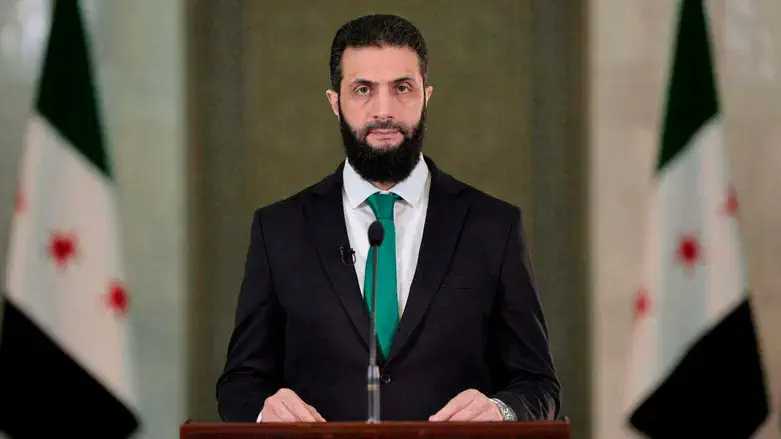
Syria's President Ahmed al-Sharaa

Syrian President Ahmed al-Sharaa on Sunday insisted that the path to restoring unity in his war-torn country must come through dialogue, not violence, while accusing Israel of inciting unrest in the south.

Sharaa’s remarks, broadcast by state television, came amid mounting tensions in the Druze-majority province of Sweida, where hundreds took to the streets following last month’s violent clashes between local Druze residents and Sunni Bedouin tribes. Demonstrators called for self-determination and denounced what they described as increasing sectarian strife.

“We still have another battle ahead of us to unify Syria, and it should not be with blood and military force… it should be through some kind of understanding because Syria is tired of war,” Sharaa said, as quoted by AFP, during a dialogue meeting with officials and tribal leaders from the northwestern Idlib region.

Rejecting calls for partition, the Syrian leader stated, “I do not see Syria as at risk of division. Some people desire a process of dividing Syria and trying to establish cantons… this matter is impossible.”

He further accused foreign actors, including Israel, of attempting to leverage regional tensions to their advantage. “Some parties seek to gain power through regional power, Israel or others. This is also extremely difficult and cannot be implemented,” he said.

Syrian armed forces were deployed to Sweida on July 15 to quell clashes between Bedouin tribes and Druze fighters that left over 1,000 dead.

The Syrian army eventually withdrew from Sweida after Israeli airstrikes and intense diplomatic pressure.

While Damascus claimed its forces had intervened to restore order, opposition sources, including the Syrian Observatory for Human Rights and local Druze factions, accused government troops of siding with Bedouin militants and committing atrocities, including alleged summary executions of Druze fighters.

“Sweida witnessed many violations from all sides… some members of the security forces and army in Syria also carried out some violations,” Sharaa acknowledged, adding that the government bears responsibility to “hold all perpetrators of violations to account,” regardless of affiliation.

Related articles:
Minister Chikli calls for elimination of Syrian President
‘Israel and Syria have agreed to a ceasefire’
IDF launches wave of airstrikes to protect Syrian Druze
‘We don’t trust al-Julani, we trust only G-d and the IDF’
The Syrian president directly accused Israel of exploiting the unrest to advance its interests. “Israel is intervening directly in Sweida, seeking to implement policies aimed at weakening the state in general or finding excuses to interfere in ongoing policies in the southern region,” he claimed.

Sharaa made similar accusations against Israel in a televised speech he delivered after the army left Sweida.


The Saudi channel Al-Arabiya reported that the Hamas delegation, which has been in Egypt in recent days, received a new proposal presented by representatives of Egypt and Qatar in mediation with the Palestinian Arab factions.

According to the report, the factions demanded that Hamas provide a response to the proposal within a few hours.


Iranian MP Abolfazl Zohrevand claims upgraded missiles can strike the US and cause nuclear-level damage, warns of an inevitable war unless Iran achieves full power and the US abandons global dominance.

Published:

https://www.israelnationalnews.com/news/413442

A senior Iranian lawmaker declared that Iran now possesses the capability to strike targets across the globe – including the United States and Canada – using advanced long-range missiles, which he claimed are capable of inflicting devastation equivalent to nuclear weaponry.

In an interview published July 27 on the Iranian website Tahririeh.com, Iranian MP Abolfazl Zohrevand, a member of the Majles National Security and Foreign Policy Committee, warned that Iran’s enhanced Khorramshahr-5 missile system serves as a powerful deterrent, capable of causing mass destruction. His remarks were translated by the Middle East Media Research Institute (MEMRI).

“When we say that the Khorramshahr-5 [missile] has been upgraded, and has a range of 12,000 km, a velocity of several Machs, and a 2-ton payload, and that it can hit a target with precision – do you know what this means? It means that the kind of [damage] normally caused by 2-3 nuclear bombs could also be achieved with 10 Khorramshahr-5 missiles. This is deterrence. If the U.S. or Canada or any other country plans to attack you, you can strike them back, [on their soil],” Zohrevand said.

He asserted that the ongoing hostility between Iran and the United States cannot be resolved through diplomacy, warning instead of an inevitable escalation unless one side is ultimately destroyed.

“The conflict between Iran and the United States will not be resolved. Either we remain in deterrence mode, with both sides making progress until an Armageddon-scale war erupts, or one of the sides is disintegrated, divided into many parts, and wiped out. This is what the Americans are currently pursuing, because they understand [the situation] and we do not. They know that if Iran continues this path, they can forget about controlling the world. They would not even be able to control the United States,” he said.

Zohrevand maintained that the only path forward for Iran is continued growth and expansion across all sectors to the point where it becomes untouchable.

“The only way to resolve the conflict between Iran and the United States is for Iran to grow continuously and achieve full development in all sectors, to the point where the other side would not even dare think ill of Iran,” he concluded.

Iran often touts its military accomplishments, though it is often difficult to verify the veracity of its claims.

In March, Iran’s Islamic Revolutionary Guard Corps (IRGC) stationed advanced missile systems on three key islands in the Gulf, claiming they can strike “enemy bases, vessels, and assets” in the region.

Earlier this year, Iran unveiled a new ballistic missile, claiming it has a range of 1,700 kilometers. The missile, named Etemad—meaning “trust” in Persian—was showcased at a ceremony in Tehran attended by President Masoud Pezeshkian.

The unveiling came just one day after Iran’s Revolutionary Guards Navy revealed a new underground missile facility along the country’s southern coast.

The facility, whose exact location was not disclosed, houses missile systems stored “hundreds of meters underground” and capable of being deployed swiftly, claimed Iranian media.

The Islamic Republic has also claimed it has equipped its drones with domestically-produced missiles incorporating artificial intelligence (AI) technology.