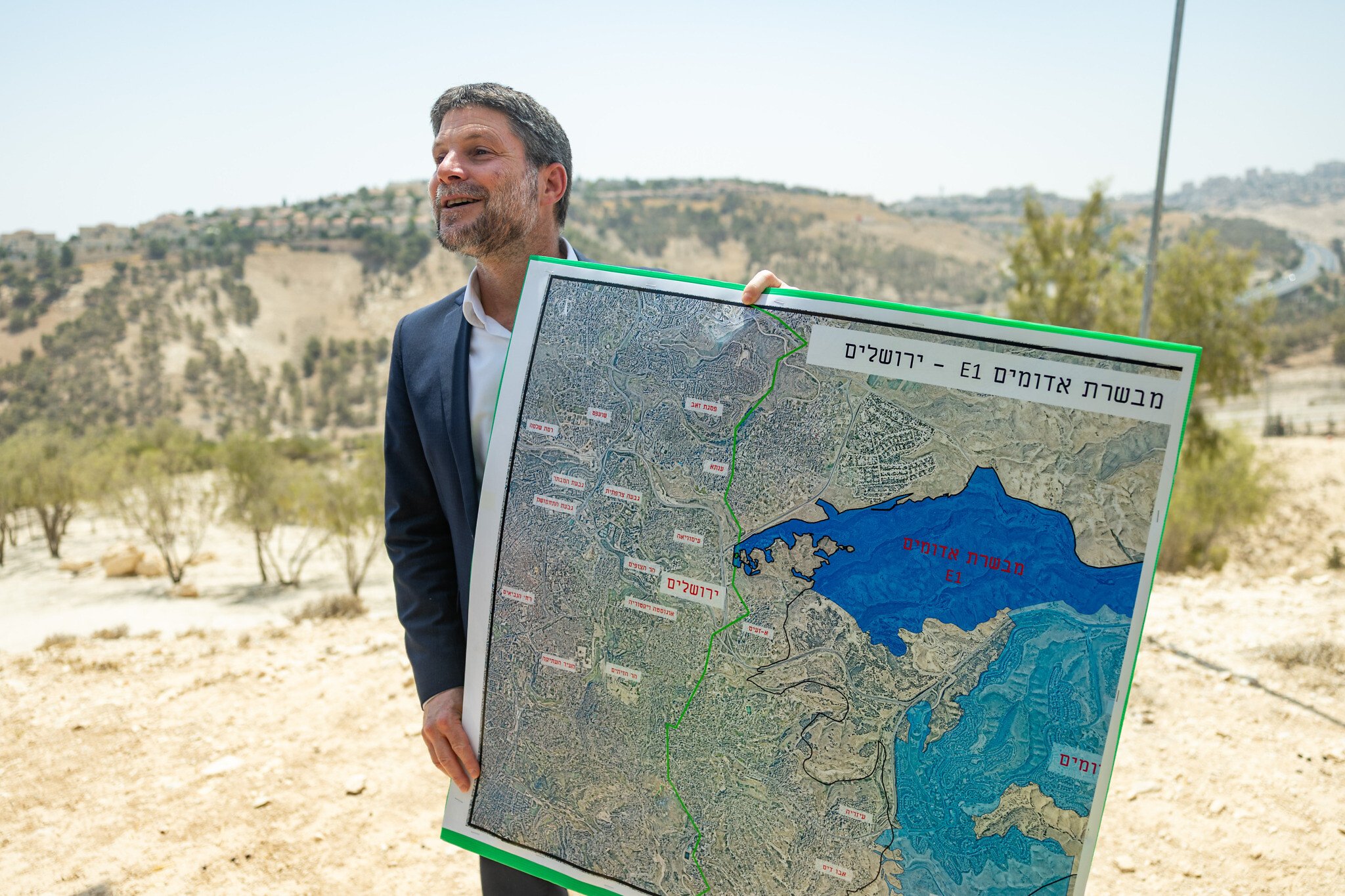
Europe, Arab countries and the United Nations, alongside Israeli rights groups, on Thursday assailed a government plan to greenlight the construction of thousands of Israeli homes in a contentious area of the West Bank, after the move was announced by Finance Minister Bezalel Smotrich.
The far-right politician said that he intends to approve tenders to build more than 3,000 housing units in the controversial E1 settlement project between Jerusalem and Ma’ale Adumim, a plan that he claimed Thursday “buries the idea of a Palestinian state.”
The UN called on Israel to reverse its decision, UN spokesperson Stephane Dujarric said on Thursday. “It would put an end to prospects of a two-state solution,” he told reporters. “Settlements go against international law… further entrench the occupation.”
The EU urged Israel “to desist” from its plan, with top diplomat Kaja Kallas saying in a statement, “The decision of Israeli authorities to advance the E1 settlement plan further undermines the two-state solution while being a breach of international law.”
The plan was also condemned by British Foreign Minister David Lammy, who said it marked a breach of international law and must be stopped immediately.
“The UK strongly opposes the Israeli government’s E1 settlement plans, which would divide a future Palestinian state in two and mark a flagrant breach of international law. The plans must be stopped now,” Lammy said in an emailed statement.
Norway’s Foreign Minister Espen Barth Eide said the move shows Israel “seeks to appropriate land owned by Palestinians in order to prevent a two-state solution.”

Norwegian Foreign Affairs Minister Espen Barth Eide addresses the media during a press conference at NATO’s headquarters in Brussels on April 4, 2025. (Nicolas Tucat/AFP)
Egypt came out firmly against the plan, with Cairo’s Foreign Ministry denouncing the minister’s “extremist statements,” saying they serve as a “new indication of Israeli deviation and arrogance.”
The Egyptian ministry linked Smotrich’s announcement to Prime Minister Benjamin Netanyahu’s remark earlier this week in an i24News interview in which the prime minister acknowledged a connection to the expansionist vision of a “Greater Israel.”
Qatar, which has mediated between Hamas and Israel in efforts to secure a ceasefire in Gaza, joined Egypt in denouncing Smotrich’s actions as a “blatant violation of international law.”
A spokesman for Palestinian Authority President Mahmoud Abbas called on the United States to pressure Israel into halting the plan.
Speaking separately to the Associated Press, PA Foreign Ministry official Ahmad al-Deek called the plan “colonial, expansionist and racist” and claimed that it is par for the course for Netanyahu’s ruling coalition.
“It falls within the framework of the extremist Israeli government’s plans to undermine any possibility of establishing a Palestinian state on the ground, to fragment the West Bank and to separate its southern part from the center and the north,” he said.
The E1 settlement project has been frozen for decades amid fierce opposition from the international community, including past US administrations, which feared the new settlement neighborhood would prevent the establishment of a contiguous, viable Palestinian state.
The plan would connect the Jerusalem and Ma’ale Adumim metropolitan areas, while simultaneously scuttling the prospect of a contiguous Palestinian presence between the population centers of Bethlehem, East Jerusalem, and Ramallah, which has long been considered the basis for a Palestinian state.
The construction scheme is scheduled to receive final approval from the government’s Higher Planning Council next week, on August 20.

A picture taken from the controversial E1 corridor in the West Bank shows the settlement of Ma’ale Adumim in the background, Feb. 25, 2020. (Ahmad Gharabli/AFP)
Israeli rights groups also condemned the plan, with the anti-settlement watchdog organization Peace Now warning that resuming construction in E1 is “deadly for the future of Israel and for any chance of achieving a peaceful two-state solution.”
“We are standing at the edge of an abyss, and the government is driving us forward at full speed. There is a solution to the Israeli-Palestinian conflict and to the terrible war in Gaza — the establishment of a Palestinian state alongside Israel — and it will ultimately come. The government’s annexation moves are taking us further away from this solution and guaranteeing many more years of bloodshed,” the group said in a statement.
Breaking the Silence, a left-wing group established by former Israel Defense Forces soldiers, accused Smotrich of encouraging West Bank settlement activity as the Gaza war continued to capture global attention.
“This land grab and settlement expansion will not only further fragment the Palestinian territory, but will further entrench apartheid,” it said.
Plan is ‘answer on the ground’ to Palestinian state recognition
Smotrich — who, in addition to being finance minister, holds a junior ministerial position within the Defense Ministry that gives him wide say over settlement construction — said Thursday that Netanyahu supported the controversial plan, as the premier remained mum on the dramatic step.
“He backs me up in everything concerning Judea and Samaria, and is letting me create the revolution,” Smotrich said at an event in Ma’ale Adumim organized by the Yesha Council, the umbrella organization representing local authorities in settlements.
“After 20 years of delays… the traffic jam has been broken [and] the E1 plan is underway,” he continued, adding that the government is “fulfilling the promise and connecting Ma’ale Adumim with a strategic, security and demographic connection, which ensures our united capital for generations.”
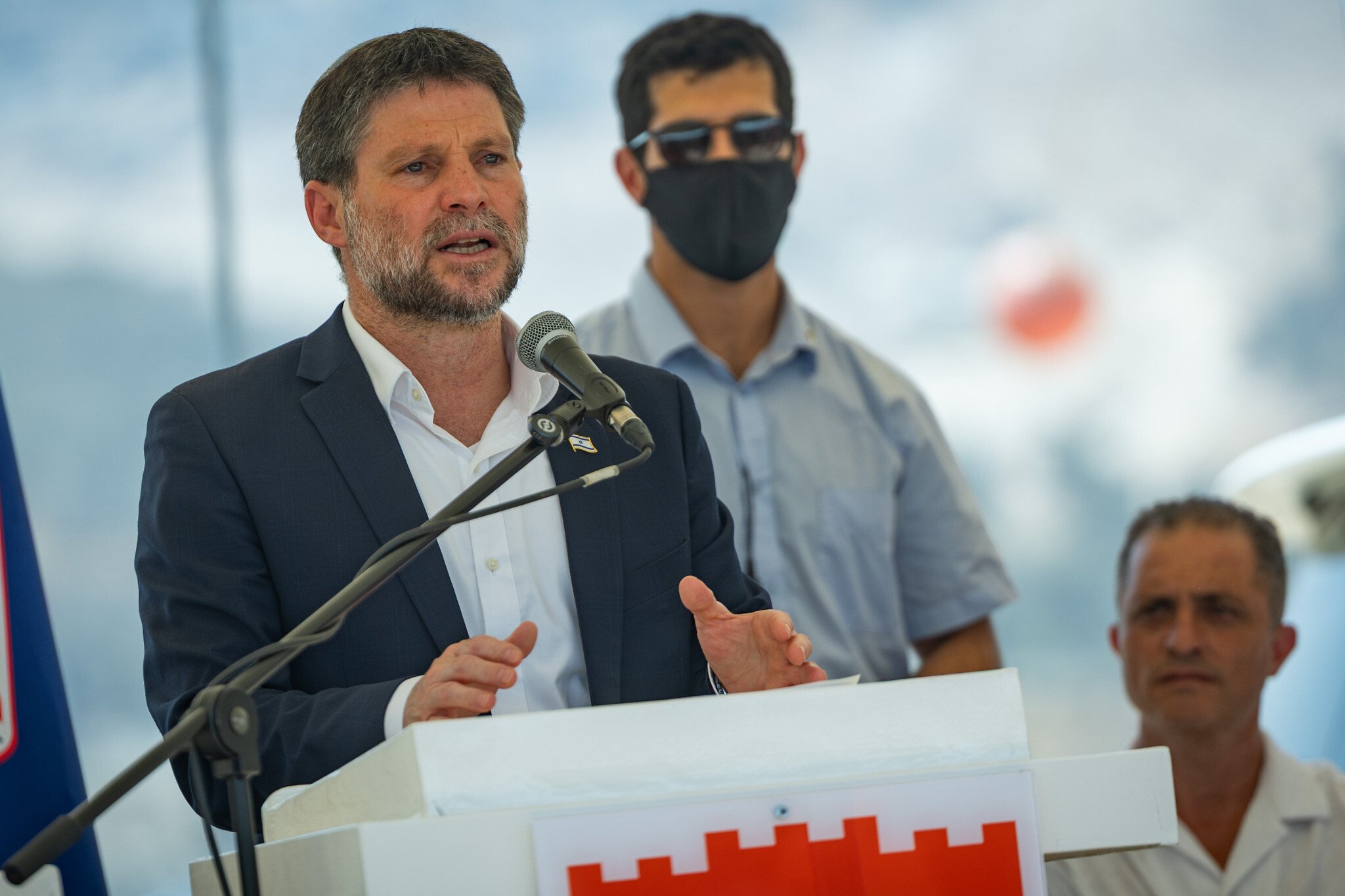
Finance Minister Bezalel Smotrich attends a press conference announcing his plans to approve more than 3,000 housing units in the E1 settlement project between Jerusalem and Ma’ale Adumim on August 14, 2025. (Yonatan Sindel/Flash90)
Smotrich said that the resumption of the long-frozen project was a response to a wave of Western countries that announced or floated plans to recognize a Palestinian state at the United Nations in September.
“Today, anyone in the world who tries to recognize a Palestinian state will receive an answer from us on the ground,” he declared. “Today we are writing a historic chapter in the story of the redemption of the people of Israel in their land.”
He also claimed that US President Donald Trump and Ambassador Mike Huckabee backed the step, hailing them “men of truth with a clear and distinct moral voice that is not confused by the hypocrisy of the West.”
Trump and Huckabee did not comment specifically on Smotrich’s E1 announcement as of Thursday afternoon. The US State Department, however, issued a vague statement stressing the importance of “stability” in the West Bank in response to reporters’ queries about the plan.
“A stable West Bank keeps Israel secure and is in line with the Trump administration’s goal to achieve peace in the region,” said a statement from the agency.
“We remain focused on ending the war in Gaza and ensuring Hamas will never govern Gaza again, freeing the hostages, including the remains of two Americans, and facilitating the delivery of critically needed humanitarian assistance,” the statement continued, indicating that the US is less focused on developments in the West Bank than those in Gaza.
Jacob Magid contributed to this report.