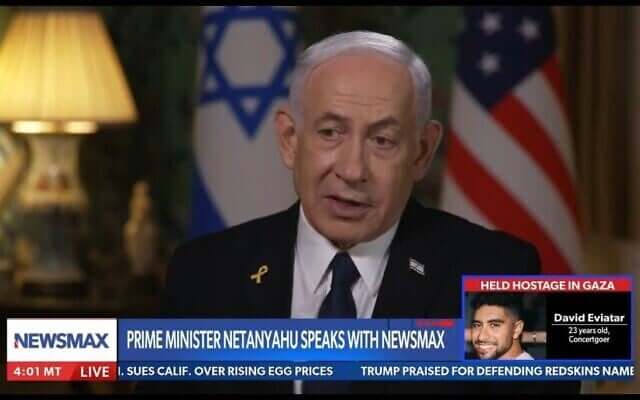
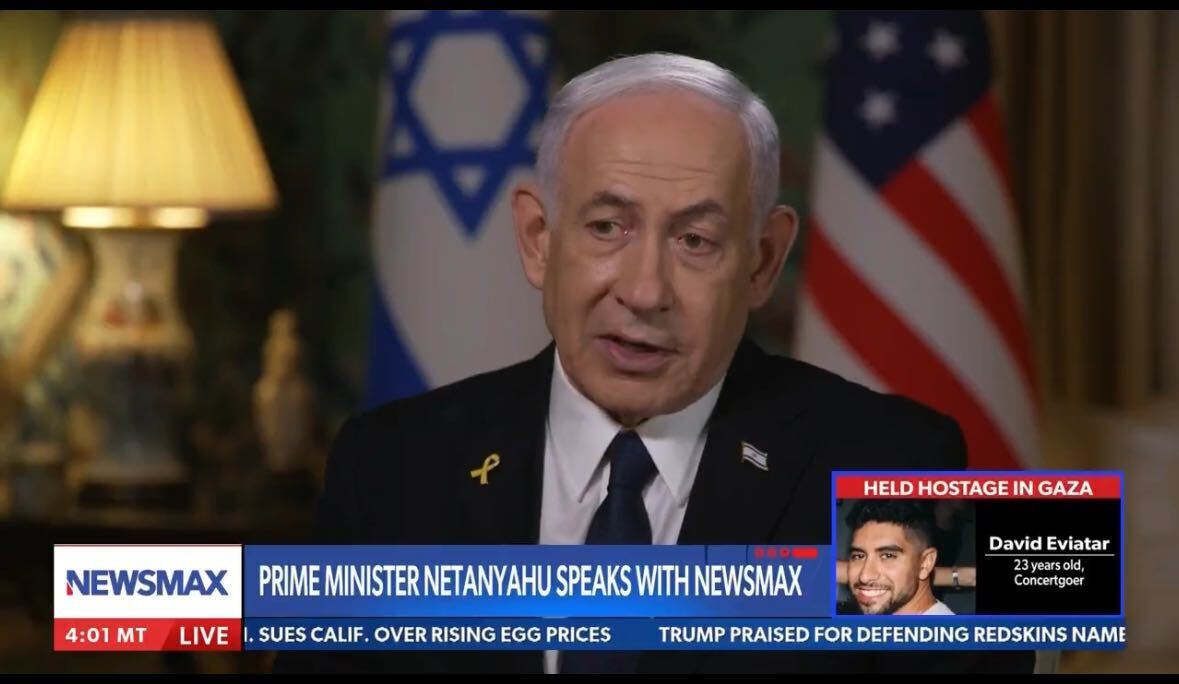
WASHINGTON — Prime Minister Benjamin Netanyahu expressed optimism on Thursday that a hostage release deal with Hamas could be sealed in the near future.
“I hope we can complete it in a few days,” he told Newsmax’s Greta Van Susteren in an interview before flying back to Israel while indirect talks continued in Qatar amid signs of deadlock.
“We’ll probably have a 60-day ceasefire. Get the first batch out and then use the 60 days to try to negotiate an end to this,” he said on the last day of a four-day visit in which he met US President Donald Trump twice. “And this could end tomorrow, today, if Hamas lays down its arms.”
“We think we can bring it to completion,” said Netanyahu. “So I wouldn’t tell you that we have a war goal that is unachievable. We’re going to defeat these monsters and get our hostages back.”
Netanyahu granted three interviews to US media during his trip, but no interviews to the Israeli press.
Amid reports that the Trump administration does not intend to allow Israel to resume fighting in Gaza after a potential ceasefire, Netanyahu promised earlier Thursday that Israel would return to war if Hamas does not give in.
“We were told, ‘You will not return to war,’ after the first ceasefire, and we did return,” said Netanyahu in a video statement. “We were told ‘You will not resume your fight,’ after the second ceasefire, and we did.”
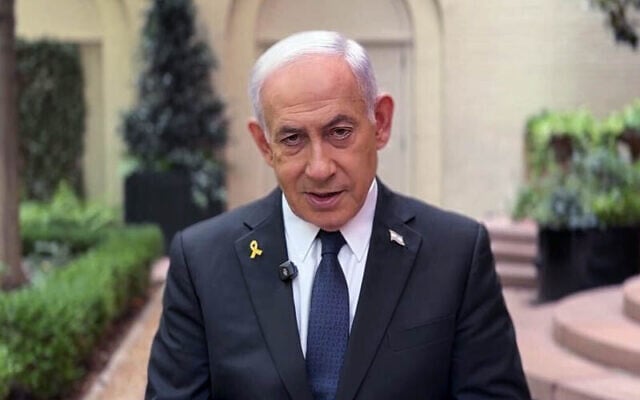
Prime Minister Benjamin Netanyahu speaks in a video statement from Washington, DC, July 10, 2025.(Screenshot/GPO)
“Now they’re saying ‘You will not continue fighting’ after the third ceasefire. Do I need to say more?”
After Hamas invaded Israel on October 7, 2023, and Jerusalem declared war on the terrorist organization, the sides agreed to ceasefires in November 2023 and January 2025.
Two sources told The Times of Israel on Wednesday that the Trump administration has assured mediators that it does not intend to allow Jerusalem to go back to fighting against Hamas in Gaza following a 60-day ceasefire, even if this is not explicitly included in the text of the deal being hashed out in Washington and Qatar.
The issue of whether Israel will be able to restart its military campaign after the proposed 60-day ceasefire and the release of 10 living and 18 dead hostages is one of the main sticking points in talks, which have failed to produce a breakthrough even as leaders continue to express some optimism that one can be reached.
However, indications that talks were bogged down continued to emerge on Thursday. Hamas said it opposes any ceasefire deal that includes a large Israeli military presence in Gaza, describing disagreements over the withdrawal and free flow of aid into Gaza as sticking points, as well as its demands for “real guarantees” for a lasting truce.
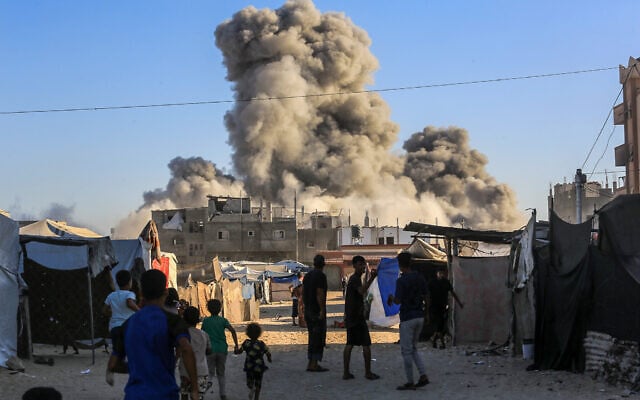
Palestinians at the site of an Israeli airstrike in Khan Younis, in the southern Gaza Strip, on July 9, 2025. (Abed Rahim Khatib/Flash90)
“We cannot accept the perpetuation of the occupation of our land and the surrender of our people to isolated enclaves under the control of the occupation army,” senior Hamas official Bassem Naim told AFP. “This is what the negotiating delegation is presenting to the occupation so far in the current round of negotiations in Doha.”
Hamas is particularly opposed to Israeli control over the southern city of Rafah, on the border with Egypt, and the so-called Morag Corridor between Rafah and Khan Younis, he added.
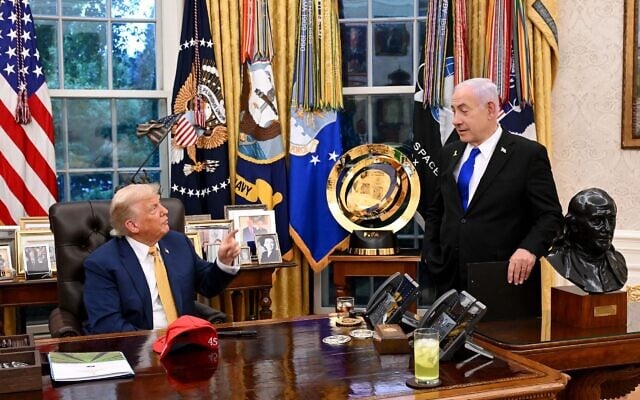
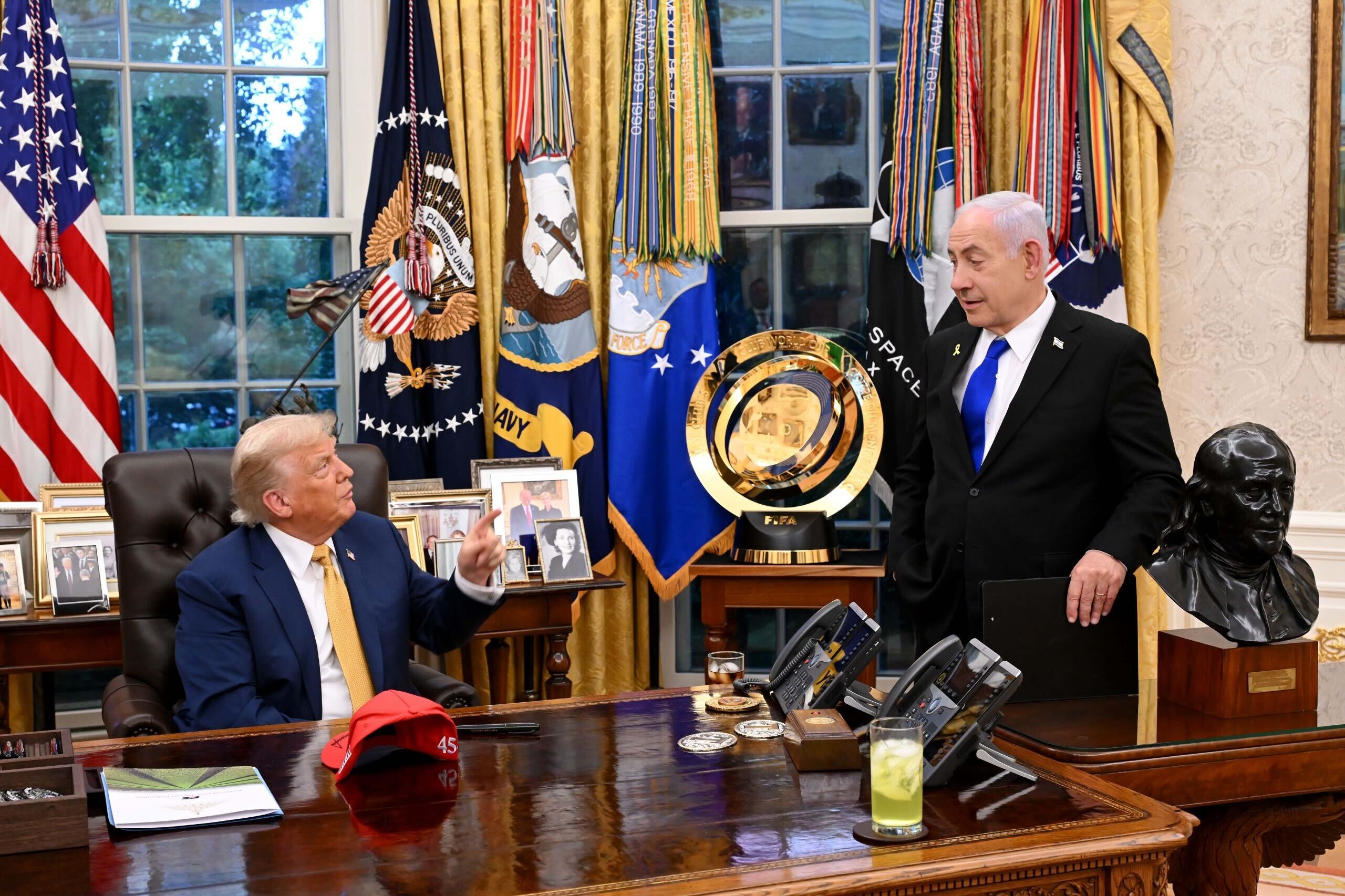
US President Donald Trump, left, meets Prime Minister Benjamin Netanyahu in the White House, July 8, 2025. (Avi Ohayon/GPO)
In his Thursday video, Netanyahu said that Israel is willing to discuss the end of the war in Gaza during the 60-day ceasefire, should Hamas and Israel come to an agreement.
But, he cautioned, the war will end only under Israel’s conditions: “Hamas lays down its weapons, Gaza is demilitarized, Hamas no longer has any governmental or military capabilities. These are our basic conditions.”
Netanyahu has made those demands throughout the war, which Hamas has repeatedly rejected.

Friends and family of hostage Segev Kalfon join Shift 101 in his hometown of Dimona on July 8, 2025. (Tanya Zion-Waldoks/Shift 101)
On way or another, said Netanyahu, Israel’s war aims will be achieved.
“If this can be achieved through negotiations — that’s great. If it is not achieved through negotiations in 60 days, we will achieve it in other ways; by using force, the force of our heroic army,” he said, after speaking at a memorial service for two embassy employees who were murdered in May.
In the Oval Office on Wednesday, Trump told reporters, “We’re getting very close to a deal on Gaza.” That came after Netanyahu stated there was a “good chance” to reach a deal and Foreign Minister Gideon Sa’ar said he thought an agreement to end 21 months of bitter fighting was “achievable.”
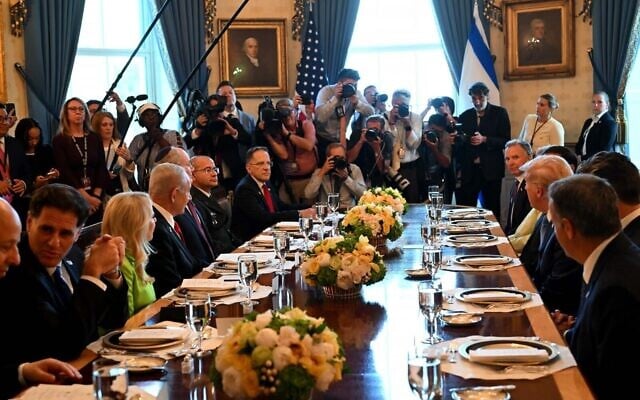
US President Donald Trump hosts Prime Minister Benjamin Netanyahu at the White House, with their respective teams, as the White House press corps watches, July 7, 2025. (GPO)
Netanyahu also said in his Thursday statement that he is aware Israelis are asking why the war against Hamas is taking so long, defending his approach to combating the terror group.
“First of all, this is a war zone that no army in the world has faced,” he said. “And thanks to the heroism of the fighters, thanks to the sacrifice of the fallen, thanks to the creativity, we dismantled most of Hamas’s military capabilities. But not all of them. There are still thousands of fighters there with weapons. And we want to act, again, with a combination of diplomacy and military force, and military force if diplomacy doesn’t work, to complete the mission.”
Regarding the order in which hostages will be released, Netanyahu said he would prefer to get everyone out at once, but “we are dealing with a cruel terrorist organization. Of course, we would like to rescue everyone, and from our point of view, they are all humanitarian. I want to rescue everyone in one fell swoop.”
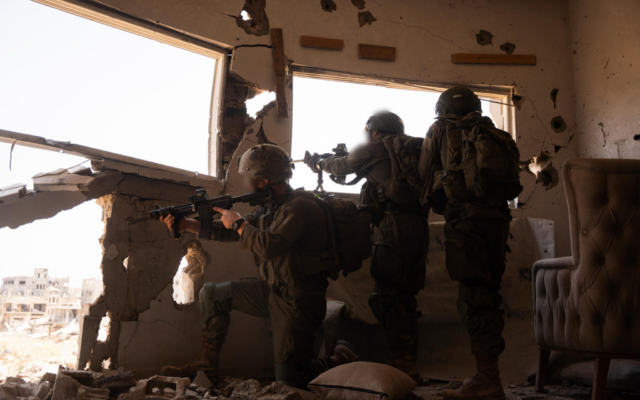
IDF troops operate in Gaza, in a handout photo published July 3, 2025. (Israel Defense Forces)
“Here we are dealing with two stages, but the choice is not always ours. We will do everything to maximize this release in the best possible way. Not everything is in our hands.”
Netanyahu told hostage families on Wednesday that Hamas will determine which hostages will be released during the 60-day truce, a source present at the Washington meeting told The Times of Israel.
The source said Netanyahu told the families that as far as Israel is concerned, all of the hostages are considered “humanitarian” — meaning that no group of living captives will be prioritized over the other, given that their conditions are all acutely dire after 643 days in Gaza.
However, two sources told the Haaretz daily that intelligence on the conditions of the hostages is being given to Netanyahu’s office, and that the political leadership will decide on the order of release.
‘A beautiful couple’
Earlier Thursday, Netanyahu addressed a memorial service for slain embassy employees Yaron Lischinsky and Sarah Milgrim at the Israeli mission in Washington.
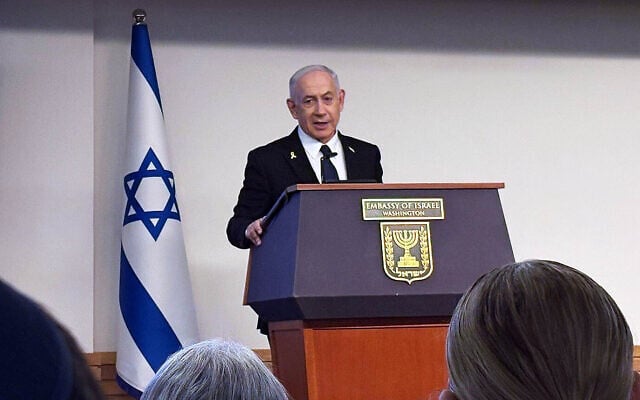
Prime Minister Benjamin Netanyahu speaks at a memorial service for slain embassy employees Yaron Lischinsky and Sarah Milgrim at the Israeli embassy in Washington, DC, July 10, 2025. (Lazar Berman/Times of Israel)
“The agony of losing a brother is great,” Netanyahu said. “The agony of losing a son is greater.”
He recognized Ambassador Yechiel Leiter, who lost his son in war against Hamas in the Gaza Strip.
Netanyahu said he learned from losing his brother Yoni that “life is a raging river” and that it will carry you to new places if you allow it.
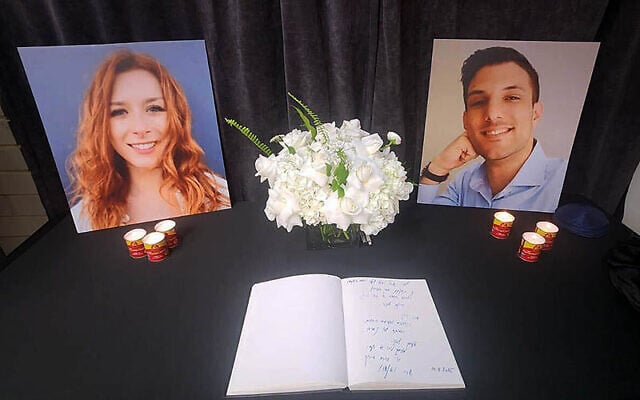
A memorial plaque for Sarah Milgrim and Yaron Lischinsky, two employees of the Israeli Embassy in the US who were killed in a terror attack, at an event attended by Prime Minister Benjamin Netanyahu and his wife Sara, July 10, 2025. (Prime Minister’s Office)
Netanyahu told the relatives of Lischinsky and Milgrim — who were about to get engaged when a gunman shot them dead outside the Capital Jewish Museum in May — that he spoke about the victims with Trump. According to the prime minister, Trump remarked after seeing their photo, “What a beautiful couple.”
With Milgrim’s parents and Lischinsky’s siblings present, Netanyahu signed a memorial book and spoke with the relatives.
Lischinsky’s parents watched the proceedings on Zoom.
Netanyahu unveiled a memorial plaque with a photograph of the two victims, then affixed a new mezuzah.

Yaron Lischinsky and Sarah Milgrim (Courtesy)
Having a Jewish state “comes with a heavy cost,” said Netanyahu in his address.
He stressed that Israel will fight antisemitism, which he said is growing amid an organized campaign.
“When we began the great return to our land,” the first thing Israel did was create an army, he said. “God helps those who help themselves.”
Israel has become one of the great powers on earth, he asserted: “We do not bow down. We do not surrender. We win.”
Jacob Magid and AFP contributed to this report.