
While the Syrian government said it conducted two raids in Damascus earlier this week, to arrest ISIS operatives, it has not yet acknowledged any attack by the terror group.
By DANIELLE GREYMAN-KENNARDUpdated: MAY 31, 2025 12:12Islamic State billboards are seen along a street in Raqqa, eastern Syria, which is controlled by the worldwide jihadist group, October 29, 2014. The billboard (R) reads: “We will win despite the global coalition.”(photo credit: Nour Fourat/Reuters)
Islamic State (ISIS) has claimed responsibility for two bomb attacks on the new Syrian government, which would be the first move against the new Syrian government since it took power in December, according to a war monitoring group and international media reports on Friday.
The bombs allegedly killed and wounded multiple government soldiers and members of a government-allied militia, according to the SITE Intelligence Group.
ISIS said it had planted a bomb on a “vehicle of the apostate regime” in the desert of the southern province of Sweida last Tuesday and claimed to have killed a member of the US-backed Free Syrian Army in a second bomb attack this week.
While the Syrian government said it conducted two raids in Damascus earlier this week to arrest ISIS operatives, it has not yet acknowledged any attack by the terror group.
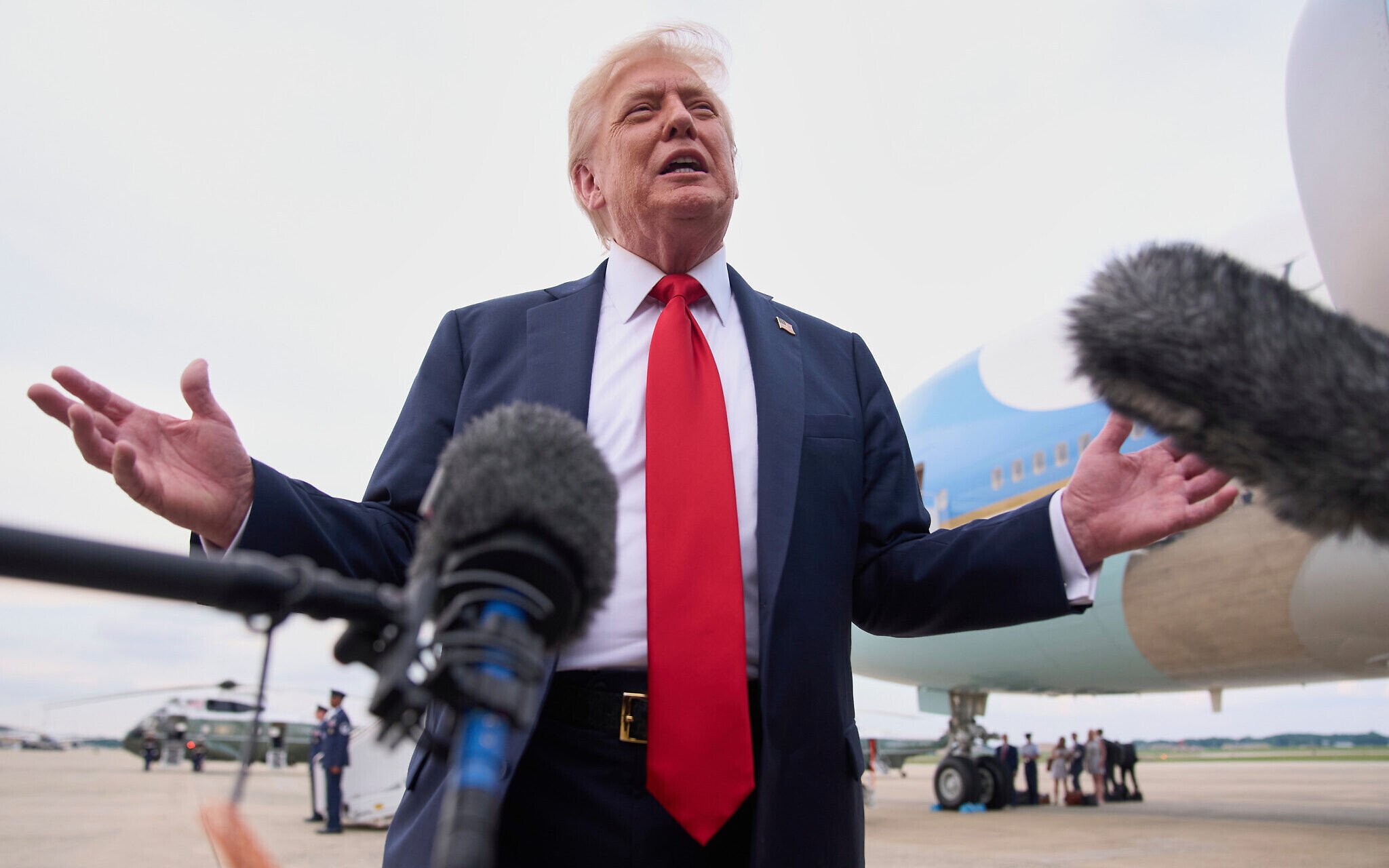
Syiran President Ahmed al-Sharaa and US President Donald Trump. (credit: Canva/Kaboompics.com, Engin Akyurt from Pexels, BRENDAN SMIALOWSKI/AFP, Getty Images/LUDOVIC MARIN/AFP)
Islamic State’s hold on Syria
While ISIS’s hold on Syria was significantly reduced in 2019 after large-scale efforts by the US-backed Syrian Democratic Forces, small cells have continued to carry out attacks.
Kurdish authorities struck a deal with the Syrian government earlier this week to begin clearing camps of ISIS families in eastern Syria, TheJerusalem Post‘s Seth Frantzman reported.
“THE KURDISH authorities and the Syrian interim government have reached an agreement to empty the notorious al-Hol camp from Syrians and return them to their homes, a Kurdish official said on Monday,” according to a report from Kurdish media Rudaw on Monday.
Syria warms ties with the United States as ISIS ups threat level against Western world
While Syria’s interim president, Ahmed al-Sharaa, was once a member of a group affiliated with Al-Qaeda, he has since distanced himself from the group in order to seek alliances among Western nations.
While Sharaa has warmed ties with the Trump administration, ISIS has planned several attacks against the US. An ISIS-affiliated attack claimed the lives of 14 people in New Orleans in January and only two weeks ago a national guardsman was arrested for allegedly planning an attack in the name of the group.
An anonymous senior US defense official told Reuters that following the New Orleans attack, there had been growing concern about the Islamic State increasing its recruiting efforts and resurging in Syria – worries which were heightened when the Assad regime fell.
A UN team that monitors Islamic State activities reported to the UN Security Council in July a “risk of resurgence” of the group in the Middle East and increased concerns about the ability of its Afghanistan-based affiliate, ISIS-Khorasan (ISIS-K), to mount attacks outside the country.
European governments viewed ISIS-K as “the greatest external terrorist threat to Europe,” it said.
“In addition to the executed attacks, the number of plots disrupted or being tracked through the Islamic Republic of Iran, the Levant, Asia, Europe, and potentially as far as North America is striking,” the team said.
DIPLOMATIC AFFAIRS: A new Israel – and US-backed – aid model bypasses Hamas and delivers food directly to Gazans, shifting dynamics on the ground and triggering strong criticism abroad.
By HERB KEINONUpdated: MAY 30, 2025 14:27GAZA RESIDENTS carry aid supplies which they received from the US-backed Gaza Humanitarian Foundation, near the Netzarim Corridor, yesterday.(photo credit: Ramadan Abed/Reuters)
The images emerging from Gaza this week were both familiar and unprecedented.
Familiar, in that they showed thousands of desperate Palestinians lining up for food. Unprecedented, in that those crowds weren’t swarming UNRWA trucks or local aid convoys but distribution centers run by a little-known Swiss-based NGO operating with quiet Israeli and American support.
What initially unfolded on Tuesday was chaotic.
There were delays, rumors, threats, and even violence. But also, something new and promising: Gazans bypassing Hamas’s orders to accept food from a group unaffiliated with it.
For many in Israel, this is a long-overdue correction – perhaps even a game changer. For critics of the new system in the international community, it’s a troubling shift in how humanitarian assistance is delivered.
Palestinian trucks loaded with humanitarian aid cross into Gaza through the Kerem Shalom crossing, February 17, 2025 (credit: ABED RAHIM KHATIB/FLASH90)
The Gaza Humanitarian Foundation (GHF), a previously unknown Swiss-registered nonprofit backed by American private contractors and facilitated by Israel, began distributing food directly to Gazans on Tuesday under a new model. As of Thursday, around 14,500 food boxes – each containing basic staples able to feed between five and six people for 3.5 days – had been distributed at two locations, with a third distribution point opened that day.
But the story here is not only about the food staples – though they will undoubtedly alleviate hunger in the enclave. The real issue at hand is control. And Hamas knows it, which is why the terrorist group’s reaction was furious.
Hamas warned and threatened people not to participate in the program, circulated false reports that the distribution had been disrupted or suspended, and even set up barriers to make the distribution points in the south – where the IDF has been urging Gazans to move – difficult to access.
All to no avail.
Thousands of Gazans arrived despite the hardships, walking many kilometers to reach the food and trampling Hamas’s barricades to get to the distribution spots. One viral video captured a Gazan father thanking “everyone who helped us – Muslims, infidels, Americans,” while children around him carried the food packages on their shoulders. The message from the ground was unmistakable: Hamas’s monopoly over aid distribution was fraying, and with it, the possibility that its grip on Gazan civilians was also slipping.
THE AID distribution began on the 599th day of the war, a war whose goals include – among others – destroying Hamas militarily and ending its governance over Gaza.
Though the IDF is well on its way to dismantling Hamas’s military capabilities, the terrorist organization has been able to retain its civilian control. According to Israeli officials, this is largely because it hijacked and then controlled the distribution of the aid that has been allowed into Gaza.
“We prepared for far worse scenarios,” a senior IDF officer told Yediot Aharonot after the initial scenes of unrest on Tuesday. “The barrier of fear has been broken. Hamas is at its lowest point in terms of governance.”
The symbolism was striking: hungry Palestinians trampling Hamas-erected fences to reach Americans – guarded along the perimeter by Israeli soldiers – distributing boxes of food.
Israeli officials are framing the new distribution model as both a humanitarian necessity and a strategic tool. In a speech on Tuesday, Prime Minister Benjamin Netanyahu said that Hamas looted the aid that flowed into Gaza before Israel blocked it on March 2.
“They [Hamas] took a good chunk for themselves, and the remainder they sold to the civilian population at exorbitant prices,” he said. “And thereby, they funded new recruits because we were able to kill a lot of terrorists. They have to replenish their war machine, their terrorist machine, their terrorist army. So they used the aid to continue the war. And we said, that has to stop.”
Foreign Minister Gideon Sa’ar echoed that sentiment, recently stating that aid “must go directly to the people,” and “Hamas must not be allowed to get their hands on it.”
From this perspective, the new system is a form of disruption – breaking the link between aid and Hamas, undermining its governance, and showing Gazans that there are alternatives.
As former National Security Council head Yaakov Amidror put it in a Galei Yisrael radio interview: “We are trying to sever the ties between Hamas and food distribution…. If we succeed in doing that, it will be a very, very big achievement on the way to building an alternative to Hamas on ‘the day after.’”
But not everyone sees this as a solution. Critics argue that what is happening is not just a logistical shift but a fundamental reframing of humanitarian aid – with all the ethical and legal questions that entails.
A day before the plan went into effect, Jake Wood, the former US Marine who founded GHF, resigned, stating that the group could not function under the humanitarian principles of neutrality, independence, and impartiality. His resignation fueled criticism from the UN and major international aid organizations, which argued that placing the distribution of aid under the de facto control of Israel undermines decades of humanitarian norms not to put the aid in the hands of one of the warring parties.
Predictably, this new model sparked an uproar among international organizations. UN Secretary-General Antonio Guterres condemned the arrangement, saying it violates humanitarian principles. The UN and many of its donor countries – including Canada, Australia, the UK, and most of Europe – claimed this is politicized aid designed not to help civilians but to advance Israeli war aims.
That’s rich.
For years, the world was content to look the other way as Hamas turned humanitarian assistance into a tool of repression. While UN agencies and NGOs handed over aid with little oversight, Hamas hijacked it – taxing, reselling, diverting, and using the proceeds to recruit fighters, dig tunnels, and fund its war machine.
This modus operandi continued throughout the war, and there was no uproar in the humanitarian aid community about how this was a “weaponization of assistance.” But now that Israel and the US are attempting to bypass Hamas and deliver food directly to families – through secured, monitored, militarily protected centers – that’s suddenly beyond the pale?
Amidror said that while international organizations, such as UNRWA, were distributing aid, “it was connected to Hamas. Hamas decided what they will and will not do. They took tax from the population and controlled the distribution.” By taking it away, Hamas is weakened substantially.
Or, as Netanyahu said this week, “It leaves the fish without the water.”
The logic runs like this: Hamas is weaker than ever. Militarily, the IDF continues to dismantle its capabilities. Politically, the loss of control over aid distribution hits at the heart of Hamas’s remaining claim to authority. Every family that receives food without Hamas’s blessing is a small act of rebellion. And every day the new model continues is one more crack in the wall of Hamas control.
Still, few in the IDF or the political echelon are declaring victory just yet. “The real test is determination and persistence,” Yediot quoted defense officials as saying. “This effort must not be halted. It is no less strategic than the military campaign.”
The new model is still in its infancy. GHF plans to expand operations to four hubs, with the goal of delivering up to 300 million meals within 90 days. But security concerns remain. The organization’s leadership is in flux. And the international pressure is only growing.
Moreover, this is Gaza, and Hamas is fighting for survival, so what works one day can unravel the next.
But the very fact that tens of thousands of Gazans defied Hamas to obtain food, that Israel was able to help facilitate this without losing control, and that the first distribution didn’t end in total collapse – these are developments that are not only worth noting but also promising.
Still, while Israel and the US see this as a targeted, tactical move designed to serve both humanitarian and strategic goals, much of the world views it as a dangerous precedent. Aid organizations worry that the new model may exclude those unable to travel, punish those in areas outside the “sterile zone” where the aid is distributed, and embed military aims within a humanitarian infrastructure.
Some academics have gone even further. Thea Hilhorst, a professor of humanitarian studies at Erasmus University in Rotterdam, told the German broadcaster Deutsche Welle that the new approach was tantamount to “the instrumentalization of aid for war purposes” and warned it could amount to “ethnic cleansing.”
Other international critics see it as using aid as a lever of coercion, not compassion.
The UN’s emergency relief coordinator, Tom Fletcher, told the UN Security Council on May 13 that this tactic appeared to prioritize “placing the objective of depopulating Gaza over the lives of civilians.”
But Fletcher’s assessments are suspect. On May 20, he told the BBC that about 14,000 babies would die in Gaza in two days if aid did not flow – an inflammatory and baseless accusation that undermines his, and his agency’s, credibility.
Israel argues that there is no choice but to set up this alternative method of distribution, and that it cannot simply return to a situation where aid is looted and sold on the black market to fund salaries for more Hamas recruits.
The new distribution method – backed, funded, and protected by Israel and the US – is designed to break that cycle.
If it succeeds, it will do more than just feed people. It will chip away at Hamas’s claim to authority. It will empower Gazans to look elsewhere for leadership. And it will help answer the question Israel has been grappling with for 600 days: How do you defeat not just Hamas’s army but also its grip on society?
Smoke rises in the sky following an Israeli airstrike in Gaza City, Friday, May 30, 2025. (AP Photo/Jehad Alshrafi)
Palestinians receive a hot meal prepared by volunteers, in Khan Younis, in the southern Gaza Strip, May 30, 2025 (Abed Rahim Khatib/Flash90)
Yemenis, some in Ihram garments worn for the yearly Hajj pilgrimage, burn flags of Israel and the US during a rally in solidarity with Palestinians and the Gaza Strip and in condemnation of Israel and the US, in the Houthi-run capital Sanaa, on May 30, 2025. (Mohammed HUWAIS / AFP)
US President Donald Trump speaks during a news conference with Elon Musk in the Oval Office of the White House, May 30, 2025, in Washington. (AP Photo/Evan Vucci)
Police, supporters of Israel, and pro-Palestinian demonstrators outside Barclays Center for a graduation ceremony for Hunter College students on May 30, 2025 in the Brooklyn borough of New York City (SPENCER PLATT / GETTY IMAGES NORTH AMERICA / Getty Images via AFP)
The Times of Israel is liveblogging Saturday’s events as they happen.
The Defense Ministry’s Coordinator of Government Activities in the Territories (COGAT) issues a message to Gazans after a video posted to social media yesterday showed a Palestinian in the Strip criticizing Hamas’s leadership.
“Residents of Gaza, the Hamas leadership has sold you out. This is the same leadership that deceived you. Instead of focusing on caring for the civilian population, it abandoned its people, while senior leaders abroad indulge in luxury on airplanes, in hotels, and in restaurants,” says COGAT chief Maj. Gen. Ghassan Alian in a Facebook post, where he attached an edited version of the social media video with subtitles. The full context of the clip is unclear.
Israel has been attempting to drive a wedge between Hamas and the Palestinian civilian population in Gaza, in an effort to weaken the terror group’s rule in the Strip.
Yesterday, an Israeli defense official said Hamas’s rule in Gaza was slipping as a new aid distribution system ramped up activities.
A video of a Gazan man criticizing Hamas’s leadership in the Gaza Strip, in a video published on social media on May 30, 2025. (COGAT)
Hamas will present its response to a ceasefire-hostage release deal proposal made by US special envoy Steve Witkoff later today, a senior official in the terror group tells al-Risala, a Hamas mouthpiece.
According to a copy of Witkoff’s latest proposal, the authenticity of which was confirmed to The Times of Israel by two sources familiar with the negotiations, Hamas would release 10 living Israeli hostages held in Gaza and return the bodies of 18 deceased hostages during a 60-day ceasefire.
In return, Israel would release 125 Palestinian terror convicts serving life sentences, 1,111 Gazans detained since the start of the war on October 7, 2023, and 180 bodies of Palestinians currently held by Israel.
The US proposal stipulates that the sides still need to agree on the parameters of the IDF’s partial withdrawal from Gaza during the temporary truce.
Sources familiar with the negotiations told The Times of Israel that Hamas was disappointed with the proposal, since it still gives Israel the option to resume fighting at the end of the temporary truce, as Prime Minister Benjamin Netanyahu has pledged to do.
Not wanting to be pegged as the party to blame for the impasse, Hamas is leaning toward accepting the proposal, while submitting a series of reservations, the two sources said, in what will likely drag the talks out for at least several more days.
Mazloum Abdi, commander-in-chief of the Syrian Democratic Forces (SDF), speaks during the pan-Kurdish “Unity and Consensus” conference in Qamishli, in northeastern Syria on April 26, 2025. (Delil SOULEIMAN / AFP)
BEIRUT, Lebanon — The commander of Kurdish forces that control northeast Syria says that his group is in direct contact with Turkey and that he would be open to improving ties, including by meeting Turkish President Tayyip Erdogan.
The public comments represent a significant diplomatic overture by Mazloum Abdi, whose Syrian Democratic Forces fought Turkish troops and Ankara-backed Syrian rebels during Syria’s 14-year civil war.
Turkey has said the main Kurdish group at the core of the SDF is indistinguishable from the militant Kurdistan Workers Party (PKK), which decided earlier this month to disband after 40 years of conflict with Turkey.
Abdi tells regional broadcaster Shams TV in an interview that his group was in touch with Turkey, without saying how long the communication channels had been open.
“We have direct ties, direct channels of communication with Turkey, as well as through mediators, and we hope that these ties are developed,” Abdi says. There is no immediate comment from Turkey on Abdi’s remarks.
He notes his forces and Turkish fighters “fought long wars against each other,” but that a temporary truce had brought a halt to those clashes for the last two months. Abdi says he hoped the truce could become permanent.
A Hezbollah commander was killed in a drone strike in southern Lebanon overnight, the IDF says.
According to the military, the strike near Deir ez-Zahrani killed Muhammad Ali Jamoul, the commander of Hezbollah’s rocket unit in the Beaufort Castle area.
The IDF says Jamoul advanced numerous rocket attacks on Israel during the war, and was recently involved in attempting to restore Hezbollah infrastructure in the area.
His actions “constituted a blatant violation of the understandings between Israel and Lebanon,” the military adds.
View of a United Airlines flight at Ben Gurion Airport on August 3, 2013. (Moshe Shai/Flash90)
United Airlines announces it will resume flight services from New York to Tel Aviv with a single flight on June 5.
The US airline says it will restart its second daily flight between the two cities the following day.
“This resumption follows a detailed assessment of operational considerations for the region and close work with the unions who represent our flight attendants and pilots,” United says in a statement.
United halted flight services between New York’s Newark airport and Tel Aviv’s Ben Gurion Airport on May 4 after a ballistic missile from Yemen struck an area at Israel’s main international airport.
People carry sacks of flour as aid trucks are apparently looted in the Khan Younis area on May 31, 2025 (Screen grab used in accordance with Clause 27a of the Copyright Law)
Over 100 UN World Food Programme trucks loaded with flour were looted in the Khan Younis area, Palestinian media reports.
The Ynet news site reports that distribution of the flour had been set to begin tomorrow.
Gunfire can be heard in video footage. There are no immediate reports of injuries.
Under pressure from allies, Israel began allowing some humanitarian aid into Gaza last week after blocking all food, medicine, fuel or other goods from entering since March 2.
Aid groups have warned of famine and say the aid that has come in is nowhere near enough to meet mounting needs of an increasingly desperate Gazan civilian population.
Israel has accused Hamas of stealing aid, and says it needs to be tightly controlled to prevent it from helping the terror group.
Iran’s Foreign Minister Abbas Aragchi attends a press conference following a meeting with Russia’s Foreign Minister Sergei Lavrov in Moscow, April 18, 2025. (Tatyana Makeyeva/Pool via Reuters)
Foreign Minister Abbas Araghchi says that Iran considers nuclear weapons “unacceptable,” reiterating the country’s longstanding claim amid delicate negotiations with the United States.
“If the issue is nuclear weapons, yes, we too consider this type of weapon unacceptable,” Araghchi, Iran’s lead negotiator in the talks, says in a televised speech. “We agree with them on this issue.”
The United States, Israel and other Western countries have repeatedly accused Iran of seeking to acquire a nuclear weapon.
Iran has categorically denied the claims, instead arguing that it is pursuing a nuclear program for civilian purposes alone. According to the International Atomic Energy Agency (IAEA), however, Iran is the only country in the world that enriches uranium up to 60 percent. That rate is only a technical step below the 90 percent threshold required for a nuclear weapon, and far above the 3.67 percent limit set under a 2015 agreement with world powers.
One person is said to have been killed in an Israeli strike on a vehicle in south Lebanon.
Lebanese reports cited by Hebrew-language media say the individual was killed in the strike in Deir ez-Zahrani.
There is no comment from the Israel Defense Forces.
During the ongoing ceasefire in Lebanon, the IDF has continued to strike Hezbollah operatives and sites it says violate the understandings between Israel and Lebanon.
More than 150 Hezbollah operatives have been killed since the start of the ceasefire in November 2024.
White House Chief of Staff Susie Wiles listens during a cabinet meeting at the White House, April 30, 2025, in Washington. (AP Photo/Evan Vucci, File)
The US government is investigating after elected officials, business executives and other prominent figures in recent weeks received messages from someone impersonating Susie Wiles, President Donald Trump’s chief of staff.
A White House official confirms the investigation and says the White House takes cybersecurity of its staff seriously. The official was not authorized to discuss the matter publicly and spoke on condition of anonymity.
The Wall Street Journal reported Thursday that senators, governors, business leaders and others began receiving text messages and phone calls from someone who seemed to have gained access to the contacts in Wiles’ personal cellphone. The messages and calls were not coming from Wiles’ number, the newspaper reported.
Some of those who received calls heard a voice that sounded like Wiles, which may have been generated by artificial intelligence, according to the report. Some received text messages that they initially thought were official White House requests but some people reported the messages did not sound like Wiles.
The FBI warned in a public service announcement this month of a “malicious text and voice messaging campaign” in which unidentified “malicious actors” have been impersonating senior US government officials.
The scheme, according to the FBI, has relied on text messages and AI-generated voice messages that purport to come from a senior US official and that aim to dupe other government officials as well as the victim’s associates and contacts.
“Safeguarding our administration officials’ ability to securely communicate to accomplish the president’s mission is a top priority,” FBI Director Kash Patel says in a statement.
It is unclear how someone gained access to Wiles’ phone, but the intrusion is the latest security breach for Trump staffers. Last year, Iran hacked into Trump’s campaign and sensitive internal documents were stolen and distributed, including a dossier on Vice President JD Vance, created before he was selected as Trump’s running mate.
Wiles, who served as a co-manager of Trump’s campaign before taking on the linchpin role in his new administration, has amassed a powerful network of contacts.