Members of the 36th Munitions Squadron and the 74th Joint Civilian Orientation Conference put together a GBU-50 bomb on Andersen Air Force Base, Guam, Nov. 6, 2007.

Today, on Sivan 23, 5785, King Achashverosh is going to decide if it pleases him to help the Jews erase yet another design of a Holocaust against them.

Sivan 23 is a very special day in Jewish history. On Sivan 23, sometime in the fifth or fourth century BCE, the first Holocaust was canceled. Here’s the documentation (Esther 8:7-9):

Then King Ahasuerus said to Queen Esther and Mordecai the Jew, “I have given Haman’s property to Esther, and he has been impaled on the stake for scheming against the Jews. And you may further write with regard to the Jews as you see fit. [Write it] in the king’s name and seal it with the king’s signet, for an edict that has been written in the king’s name and sealed with the king’s signet may not be revoked.”
So the king’s scribes were summoned at that time, on the twenty-third day of the third month, that is, the month of Sivan; and letters were written, at Mordecai’s dictation, to the Jews and to the satraps, the governors and the officials of the one hundred and twenty-seven provinces from India to Nubia: to every province in its own script and to every people in its own language, and to the Jews in their own script and language.

Sivan 23 is a day when our evil fortunes can be turned around. This day reveals that Jews possess the power to cause the King of the Universe to declare, just as it is written in the Megillah on this day: “And you may further write with regard to the Jews as you see fit.”

With that in mind, the modern-day King Achashverosh, President Donald ben Fred Trump, “is getting comfortable with the idea of taking out Iran’s nuclear facility, the Fordo Fuel Enrichment Plant,” as a source familiar with the intelligence told ABC News early Thursday morning.

It wouldn’t be a single strike on the facility—it would involve multiple hits, the source said, adding that preparations are now underway.

The Fordo Fuel Enrichment Plant (FFEP), officially known as the Shahid Ali Mohammadi Nuclear Facility, is an underground uranium enrichment site located 80 meters underground inside a mountain, approximately 20 miles north of the city of Qom, in Iran.

Air Force Senior Airman Cody Mehren signals to a B-2 Spirit bomber during a refueling stop at Andersen Air Force Base, Guam, Jan. 17, 2019. / Air Force Tech. Sgt. Jake Barreiro

In March 2023, CNN reported that uranium enriched to “near bomb-grade” levels had been detected at the Fordo facility. The International Atomic Energy Agency (IAEA) confirmed the discovery of uranium enriched to 83.7% purity—just below the 90% typically considered weapons-grade—describing the finding as a significant and unexpected development. By June 2024, the IAEA noted that Iran had installed additional centrifuges at the site, while The Washington Post reported that Iranian authorities had ordered a tripling of Fordo’s centrifuge capacity, further escalating international concerns over Tehran’s nuclear ambitions.

On June 13, 2025, Israel launched a strike on the Fordo nuclear facility as part of a broader series of attacks on Iranian targets. Due to the deeply buried nature of the Fordo site, the extent of the damage remained uncertain. However, satellite imagery and various reports indicated that while some above-ground infrastructure at both Fordo and Natanz was hit, the fortified underground sections housing centrifuges and enriched uranium appeared to remain intact. On June 14, the Atomic Energy Organization of Iran confirmed that the site had sustained only limited damage as a result of the Israeli strikes.

One of the few weapons capable of inflicting serious damage on the Fordo facility and the centrifuges believed to be housed within is the GBU-57A/B Massive Ordnance Penetrator, commonly known as the “bunker buster.” This 20-foot-long, 30,000-pound bomb is engineered to penetrate up to 200 feet of earth or reinforced concrete before detonating, making it uniquely suited for attacking heavily fortified underground sites like those in Iran. The GBU-57 has never been used in combat and was specifically developed for missions targeting deeply buried facilities. Crucially, no military outside the United States—including Israel—has access to this weapon or the only aircraft capable of delivering it: the B-2 Spirit stealth bomber, which can carry two of the massive bombs. These aircraft are currently based at Whiteman Air Force Base in Missouri and would require approximately 15 hours to reach Iranian airspace if deployed.

Today, on Sivan 23, 5785, King Achashverosh is going to decide if it pleases him to help the Jews erase yet another design of a Holocaust against them.

Holy cow, we live in Biblical times.


Russian President speaks out about the tensions between Iran and Israel, states Iranian society is consolidating amidst Israeli air strikes and stresses the need for a resolution ensuring both Iran’s peaceful nuclear rights and Israel’s unconditional security.

Vladimir Putin

Vladimir PutinReuters

Russian President Vladimir Putin on Wednesday night made his first public comments on the tensions between Iran and Israel, Reuters reported.

Putin emphasized the necessity for all parties to seek an end to hostilities, advocating for a solution that simultaneously ensures “Iran’s right to peaceful nuclear power and Israel’s right to the unconditional security of the Jewish state.”

When pressed on Prime Minister Benjamin Netanyahu’s assertions that military attacks could result in regime change in Iran, and US President Donald Trump’s demand for unconditional Iranian surrender, Putin advised considering whether “the main aim was being achieved before starting something.”

“We see that today in Iran, with all the complexity of the internal political processes taking place there…that there is a consolidation of society around the country’s political leadership,” Putin told senior news agency editors in St. Petersburg, as quoted by Reuters.

Putin confirmed personal contact with both President Trump and Prime Minister Netanyahu, indicating he had conveyed Moscow’s proposals for conflict resolution. He further noted that Iran’s underground uranium enrichment facilities remain intact.

“These underground factories, they exist, nothing has happened to them,” Putin asserted. He reiterated his call for a resolution that upholds the interests of both nations.

“It seems to me that it would be right for everyone to look for ways to end hostilities and find ways for all parties to this conflict to come to an agreement with each other,” Putin concluded. “In my opinion, in general, such a solution can be found.”

The Russian President’s comments come a day after Russia’s Foreign Ministry vehemently condemned the ongoing Israeli attacks on Iranian nuclear sites, labeling them as “illegal” under international law and a severe threat to global security.


The ministry emphasized that a resolution to the dispute over Tehran’s nuclear program can only be achieved through diplomatic means.

That statement came several days after Trump said, following a phone call he held with Putin, that the two both thought that the war between Iran and Israel should end.


Samaria Regional Council calls for immediate fortification funding to be allocated to settlements in Samaria, similar to the model used for frontline communities elsewhere in Israel. ‘Life of a child in Samaria is not less valuable.’

The interception shrapnel

The interception shrapnelspokesperson

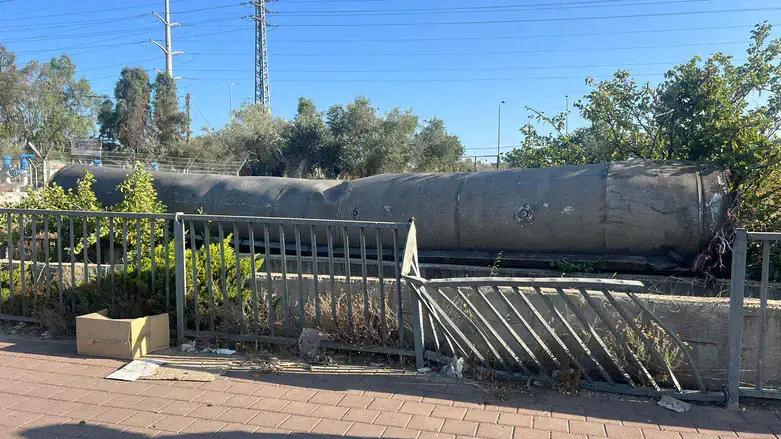
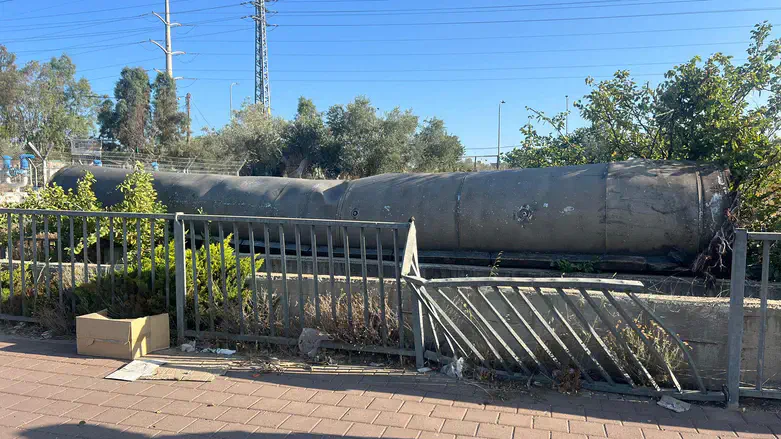
On Thursday morning, following an Iranian missile barrage, a piece of missile debris the size of a bus fell in a central location in Samaria. Since the start of the war, over 100 missile fragments and intercept debris have fallen in the Samaria area, some of which are the size of a bus.

The Samaria Regional Council reports that tens of thousands of people in settlements are without protection, with entire neighborhoods of old and vulnerable buildings lacking both reinforced rooms (“mamad” rooms) and shelters. Despite repeated requests from the council to the relevant authorities in recent years, no response has been received from the government, and there are no protected spaces in these areas.

Across Judea and Samaria, tens of thousands of people are in the same situation. In recent days, numerous pieces of Iranian missile fragments and intercept debris have fallen in Samaria, including one that landed in a schoolyard in a settlement, another in a synagogue, and several falling on cars and homes throughout the region.

Yossi Dagan, head of the Samaria Regional Council, criticized the Ministry of Defense, stating: “The fact that protection has not been provided to the central settlements borders on irresponsibility. Immediate budget allocation for fortification in the Samaria settlements should be made, similar to the model recently implemented for residents along other frontline areas in Israel, which are eligible for 132,000 NIS per family for protection, based on proximity to the frontline.”


He demands that the fortification policy be aligned with the model for other frontline residents or, at the very least, for the government to immediately start providing mamads and public shelters for the tens of thousands of people left unprotected.

Dagan added: “Tens of thousands of people in Judea and Samaria, which has become Israel’s missile target zone, are without protection. Every night, intercept debris falls on homes, yards, and vehicles. We expect the government, in these difficult times, to approve the construction of public shelters as required and as has been done throughout the country. I call on the Prime Minister and the Defense Minister to approve an emergency plan for funding protective buildings in young settlements, and to approve a fortification plan in the format of the ‘Northern Shield’ program for the residents of Judea and Samaria, who are a frontline for all intents and purposes.”

“Residents of Samaria, who are on the frontline against both Palestinian Authority terrorism and Iran, remain exposed without basic protection. Those living 5 km from the Palestinian Authority are just as much a frontline as those living 5 km from the northern or southern border. If the security establishment defines Judea and Samaria as a front, it is clear to any reasonable person that the residents of Judea and Samaria are part of the front and should be treated accordingly.”

“In Samaria, there are hundreds of families living in buildings without mamads, some in settlements experiencing fire, infiltration, and attempted terror attacks. We are on the frontline for all intents and purposes – and it is time the state recognizes this, including in its budget. A child’s life in Samaria is no less valuable.”

He warned that this policy distortion could come at a heavy cost: “We demand from the government: Fund the fortifications – before the next disaster. This is not a political matter. It is a national responsibility.”