IDF carries out airstrikes across southern Syria after two projectiles fired from 12 km inside northern neighbor; Houthi missile triggers sirens across central Israel; no injuries reported
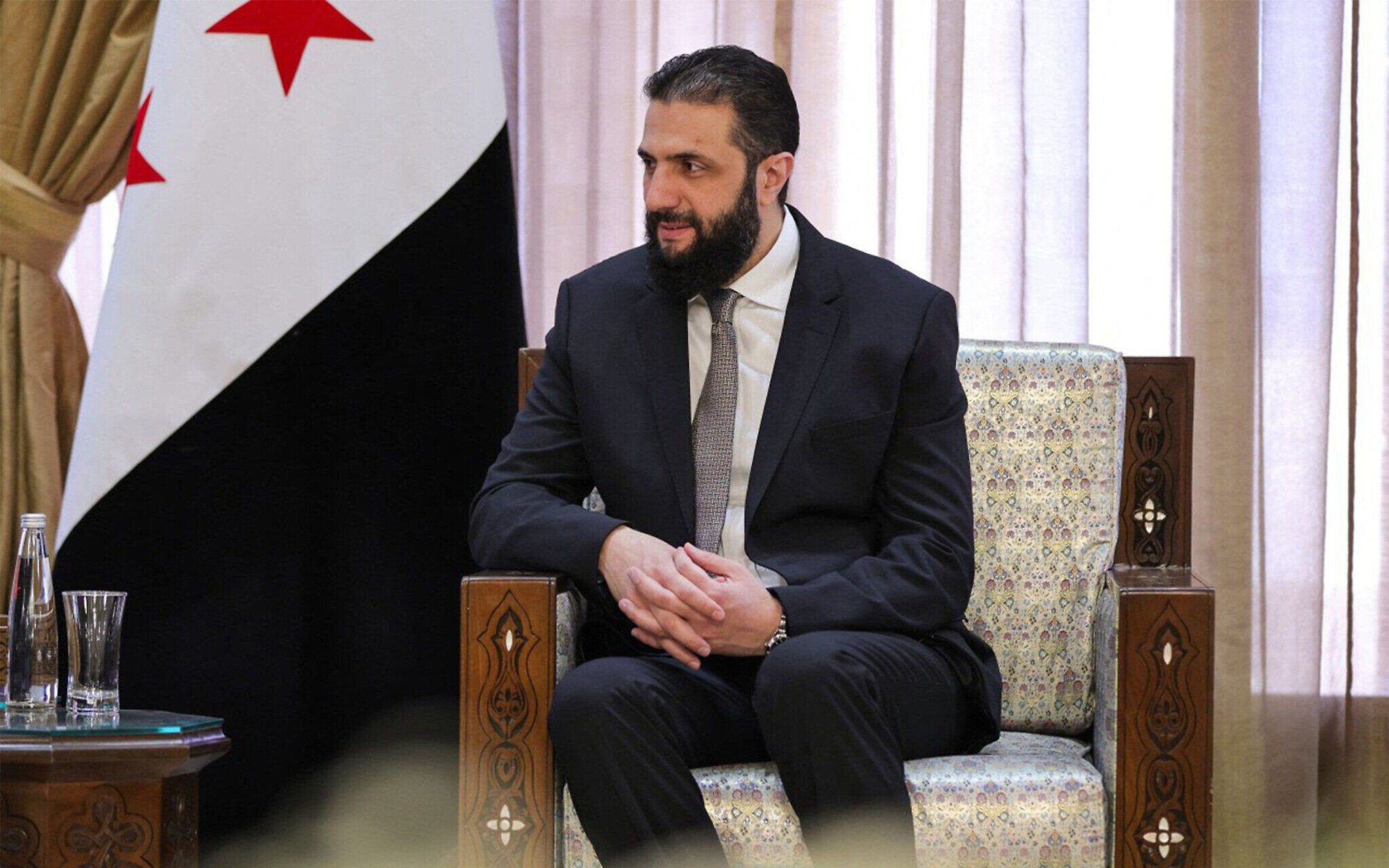
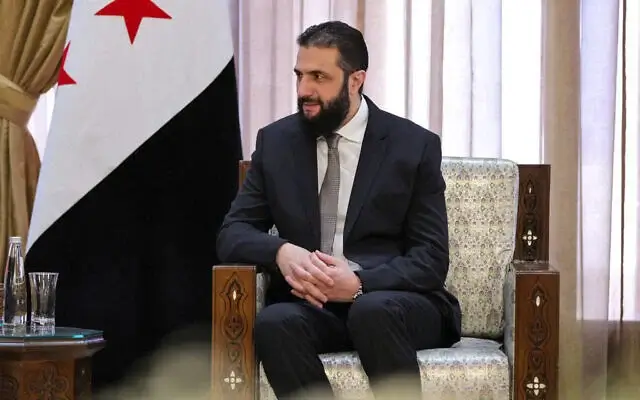
Syria's interim president Ahmed al-Sharaa receives Saudi Arabia's foreign minister in Damascus, Syria, on May 31, 2025. (SANA / AFP)

Syria’s interim president Ahmed al-Sharaa receives Saudi Arabia’s foreign minister in Damascus, Syria, on May 31, 2025. (SANA / AFP)

Defense Minister Israel Katz said Jerusalem would mount a “full response” against the regime of Syrian leader Ahmed al-Sharaa after two rockets were fired from Syria at the Golan Heights for the first time in over a year, minutes before a Houthi missile triggered sirens across central Israel.

No injuries were reported from either attack. The IDF said it had responded to the attack from Syria with artillery fire on the source of the rockets, some 12 kilometers (7.5 miles) from the border with Israel.

The IDF also carried out a series of airstrikes throughout southern Syria that it said targeted weapons belonging to the regime.

“The Syrian regime is responsible for what is happening in Syria and will continue to bear the consequences as long as hostile activity continues from its territory,” the IDF said in a statement.

Katz issued his own statement asserting that Israel views Sharaa himself as “directly responsible for every threat and [rocket] fire toward the State of Israel.”

“The full response will come soon,” said Katz, adding that Israel “will not allow a return to a pre-October 7 reality.”

The rockets from Syria triggered sirens in the Golan Heights communities of Hispin and Ramat Magshimim. Police later said officers located the site of the two rocket impacts in an open area near Ramat Magshimim.

The IDF said the rockets were launched from Tasil in south Syria, near an area where gunmen fired at Israeli troops in April.
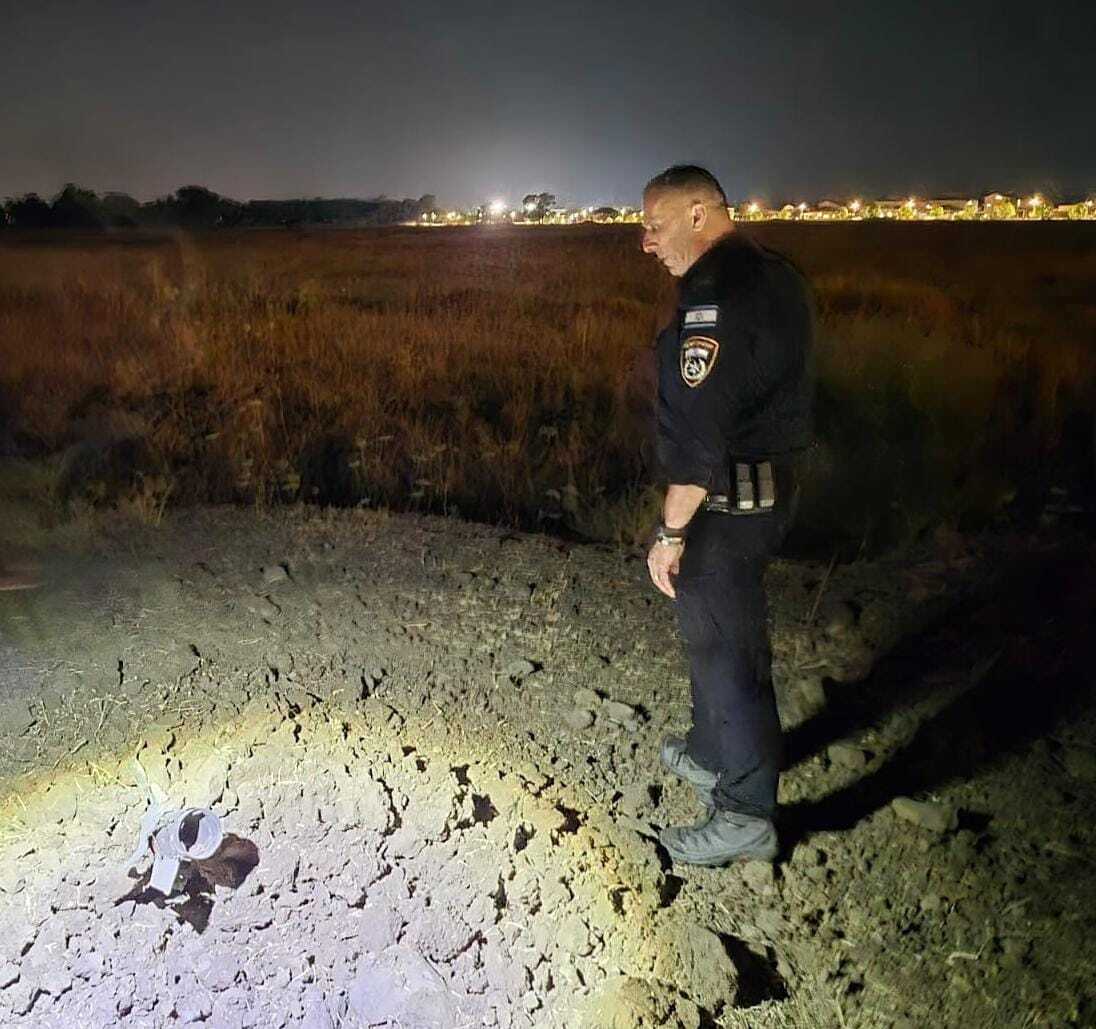
A police officer at the site of a rocket impact near the Golan Heights community of Ramat Magshimim, shortly after two rockets were fired from Syria, June 3, 2025. (Israel Police)

The Syrian foreign ministry asserted that it “has not and will not pose a threat to any party in the region” and was working to rein in armed, non-state actors in southern Syria.

The Syrian government claimed it had yet to confirm the rocket launches that targeted Israel, but it did condemn the Israeli counter-attack, saying it resulted in “heavy human and material losses” and violated Syria’s sovereignty “at a time when we are most in need of calm and peaceful solutions.”

“We call on the international community to assume its responsibilities in stopping these attacks, and to support efforts aimed at restoring security and stability to Syria and the region,” the Syrian foreign ministry statement said.

It was the first alert in the Golan since a drone alarm from Iraq sounded there in November, and the first the first rocket fire from Syria since May 5, 2024, seven months before a jihadi group led by Sharaa toppled the country’s Iran-backed President Bashar Al-Assad.

The United States, which previously placed a bounty on Sharaa’s head, has since embraced him and removed Assad-era sanctions on Syria. On Tuesday, Sky News Arabic reported Sharaa will speak at the coming UN General Assembly in September, which would make him the first Syrian leader to travel to the US in almost 60 years.

Israel has remained publicly leery despite reportedly seeking warmer ties with Sharaa’s administration. Following Assad’s ouster, Israel moved troops into the Syrian side of the two countries’ demilitarized buffer zone, and has carried out numerous strikes across Syria.

rael downs 3rd Houthi missile in as many days

Additionally on Tuesday evening, the IDF said it downed a missile fired by Yemen’s Iran-backed Houthis that triggered sirens in central Israel roughly 20 minutes after the attack from Syria. The sirens were preceded by an early warning to residents via a push notification on their phones. It was the third Houthi attack in as many days.

Sirens also sounded some three minutes later in the northern town of Nof HaGalil and other communities near Nazareth. The IDF said those sirens were caused by “fears of interceptor fragments” but were later confirmed to have been a “false identification,” meaning not a threat.

Possible fragments from either the Houthi or interceptor missiles landed in the central city of Modiin, police said, adding that officers were at the scene to remove the debris.
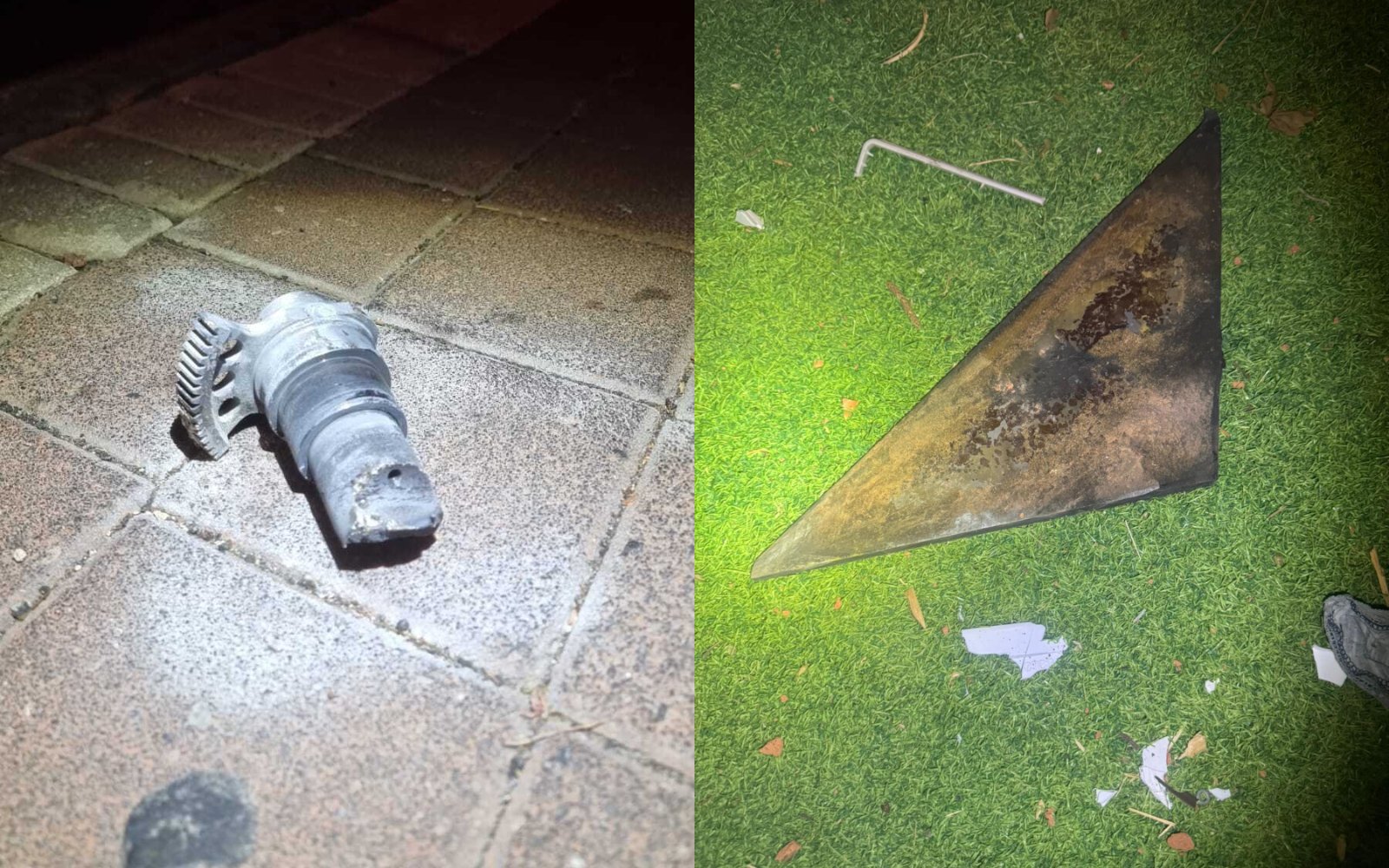
Possible fragments from a Houthi ballistic missile or the interceptor missiles used to shoot it down that landed in the central city of Modiin, June 3, 2025. (Israel Police)

The Houthi missile stopped air traffic at Ben Gurion International Airport for some 25 minutes, in accordance with standard procedure.

The Houthis — whose slogan calls for “Death to America, Death to Israel, [and] a Curse on the Jews” — began attacking Israel and maritime traffic in November 2023, a month after the October 7 Hamas massacre sparked the war in Gaza.

The Houthis held their fire when Israel and Hamas reached a ceasefire in January 2025. By that point, they had fired over 40 ballistic missiles and dozens of attack drones and cruise missiles at Israel, including one that killed a civilian and wounded several others in Tel Aviv in July, prompting Israel’s first strike in Yemen.

Since March 18, when the IDF resumed its offensive against Hamas in the Gaza Strip, the Houthis in Yemen have launched 45 ballistic missiles and at least 10 drones at Israel. Several of the missiles have fallen short.
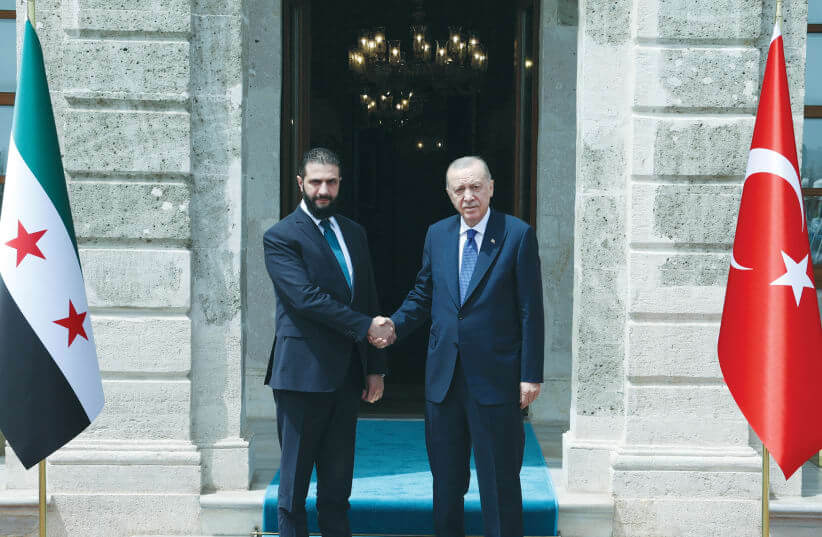
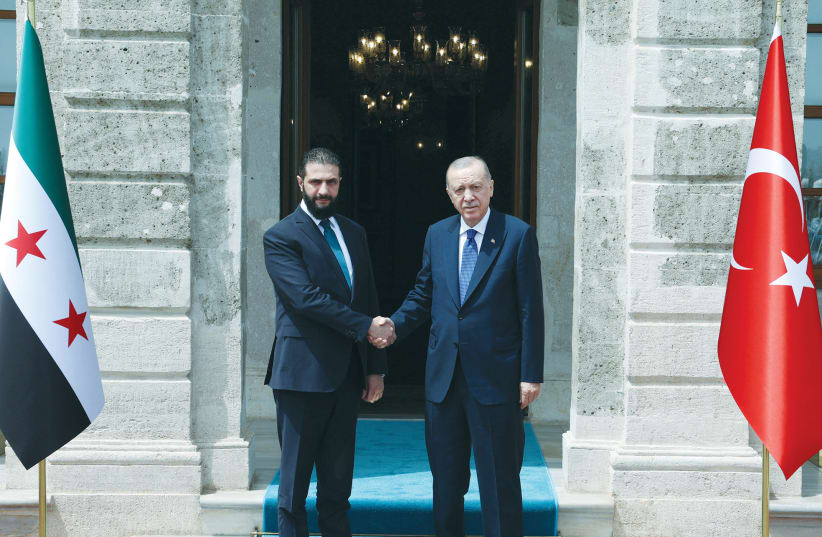
 TURKEY’S PRESIDENT Recep Tayyip Erdogan meets with Syrian President Ahmed al-Sharaa in Istanbul, earlier this week. (photo credit: Murat Cetinmuhurdar/PPO/Reuters)
TURKEY’S PRESIDENT Recep Tayyip Erdogan meets with Syrian President Ahmed al-Sharaa in Istanbul, earlier this week.
(photo credit: Murat Cetinmuhurdar/PPO/Reuters)
It has been a good few weeks for Turkish President Recep Tayyip Erdogan. All current indications suggest that the Turkish leader is making notable advances in his effort to place Turkey at the center of regional strategic affairs. As Erdogan’s Turkey builds its power and influence, its opposition to and agitation against Israel is continuing unabated.

Observe: this week, Erdogan hosted Ahmed al-Sharaa, the current interim president of Syria, at the Dolmabahce Palace in Istanbul. This was Sharaa’s third visit to Turkey since he assumed power in Syria. The Syrian leader thanked Erdogan for what he called Ankara’s “critical support” in securing the lifting of international sanctions against his country.

The US and European decisions to lift sanctions against Syria open the way for Sharaa to acquire critical funds for reconstruction in Syria, and potentially to consolidate his own rule.

While US President Donald Trump acknowledged the role of Saudi Crown Prince Mohammed bin Salman in securing this decision, Erdogan has been arguing consistently for the removal of economic restrictions against Syria in recent weeks, including, according to reports, in his conversations with the US President (with whom he enjoys “great relations,” in Trump’s own words.)

The new Syrian leader is clearly keen to maintain good relations with Riyadh and avoid the impression that he and his organization owe their position in its entirety to the Sunni Islamist axis of Turkey and the Emirate of Qatar. At the same time, it would be difficult to exaggerate the centrality of Turkey in recent events in Syria.

 An illustrative image of Turkish President Recep Tayyip Erdogan.  (credit: SHUTTERSTOCK/Mustafa Kamaci/Turkish Presidential Press Office/Handout via REUTERS)Enlrage image
An illustrative image of Turkish President Recep Tayyip Erdogan. (credit: SHUTTERSTOCK/Mustafa Kamaci/Turkish Presidential Press Office/Handout via REUTERS)

Crucially, it was the Turkish decision never to entirely abandon the Syrian Sunni Islamist insurgency that provided Sharaa with the territorial incubator in which he could maintain and grow the force that would eventually march to Damascus.

In this regard, it is worth remembering that just a year ago, the regional and global consensus was that the Syrian civil war was over and Assad had won it. Erdogan’s decision to stand outside this consensus has earned him the central role in determining the direction of Syria.

Turkey appears set to develop a military infrastructure in Syria in cooperation with the new regime. This is likely to be framed as part of the ongoing struggle against ISIS.

Such a framing is entirely disingenuous, given the former relations of de facto cooperation between Ankara and the Sunni jihadi organization, and the complex relations of ISIS with Sharaa and Hay’at Tahrir al-Sham (HTS). Nevertheless, with Sharaa’s new regime gaining in legitimacy, it may prove difficult to challenge these claims effectively.

Sources I spoke with recently in Washington emphasized the determination of the Trump administration to wind down the American presence in Syria in the course of this year. The US presence formed an effective containment to the ambitions of both Iran and Turkey in Syria. Should it be removed, Erdogan and his allies are likely to be the main beneficiaries.

Additional developments on the Kurdish front

ALONGSIDE DEVELOPMENTS in Syria, things appear to be moving in a positive direction for the Turkish leader on the crucial Kurdish front. According to a report in al-Monitor, the PKK (Kurdish Workers Party) announced earlier this month that it had held a congress in its area of control in the mountains of northern Iraqi Kurdistan, in response to the movement’s leader Abdullah Ocalan’s call for the end of its 40-year insurgency against Turkey.

On May 12, the movement announced its decision to disarm and disband. The details still remain to be settled, and the chance that this process may break down remains. But if it is carried through, as appears possible, the Turkish leader will be able justifiably to present it as a historic achievement.

Meanwhile, on the home front, Erdogan has secured the incarceration of his most serious political rival, former Istanbul mayor Ekrem Imamoglu. The arrest of Imamoglu appears to be the latest milestone on Turkey’s road to undisguised autocracy. Notably, and in a sign of the times, Erdogan’s suppression of political opposition at home appears to have been met with indifference in the West.

Erdogan also spoke this week with Pakistani Prime Minister Shehbaz Sharif. Sharif thanked Erdogan for Turkey’s support during its brief standoff with India after Islamist terrorists, who probably have links with Pakistan, murdered 26 people near Pahalgam, in Kashmir. This stance reflects Turkey’s ability to combine strategic and pan-Islamic objectives, and translate these into influence both in the Middle East and beyond.

It all appears to be going well for Erdogan: burgeoning relations with the US, central influence in Syria, the apparent eclipse of a major security challenge, the successful repression of internal opposition (met with international indifference), and the casting of influence beyond the region. Clearly, he is remaking Turkey as an Islamic and neo-Ottoman power. But what challenges and adversaries remain?

In this regard, it should be noted that success is not serving to moderate Erdogan and his allies, in particular in their enthusiastic support for Hamas, and the near-hysterical tone of much of their opposition to Israel.

A headline in the Yeni Safak newspaper this week caught the tone of the Erdogan government’s rhetoric in this regard. Yeni Safak is a Turkish language publication known for its close relations to the government. Its headline on Tuesday, May 27, referred to what it claimed were Israeli attacks on children in Gaza. The headline read: “There will be no peace for humanity until these vile murderers are destroyed.”

The headline joins similar utterances by Erdogan in recent months, in which he has variously compared Prime Minister Benjamin Netanyahu with Adolf Hitler, claimed that Israel was planning to invade Turkey, and called for Israel’s destruction.

Erdogan’s commitment to Israel’s destruction combines geo-political and Islamic ideological elements in the manner by now familiar. For the Turkish leader, Israel is a symbol of both Turkish and Muslim weakness. Its establishment in a former Ottoman territory is testimony both to imperial retreat, and to Islamic inability to prevent territory held by Muslims from falling back into the hands of its pre-Islamic custodians.

At the same time, Israel represents a formidable real-world adversary to Turkey’s advance, able to challenge it on the strategic level in the eastern Mediterranean, in Syria, and on the diplomatic front in Washington and other Western capitals.

Erdogan also fears the possibility of Israel finding its way to Turkey’s other enemies. Halil Karaveli, a Turkish analyst writing in The New York Times this week, noted that “above all, Turkey fears a Kurdish alliance with Israel.”

It’s undeniable that the Turkish challenge is set to be central in the period ahead for all those elements, in the region and beyond it, who are opposed to political Islam and its advance. The strategic and diplomatic contest between Israel and Turkey looks set to be one of the central regional dynamics in the period now opening up.


“The enemies of the Iranian nation should understand that any violation of our airspace will cause them significant harm,” Iran’s Armed Forces Chief of Staff said.

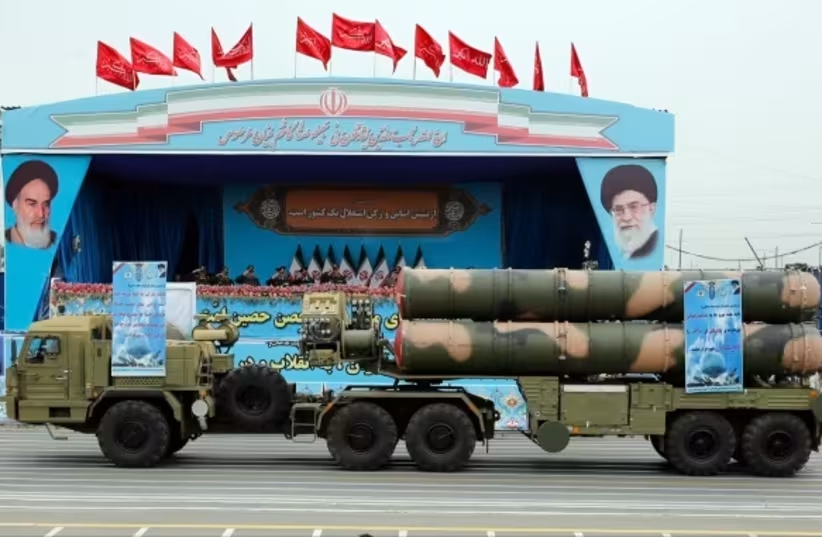
 An S-300 missile system on display during Iran’s Army Day parade. (photo credit: AFP/Getty Images)
An S-300 missile system on display during Iran’s Army Day parade.
(photo credit: AFP/Getty Images)
Iran is strengthening its air defense systems amid preparations for the possibility of an American or Israeli attack on the country’s nuclear infrastructure should nuclear negotiations fail, the Financial Times reported on Sunday.

“We are witnessing an impressive improvement in the capabilities and competence of the country’s air defense system,” Iran’s Armed Forces Chief of Staff Mohammad Baqeri reportedly said in May, adding that Iran’s military has seen a “multi-fold increase in investments.”

“The enemies of the Iranian nation should understand that any violation of our airspace will cause them significant harm,” he added.

According to Western intelligence assessments and security analysts’ investigation of satellite imagery, Iran appears to have relocated several anti-aircraft missile launchers to positions close to key nuclear sites like Natanz and Fordow, the report says.

A significant portion of Iran’s most advanced anti-aircraft missiles and radar systems – including its long-range Russian S-300 systems – were destroyed or damaged during Israeli air strikes on the country in October and April 2024, the FT states.

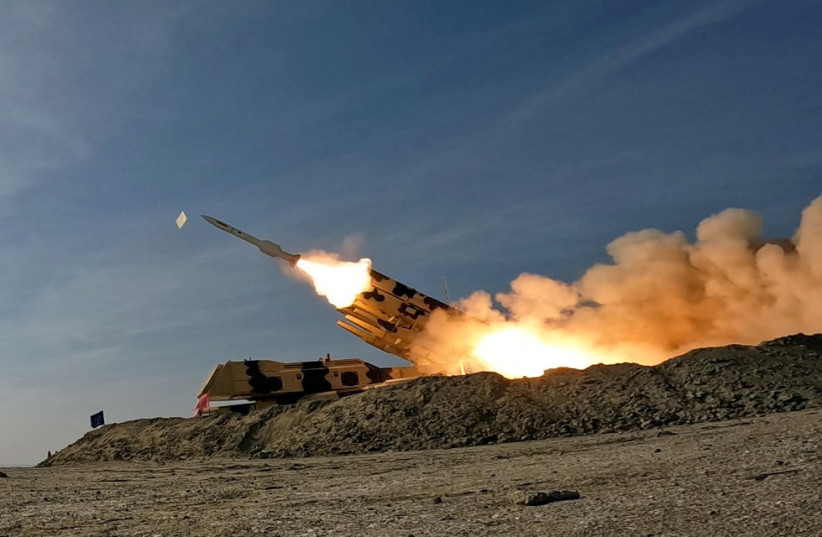
 A missile is launched during a military exercise in an undisclosed location in the south of Iran, in this handout image obtained on January 19, 2024 (credit: IRANIAN ARMY/WANA/REUTERS)Enlrage image
A missile is launched during a military exercise in an undisclosed location in the south of Iran, in this handout image obtained on January 19, 2024 (credit: IRANIAN ARMY/WANA/REUTERS)

Despite that, experts believe that many components of Iran’s air defense system remain intact or appear to have been repaired in recent months.

Weapons have been displayed to the public to refute destruction claims

Military equipment and weapons have been publicly displayed in Iran, with an S-300 launcher and a radar truck presented in Tehran during the country’s Army Day celebrations in May, and an S-300 shown launching an anti-aircraft missile during a military exercise in February.

“There is no doubt that Iran is seeking to refute the claim that its advanced air defense systems have been destroyed,” Nicole Gryzewski of the Carnegie Institution in Washington told the FT.

Israel would have the upper hand if it came to a fight

“Israel currently has almost complete air superiority over Iran,” Robert Tolast, a researcher at the British RUSI Institute, told the FT. “But such an attack would require waves upon waves of aircraft for hours. Crew fatigue comes into play – the longer they are over Iran, the greater the chance that something will go wrong.”

“From the Iranian side, this effort is trying to recreate the success story of Iran’s ballistic missile development program,” Fabian Hintz, a research fellow at the International Institute for Strategic Studies in Britain, said to the FT.

Dealing with this defense system would not be easy for Israel, John Alterman, chairman of the Global Security and Geopolitical Strategy Program at the Center for Strategic and International Studies in Washington, told the FT. “But is it beyond Israel’s capabilities? No, of course not. The Israelis have been training for exactly this scenario for decades.”

Nuclear negotiations are ongoing between Iran, US

Talks between Washington and Tehran over the future of Iran’s nuclear program are ongoing. Most recently, the US presented a proposal for a new nuclear deal to Iran on Saturday via Oman’s Foreign Minister Sayyid Badr Albusaidi, who was on a short visit to Tehran and has been mediating nuclear talks between Iran and the US.

However, a senior diplomat close to Iran’s nuclear negotiating team said on Monday that Iran is poised to reject the proposal, slamming it as a “non-starter” that fails to address Tehran’s interests and leaves Washington’s stance on uranium enrichment unchanged.

“Iran is drafting a negative response to the US proposal, which could be interpreted as a rejection of the US offer,” the diplomat said.

Reuters contributed to this report.