Top officer says Islamic Republic ‘can pounce on nuclear program’ if talks don’t see its stockpile taken away; says IDF’s ‘hands tied’ in countering Hezbollah drone threat due to truce

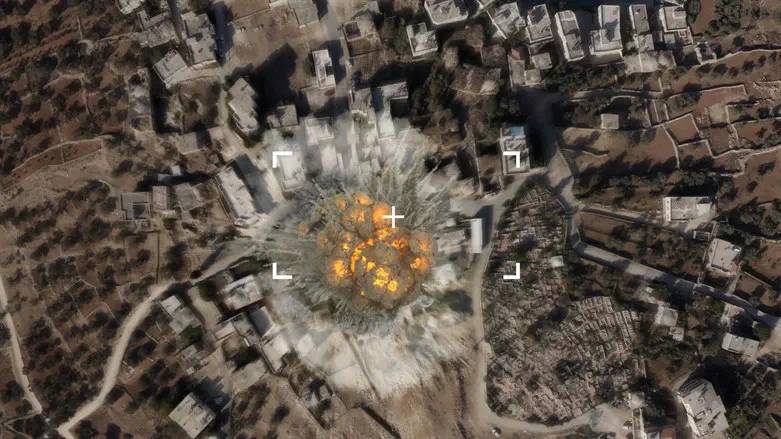
Footage released by the IDF on June 21, 2025, shows the aftermath of Israeli strikes on Iran's Isfahan nuclear facility. (Israel Defense Forces)

Footage released by the IDF on June 21, 2025, shows the aftermath of Israeli strikes on Iran’s Isfahan nuclear facility. (Israel Defense Forces)

A senior Israeli military official said on Friday that if Iran’s stockpile of more than 400 kilograms of highly enriched uranium is not removed from the country in the wake of the recent war, the campaign could be considered “one big failure.”

Israeli officials have said that this stockpile is sufficient for 11 nuclear bombs if enriched further. Iran has long maintained that its program is peaceful, despite enriching uranium at near-weapons-grade levels.

Israel launched its campaign against Iran on February 28, alongside the United States, to degrade the Iranian regime’s military capabilities, distance threats posed by Iran — including its nuclear and ballistic missile programs — and “create the conditions” for the Iranian people to topple the regime, the military and other Israeli leaders have said.

The senior officer said that if, under the ongoing negotiations between the US and Iran, no agreement is reached to remove the uranium stockpile and halt enrichment in the country, the achievements of the 40 days of fighting will have been for nothing.

“If the nuclear objective is not achieved, then everything we did in Iran will be one big failure. The evil Iranian regime can pounce on the nuclear program,” the official said during a briefing for reporters, speaking on condition of anonymity.

The officer added that “if the uranium is removed from Iran through diplomatic means, we have done our part.” However, if that does not happen, Israel would need to launch another operation in Iran to achieve the objective.

Iran’s Foreign Minister Abbas Araghchi, fifth left, meets with Prime Minister Shehbaz Sharif, center, in Islamabad, Pakistan, April 25, 2026. (Pakistan Prime Minister’s Office via AP)

During a recent visit to southern Lebanon, IDF Chief of Staff Lt. Gen. Eyal Zamir said that “every [goal] the political echelon defined for us regarding the current campaign in Iran and Lebanon has been achieved and even beyond that.”

“In doing so, we have created the operational conditions for the processes now being led by the political echelon,” he stated.

IDF’s hands ‘tied’ in Lebanon

The officials said the Israeli military is optimistic that a solution will be found to counter the fresh threat of Hezbollah’s first-person view (FPV) fiber-optic cable-guided drones, which have been repeatedly used in attacks on Israeli troops in southern Lebanon and northern Israel in recent weeks.

A Hezbollah drone slams into an Israeli tank in the southern Lebanon town of Mays al-Jabal on April 11, 2026, in footage published by the terror group on April 27, 2026. (Hezbollah media office)

The military official said the IDF has been taking the threat seriously and working to develop and test systems to counter fiber-optic FPV drones, which are immune to electronic jamming. However, it is unlikely that any such system would be ready in the short term, he said, nor would it provide a hermetic solution to the threat.

“There is no magic solution. But we are optimistic that we will find a solution for the drones,” he said.

Still, the official said the most effective way to counter the threat would be to target the drone operators deep in Lebanon and Hezbollah’s supply chain for the drones.

However, this is currently not possible due to the ceasefire, as Israel is only permitted to target imminent threats to troops in southern Lebanon, such as drone operators actively piloting a drone.

“We need to go on the offense,” the officer said, while noting that currently, “our hands are tied.”

A cache of Hezbollah weapons and drones found by IDF troops in southern Lebanon, in a handout photo published by the military on April 27, 2026. (Israel Defense Forces)

The Israeli Air Force has been assisting ground troops in Lebanon in dealing with the FPV drone threat by deploying mobile radars to detect them and alert forces, who can then attempt to shoot them down.

The IAF has also carried out interceptions, reporting that it shot down at least 27 FPV drones using the short-range Iron Dome air defense system.

While the military has deployed the Iron Beam — a high-powered laser system designed to shoot down drones and other aerial threats at a far lower cost per interception — it has seen limited use and has not yet been declared operational within the IDF. The senior officer said the Iron Beam’s coverage is partial, and more time is needed for a wider and more complete laser-based defense array.


Report: Iran restoring missile stockpiles

US officials say Iran using ceasefire lull to recover buried missiles and rebuild capabilities, as Trump weighs next steps in coming days.

Ballistic missile production site following IDF attack

Ballistic missile production site following IDF attackIDF spokesperson

Iran is using the ceasefire to dig up the missiles and other munitions stored underground or buried in US and Israeli strikes, a US official and two others familiar with the matter told NBC News.

According to NBC, the US believes that Iran is aiming to “quickly reconstitute” its capabilities to enable it to attack targets across the Middle East if fighting resumes.

One of the US officials added that US President Donald Trump is likely to decide on his next steps within the coming days.

Last month, US Secretary of War Pete Hegseth said in a Pentagon briefing that Iran, “can dig out for now, but you can’t reconstitute, but we can.”

Asked by NBC for comment, a spokesperson for the Defense Department pointed to Hegseth’s remarks.


According to one source, the Lebanese government is hesitant to embrace the initiative, citing concerns over expanding Turkish influence in the country.

Turkey’s President Tayyip Erdogan speaks after a cabinet meeting in Ankara, Turkey, March 9, 2026.
(photo credit: Mustafa Kamaci/Presidential Press Office/Handout via REUTERS) 
Turkey has approached the United States and Lebanon with a proposal to help broker an arrangement involving Hezbollah, according to two sources familiar with the matter who spoke to The Jerusalem Post.

The initiative includes an offer by Ankara to act as a mediator and take an active role in addressing the Hezbollah issue. The proposal reflects Turkey’s broader effort to expand its diplomatic reach and position itself as a regional power broker. The US administration has not yet provided a clear response, with officials neither accepting nor rejecting the offer.

In recent years, Turkey has sought greater involvement across the Middle East, particularly in areas bordering Israel. In the Gaza Strip, Ankara aimed to participate in a planned CMCC peacekeeping force expected to be deployed following “Trump’s 20-point plan,” but Israel vetoed the inclusion of Turkish troops.

In Syria, Turkey has emerged as a significant actor since the rise of President Ahmed al-Sharaa. At the same time, Israel has worked to prevent the establishment of Turkish military bases in the country.

Lebanon ‘hesitant’ to accept Turkish influence

According to one source, the reaction in Beirut has been “not very enthusiastic.” The Lebanese government is hesitant to embrace the initiative, citing concerns over expanding Turkish influence in the country – an outcome that could further complicate Lebanon’s fragile political balance.

Israel Ambassador to the US Yechiel Leiter, US Ambassador to Lebanon Michel Issa, Lebanon Ambassador to the US Nada Hamadeh Moawad, US President Donald Trump, US Secretary of State Marco Rubio, and US Vice President JD Vance in the Oval Office, April 23, 2026.
Israel Ambassador to the US Yechiel Leiter, US Ambassador to Lebanon Michel Issa, Lebanon Ambassador to the US Nada Hamadeh Moawad, US President Donald Trump, US Secretary of State Marco Rubio, and US Vice President JD Vance in the Oval Office, April 23, 2026. (credit: Reuters/Kylie Cooper)

Before the current Iran-US ceasefire, Turkey said that any agreement with Iran should include Lebanon. More recently, Turkey delivered 360 tons of aid to displaced civilians through the port of Beirut.

More than one million people have been displaced from southern Lebanon and Beirut since the start of the war.

“Turkey will always stand by Lebanon, and its friendly people,” Turkish Ambassador Lütem said at the event. “Turkey has consistently supported Lebanon through its official institutions and non-governmental organizations.”