Israel’s repeated strikes on Syria act as a warning to the new Islamist rulers in Damascus, which Israel views as a potential threat on its border.
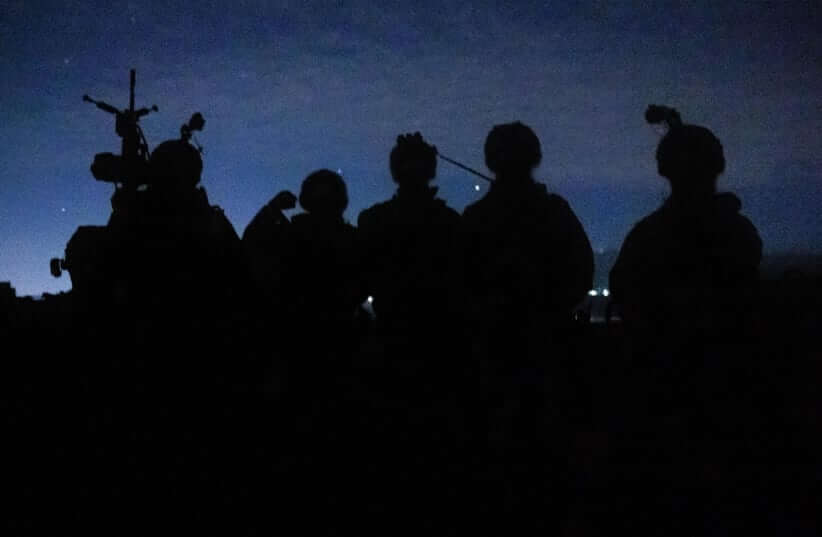
By REUTERSUpdated: MAY 3, 2025 01:15IDF operates in southern Syria, April 5, 2025.(photo credit: IDF SPOKESPERSON’S UNIT)
Israeli strikes targeted the vicinity of Syria’s Damascus countryside and Hama late on Friday, Syrian state news agency SANA reported on Friday, without providing further details.
Israel’s repeated strikes on Syria act as a warning to the new Islamist rulers in Damascus, which Israel views as a potential threat on its border.
The IDF later confirmed it had struck a military site, anti-aircraft cannons, and surface-to-air missile infrastructure in Syria.
The IDF has previously said it targeted Syria’s military infrastructure, including headquarters and sites containing weapons and equipment, since mainly Sunni Muslim Islamist fighters toppled President Bashar al-Assad in December.
IDF earlier that day had bombed near the Syrian presidential palace in capitol
Earlier on Friday, Israel bombed an area near the presidential palace in Damascus, in its clearest warning yet to Syria’s new Islamist-led authorities of its readiness to ramp up military action, which has included strikes it said were in support of the country’s Druze minority.
Syrian security forces check vehicles at the entrance of Druze town of Sahnaya, Syria, May 1, 2025. (credit: REUTERS/YAMAM AL SHAAR)
Israel bombed Syria frequently when the country was governed by Assad, targeting a foothold established by his ally Iran during the civil war.
Marco Rubio said Iran must stop enrichment, missile development, and terrorism support, and allow US inspectors. Nuclear talks were postponed amid major US-Iran disagreements.
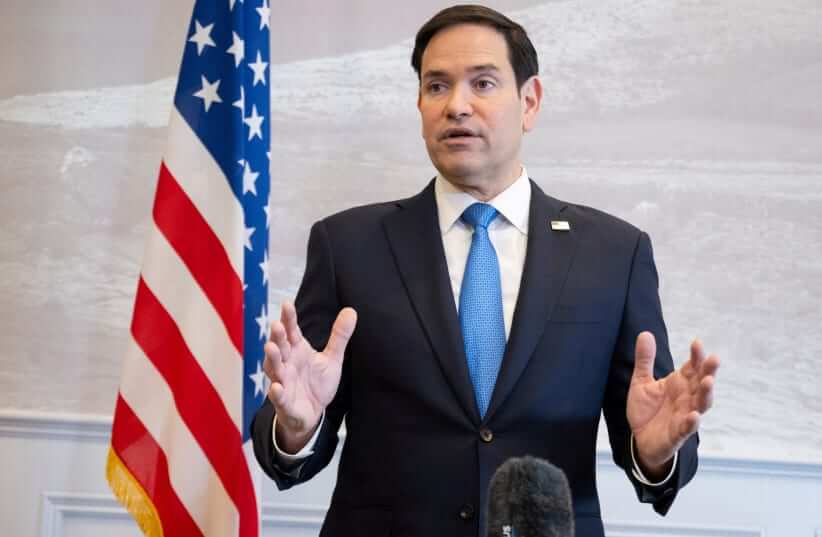
By REUTERSUpdated: MAY 2, 2025 11:52US Secretary of State Marco Rubio speaks to the media during a refueling stop at Shannon Airport in Shannon, Ireland, March 12, 2025, as he travels from talks with Ukraine in Saudi Arabia to attending a G7 Foreign Ministers meeting in Canada.(photo credit: SAUL LOEB/POOL VIA REUTERS)
Iran has to ‘walk away’ from uranium enrichment and long-range missile development and it should allow American inspectors of its facilities, US Secretary of State Marco Rubio said on Thursday as a round of nuclear talks was postponed.
Rubio’s comments underscore the major remaining divisions in talks between the countries to resolve the long-running dispute over Iran’s nuclear program, with US President Donald Trump threatening to bomb Iran if there is no agreement.
“They have to walk away from sponsoring terrorists, they have to walk away from helping the Houthis (in Yemen), they have to walk away from building long-range missiles that have no purpose to exist other than having nuclear weapons, and they have to walk away from enrichment,” Rubio said in a Fox News interview.
Iran has repeatedly said it will not give up its missile program or its uranium enrichment – a process used to make fuel for nuclear power plants but which can also yield material for an atomic warhead.
On Thursday a senior Iranian official told Reuters that the scheduled fourth round of talks due to take place in Rome on Saturday had been postponed and that a new date would be set “depending on the US approach.”
U.S. Secretary of State Marco Rubio attends an interview after meeting with Russian Foreign Minister Sergei Lavrov and Russian President Vladimir Putin’s foreign policy advisor Yuri Ushakov, , U.S. National Security Advisor Mike Waltz, and U.S. Middle East envoy Steve Witkoff, at Diriyah Palace (credit: REUTERS/Evelyn Hockstein/Pool REFILE )
Iran would have to accept American inspection
Rubio said Iran should import enriched uranium for its nuclear power program rather than enriching it to any level.
“If you have the ability to enrich at 3.67% it only takes a few weeks to get to 20% then 60% and then the 80 and 90% that you need for a weapon,” he said.
Iran has said it has a right to enrich uranium under the terms of the nuclear Non-Proliferation Treaty. It denies wanting to build a nuclear bomb.
Rubio also said Iran would have to accept that Americans could be involved in any inspection regime and that inspectors would require access to all facilities, including military ones.
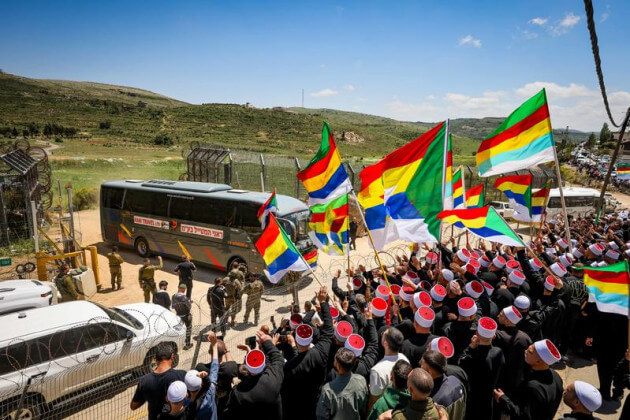
Druze from Syria enter Israel at Majdal Shams, April 25, 2025.
In response to the massacre of Druze civilians in Syria and violent protests by Israeli Druze citizens that erupted Thursday along the country’s northern highways, Prime Minister Benjamin Netanyahu and Defense Minister Israel Katz issued a joint statement declaring, “Israel attacked last night near the presidential palace in Damascus.” The statement stressed that “This is a clear message to the Syrian regime: we will not allow a movement of forces to the south from Damascus or any threat to the Druze community.”
At least 73 Druze have been killed in Syria, and in response, hundreds of Druze living in Israel took to the streets Thursday night to protest the ongoing massacre. Demonstrators gathered at major intersections, lighting bonfires and causing massive traffic jams, which trapped thousands of drivers. Clashes ensued between protesters and motorists.
Lebanese Hezbollah-affiliated channel Al-Manar aired footage reportedly from the site of the IAF strike, showing smoke rising and sirens sounding in the area.
The IDF Spokesperson released an update after the Prime Minister’s Office announcement, confirming that “warplanes attacked in the area near the palace of Ahmed Hussein al-Shara’ in Damascus.”
Ahmed Hussein al-Shara, also known by his nom de guerre Abu Mohammad al-Julani, is the former rebel commander who became President of Syria in January 2025, after serving as the country’s de facto leader since December 2024.
Overnight, the Druze villages of Lubin, Haran, and Jarin in Syria’s As-Suwayda province came under hours-long attack. Local residents reported returning fire at the sources of the assault.
According to SyriaTV, local factions in As-Suwayda successfully repelled a large-scale offensive, as extremist groups launched shell attacks on the villages. The Syrian government continues to claim that the groups targeting the Druze are “outlawed factions that do not belong to the Ministry of Defense or the security apparatus.”
ISRAELI DRUZE PROTESTING
Members of the Druze community held demonstrations across northern Israel on Thursday evening to protest the violent attacks against Druze in Syria, carried out by supporters of the Syrian President.
The protests caused heavy traffic congestion, with several northern highways blocked by demonstrators who lit bonfires on the roads. Footage shared online showed clashes between protesters and motorists attempting to clear passage. A separate demonstration was also held in Caesarea, near the Prime Minister’s residence.
The IDF confirmed Thursday that another Druze individual wounded in the massacre in Syria was admitted for treatment at Ziv Hospital in Tzfat. This marks the seventh Syrian Druze to enter Israel for medical care this week. Meanwhile, unrest has intensified among Druze soldiers and officers in the IDF, who are expressing frustration over what they see as the government’s slow and ineffective response to the Syrian president’s regime.
Shortly after midnight, hundreds of Druze demonstrators gathered outside Prime Minister Benjamin Netanyahu’s home in Caesarea, escalating tensions as the community continues to demand stronger action.
Hundreds of IDF Druze fighters, both active-duty and reservists, released a letter Thursday evening addressed to Prime Minister Benjamin Netanyahu and Defense Minister Israel Katz, demanding permission to cross into Syria to defend their relatives and communities who are under attack.
In their letter, the Israeli Druze fighters wrote: “According to heartbreaking and shocking reports and videos, Druze civilians are being murdered and humiliated. Despite the loyalty of the community, including respected sheiks who are fighting fiercely against the rioters to protect their families, our Druze brothers in Syria have failed to repel the rioters and prevent many massacres.”
“We expect you to fulfill your promise of solidarity and protection, and stop the massacre of our Druze brothers across the border in Syria – as you and the Minister of Defense promised – and to activate the IDF for this purpose.”
The letter also calls for direct action by Druze fighters themselves: “Hundreds of Druze fighters are ready to immediately volunteer and fight alongside our brothers to save them, even at the cost of taking responsibility for all the risks this entails for our safety and lives.”
DRUZE PROTESTERS ATTACK IDF SOLDIER
A violent incident broke out Thursday night during a Druze demonstration on Highway 6 in northern Israel. Footage shared on social media shows a uniformed soldier caught in the middle of a brawl, being physically assaulted before police intervened and removed him from the scene.
During the melee, the soldier is seen in the footage being struck with a flag, punched, and surrounded by a large group of Druze protesters for several tense seconds. At one point, one of the protesters appears to take hold of the soldier’s weapon, further escalating the situation before police intervened to extract him from the crowd.
Another individual was filmed being severely beaten by protesters during the demonstration. In the video capturing the incident, the victim is shown attempting to escape but is relentlessly pursued and attacked by a group of protesters, who continue to strike him as he struggles to flee.