If Saudi Arabia does join the Abraham Accords, it would signal a brave new Middle East, where peace and prosperity between Jews and Arabs can become the new norm.

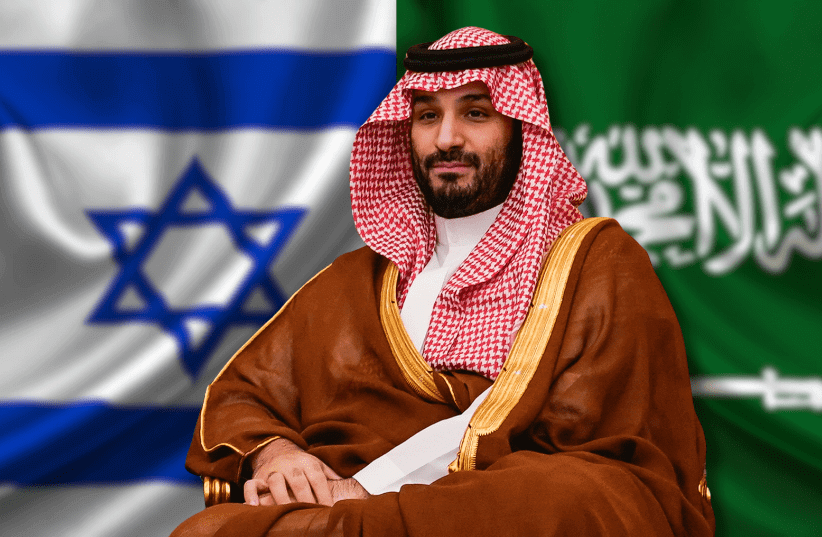
 Illustrative image of Saudi crown prince Mohammed bin Salman (photo credit: Canva, GoodFon, REUTERS/Nathan Howard/Pool)
Illustrative image of Saudi crown prince Mohammed bin Salman
(photo credit: Canva, GoodFon, REUTERS/Nathan Howard/Pool)
Enlrage image

French president Charles de Gaulle famously stated that “Countries don’t have friends, countries have interests.” It now seems plausible that Saudi Arabia and Israel have mutually beneficial interests that were unimaginable in the past. Let’s look at the recent history and the current situation regarding Saudi Arabia.

Starting in 1902, Abdul Aziz bin Saud, known as Abdulaziz, and his followers captured Riyadh, and then began conquering clans and tribes across Arabia. His modus operandi was to marry a young woman from each tribe that he conquered. In this way, he united the conquered tribes into the House of Saud. He ended up marrying 22 women and fathered 45 sons and an unknown number of daughters. In keeping with the laws of the Quran, he never had more than four wives at any one time.

In September 1932, Abdulaziz officially renamed Arabia as the Kingdom of Saudi Arabia and declared himself king. The kingdom is officially a Sunni Islamic State with the Quran as its constitution. It remains an absolute monarchy with no elections.

In 1932, the country had a population of approximately 2.8 million and was one of the poorest countries on Earth. Most of the country was a barren desert. Life expectancy was in the 40’s, and the majority of the population were illiterate. The country was facing a dire financial crisis, exacerbated by the Great Depression that started in 1929 and resulted in less than 10% of the normal number of Muslims undertaking the Hajj in the following years. By 1932, the Kingdom of Saudi Arabia was basically broke. Jack Philby came up with a solution.

How Saudi Arabia was transformed to a wealthy nation

Philby was born in 1885. He was brilliant in languages and studied Oriental languages at Cambridge University. In November 1917, he was sent to Riyadh as the head of a four-man British delegation to meet with Abdulaziz. He arrived in Riyadh by crossing the Arabian desert by camel. Philby met Abdulaziz and was greatly impressed with him. He returned to England and felt disillusioned with Christianity and his life. He divorced his wife, converted to Islam, and went to live in Arabia. He was fluent in Arabic and changed his name to Sheik Abdullah. He married a Saudi woman and became an adviser to Abdulaziz.
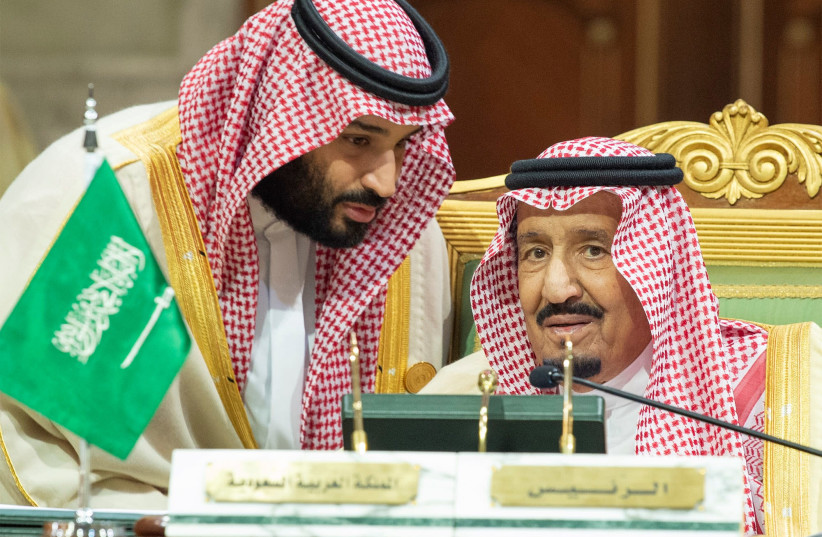
Saudi Arabia's Crown Prince Mohammed bin Salman talks with Saudi Arabia's King Salman bin Abdulaziz Al Saud during the Gulf Cooperation Council's (GCC) Summit in Riyadh, Saudi Arabia December 9, 2018 (credit: BANDAR ALGALOUD/COURTESY OF SAUDI ROYAL COURT/HANDOUT VIA REUTERS)Enlrage image
Saudi Arabia’s Crown Prince Mohammed bin Salman talks with Saudi Arabia’s King Salman bin Abdulaziz Al Saud during the Gulf Cooperation Council’s (GCC) Summit in Riyadh, Saudi Arabia December 9, 2018 (credit: BANDAR ALGALOUD/COURTESY OF SAUDI ROYAL COURT/HANDOUT VIA REUTERS)

In 1932, he advised Abdulaziz that the best way to solve Saudi Arabia’s financial problem was to sell the rights to prospect for oil in Saudi Arabia to the Americans, provided that payments would be made in advance to sustain the kingdom. He advised Abdulaziz to offer Standard Oil of California, known as SOCAL, the rights to prospect for oil in Saudi Arabia. The deal appealed to Abdulaziz and was duly signed.

What Sheik Abdullah failed to reveal was that he was in the employ of SOCAL and had been promised a bonus if he could seal the deal. It turned out to be an epic deal for both the kingdom and SOCAL. In 1938, the largest oil reserves in the world were discovered beneath the vast desert in Saudi Arabia. It was the start of huge American investments in the Middle East. Several decades later, the massive income from the sale of oil would transform Saudi Arabia into one of the richest countries in the world.

In 1953, Abdulaziz, the founder of Saudi Arabia, died. In his will, he stipulated that the oldest surviving son at the time of his death would succeed him and become king, and that would continue until all his sons were deceased. King Salman, the current king of Saudi Arabia, is the last surviving son of Abdulaziz. He is 89 years old. Five years ago, he appointed his seventh son, Mohammed bin Salman, as the de facto ruler of the Kingdom of Saudi Arabia. He is known as MBS and is now 39 years old.

Barring unforeseen circumstances, MBS will most likely be the next king of Saudi Arabia and will remain so for decades. He has indicated that he wants to chart a different future for Saudi Arabia than his predecessors. He understands that the world is rapidly changing and that relying solely on oil to maintain a prosperous future for Saudi Arabia is neither wise nor sustainable in the long term.

Saudi citizens pay no income taxes, receive free medical services, free primary and university education, and receive monthly allowances from the government.

What could go wrong? Let’s take a closer look at the situation.
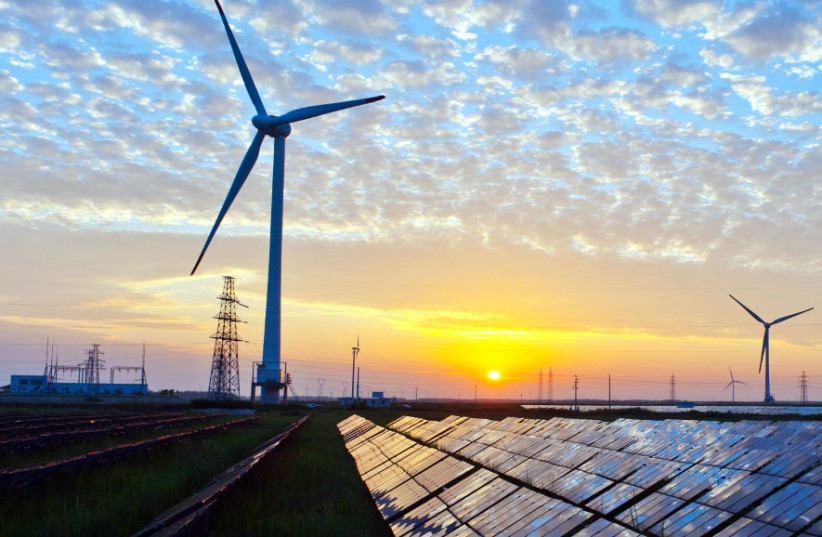
 Clean and sustainable energy (illustrative). (credit: Wikimedia Commons)Enlrage image
Clean and sustainable energy (illustrative). (credit: Wikimedia Commons)

Climate change and green energy: Why Saudi Arabia’s continued prosperity is uncertain

The world has become aware of the devastating effect of climate change, and it is promoting alternative forms of energy to reduce carbon emissions. Britain has banned the sale of new petrol and diesel cars from 2030, and the EU has done likewise from 2035. In Norway, 88.9% of new cars sold in 2024 were electric cars. It is clear that the movement away from fossil fuels is gaining momentum worldwide.

The growth of solar power, wind power, and other forms of energy are now ubiquitous in the world. The largest source of electricity in France comes from 18 nuclear power stations. Mini nuclear power stations that are considered safer are in the planning stages. President Donald Trump is promoting an increase in local oil production by drilling and fracking. This has the potential to turn America from an oil importer into an oil exporter. New oil and gas deposits have been discovered in several areas of the world. If the demand for oil decreases and the supply increases, it is clear that the price of oil will decrease.

MBS has realized that Saudi Arabia, with 38 million people, cannot continue to rely solely on oil production for a prosperous future. He is promoting what is called Vision 2030 for Saudi Arabia. Vision 2030 is aimed at diversifying Saudi Arabia economically, socially, and culturally in order to have a better long-term future for the country. Israel can play an important role in fulfilling that vision.
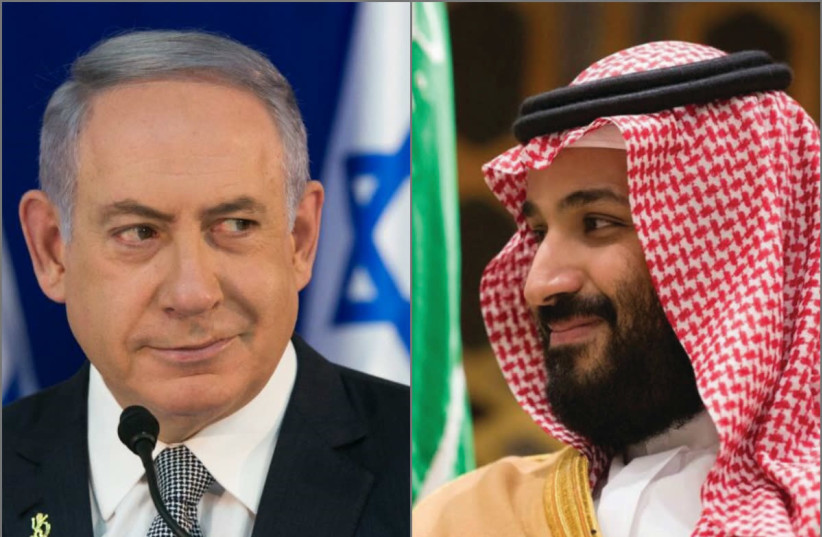
Israeli Prime Minister Benjamin Netanyahu and Saudi Arabian Crown Prince Mohammed Bin Salman (credit: MARC ISRAEL SELLEM/REUTERS)Enlrage image
Israeli Prime Minister Benjamin Netanyahu and Saudi Arabian Crown Prince Mohammed Bin Salman (credit: MARC ISRAEL SELLEM/REUTERS)

How Israel can help Saudi Arabia achieve a brighter future

Israel is known as the Start-Up Nation. Thinking out of the box is in the DNA of Israelis and has been at the heart of Israel’s exceptional growth and success. Israel is a powerhouse of innovation, intellectual property, and ideas. It has made the desert bloom. It has revolutionized agricultural production with drip irrigation and recycled wastewater. It has expertise in providing drinking water through desalination and even providing drinking water from air. In addition, Israel is a leading innovator in cybersecurity, hi-tech, the medical field, and many other areas.

Israel is ideally suited from a geographical point of view to provide Saudi Arabia with an alternative route to export oil by the use of a pipeline from Eilat to an Israeli port on the Mediterranean Sea. From there, the oil can be shipped to its final destination. This would bypass Iranian control of the current sea routes used by Saudi Arabia. Israel has produced innovative solutions to problems that are similar to those facing Saudi Arabia.

Israel is also a formidable military power with battle-tested military capabilities that extend far beyond its borders. One important factor is that Israel has no border dispute with Saudi Arabia. Israel can be an excellent partner for Saudi Arabia, and Saudi Arabia can be a game-changing partner for Israel. In short, the two countries can benefit enormously from each other.

The big question is whether MBS is willing to chart a future that includes joining the Abraham Accords. He has indicated that the formation of a Palestinian state is a prerequisite for this to happen. Israel is unlikely to agree to this. However, politics is the art of agreeing to compromises. Anything is possible when people with foresight and courage are involved. Saudi Arabia is the keeper of the Muslim holy cities of Mecca and Medina and needs to be seen as worthy of that position. Joining the Abraham Accords would have to be skillfully negotiated in order to be accepted by the Muslim world.

It is time for Saudi Arabia to inform the Palestinians that they cannot be an impediment to progress forever, and that they need to internalize that the Arab League resolution passed in 1967 in Khartoum, known as the Three No’s Resolution  – “No peace with Israel. No negotiation with Israel. No recognition of Israel” – ended when Egyptian president Anwar Sadat signed a peace treaty with Israel in 1979 and is no longer applicable.

If Saudi Arabia does join the Abraham Accords, it would signal a brave new Middle East, where peace and prosperity between Jews and Arabs can become the new norm. It would be a remarkable milestone in the history and advancement of mankind, and a better future for the entire Middle East. ■

EU needs to decide on possible Iran sanctions, Rubio says

Rubio also stated that the United States will stop trying to broker a Russia-Ukraine peace deal within days unless there are clear signs that a deal can be done.

 US Secretary of State Marco Rubio looks on upon his arrival at the Quai d'Orsay, France's Ministry of Foreign Affairs, before a bilateral meeting with his French counterpart in Paris, France April 17, 2025. (photo credit: JULIEN DE ROSA/Pool via REUTERS)
US Secretary of State Marco Rubio looks on upon his arrival at the Quai d’Orsay, France’s Ministry of Foreign Affairs, before a bilateral meeting with his French counterpart in Paris, France April 17, 2025.
(photo credit: JULIEN DE ROSA/Pool via REUTERS)
Europe needs to decide if it is willing to reimpose sanctions on Iran when it becomes clear it is close to developing a nuclear weapon, US Secretary of State Marco Rubio said on Friday.

“The Europeans have a decision to make, because I believe we should all anticipate that they’re about to get a report from the IAEA that says not just Iran is out of compliance, but Iran is dangerously close to a weapon, closer than they’ve ever been,” Rubio said in Paris after meeting with European leaders.

Rubio said the US administration is looking for a peaceful solution with Iran, but will never tolerate the country developing a nuclear weapon.

“It has to be something that not just prevents Iran from having a nuclear weapon now,” he said about a possible agreement.

“But in the future as well, not just for ten years with some sort of sunset provision or the like.”

 US Secretary of State Marco Rubio shakes hands with France's Minister for Europe and Foreign Affairs Jean-Noel Barrot, upon his arrival at the Quai d'Orsay, France's Ministry of Foreign Affairs, before a bilateral meeting with his French counterpart in Paris, France April 17, 2025. (credit: JULIEN DE ROSA/Pool via REUTERS)Enlrage image
US Secretary of State Marco Rubio shakes hands with France’s Minister for Europe and Foreign Affairs Jean-Noel Barrot, upon his arrival at the Quai d’Orsay, France’s Ministry of Foreign Affairs, before a bilateral meeting with his French counterpart in Paris, France April 17, 2025. (credit: JULIEN DE ROSA/Pool via REUTERS)

Ukraine-Russia War

Rubio also stated that the United States will stop trying to broker a Russia-Ukraine peace deal within days unless there are clear signs that a deal can be done.

Rubio said that President Donald Trump was still interested in a deal but had many other priorities around the world and was willing to move on unless there are signs of progress.


Three-stage proposal would reportedly see Tehran temporarily cap enrichment at 3.67%, transfer highly enriched uranium to 3rd country, boost UN oversight at nuclear facilities

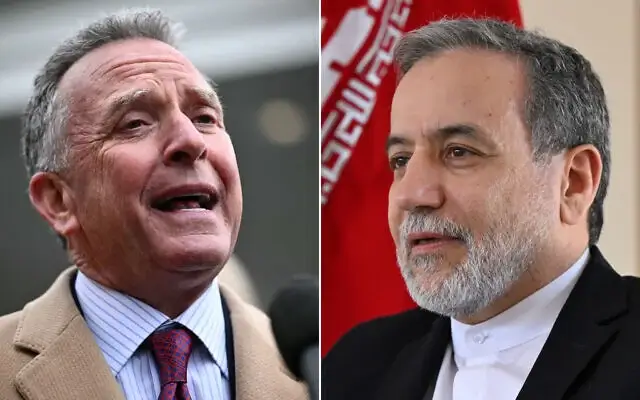
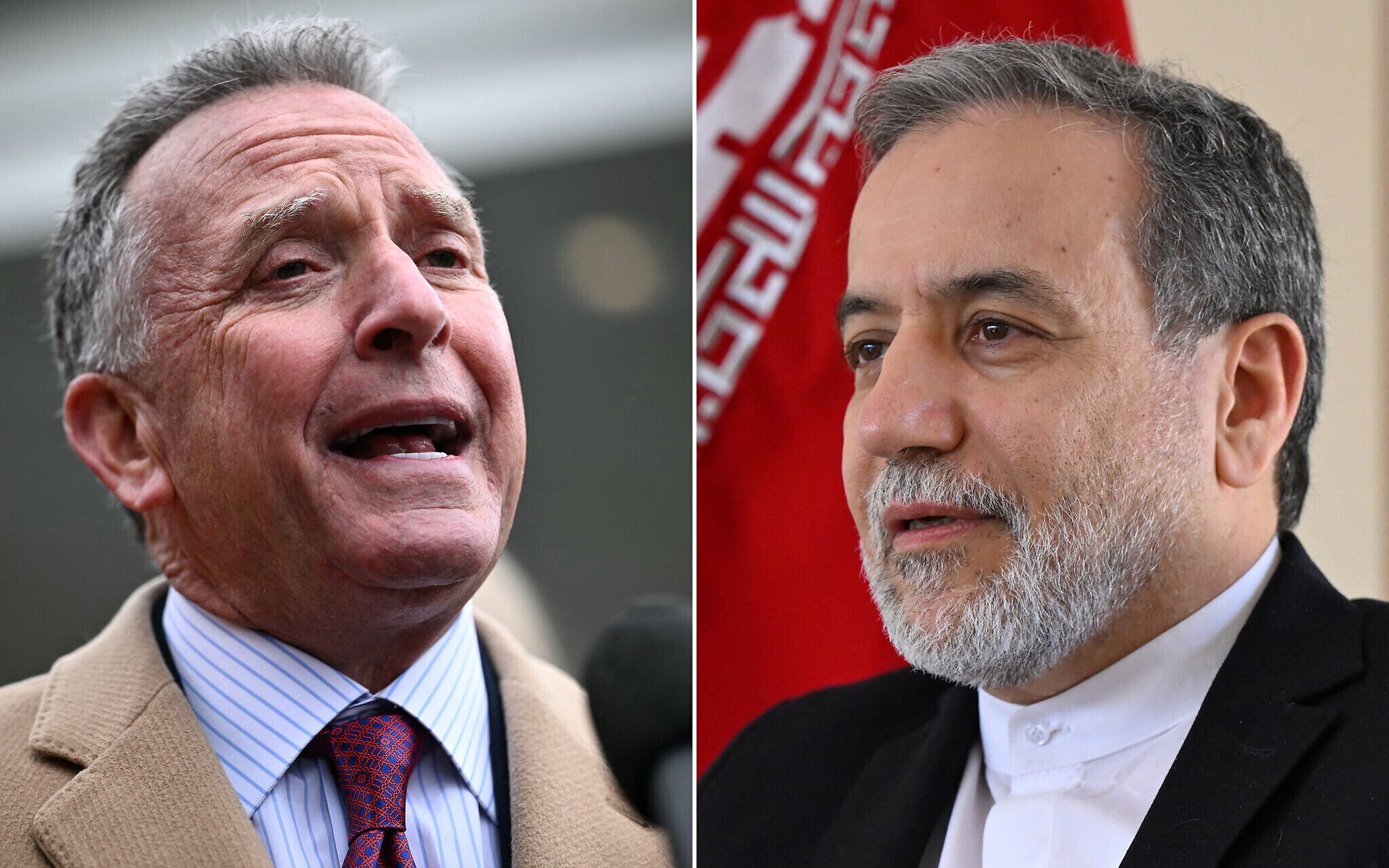
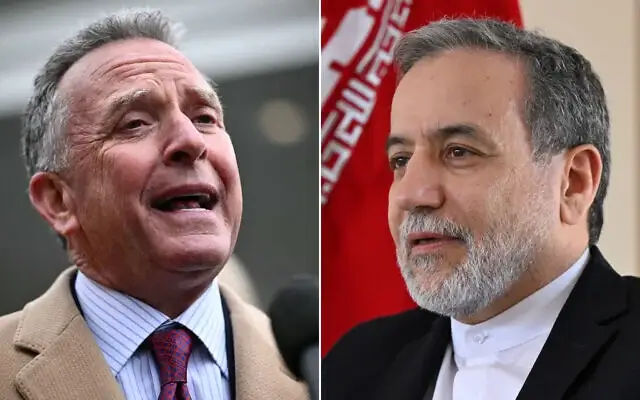
This combination of file photos created on April 9, 2025, shows US Middle East envoy Steve Witkoff speaking to reporters outside the West Wing of the White House in Washington, DC, on March 6, 2025 (L), and Iran's Foreign Minister Abbas Araghchi speaking to AFP during an interview at the Iranian consulate in Jeddah, Saudi Arabia, March 7, 2025. (Mandel Ngan and Amer Hilabi / AFP)

This combination of file photos created on April 9, 2025, shows US Middle East envoy Steve Witkoff speaking to reporters outside the West Wing of the White House in Washington, DC, on March 6, 2025 (L), and Iran’s Foreign Minister Abbas Araghchi speaking to AFP during an interview at the Iranian consulate in Jeddah, Saudi Arabia, March 7, 2025. (Mandel Ngan and Amer Hilabi / AFP)

Tehran proposed during talks on Saturday a three-stage deal that would cap its uranium enrichment to the same levels agreed to in the abandoned 2015 deal in exchange for the lifting of US sanctions, dissident Iranian news outlet Iran International reported Thursday, citing three diplomatic sources.

According to Iran International, Iran’s proposal would temporarily decrease uranium enrichment to 3.67%, the level set in the 2015 deal that Trump withdrew from during his first term. In exchange, the US would permit Iran to access frozen financial assets and export its oil in the first phase, the outlet said. Uranium is considered weapons-grade when it is enriched to 90%.

In the second phase, the US would lift more sanctions and prevent the snapback of UN sanctions, according to Iran International. In exchange, Iran would reportedly allow the United Nations’ International Atomic Energy Agency to resume its inspections of nuclear sites, while also carrying out the “additional protocol,” allowing the nuclear watchdog to perform surprise inspections of undeclared sites.

In the final stage, the report said, Iran would transfer stockpiles of highly enriched uranium to a third country, the US Congress would ratify the nuclear deal, and the Trump administration would lift primary and secondary sanctions.

White House special Mideast envoy Steve Witkoff was said to have surprised the Iranian delegation by welcoming the offer, which was presented by Iran’s Foreign Minister Abbas Araghchi during their talks in Oman. The report comes as Witkoff and Araghchi are set to hold a second round of talks in Rome on Saturday.

The next day, however, he hardened his stance and said that any agreement would require the Islamic Republic to “stop and eliminate its nuclear enrichment and weaponization program.”

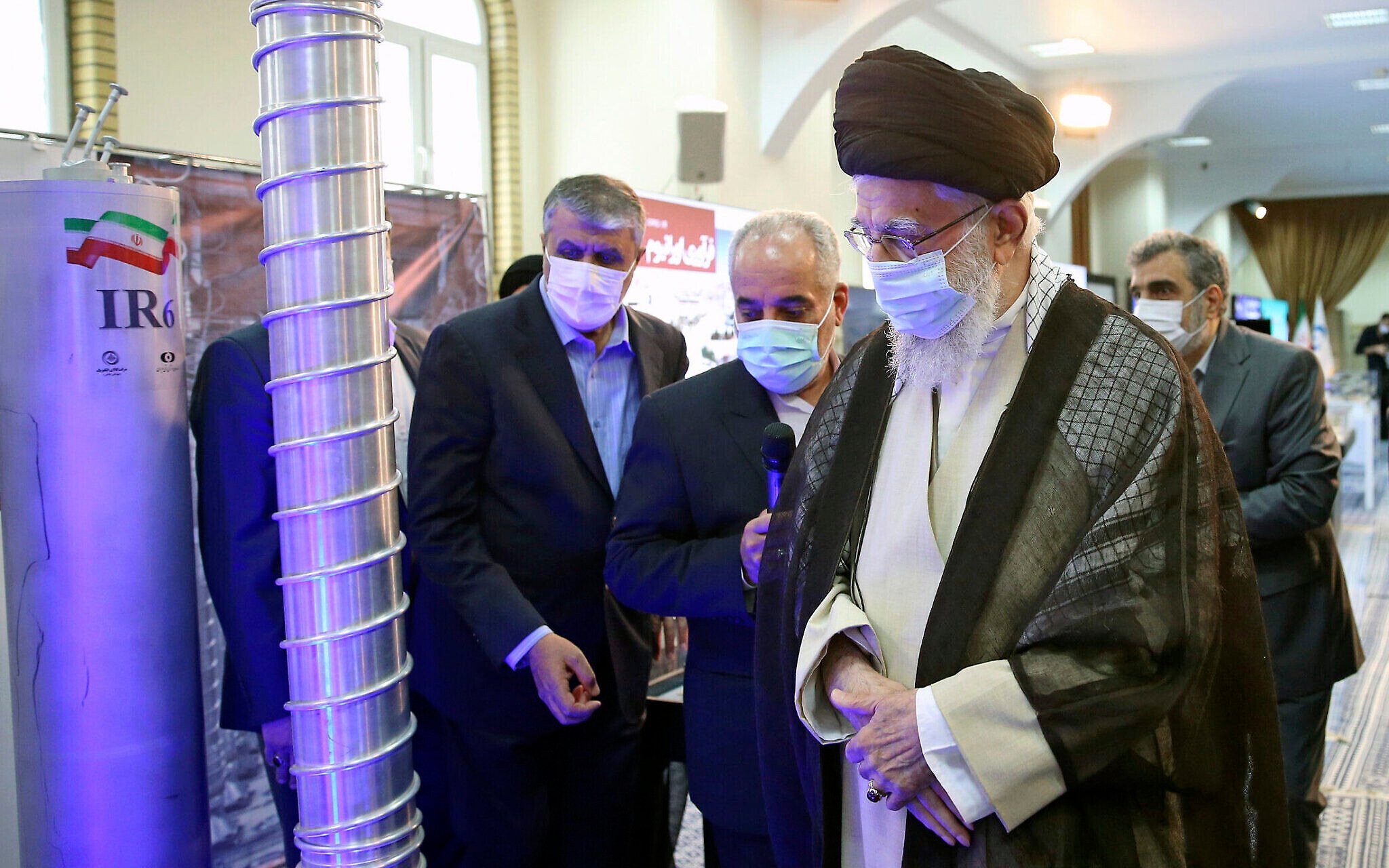
Iranian Supreme Leader Ayatollah Ali Khamenei, right, visits an exhibition of the country’s nuclear achievements, at his office compound in Tehran, Iran, June 11, 2023. (Office of the Iranian Supreme Leader, Via AP)

A diplomatic source outside Tehran was quoted by Iran International as saying that Iran’s Supreme Leader Ayatollah Ali Khamenei had agreed to the talks with Witkoff as a ruse to “buy more time” for Iran to rebuild its air defenses, which were destroyed by Israeli airstrikes in October, “and to restore its capacity to produce surface-to-surface missiles which were damaged in that same Israeli attack.”

That Israeli attack came in response to Iran’s massive October 1 ballistic missile attack — Tehran’s second-ever assault on Israel after a missile-and-drone attack last April.

The final stage reported by Iran International appeared to contradict a report in Britain’s Guardian newspaper on Tuesday that said Tehran was set to reject a proposal that it move its enriched uranium to a third country. Later that day, Russia, which powers Iran’s sole nuclear reactor, declined to say if it would agree to take Iran’s stock of enriched uranium as part of a nuclear deal.

Iran, whose leaders are sworn to destroy Israel, says it does not seek nuclear weapons, but has since December increased by about half its already sizable stockpile of 60%-enriched uranium, and is on track to roughly quadruple its production of uranium ore this year, according to international nuclear watchdogs.

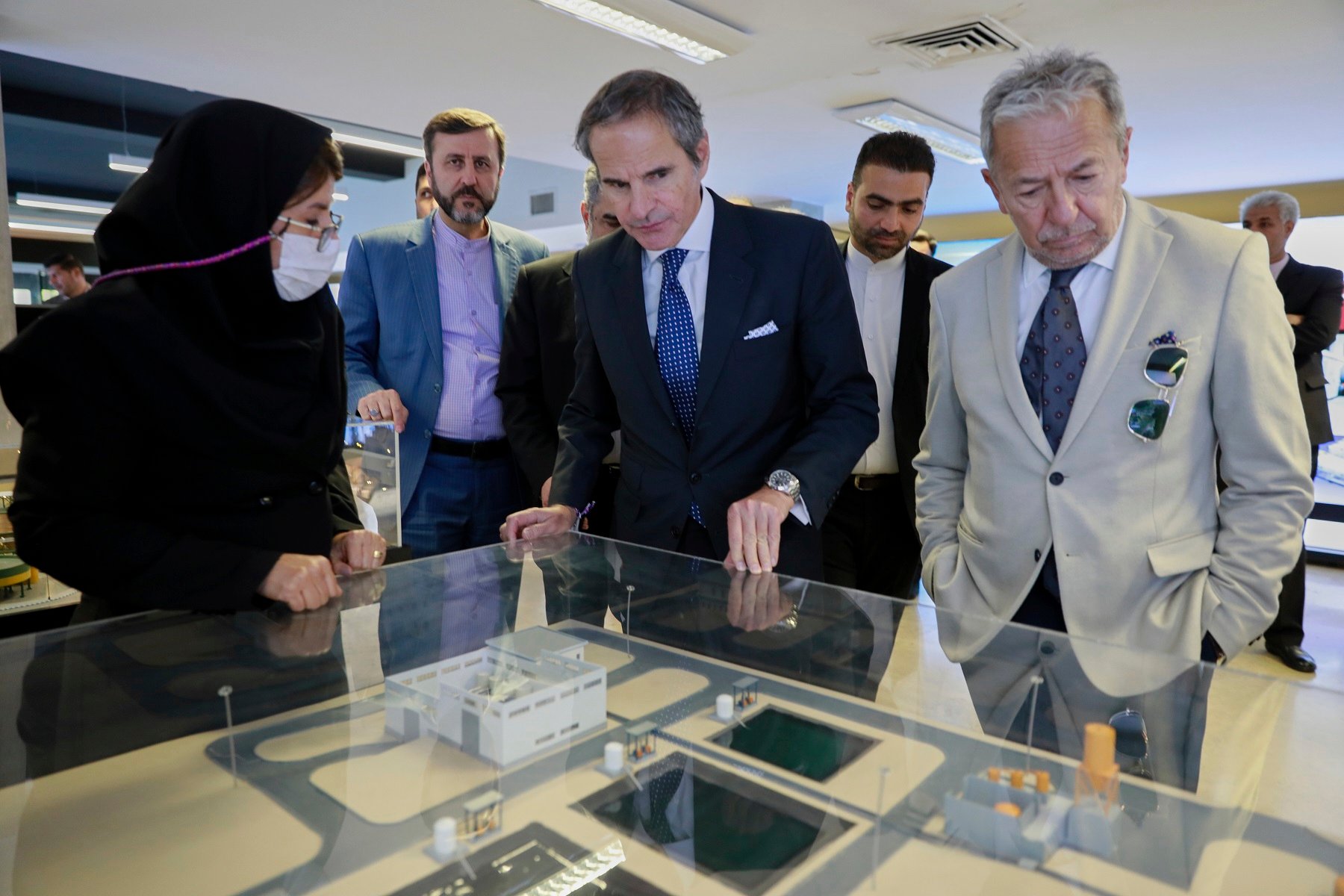
International Atomic Energy Agency (IAEA) Director General, Rafael Mariano Grossi, center, visits an exhibition of Iran’s nuclear achievements, in Tehran, Iran, Thursday, April 17, 2025. (Atomic Energy Organization of Iran via AP)

The enrichment rate is far beyond what is necessary for a civilian nuclear program and a short step away from weapons-grade. On Thursday, while visiting Tehran, IAEA chief Rafael Grossi warned that the US and Iran “don’t have much time” to ink a deal.

The New York Times reported Thursday that Trump, who has threatened to bomb Iran’s nuclear sites, had “waved off” such an attack planned by Israel for next month. Trump, who instead chose to initiate the negotiations with Tehran, partially confirmed the report later Thursday, saying: “I wouldn’t say ‘waved off’,” but “I’m not in a rush to do it.”

US President Donald Trump (left) welcomes Prime Minister Benjamin Netanyahu to the White House in Washington on April 7, 2025. (Brendan Smialowski/AFP)

Meanwhile, Prime Minister Benjamin Netanyahu’s office touted the premier’s “countless” actions against Iran’s nuclear program, but did not deny that Trump had blocked a strike.

Trump, who has renewed his first term’s “maximum pressure” sanctions against Iran, announced the renewed talks with Iran in a meeting with Netanyahu at the White House earlier this month. Hebrew media later reported that Witkoff had updated Netanyahu of the announcement only hours earlier, shortly after the Israeli leader arrived in Washington for the brief, unexpected visit.

Netanyahu reportedly did not receive assurances that Israel’s demands would be met in the talks, nor regarding what would happen if negotiations fell through or Iran reneged on a deal.