Hamas is willing to release a greater number of hostages under a new truce proposal that it had previously agreed to, with the US reportedly telling the terror group it will pressure Israel into entering talks to end the war, the Saudi Al-Arabiya channel reported Sunday night.
Talks have reportedly been deadlocked over Israel’s demand that the terror group free 11 of the hostages in exchange for an extended ceasefire while Hamas has offered to release five. According to reports over the weekend, in its latest proposal Israel has expressed readiness to lower the number of hostages released.
The Al-Arabiya report, citing unnamed sources, said that the drafting of the new deal is in its final stages and that Hamas has given an initial agreement to raise the number of hostages to be freed. The report did not detail the number of hostages that would potentially be released.
If a deal is reached under the proposed draft, hostages will be released in two stages alongside agreements on the entry of humanitarian aid into the Strip, the report said.
The report also said that while the US has told Hamas it will pressure Israel into entering talks to end the fighting, discussions on whether leaders from the terror group will be permitted to stay in Gaza have been postponed to a later time.
The Saudi outlet also said that under the potential agreement, medical reports will be provided by the terrorists on the conditions of the remaining hostages.
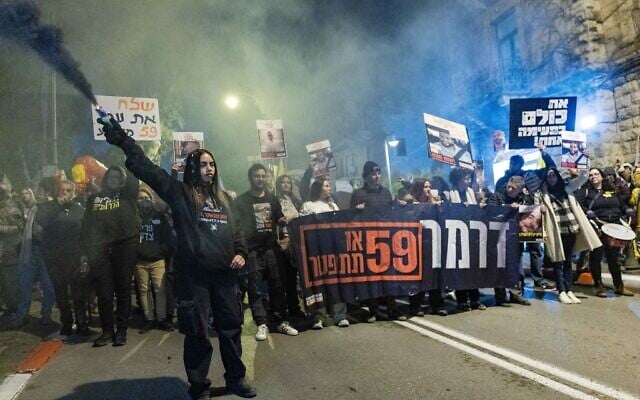
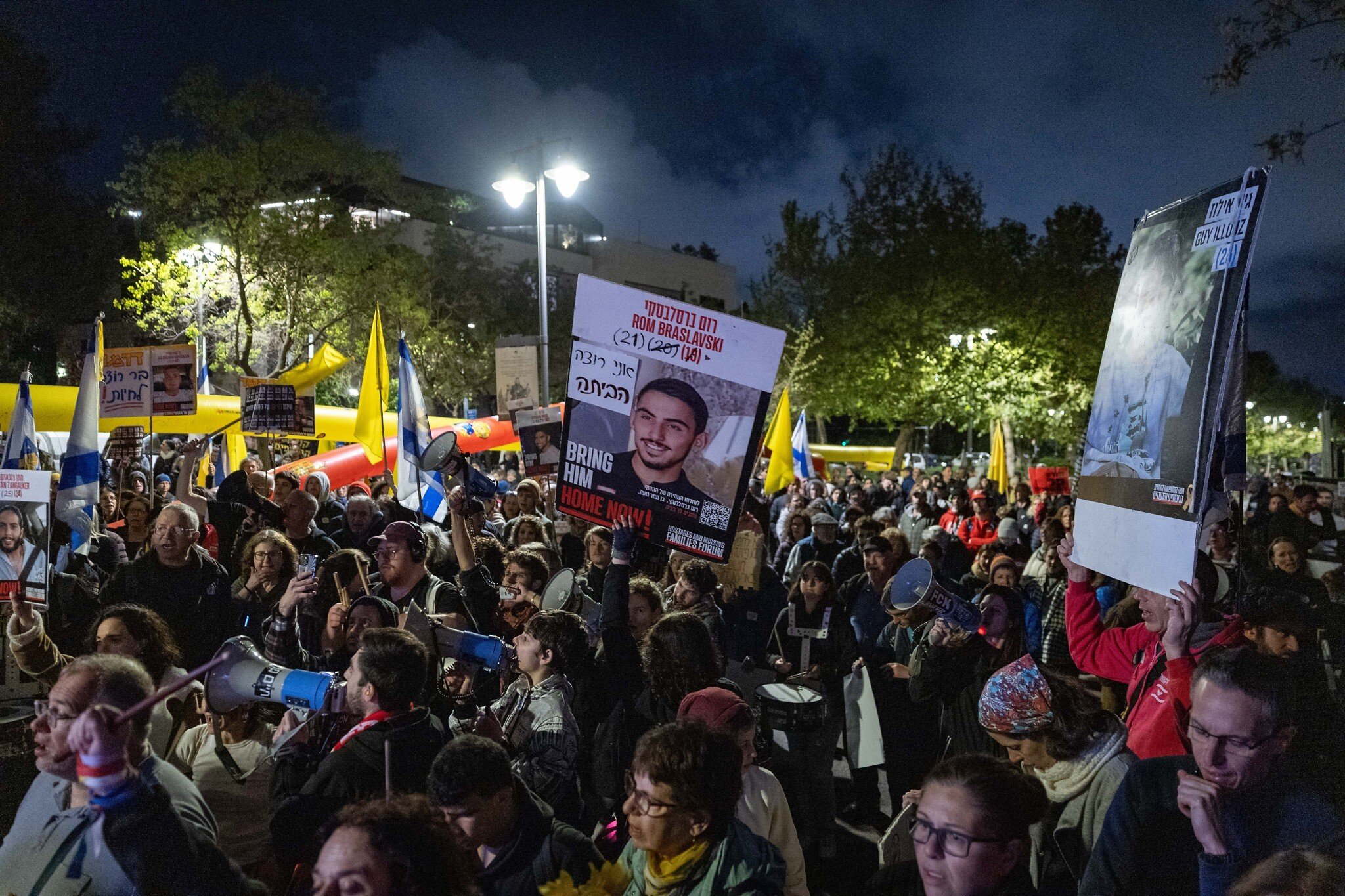
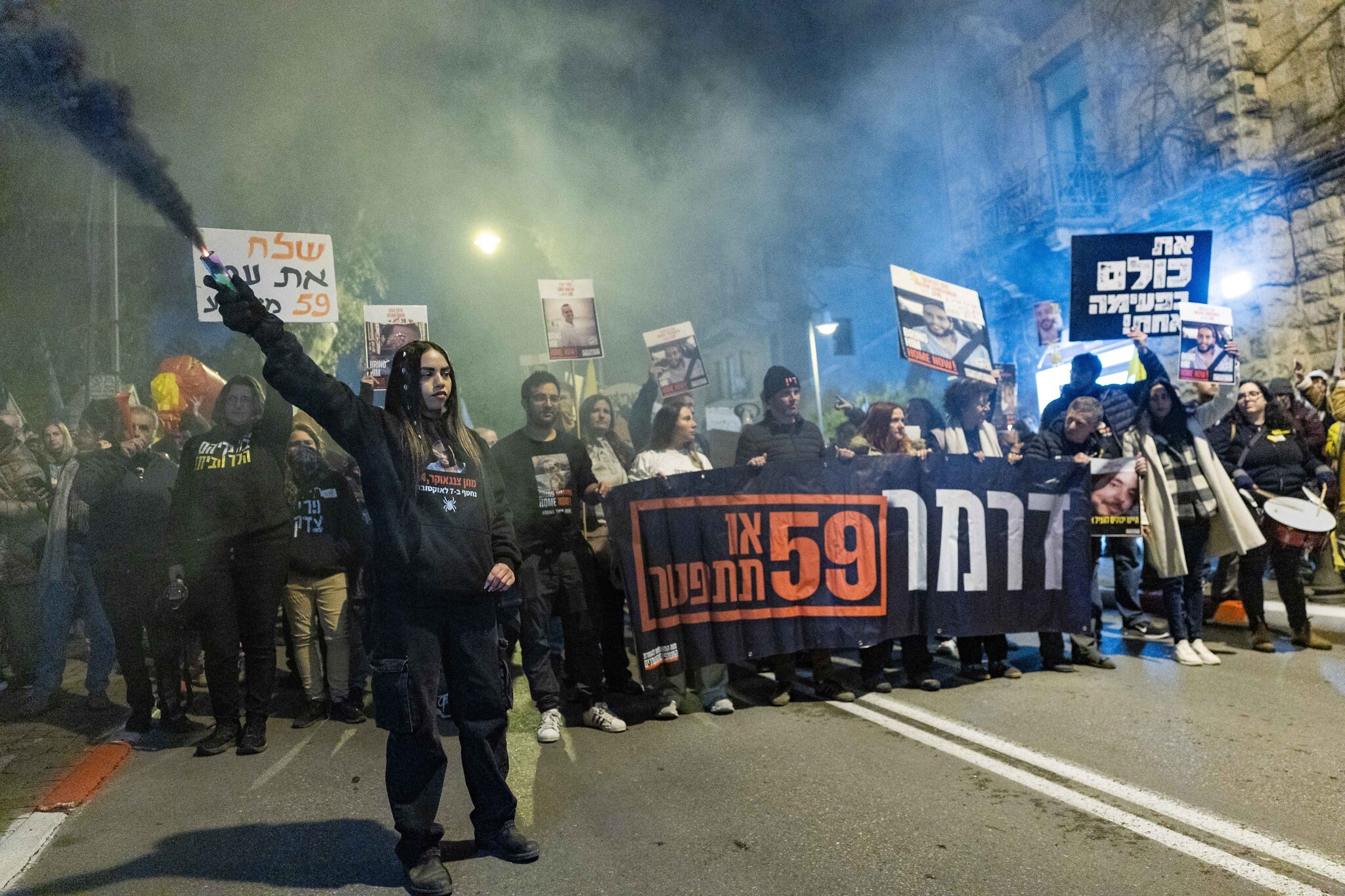
Families of hostages held in Gaza and their supporters demonstrate for their release during a march to the home of Strategic Affairs Ron Dermer, head of the hostage negotiation team, in Jerusalem, on April 13, 2025 (Chaim Goldberg/Flash90)
Israel has been waiting for a response to its latest proposal for a ceasefire-hostage release deal after a delegation from the terror group arrived in Cairo over the weekend. The US is seeking to pressure the sides to move forward, according to reports in Israeli media outlets.
The Haaretz daily, citing Palestinian sources involved in the talks, reported Sunday night that Cairo and Doha are working with the US toward a potential additional stage of the ceasefire-hostage release deal reached in January that would also include talks to end the 18-month war.
The report also claimed Egypt has put forward a proposal under which Hamas would demilitarize under Cairo’s supervision as part of a permanent ceasefire deal.
Hamas, the report said, is lowering expectations for results in the current round of negotiations, but believes there is an opportunity to reach a ceasefire deal before mid-May, when US President Donald Trump is slated to visit Saudi Arabia, the UAE and Qatar.
Meanwhile, a report in the Ynet news site Sunday said that Israel was waiting for a response from the terror group to a proposal to release nine or 10 living hostages — including US-Israeli Edan Alexander, who was featured in a Hamas propaganda video released Saturday — slightly down from Israel’s earlier demand that 11 hostages be freed in any next stage.
The Ynet report said, without citing sources, that the US has promised Hamas that if it agrees to free more than eight hostages, it will provide the group with a commitment that Israel will enter talks aimed at ending the ongoing war.
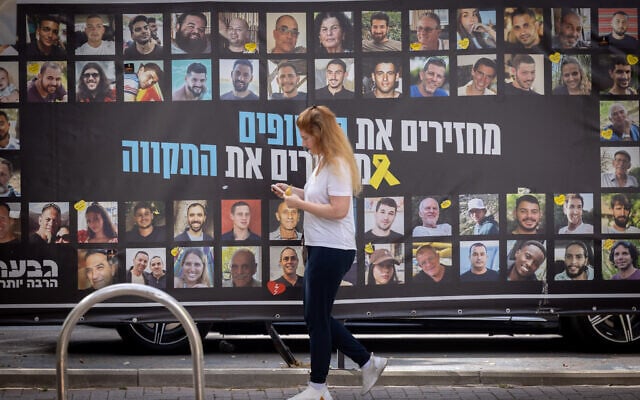
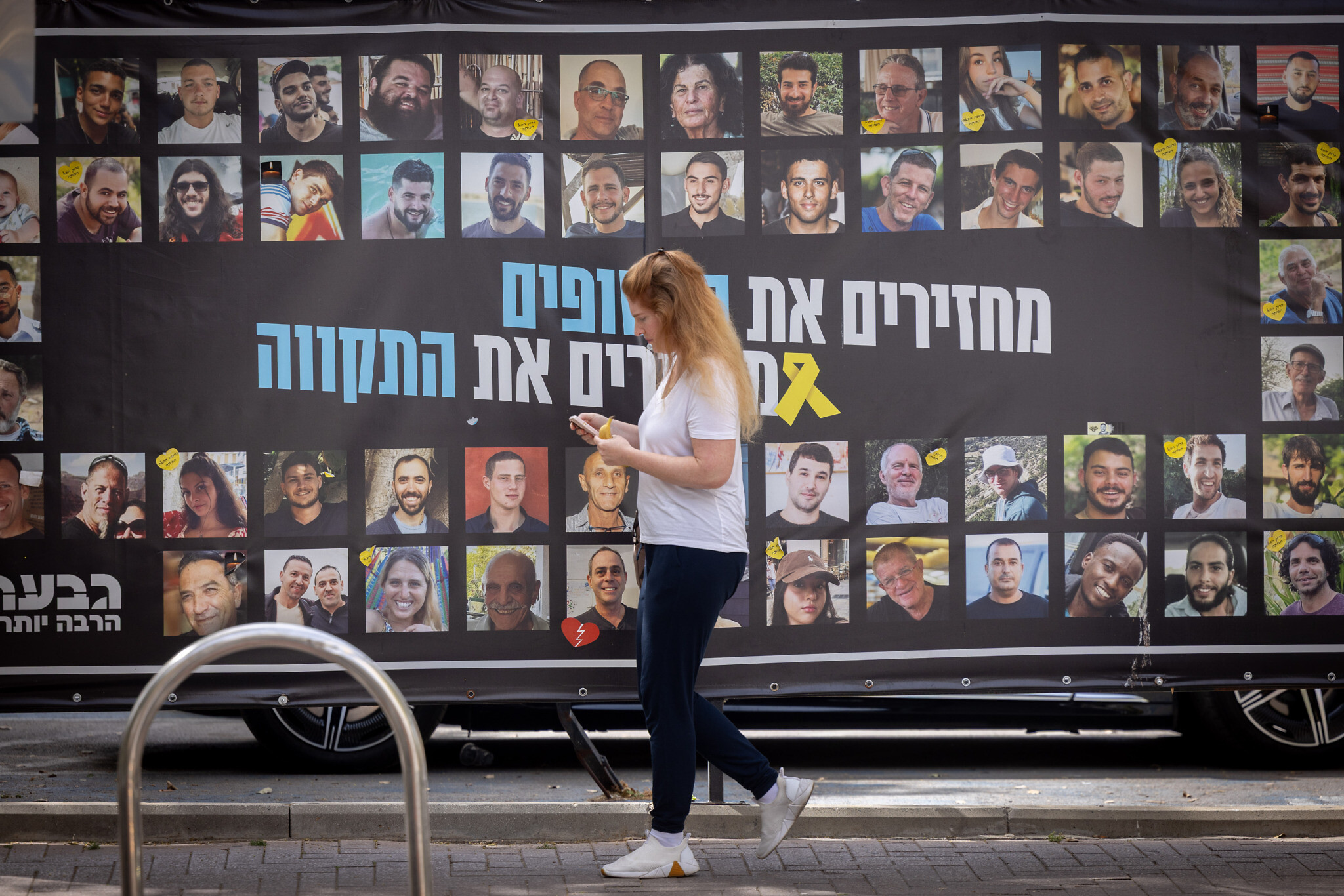
A woman walks past a poster depicting hostages held in Gaza, in Tel Aviv on April 6, 2025. (Miriam Alster/Flash90)
A Hamas official told AFP on Friday that it hoped its delegation in Cairo, headed by the group’s chief negotiator Khalil al-Hayya, would lead to “real progress towards reaching an agreement to end the war, halt the aggression and ensure the full withdrawal of occupation forces from Gaza.”
In a statement Sunday evening, Prime Minister Benjamin Netanyahu’s office said that during a conversation between the premier and the family of hostage Eitan Mor, he stressed that efforts to free those held captive by Hamas are continuing “at this very moment.”
The Hebrew media reports echoed
reporting from The Times of Israel on Friday, citing two officials familiar with the talks who said Israel had come down slightly from its earlier demand that 11 living hostages be released in order to revive the ceasefire deal, and would instead agree to the release of eight.
After meeting with Trump last week in Washington, Netanyahu agreed to soften his demands, the two officials said.
Last month, Israel demanded the release of 11 living hostages in exchange for restoring the ceasefire. Hamas said it was only willing to release five living hostages. For several weeks, both sides refused to compromise further, and the talks remained at an impasse as Israel expanded its military campaign throughout the Gaza Strip, which it resumed on March 18.
On Thursday, Israel submitted to Egyptian mediators its response to Cairo’s latest proposal, the officials told The Times of Israel, and is demanding that the living hostages be freed during the first two weeks of a 45-day ceasefire, rejecting previous Hamas demands that the releases take place periodically during the duration of the truce.
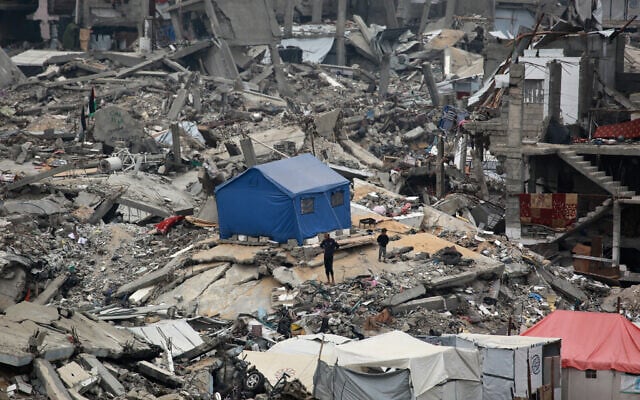
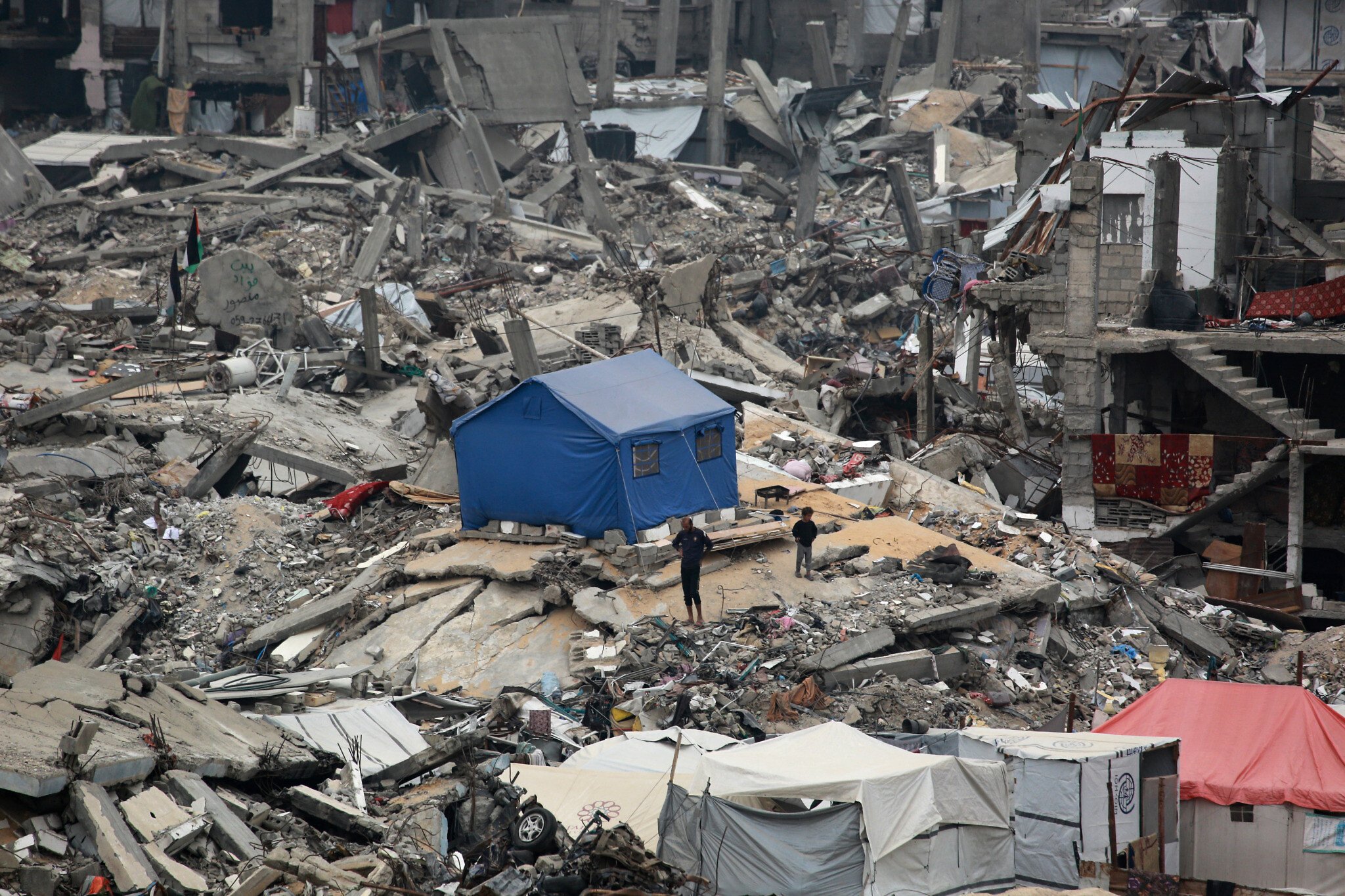
People stand amid the rubble of a destroyed building at the Jabalia camp for displaced Palestinians in the northern Gaza Strip on April 8, 2025. (Bashar Taleb / AFP)
Moreover, the Israeli proposal seeks to lower the ratio of Palestinian prisoners — including those serving life sentences — who will be released for each hostage, one of the officials said. In addition, the latest Israeli response seeks the release of 16 bodies of Israelis still held in Gaza, while offering to release the bodies of Gazans held by Israel in exchange.
Israel would also agree to allow the resumption of humanitarian aid deliveries into Gaza and withdraw its troops to where they were positioned in the Strip before it resumed fighting on March 18 and recaptured swaths of the enclave.
In its response, Israel agreed to hold negotiations on the terms of a permanent ceasefire once the truce has been restored, said the two officials.
While Israel signed onto the phased framework that went into place in January, Netanyahu has long insisted that he would not agree to a permanent ceasefire nor a full withdrawal of Israeli forces until Hamas’s governing and military capabilities have been fully dismantled.
Accordingly, he largely refused to even hold negotiations regarding the exact terms of phase two, which the deal stipulated were supposed to have started on February 3. Instead, he has sought to extend the first phase of the deal through proposals that would see the release of additional hostages while still allowing Israel to resume fighting against Hamas.
The premier is backed by many of his hardline coalition partners who have threatened to collapse his government if he agrees to end the war.
However, successive polls have indicated that the government is out of step with a majority of Israelis who back ending the war started with Hamas’s October 7, 2023, attack in exchange for the release of all 59 remaining hostages, only 24 of whom are still believed to be alive.
Jacob Magid contributed to this report.