
“There may come a point when we are no longer able to be reasonable, and will be forced to militarily complete the job that we very successfully started,” said US President Donald Trump.

n F-35 lights its afterburner as it does a flyover during a rally to kick off the Great American State Fair on the National Mall on June 24, 2026 in Washington, DC.
(photo credit: Al Drago/Getty Images)

The US military said it struck Iran again on Saturday, hours after a tanker was hit in the Strait of Hormuz, in the worst escalation since the two sides signed an interim peace deal two weeks ago.

“The enemy is using tricks, and we do not trust it,” the Islamic Revolutionary Guard Corps (IRGC) said on Sunday morning in response to the strikes. “It may make moves at any stage, even during the negotiations.”

“Our response will be more severe than the last time every time the enemy violates the ceasefire.”

US President Donald Trump said in a Truth Social post on Saturday that the “United States aircraft just struck Iranian missile and drone storage locations, and coastal radar sites, for violating the Cease Fire Agreement, AGAIN!”

“It is very possible that they will never learn! There may come a point when we are no longer able to be reasonable and will be forced to militarily complete the job that we very successfully started. If that happens, the Islamic Republic of Iran will no longer exist!” he wrote.

A screengrab from a video released by CENTCOM shows a flight deck crew member signaling an F‑35 jet on an aircraft carrier, in this image obtained from social media released on February 28, 2026
A screengrab from a video released by CENTCOM shows a flight deck crew member signaling an F‑35 jet on an aircraft carrier, in this image obtained from social media released on February 28, 2026 (credit: US CENTCOM)

Each of the warring sides has accused the other of violating the agreement reached two weeks ago to end the four-month-old conflict.

US Central Command said its forces carried out fresh strikes after a Panama-flagged tanker was attacked by an Iranian drone early on Saturday. In Iran, state broadcaster IRIB said early Sunday local time that explosions were heard in Sirik in southern Iran, without providing further details.

According to Trump, the US struck missile and drone storage facilities, as well as coastal radar sites.


Iran said on Sunday that US airstrikes targeted several monitoring and surveillance facilities on Iran’s southern coast, calling the attacks a violation of an interim deal meant to end the four-month-old war between the two countries.

“These brutal attacks … show that the US does not place the slightest value or credibility on its commitments, and breaking promises is part of its nature,” Iran’s Foreign Ministry said in a statement.

Retaliation for Iranian strikes in Hormuz, US-linked targets attacked

“Iran was given a chance to honor the ceasefire agreement but elected not to,” CENTCOM said in a statement. It said the strikes were “in direct response to continued Iranian aggression against commercial shipping” and targeted Iranian military surveillance, communications, air defense, drone storage, and mine-laying facilities.

A US defense official later reported that the strikes on Iranian targets were complete, according to Fox News.

Washington said earlier that it hit Iranian targets overnight. Iran said it responded on Saturday by striking targets linked to US forces.

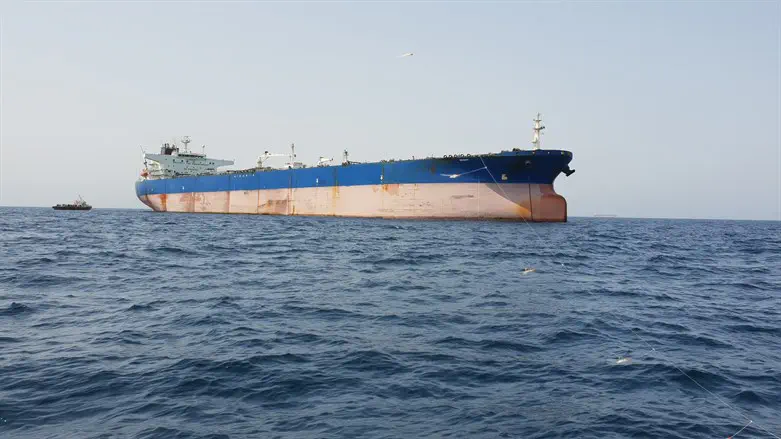
Iran’s Saturday drone attack on the cargo ship M/T Kiku, which, according to CENTCOM, carried more than two million barrels of crude oil, came after an earlier attack on the cargo ship M/V Ever Lovely that triggered the latest escalation on Thursday. Iran has made a fresh bid to assert control over the world’s most important energy shipping route, which has begun to reopen after months of disruption.

Britain’s UKMTO maritime security agency said the tanker hit on Saturday had sustained damage to its bridge, with all crew reported safe. The Joint Maritime Information Center, run by a coalition of navies protecting shipping, raised its security threat level as a result of recent incidents.


Iran has not directly commented on reports of specific attacks on ships. But Iranian state television reported that the Revolutionary Guards fired “warning shots” toward unspecified vessels attempting to pass through channels not approved by Iran, and that this was now prompting other ships to seek Iranian permits before attempting to cross the strait.

Earlier, Iran’s foreign ministry said it launched “defensive” attacks on US-linked military targets, while Bahrain, which hosts the US Navy’s regional headquarters, reported an Iranian drone attack. The US military did not immediately respond to the reports.

According to Reuters, in response to the latest US attacks, Iran’s IRGC Navy command announced that US bases in the region will experience “hell” in the coming days.

CENTCOM affirms that US forces “remain vigilant, lethal, and ready” to continue defending commercial vessel transits through the Strait of Hormuz.
There are no reported US casualties, major impacts, or damage to US locations in the region at this time, a US official told Reuters. According to the source, the situation is still unfolding.


Report: Iran fumes at Oman over Hormuz passage

Oman trapped between Iranian, US, demands over Strait of Hormuz, New York Times reports.

Oil tanker in Strait of Hormuz

Oil tanker in Strait of HormuziStock

An Iranian source has told The New York Times that Tehran is fuming at Oman, after Oman allowed naval vessels to move transverse an alternate route through the Strait of Hormuz, without coordinating with the IRGC.

In response, Iran launched a UAV towards a ship in the Strait, in order to harm the passage and completely halt naval traffic in the area.

According to the source, Oman is under pressure from the US, which demands free passage, as well as from Iran, which is demanding to control the routes. Iran has warned that Oman cannot provide ships any security commitments without Tehran’s approval, and that they will not allow any external body to interfere in their control of the Strait of Hormuz.

The state-run Oman News Agency (ONA) reported that this provisional corridor is accessible to all maritime traffic. Vessel operators must align their voyages directly with the international shipping regulator, following explicit navigational coordinates provided jointly by the IMO and Omani maritime regulators.

The announcement came hours after Oman and Iran reaffirmed what they described as their sovereignty and sovereign rights over the Strait of Hormuz in a joint statement issued following talks in Muscat between senior officials from the two countries.

However, on Thursday, elements of Iran’s Islamic Revolutionary Guard Corps targeted a commercial cargo vessel flying the Singapore flag within the strategic Strait of Hormuz. Citing two senior American officials, The Wall Street Journal reported that the assault inflicted significant damage on the ship’s bridge, though no injuries or fatalities were reported.

Concurrently, a regulatory Iranian state body known as the Persian Gulf Strait Authority (PGSA) issued a strict warning regarding maritime lanes on Thursday.

The agency, which holds an official mandate to supervise and govern transit through the chokepoint, announced that any vessels traveling via routes outside its designated framework will be stripped of safe-passage assurances, liability arrangements, and insurance protections.


The Israeli Embassy in the United States confirmed the extension of the talks, which entered their fourth day. The negotiating teams will return to the table at the US State Department in the morning

IDF troops operate in the Wadi Saluki area of southern Lebanon.
(photo credit: IDF SPOKESPERSON UNIT)

The negotiations between Israel and Lebanon were extended beyond what had been planned and will continue in Washington on Friday.

The decision was taken after 11 straight hours of talks, in an effort to reach an “in-principle commitment” to a security arrangement.

The Israeli Embassy in the United States confirmed the extension of the talks, which entered their fourth day. The negotiating teams will return to the table at the US State Department in the morning.

The talks, held under American mediation, are focused on Hezbollah’s future and the new security mechanisms in southern Lebanon.

One of the main ideas being discussed is the establishment of “pilot areas.” Under this framework, security responsibility would be transferred to the Lebanese Army in specific areas after Lebanese soldiers are screened and vetted in the United States to rule out ties to the organization.

Talks between the US, Lebanon, and Israel in Washington DC earlier this year.
Talks between the US, Lebanon, and Israel in Washington DC earlier this year. (credit: AMICHAI STEIN)

The discussions are taking place against the backdrop of significant gaps between the sides. Lebanon is insisting on drawing up a timetable for an Israeli withdrawal from the areas the IDF currently holds. Israel, for its part, is demanding that any arrangement include the disarmament of Hezbollah, and is refusing to withdraw until that condition is met.

Israel denies withdrawing from Lebanon buffer zone

On Thursday, a State Department official claimed that Israel had already begun withdrawing from part of the buffer zone as a “goodwill gesture,” but an Israeli security source denied the report.

Defense Minister Israel Katz made clear this week that “even if there is an American demand, we will not withdraw from Lebanon,” and that Israel will keep forces in place to monitor implementation on the ground.

The fact that the talks stretched for more than 11 hours in a single day suggests American pressure to achieve a breakthrough, but the atmosphere within the Israeli delegation is marked by concern.

Earlier this week, Israel’s ambassador to the United States, Yechiel Leiter, said the contacts were a “train wreck.” Leiter criticized the influence of Tehran and the parallel talks Washington is holding with the Iranians, and stressed that dismantling Hezbollah must remain the basis for the talks.

In parallel with the diplomatic track, the United States is putting together a monitoring mechanism through US Central Command. The mechanism is intended to give Washington a real-time picture from the ground in order to prevent escalation.

As part of those efforts, US Central Command chief Adm. Brad Cooper is expected to arrive in Israel to meet with IDF Chief of Staff Lt. Gen. Eyal Zamir and Defense Minister Katz.