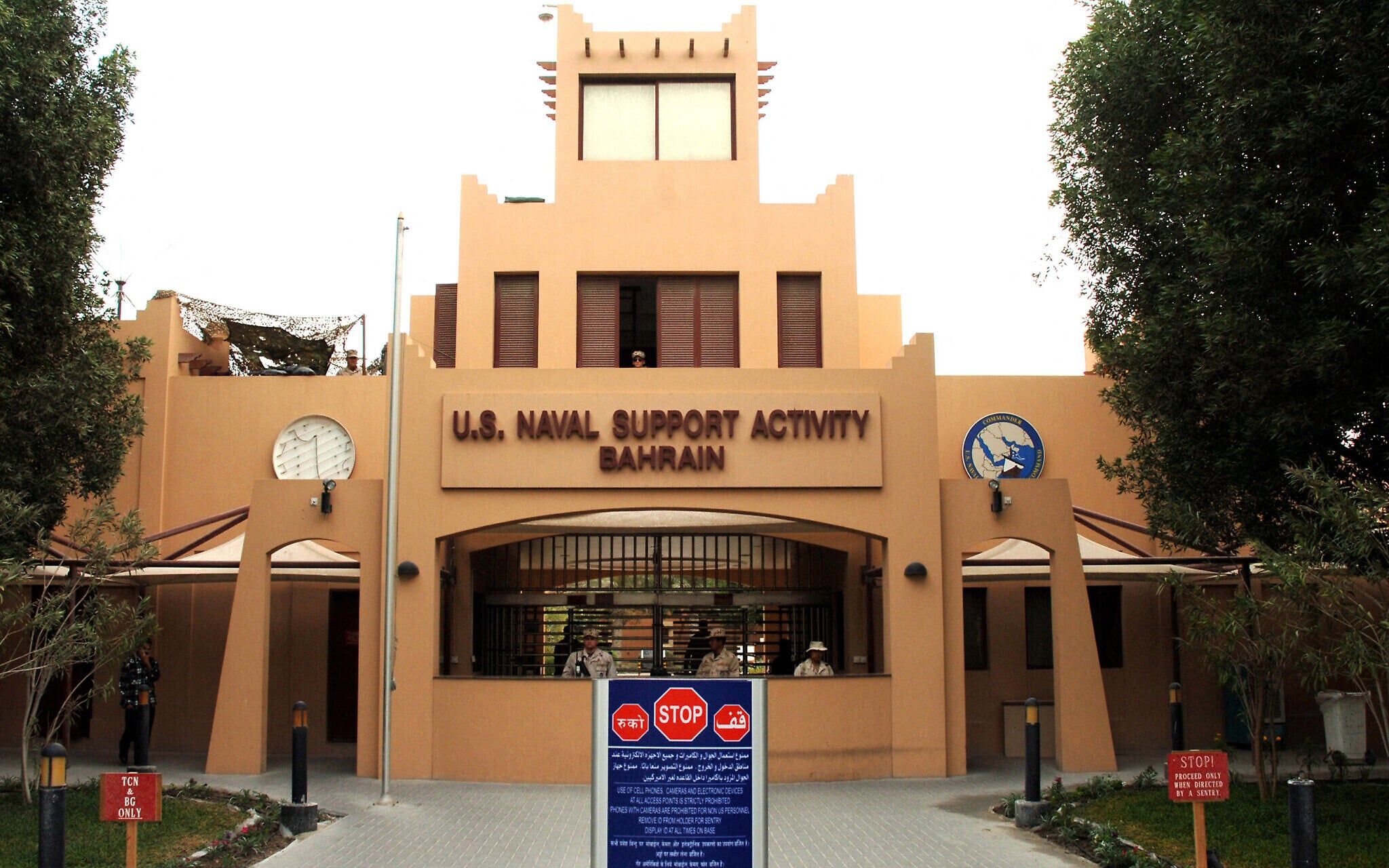
An undated handout photo provided by the US Navy shows the front walk-in entrance of the US Naval Support Activity in Bahrain near Manama. (US Naval Support Activity / AFP)
The United States is considering moving Middle East military installations westward, including to Israel, to reduce their exposure to Iran’s missiles and drones, which dealt the region’s sole US Navy base some $400 million in damage largely unacknowledged by the Pentagon, the Wall Street Journal reported Thursday.
Tehran’s retaliatory strikes, following the start of the US-Israeli bombing campaign in Iran on February 28, hit US military installations across the region, killing 13 servicemembers and wounding hundreds.
Buildings harmed at the Naval Support Activity Bahrain (NSA Bahrain) base, which lies some 240 kilometers (150 miles) south of Iran, include the Fifth Fleet headquarters, a barracks, several warehouses and a potable water tank, the Journal said Thursday, citing satellite and social media images.
No one was killed at the base, according to the US military, the Journal said.
The outlet said it estimated the cost of the damages based on procurement reports and the Pentagon’s publicly available cost model.
The estimate included only construction costs, the Journal said. It cited an analyst with the Center for Strategic and International Studies (CSIS) think tank as saying that, depending on what the buildings housed, that estimate could end up being dwarfed by other costs of the damage. For example, according to CSIS, two satellite communication terminals that Iran destroyed early in the war cost some $20 million each, the report said.
The damage to NSA Bahrain has led the US to weigh revamping the base, including by moving command centers underground and passing on rebuilding some of the destroyed structures, according to US officials familiar with the deliberations who were cited by the Journal.
The US may also curb its presence in Kuwait and Saudi Arabia, and shift some of it westward, following Iran’s targeting of military installations in the two Arab states, the officials said.
According to two of the officials, one of the destinations being weighed is Israel, where dozens of US jets parked at Ben Gurion Airport since the lead-up to the Iran war have stymied Israelis’ travel.
US President Donald Trump has faced fierce criticism in the US, including within his own Republican party, over the spiraling cost of the Iran war, which also sparked a global spike in energy prices after Iran blocked the Strait of Hormuz, a key route for oil shipments.
Pentagon chief Pete Hegseth is seeking roughly $80 billion in supplemental funding to shore up defense supplies in the aftermath of the war, which entered a truce on April 8.
The US and Iran last week reached a memorandum of understanding that kicked off 60 days of negotiations to end hostilities across the region.
Israel is not a party to the MOU or the negotiations, and Israeli officials have criticized the agreement, which requires a halt to Israel’s operations against Iran’s Lebanese proxy Hezbollah, and contains no concrete concessions from Iran on its nuclear program.
“Once the rift between the regime and the people is so deep, you cannot tell when such a regime will fall,” said the premier.
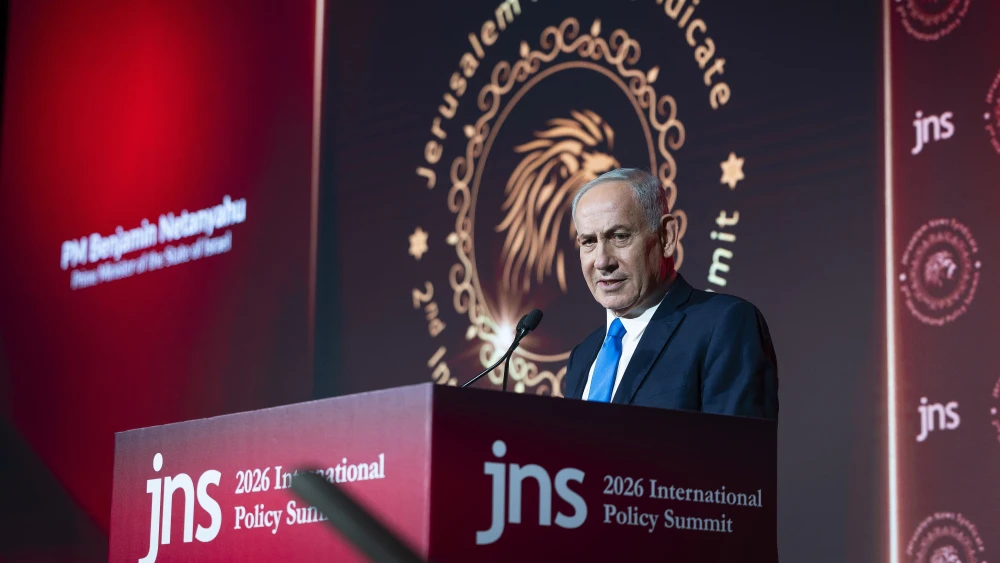
Israeli Prime Minister Benjamin Netanyahu speaks at the second annual JNS International Policy Summit at the Waldorf Astoria in Jerusalem, June 21, 2026. Photo by Chaim Goldberg/Flash90.
(June 21, 2026 / JNS)
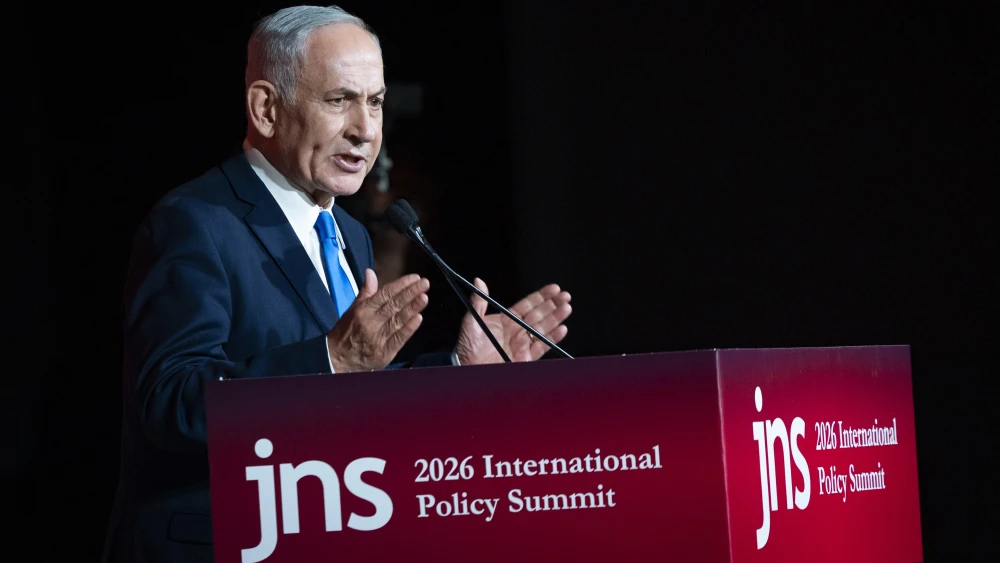
The joint U.S.-Israeli campaign against the Islamic Republic has created the conditions for the regime to fall, Israeli Prime Minister Benjamin Netanyahu said on Sunday night, addressing the 2026 JNS International Policy Summit at Jerusalem’s Waldorf Astoria.
“Together with our American friends, the American air force, the American military, we carried out the largest airstrike in our history,” Netanyahu said.
“Had we not acted in ‘Operation Rising Lion’ and in ‘Operation Roaring Lion,’ Iran would have had atomic bombs, and … they would have used them,” he said. “That’s what we prevented.”
In “Operation Roaring Lion,” the United States and Israel launched a massive surprise attack against the Islamic regime between Feb. 28-June 17, decimating its leadership, including its Supreme Leader Ali Khamenei, wiping out its remaining ballistic missile capability, sinking its navy and severely degrading its military-industrial base.
It followed “Operation Rising Lion,” a 12-day air campaign conducted mainly by Israel between June 13-24, 2025, which eliminated 30 senior Iranian military leaders, Islamic Revolutionary Guard Corps commanders and nuclear scientists within the first four minutes. The operation gained key U.S. military support when, on June 22, seven B-2 bombers struck three Iranian nuclear facilities.
“We destroyed Iran’s nuclear infrastructure. We knocked out 20 of their top nuclear scientists, 12 in ‘Rising Lion,’ another eight in ‘Roaring Lion.’ And when you take out the scientists, it’s very hard to make a nuclear weapon, exceedingly hard,” Netanyahu said.
The cumulative damage inflicted on the regime’s economy is “counted in hundreds and hundreds of billions of dollars, and it will take them a long time to recover,” he added.
“They may not recover, because once you deal these blows and once the rift between the regime and the people is so deep, you cannot tell when such a regime will fall,” he said.
The prime minister added, “I think we created the conditions for its future fall; that is what will be the real triumph, when the Iranian people take their own destiny in their hands, and they knock out this brutal regime that is terrorizing them and terrorizing the rest of the world.”
The Israeli premier highlighted other achievements under his leadership as the Jewish state clawed its way back from the Oct. 7, 2023, Hamas-led attack on southern Israel to deliver blow after blow against its enemies.
It is not just the Iranian regime, but its terror axis throughout the Middle East that Israel has thrown back, Netanyahu said. “We took out [Hamas leader Yahya] Sinwar. We took out [Hamas Political Bureau Chairman Ismail] Haniyeh. We took out [Hamas military commander Mohammed] Deif. We took out tens of thousands of terrorists. And despite those who said it couldn’t be done, we brought back to Israel every single hostage.”
Netanyahu highlighted Israel’s accomplishments in Lebanon, referring to what has become known as “Operation Grim Beeper,” in which Israel booby-trapped thousands of pagers and hundreds of walkie-talkies used by the terror group Hezbollah.
“We decimated Hezbollah’s military machine. We destroyed over 90% of the 150,000 rockets and missiles that Hezbollah amassed against us,” he said, also praising Israel’s targeted assassination of Hezbollah leader Hassan Nasrallah.
Israel has now established security zones on multiple fronts, including in Lebanon, he said.
‘What would America do?’
The Israel Defense Forces will remain in Southern Lebanon “as long as we need to protect our people” from Iranian-backed Hezbollah terrorists, he stressed. “The reason is perfectly understood; no country would be asked to do otherwise.”
“Now, you imagine the United States, across the border, you have thousands, an army of thousands of terrorists who pellet your cities and your towns with rockets and ballistic missiles and killer drones. They kill your soldiers, they kill your citizens, they kill your children. And they threaten them every day. Well, what would America do?
“Would it say, ‘Well, there’s nothing we can do; let’s hold our fire?’ Is that what America would say? No. You know damn well what America would do. It would cross the border, create a security zone, kill the terrorists and protect its people until the threat is removed,” he said. “That’s exactly what we are doing.”
Regarding the care Israel takes when targeting terrorists hiding among civilian populations, Netanyahu said “no country” would do a better job in Lebanon. The ratio of terrorists to noncombatants slain in the war has been as low as 5 to 1, despite Hezbollah’s use of human shields, which is “unheard of, because no army goes to such lengths as the Israeli army, who target terrorists and minimizes civilian casualties. We should be commended for it.”
But Israel’s greatest achievement, according to Netanyahu, was “to break through the barrier of fear.” Israel overcame the longstanding belief among naysayers that it was too dangerous to strike inside Iran. Israeli warplanes filled Iran’s skies, hitting missile production sites, terror targets and nuclear facilities.
“We changed Israel’s security doctrine. We initiate. We attack. We surprise. And we attack those enemies that seek our destruction, that seek to kill us—we attack them before they have a chance to do so,” he said.
Israeli Prime Minister Benjamin Netanyahu speaks at the second annual JNS International Policy Summit at the Waldorf Astoria in Jerusalem, June 21, 2026. Photo by Chaim Goldberg/Flash90.
Chaim Goldberg
Addressing reported disagreements with Washington over his policies on Iran and Lebanon, Netanyahu said he and U.S. President Donald Trump “respect each other’s sovereignty, leadership and commitment to our people.”
“In the United States, they say that President Trump does everything I ask him to do, and in Israel, they say that I do everything that he wants me to do. Well, neither is true,” Netanyahu said. “We’re leaders of independent and proud countries. We stand for our interests; I stand for the interests of Israel, and for its security. Often we see eye to eye; sometimes we don’t.”
Netanyahu noted that this year marks the 50th anniversary of the 1976 Entebbe Raid, considered the most daring rescue operation in modern history, in which Israeli commandos led by Netanyahu’s elder brother, Lt. Col. Yonatan Netanyahu, rescued Israeli hostages in Uganda. Netanyahu’s brother was killed during the raid.
Netanyahu had come directly to the JNS conference from Mount Herzl, where he had been visiting his brother’s grave.
“Entebbe showed that a free people, if they mobilize their courage and muster their strength and their will, they could overcome the worst tyrannies,” the prime minister said.
The 2026 JNS International Policy Summit, which was preceded by a weekend VIP gathering and tours around Judea, comes one year after the inaugural JNS Summit held in Jerusalem.
The three-day conference will include addresses and panels on U.S.-Israel relations, the war with Iran, Israel’s military, diplomatic and legal battles, the wave of global antisemitism in the wake of the Oct. 7, 2023, Hamas-led attack, as well as relations with the Christian world.
Iran’s FM says ‘major progress’ made to end Lebanon war as Qatar, Pakistan announce creation of ‘de-confliction cell’; Netanyahu: War created conditions for regime’s fall
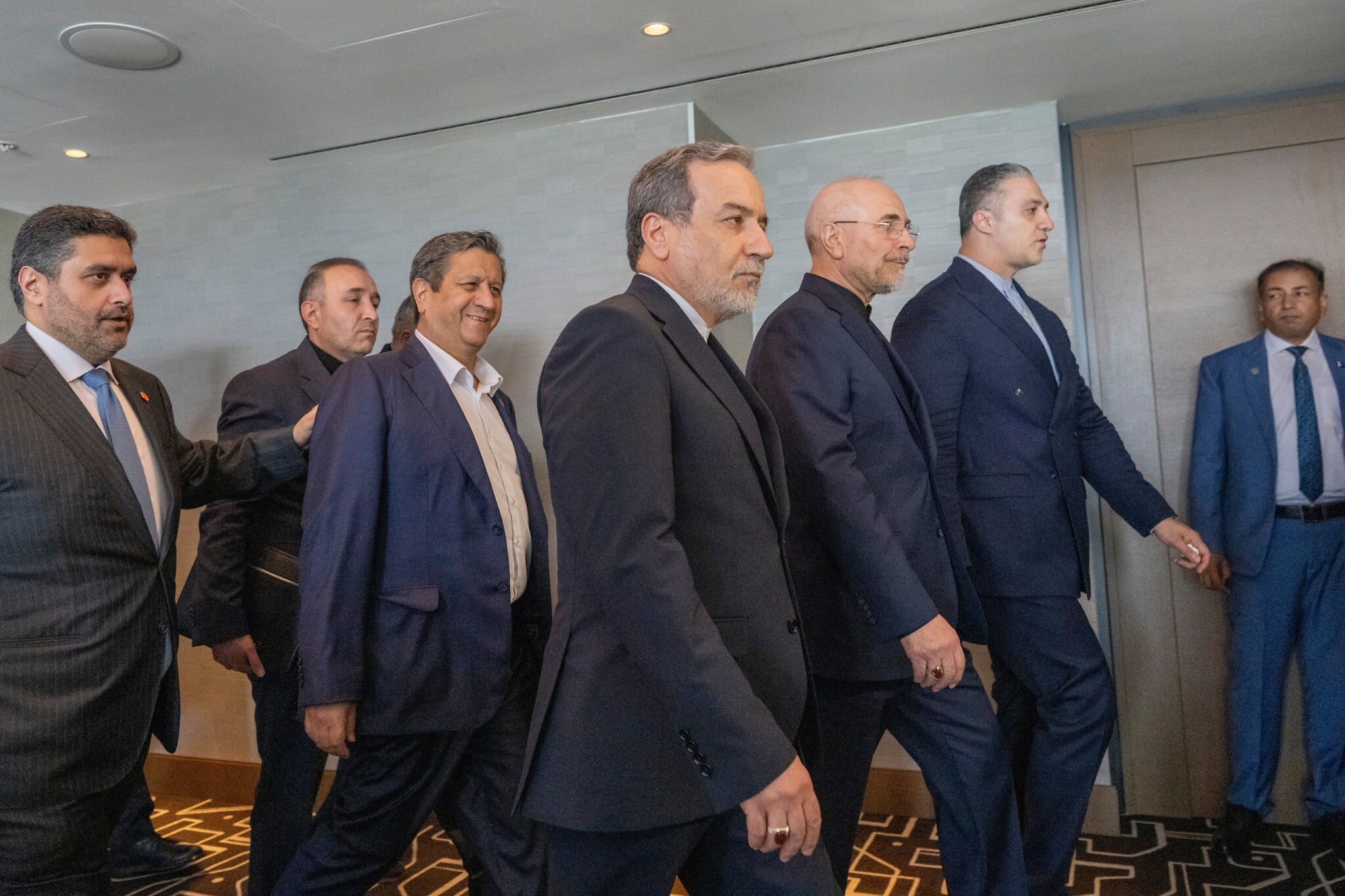
Iranian Foreign Minister Abbas Araghchi, third from right, and Speaker of the Iranian Parliament Mohammed Bagher Ghalibaf, second from right, with the delegation of Iran at the Lake Lucerne Summit at the Buergenstock resort in Switzerland, June 21, 2026. (Urs Flueeler, Pool Photo via AP)
Iran and the United States agreed on a roadmap toward reaching a final deal to end the war within 60 days, mediators Pakistan and Qatar said in a joint statement on Monday following the first day of talks between the sides, as Tehran touted “major progress.”
“The High Level Committee has agreed upon a roadmap towards reaching a final deal within 60 days, laying the foundation for the immediate commencement of further technical talks,” the joint statement from Qatar and Pakistan read, adding that the High-Level Committee was established to oversee the talks. The statement added that talks would continue all week.
The statement came after clashing reports from US and Iranian sources during a rocky first day of negotiations. A senior US diplomat said overnight Sunday-Monday that Iran’s delegation was still present at the Swiss venue where the two countries had held talks, after Iranian state media reported that the team from Tehran had left the site in protest of US President Donald Trump’s repeated threats against the Islamic Republic.
The talks, building off of a memorandum of understanding the two sides signed last week, aim to permanently end the Iran war and reach an agreement on sensitive topics such as Iran’s nuclear program.
Israel, which began the war with Iran in partnership with the US, is not a party to the talks, and the MOU’s terms have caused deep concern among Israeli officials. Iran and the US, meanwhile, have clashed over Israel’s continued conflict with Iran-backed Hezbollah in southern Lebanon, where the MOU calls for a ceasefire.
The mediators’ statement also said that Iran and the United States had agreed to set up a “de-confliction cell” with Lebanon to stop military operations there.
“The parties agreed on the creation of a de-confliction cell, between the parties, the Lebanese Republic and facilitated by the Mediators, to ensure the adherence of the termination of military operations in Lebanon,” the joint statement read. The statement mentioned neither Hezbollah nor Israel.
Commenting after the first day of talks, Iran’s Foreign Minister Abbas Araghchi said there was “major progress” made.
“Pakistani and Qatari mediation has delivered major progress to end Lebanon War,” Araghchi posted on X, saying the establishment of a de-confliction cell in the Lebanon conflict is the “1st real test.”
He noted other areas of progress in the negotiations in Switzerland: “Oil and petrochem exports are waived, blockade lifted, some frozen assets released, and major reconstruction & development plan launched for Iran.”
Conflicting reports from US, Iranian sources
On Sunday, American and Iranian representatives gathered alongside delegations from mediators Pakistan and Qatar at the luxury Swiss resort of Burgenstock. US Vice President JD Vance, who is leading the American team, said that progress had already been made, but shortly afterward, Trump posted on Truth Social, “Iran must immediately stop their highly paid PROXIES in Lebanon from causing trouble.”
He added, “If they don’t, we’ll hit Iran very hard again, just like we did last week, only harder!”
In response, Iran’s chief negotiator Mohammad Bagher Ghalibaf warned the United States against making threats, vowing that “our armed forces are ready to respond.”
“Don’t they think that if their threats had any effect, they would not have reached today’s state of desperation? We do not take American threats into account,” Ghalibaf said after Trump’s post.
“They would do better to be careful with their statements; our armed forces are ready to respond to them in a different manner,” he added. “No matter what they say, we are the ones who act.”
Later, Iranian state media said the country’s delegation left the venue hosting the talks, citing Trump’s post.
“The delegation of the Islamic Republic of Iran, after meeting with the Qatari delegation as one of the mediating parties, left the building where the negotiations were being held,” state news agency IRNA said.
“At the same time as the talks began in Switzerland, Donald Trump published a message on X in which he repeated his threats and remarks against Iran,” it added.
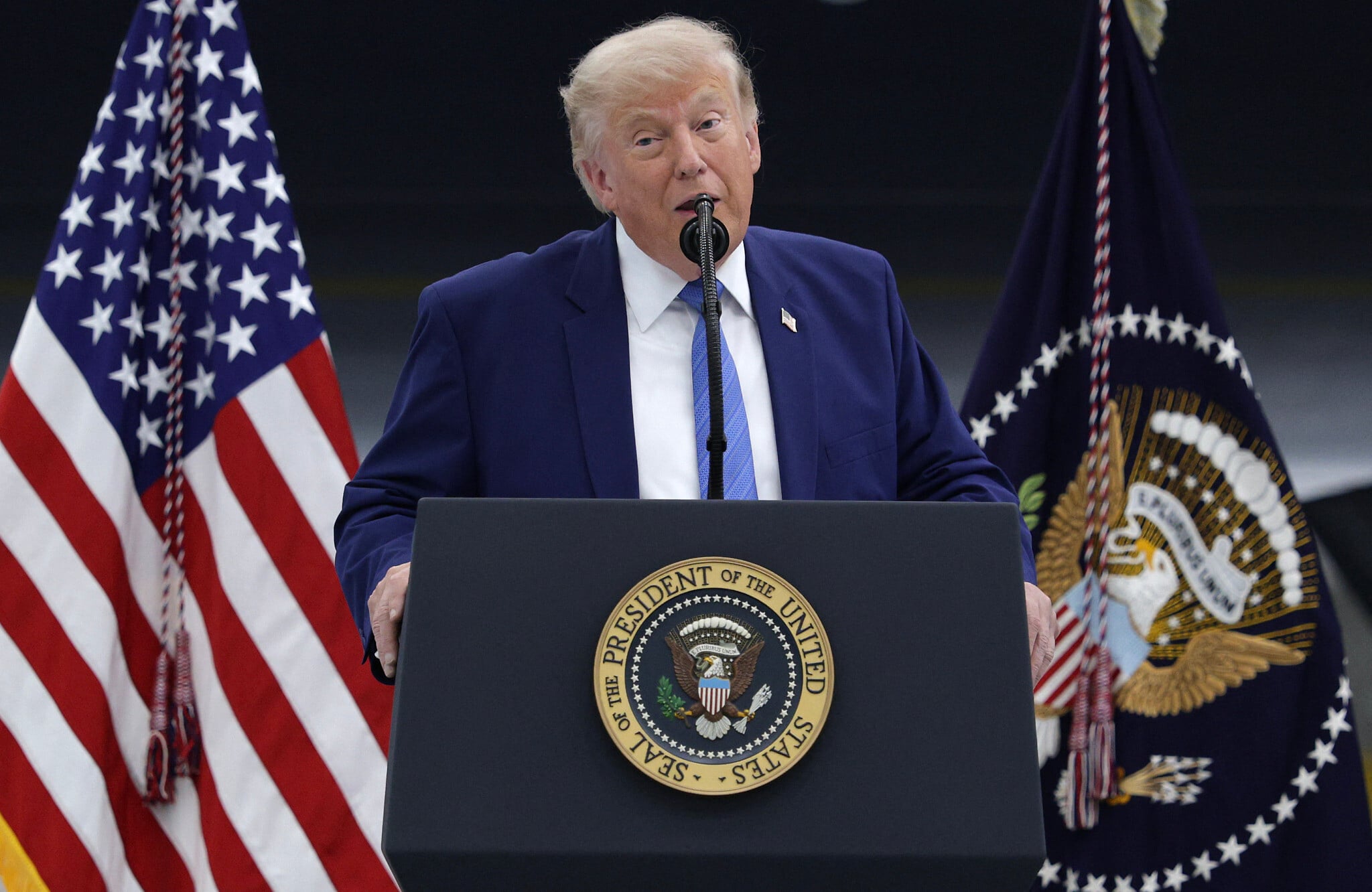
US President Donald Trump delivers remarks after touring the newest aircraft in the presidential fleet on June 19, 2026 at Joint Base Andrews, Maryland (ALEX WONG/Getty Images via AFP)
But the senior US diplomat, who was engaged in the negotiations, said talks were in fact proceeding through the night. Iranian state media has reported a series of claims that the US has asserted to be false, and that it says are motivated by a desire to present a harder line to Iran’s domestic audience.
There were some earlier reports of progress in the talks. Footage from Switzerland showed Iran’s Araghchi in the same room with Vance, though the two were not seen interacting. And a member of Iran’s negotiating team said a draft had been finalized regarding sanctions waivers for Iranian oil, adding that the waivers would be issued soon.
But Iranian state television reported that the thorniest issue in the talks, the Islamic Republic’s nuclear program, was not discussed.
“No negotiations regarding Iran’s nuclear program took place during the 80-minute first round of talks,” the state broadcaster said. The US diplomat, by contrast, said negotiators had “robust discussions on all elements of the nuclear deal,” and that they planned to use “today’s work as a starting point for ongoing technical talks going forward.”
Both sides said that they discussed the conflict in Lebanon, highlighting how the talks in Switzerland have become the central venue for discussions regarding Lebanon, even though they do not include Israel, Lebanon or Hezbollah.
“We have also worked through deconfliction mechanisms and enforcing the ceasefire in southern Lebanon,” the US diplomat said.
The US diplomat said discussions have focused on “clarifying some of the confusing messaging from Iran on the Strait and building deconfliction mechanisms to ensure the strait will remain fully open.”
Data shows decline in Hormuz traffic
Iranian state media had claimed that Tehran had closed the strait in response to Israeli actions in Lebanon, while the US has insisted that the channel remains open. Shipping data showed, however, that the number of ships that passed through the strait fell sharply on Sunday.
Five vessels passed the strait on Sunday, compared with 26 ships spotted a day earlier, data from analytics firm Kpler showed. These included three Very Large Crude Carriers carrying 2 million barrels of Saudi crude and fuel oil each, one of which was heading to Japan. The data may exclude vessels that switch off their transponders while travelling in the Gulf.
Tehran’s Islamic Revolutionary Guard Corps on Saturday declared the waterway shut once again in response to Israeli strikes in Lebanon, after opening it under the MOU. The US military said commercial vessels were still operating.
The statement from mediators said the United States and Iran agreed to set up a “communication line” to avoid incidents in the strait.
“A communication line between the parties has been formed… to avoid incidents and miscommunication with the aim of safe passage for commercial vessels through the Strait of Hormuz,” Pakistan and Qatar said.
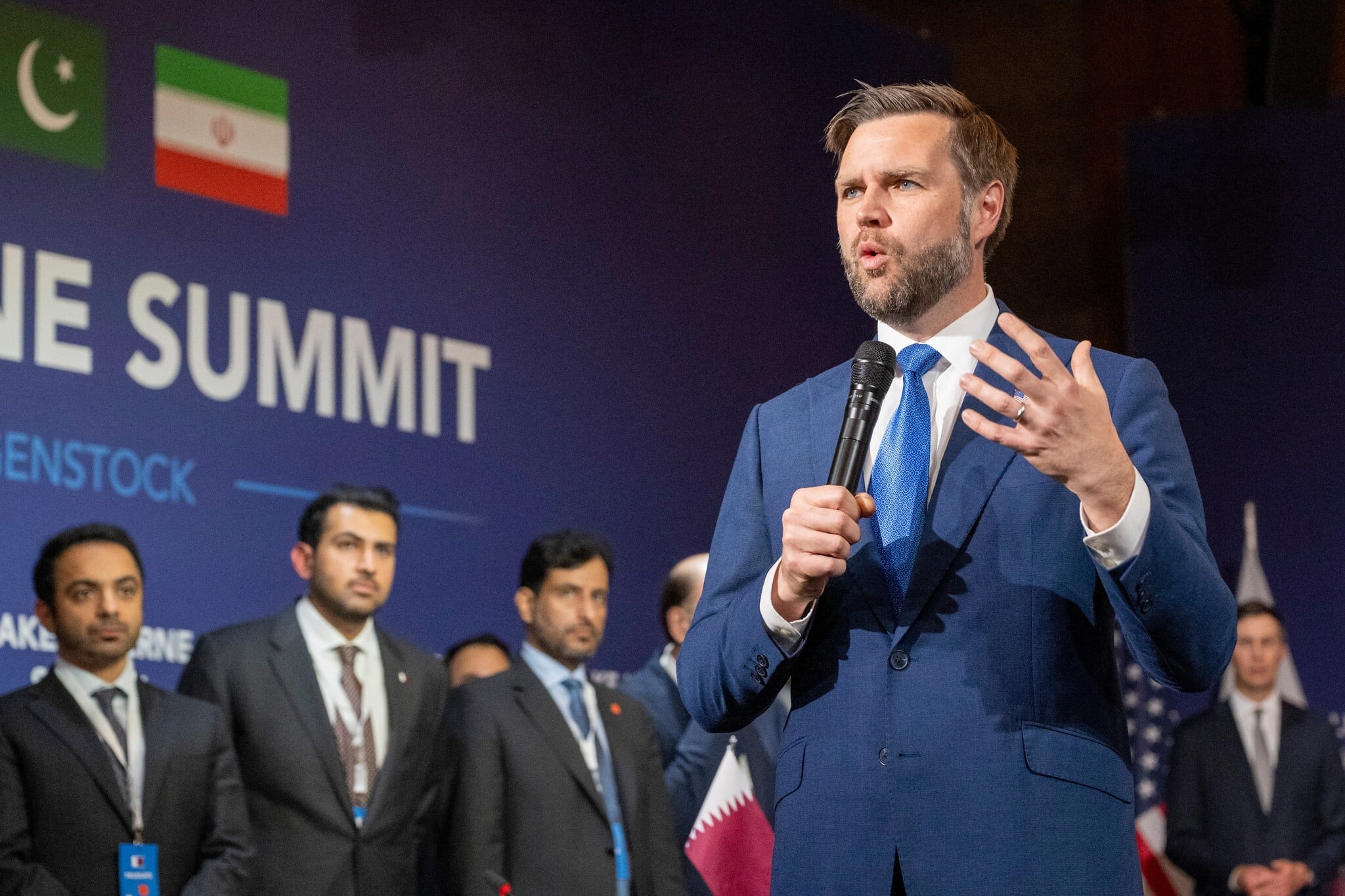
US Vice President JD Vance speaks at the Lake Lucerne Summit at the Burgenstock resort in Obbuergen, near Lucerne, Switzerland, Sunday, June 21, 2026. (Urs Flueeler, Pool Photo via AP)
Netanyahu: We created conditions for fall of Iranian regime
While Israel has been excluded from the negotiations to end the war it began alongside the US, Prime Minister Benjamin Netanyahu made a series of statements reiterating Israel’s position on the war and the peace talks in speeches on Sunday.
The premier, who has distanced himself from the MOU, repeated that Israel is committed to deterring Hezbollah and preventing Iran from obtaining nuclear weapons, and claimed that the war created the conditions for the fall of the Iranian regime, one of the central goals of the US-Israeli campaign.
“With regard to Iran: Whatever diplomatic developments may occur, I will not allow Iran to acquire nuclear weapons. As long as I am prime minister of Israel, that will not happen,” Netanyahu said, speaking in Hebrew at a memorial event marking the 50th anniversary of the death of his brother Yoni Netanyahu, who was killed while leading an elite IDF force in the 1976 Entebbe hostage rescue.
He repeated his assertion that he launched Israel’s campaigns against Iran over the past year “in order to remove the immediate threat of annihilation posed by the evil regime in Iran,” adding, “had we not acted, they would already have had nuclear bombs in their possession, and they would have used them.”
“We have achieved tremendous accomplishments, and we will not relinquish them. We will remain in the security zone in southern Lebanon for as long as necessary in order to protect the precious residents of the north and all the citizens of Israel [from Hezbollah attacks]. As prime minister of Israel, I insist on this unequivocally, and nothing will change it,” he said.
A member of the US Secret Service walks near the Palace Hotel during US-Iran negotiations, at the Burgenstock resort in Obbuergen, near Lucerne, Switzerland, June 21, 2026. (AP Photo/Vadim Ghirda)
In a separate speech, Netanyahu argued that Israel succeeded in creating the conditions for eventual regime change in Iran, even as the regime emerged intact from the conflict. The Iranian public made no known effort to overthrow their government during the war, which followed a deadly government crackdown that killed thousands after widespread January protests.
While speaking at the JNS International Policy Summit in Jerusalem, Netanyahu listed the military successes of the campaign, saying, “We decapitated the leadership of the terror regime; we shattered their missile industry; we knocked out their navy; we knocked out their air force; we attacked their military industries; we attacked their bridges.”
“The cumulative damage that we did to the Islamic Revolutionary Guards’ economy is… counted in hundreds and hundreds of billions of dollars,” he said.
“It will take them a long time to recover… And they may not recover,” the premier continued. “Because once you deal these blows, and once the rift between the regime and the people is so deep, you cannot tell when such a regime will fall. And I think we created the conditions for its future fall.”