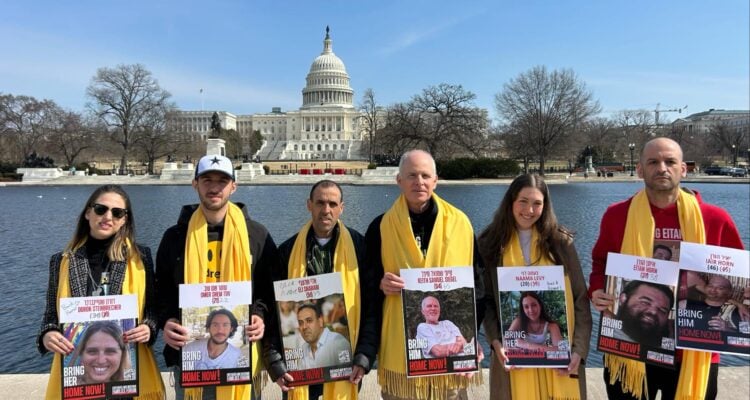
Former Israeli hostages pose outside the US Capitol on March 4, 2025. (The Hostages Families Forum and Hostage Aid)
Cairo reportedly pushing a compromise between Hamas and Israel’s positions regarding a new ceasefire deal, with 16 hostages to be released during a 70-day Gaza ceasefire.
By World Israel News Staff
Egyptian mediators have put forth a new proposal for a hostage deal and ceasefire agreement between Israel and Hamas, a Saudi-owned newspaper reported Monday, as the war in the Gaza Strip rages on.
The London-based Asharq Al-Awsat newspaper cited an Egyptian source who claimed that Cairo has drafted a new plan, under which Hamas will release a total of 16 Israeli captives still held in the Gaza Strip in exchange for a third ceasefire, lasting between 40 to 70 days.
According to the report, the hostages slated for release under the Egyptian proposal would include eight living captives and the remains of eight dead captives.
As with the November 2023 and January 2025 ceasefire deals, the freeing of Israeli hostages would be accompanied by the release of a significant number of jailed Arab terrorists.
Egypt is said to be presenting its plan to Israel and Hamas as a compromise between Israel’s demand that any new deal include the release of at least 11 living hostages, and Hamas’ refusal to free any more than 5, in exchange for a 50-day truce.
WATCH: US hostage envoy reveals updates on talks with Hamas, progress toward hostage deal
Under the Egyptian proposal, the release of the eight living captives would be staggered over the course of the ceasefire.
Neither Israel nor Hamas has refused or accepted Cairo’s plan, the report added.
Hamas still holds a total of 59 hostages in the Gaza Strip, including 35 captives whom Israeli intelligence has reason to believe are dead, with 24 who are likely still alive.
After the six-week ceasefire initiated on January 19th lapsed on March 2nd with no agreement for a continuation of the deal, Israel has ratcheted up measures to pressure Hamas into freeing additional hostages, halting the entry of aid to Gaza, cutting off the Strip from Israel’s electrical grid, and resuming hostilities against the terror group.
The Hamas-run Gaza health ministry claims that since hostilities were resumed on March 18th, over 1,000 people have died in the Strip as a result of the war.
The move to defuse tensions follows repeated warnings issued privately by US officials to the Iraqi government since Trump took power in January.
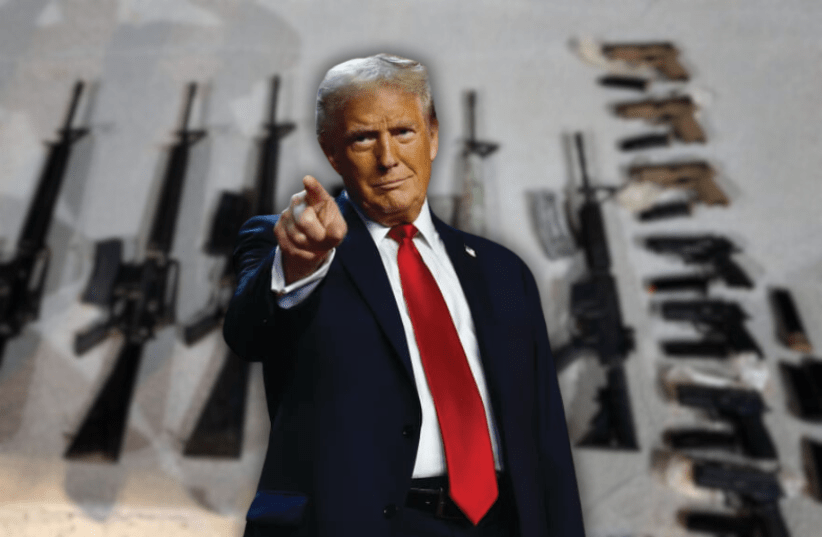
By REUTERS(Illustrative) US President Donald Trump over a backdrop of weapons.(photo credit: BRIAN SNYDER/REUTERS, Canva Pro, IDF SPOKESPERSON’S UNIT)
Several powerful Iranian-backed militia groups in Iraq are prepared to disarm for the first time to avert the threat of an escalating conflict with the US Trump administration, 10 senior commanders and Iraqi officials told Reuters.
The move to defuse tensions follows repeated warnings issued privately by US officials to the Iraqi government since Trump took power in January, according to the sources who include six local commanders of four major militias.
The officials told Baghdad that unless it acted to disband the militias operating on its soil, America could target the groups with airstrikes, the people added.
Izzat al-Shahbndar, a senior Shi’ite Muslim politician close to Iraq’s governing alliance, told Reuters that discussions between Prime Minister Mohammed Shia al-Sudani and several militia leaders were “very advanced,” and the groups were inclined to comply with US calls for disarmament.
“The factions are not acting stubbornly or insisting on continuing in their current form,” he said, adding that the groups were “fully aware” they could be targeted by the US.
Iraqi Shi’ite Muslims march during the annual al-Quds Day on the last Friday of Ramadan, in Najaf, Iraq, March 28, 2025 (credit: REUTERS/THAIER AL-SUDANI)
The six militia commanders interviewed in Baghdad and a southern province, who requested anonymity to discuss the sensitive situation, are from the Kataib Hezbollah, Nujabaa, Kataib Sayyed al-Shuhada and Ansarullah al-Awfiyaa groups.
“Trump is ready to take the war with us to worse levels, we know that, and we want to avoid such a bad scenario,” said a commander of Kataib Hezbollah, the most powerful Shi’ite militia, who spoke from behind a black face mask and sunglasses.
Following publication, Kataib Hezbollah issued a statement denying that any of its members had spoken to Reuters, adding that official comments are made only by its named spokespersons.
The commanders said their main ally and patron, Iran’s elite Revolutionary Guards (IRGC) military force, had given them its blessing to take whatever decisions they deemed necessary to avoid being drawn into a potentially ruinous conflict with the United States and Israel.
The militias are part of the Islamic Resistance in Iraq, an umbrella group of about 10 hardline Shi’ite armed factions that collectively command about 50,000 fighters and arsenals that include long-range missiles and anti-aircraft weapons, according to two security officials who monitor militias’ activities.
The Resistance group, a key pillar of Iran’s network of regional proxy forces, have claimed responsibility for dozens of missile and drone attacks on Israel and US forces in Iraq and Syria since the Gaza war erupted about 18 months ago.
Farhad Alaaeldin, Sudani’s foreign affair adviser, told Reuters in response to queries about disarmament talks that the prime minister was committed to ensuring all weapons in Iraq were under state control through “constructive dialog with various national actors.”
The two Iraqi security officials said Sudani was pressing for disarmament from all the militias of the Islamic Resistance in Iraq, which declare their allegiance to Iran’s IRGC or Quds Force rather than to Baghdad.
Some groups have already largely evacuated their headquarters and reduced their presences in major cities including Mosul and Anbar since mid-January for fear of being hit by air attacks, according to officials and commanders.
Many commanders have also stepped up their security measures in that time, changing their mobile phones, vehicles and abodes more frequently, they said.
The US State Department said it continued to urge Baghdad to rein in the militias. “These forces must respond to Iraq’s commander-in-chief and not to Iran,” it added.
An American official, speaking on the condition of anonymity, cautioned that there had been instances in the past when the militias had ceased their attacks because of US pressure, and was skeptical any disarmament would be long-term.
The IRGC declined to comment for this article while the Iranian and Israeli foreign ministries didn’t respond to queries.
Shaken: Iran’s Axis of Resistance
Shahbndar, the Shi’ite politician, said the Iraqi government had not yet finalized a deal with terrorist leaders, with a disarmament mechanism still under discussion. Options being considered include turning the groups into political parties and integrating them into the Iraqi armed forces, he added.
While the fate of any disarmament process remains uncertain, the discussions nonetheless mark the first time the militias have been prepared to give ground to longstanding Western pressure to demilitarize.
The shift comes at a precarious time for Tehran’s regional “Axis of Resistance” which it has established at great cost over decades to oppose Israel and US influence but has seen severely weakened since Palestinian group Hamas’ attack on Israel on October 7 2023 tipped the Middle East into conflict.
Hamas in Gaza and Hezbollah in Lebanon have been hammered by Israel since the Gaza war began while the Houthi movement in Yemen has been targeted by US airstrikes since last month. The fall of Syrian President Bashar al-Assad, another key Iranian ally, has further weakened the Islamic Republic’s influence.
Iraq is seeking to balance its alliances with both America and Iran in its dealing with the militias on its soil. The groups sprang up across the country with Iranian financial and military support in the chaotic wake of the 2003 US invasion that toppled Saddam Hussein, and have become formidable forces that can rival the national army in firepower.
US Secretary of Defence Pete Hegseth told Prime Minister Sudani in a phone call on March 16, shortly after the American strikes on the Houthis began, to prevent the militias carrying out revenge attacks on Israel and US bases in the region in support of their allies, according to two government officials and two security sources briefed on the exchange.
The Iraqi-based militias had launched dozens of drone and rockets attacks against Israel in solidarity with Hamas since the Gaza war began and killed three US soldiers in a drone operation in Jordan near the Syrian border last year.
Ibrahim al-Sumaidaie, a former political adviser to Sudani, told Iraqi state TV that the United States had long pressed Iraq’s leadership to dismantle Shi’ite militias, but this time Washington might not take no for an answer.
“If we do not voluntarily comply, it may be forced upon us from the outside, and by force.”
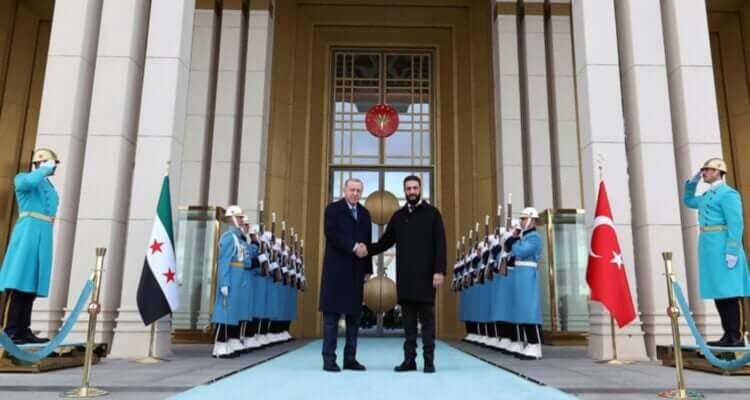
Recep Tayyip Erdoğan of Turkey meets with Syrian leader Ahmed al-Sharaa on February 4th, 2025. (X Screenshot)
Assuaging Israeli concerns over Turkish influence in Syria, Trump says he can mediate between Jerusalem and Ankara.
By World Israel News Staff
President Donald Trump addressed Israeli concerns over Turkey’s presence in Syria, saying that he would be able to “work something out” between Israel and Turkey, should both sides make “reasonable demands.”
Speaking at a press conference shortly after meeting with Prime Minister Benjamin Netanyahu on Monday at the White House, Trump stressed his strong relationship with Turkish President Recep Tayyip Erdogan.
Referring to Erdogan as “very smart,” Trump said he had phoned the Turkish leader after Islamist groups, backed by Ankara, successfully ousted Syrian president Bashar al-Assad from power in November 2024.
“I said, ‘Congratulations, you’ve done what nobody’s been able to do in 2,000 years. You’ve taken over Syria.’ With different names, but same thing,” Trump recounted.
“I told [Netanyahu]… ‘Bibi if you have a problem with Turkey, I really think I’m going to be able to work it out,’” he continued.
“You know, I have a very, very good relationship with Turkey and with their leader, and I think we’ll be able to work it out,” he added.
“As long as you are reasonable. You have to be reasonable.”
Israel has carried out regular bombing campaigns against Iranian assets in Syria for years, and is concerned that a Turkish military buildup in the country could limit the IAF’s activities in the country.
In recent years, Erdogan has spouted increasingly unhinged anti-Israel rhetoric, including calling Netanyahu a “child-killing vampire.”
Erdogan also called for Allah to destroy Israel in a public Ramadan prayer last month.
At the conference, Netanyahu praised Trump’s offer to mediate between Israel and Turkey regarding Syria.
“We’ve had neighborly relations with Turkey that have deteriorated, and we don’t want to see Syria being used by anyone, including Turkey, as a base for attack in Israel,” Netanyahu said.
“We discussed how we can avoid this conflict in a variety of ways, and I think we can’t have a better interlocutor than the president of the United States for this purpose,” he added.