

by Ailin Vilches Arguello

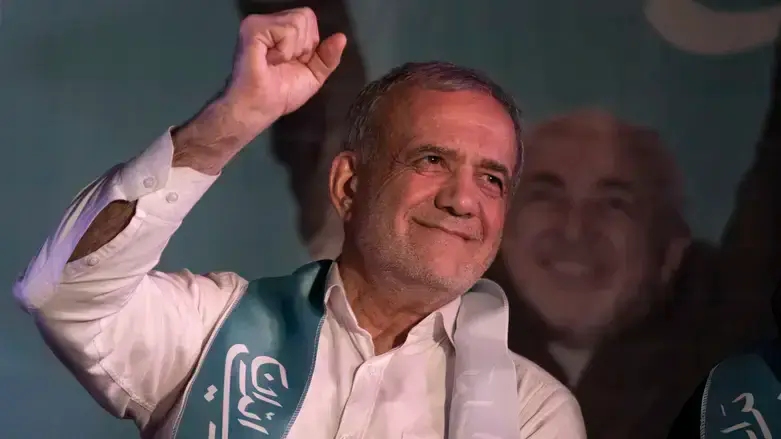
Iran’s President Masoud Pezeshkian attends a press conference in Tehran, Iran, Sept. 16, 2024. Photo: WANA (West Asia News Agency)/Majid Asgaripour via REUTERS

Iranian President Masoud Pezeshkian on Thursday warned that if “enemies” attack Iran’s nuclear facilities, the country will quickly rebuild and multiply them, seemingly responding to new reports of a possible Israeli strike on Iranian nuclear sites by the middle of this year.

“[Enemies] threaten us that they will hit our nuclear facilities … If you strike a hundred of those, we will build a thousand other ones,” Pezeshkian said during a speech in the southern province of Bushehr, according to Iranian state media.

“You can target the buildings and locations, but you cannot target those who build them,” he said, adding that Iranian “experts” will continue to expand the country’s nuclear program.

Pezeshkian’s comments came after a Washington Post report claimed that Israel may launch a preemptive strike on Iran’s nuclear facilities in Fordow and Natanz by mid-year, citing US intelligence assessments. Such an operation could exploit extensive damage done to Iran’s military capabilities in October, when Israel devastated Iranian air defense systems and ballistic missile production facilities in a coordinated, three-wave strike. The attack was a response to Iran targeting the Israeli homeland with 181 ballistic missiles weeks earlier.

During his meeting in Bushehr, Pezeshkian criticized the United States for pursuing a “contradictory” approach to Iran, saying that while President Donald Trump claims he wants to negotiate a nuclear deal, he also imposes harsh sanctions on Tehran.

“The enemy wants us to be humiliated before them with sanctions and threats, but we will not be subjugated and we will solve our problems by relying on our people,” Pezeshkian said. “We will run the country by relying on our domestic capabilities.”

Last week, Trump signed a presidential memorandum restoring his “maximum pressure” campaign on Iran that includes efforts to drive its oil exports down to zero in order to stop Tehran from obtaining a nuclear weapon. However, Trump has also denied that the US and Israel are planning to carry out a military strike on Iran, saying he instead wants to reach a “nuclear peace agreement” with Tehran.

In response to Trump’s comments, Iran’s so-called “supreme leader,” Ayatollah Ali Khamenei, rejected the idea of negotiating with Washington, calling the idea “unwise” and “dishonorable” days later.

In an interview with Fox News, Trump also mentioned the possibility of Israel striking Iran, emphasizing that he would rather reach an agreement with Tehran to stop it from obtaining nuclear weapons.

“Everyone thinks Israel, with our help or our approval, will go in and bomb the hell out of them. I would prefer that not to happen,” Trump said.

Amid increasing tensions, the commander of Iran’s conventional air force, Hamid Vahedi, also threatened to retaliate against any attack on Tehran.

“We tell all countries, friends and foes alike, that our country’s doctrine is defensive, but we will respond with force against any enemy attack,” he said.

The US, Israel, and other allied countries fear that Iran’s nuclear program is ultimately designed to produce nuclear bombs.

Iran has claimed that its nuclear program is for civilian purposes rather than building weapons. However, the UN’s nuclear watchdog, the International Atomic Energy Agency (IAEA), reported in December that Iran had greatly accelerated uranium enrichment to up to 60 percent purity, close to the roughly 90 percent weapons-grade level, at its Fordow site dug into a mountain.

The UK, France, and Germany said in a statement at the time that there is no “credible civilian justification” for Iran’s recent nuclear activity, arguing it “gives Iran the capability to rapidly produce sufficient fissile material for multiple nuclear weapons.”

According to US intelligence reports detailed in The Wall Street Journal, US officials believe that an attack on Iran’s nuclear facilities would only delay Tehran’s program for a few weeks or months, yet Israeli officials believe it would have a significant impact.

Israel is reportedly considering two potential strike options, both of which would require US support for aerial refueling, intelligence gathering, and surveillance.

Of these two options, one is reported to involve Israeli fighter jets launching ballistic missiles from the air without entering Iranian territory, while the other would see aircraft deploying bunker-busting bombs over Iranian nuclear sites. The Trump administration recently approved the sale of training kits for this type of strike.

In November, Israeli Defense Minister Israel Katz said Iran was “more vulnerable than ever to attacks on its nuclear facilities.”

“We have the opportunity to achieve our most important goal – to thwart and eliminate the existential threat to the State of Israel,” he said in a post on X.

Iran is the chief international backer of Hamas, providing the terrorist group with weapons, funding, and training. According to media reports based on documents seized by the Israeli military in Gaza last year, Iran had been informed about Hamas’s plan to invade southern Israel and massacre and kidnap civilians on Oct. 7, 2023, months in advance.


Shortly after, Hamas said it was keen that the hostage-ceasefire deal would not break down.

 Woman walks past a poster calling for the release of the hostages held by Hamas, in Tel Aviv, December 5, 2024 (photo credit: REUTERS/STOYAN NENOV)
Woman walks past a poster calling for the release of the hostages held by Hamas, in Tel Aviv, December 5, 2024
(photo credit: REUTERS/STOYAN NENOV)
Israel is optimistic that the hostage deal can be continued and that the next release of hostages can be achieved on Saturday, a source with knowledge told The Jerusalem Post on Thursday.

Shortly after, Hamas said it was keen that the hostage-ceasefire deal would not break down, according to Reuters.

Earlier on Thursday, the Saudi news outlet Asharq reported, citing a source familiar with the matter, that Hamas is ready to commit to the continuation of the hostage deal and the sixth hostage release on Saturday.

The terror group “confirmed to Egyptian officials its commitment to the agreement” and the release of hostages on Saturday, the source was cited as saying.

The report claimed that Hamas conditioned this step in exchange for Israel “bringing in [to the Gaza Strip] caravans, tents, fuel, heavy equipment, medicines, hospital renovation materials.”

On Wednesday, Egyptian sources told UK-based Qatari news outlet Al-Araby Al-Jadeed that Hamas had reached an agreement with the Egyptian ceasefire mediators to resume the hostage release deal in its original form in exchange for caravans and fuel.

According to Al-Araby Al-Jadeed, the supplies were scheduled to enter Gaza on Thursday.

 Illustrative image of Hamas terrorists. (credit: ABED RAHIM KHATIB/FLASH90, Canva, REUTERS/MOHAMMED SALEM)Enlrage image
Illustrative image of Hamas terrorists. (credit: ABED RAHIM KHATIB/FLASH90, Canva, REUTERS/MOHAMMED SALEM)

Hamas says it will not release ‘all’ hostages on Saturday

On Wednesday evening, senior Hamas spokesperson Sami Abu Zuhri spoke to Al Jazeera that Hamas was “committed” to implementing the previously agreed schedule of the hostage deal and that they would not release “all” Israeli hostages on Saturday.

Earlier on Wednesday, Israeli Defense Minister Israel Katz warned that if Hamas does not release the Israeli hostages by Saturday, all hell will break loose.

James Genn contributed to this report. 


Iran flying cash to Hezbollah via Beirut Airport – IDF warning

By World Israel News Staff

Iran is trying to rebuild its battered proxy group Hezbollah by flying millions of dollars to the terror organization through Beirut International Airport, a practice which the IDF has warned must stop immediately.

In an unusual statement, the IDF’s Arabic language spokesman Avichai Adaree wrote on X that the Israeli military will take steps to prevent the transfers from continuing.

“Iran’s Quds Force and the terrorist organization Hezbollah have been exploiting Beirut International Airport through civilian flights in an attempt to smuggle funds intended for Hezbollah’s armament, aiming to carry out attacks against the State of Israel,” Adaree wrote.

“The IDF remains in continuous communication with the monitors who are enforcing the ceasefire and regularly shares specific information to thwart these smuggling operations,” he continued.

“Despite ongoing efforts, our assessments indicate that some of these smuggling attempts have been successful.”

Adaree stressed that the “IDF will not allow Hezbollah to arm itself and will use all available means to enforce the ceasefire agreements and ensure the security of Israeli citizens.”

The statement comes just days ahead of the the deadline for Israel to withdraw troops from southern Lebanon.

A Trump administration official recently confirmed that Washington expects the IDF to leave the region by February 18th.

However, reports have indicated that Israel is lobbying to extend that deadline.

Displaced residents of northern Israel’s border region, who were evacuated from their homes shortly after the October 7th, 2023 terror onslaught, have still been unable to return to their communities.

The Israeli government set March 1st as the date for which displaced northerners are expected to return home, but that timeframe appears unlikely.

Kiryat Shmona Mayor Avichai Stern recently posted a video showing several concrete slabs haphazardly placed at the border, ostensibly as a barrier against a Hezbollah invasion.

Noting the fact that the barrier could be easily overcome, Stern said it “really looks like we’ve learned nothing from October 7th.”