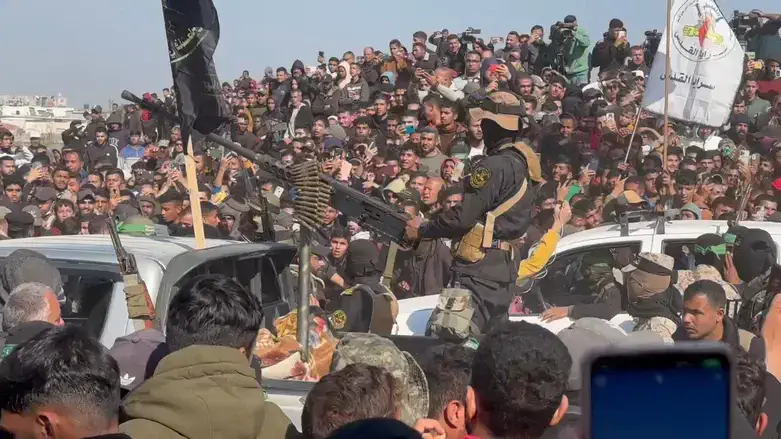
Hamas political member Mousa Abu Marzouk claimed that the Palestinian Authority opposes Hamas taking the political lead, but argued that the world only engages with active players—not the dead—insisting that both war and peace negotiations ultimately run through Hamas.
Israel waiting for Hamas to announce names of hostages to be released Saturday, as Hamas fumes over Trump announcement and Israeli delegation readies for talks in Qatar.
Terrorists alongside Red Cross staff during hostages’ releaseMajdi Fathi/ TPS
Hamas is expected to publish the names of the fifth group of hostages to be freed, who will be freed on Saturday.
Ahead of the terror group’s announcement, there are 20 people left on the list to be freed in the first stage of the deal, eight of whom are no longer alive.
Among those who may potentially be freed are Shiri Bibas and her two young children, Ariel (5) and Kfir (2). It is unlikely that they will be freed on Saturday, however, since the deal stipulated that living women would be freed before living men, and four men have already been freed: Gadi Mozes alongside Arbel Yehud and Agam Berger on January 30, and a group of three men – Ofer Calderon, Yarden Bibas, and Keith Seigel – on February 1.
Meanwhile, Hamas sources have claimed that US President Donald Trump’s plan to take over Gaza and relocate Gazans may increase the difficulty in negotiating the second stage of the deal for a ceasefire, the release of terrorists, and the return of Israeli hostages.
The delegation which will leave Israel for Qatar will be comprised of low-level officials, most of whom have not participated in the earlier discussions. The heads of the ISA and Mossad will not attend, and neither will Minister Ron Dermer.
A diplomatic source said that the team traveling to Qatar does not have the ability to make significant progress in the talks, and Qatar does not have much faith in them.
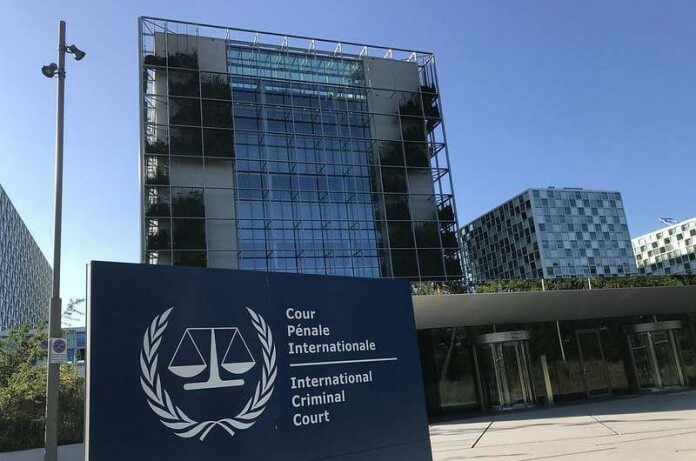
International Criminal Court in The Hague, June 30, 2019.
President Donald J. Trump signed an executive order on Thursday authorizing stringent economic sanctions against the International Criminal Court (ICC), condemning its actions as “illegitimate and baseless” for targeting the United States and Israel.
The order grants the president broad authority to impose financial and visa restrictions on ICC officials and their family members if they are found to be involved in investigations or prosecutions of US citizens and US allies.
This move follows the ICC’s November decision to issue arrest warrants for Prime Minister Benjamin Netanyahu and former Defense Minister Yoav Gallant over alleged war crimes and crimes against humanity in Gaza.
The 125-member International Criminal Court (ICC) is a permanent tribunal responsible for prosecuting individuals for war crimes, crimes against humanity, genocide, and crimes of aggression committed within the territory of member states or by their nationals. The United States, China, Russia, and Israel are not members of the ICC.
It remained unclear how soon the US would announce the names of those sanctioned. During Trump’s first administration in 2020, Washington imposed sanctions on then-ICC prosecutor Fatou Bensouda and a senior aide over the court’s investigation into alleged war crimes by American troops in Afghanistan.
The ICC has not responded to requests for comment.
I, DONALD J. TRUMP, President of the United States of America, find that the International Criminal Court (ICC), as established by the Rome Statute, has engaged in illegitimate and baseless actions targeting America and our close ally Israel.
The ICC has, without a legitimate basis, asserted jurisdiction over and opened preliminary investigations concerning personnel of the United States and certain of its allies, including Israel, and has further abused its power by issuing baseless arrest warrants targeting Israeli Prime Minister Benjamin Netanyahu and Former Minister of Defense Yoav Gallant.
The ICC has no jurisdiction over the United States or Israel, as neither country is a party to the Rome Statute or a member of the ICC. Neither country has ever recognized the ICC’s jurisdiction, and both nations are thriving democracies with militaries that strictly adhere to the laws of war.
The ICC’s recent actions against Israel and the United States set a dangerous precedent, directly endangering current and former United States personnel, including active service members of the Armed Forces, by exposing them to harassment, abuse, and possible arrest. This malign conduct in turn threatens to infringe upon the sovereignty of the United States and undermines the critical national security and foreign policy work of the United States Government and our allies, including Israel.
Furthermore, in 2002, Congress enacted the American Servicemembers’ Protection Act of 2002 to protect United States military personnel, United States officials, and officials and military personnel of certain allied countries, against criminal prosecution by an international criminal court to which the United States is not party, stating, “In addition to exposing members of the Armed Forces of the United States to the risk of international criminal prosecution, the Rome Statute creates a risk that the President and other senior elected and appointed officials of the United States Government may be prosecuted by the International Criminal Court.”
The executive order continues:
The United States will impose tangible and significant consequences on those responsible for the ICC’s transgressions, some of which may include the blocking of property and assets, as well as the suspension of entry into the United States of ICC officials, employees, and agents, as well as their immediate family members, as their entry into our Nation would be detrimental to the interests of the United States.
Prime Minister Benjamin Netanyahu who is on a state visit in the US, issued the following statement on Thursday:
“Thank you, President Trump for your bold ICC Executive Order. It will defend America and Israel from the anti-American and antisemitic corrupt court that has no jurisdiction or basis to engage in lawfare against us. The ICC waged a ruthless campaign against Israel as a trial run for action against America. President Trump’s Executive Order protects the sovereignty of both countries and its brave soldiers. Thank you, President Trump.”