Reports say US security contractors, Egyptian firm to be tasked with monitoring Netzarim corridor to ensure Palestinians traveling between southern and northern Gaza aren’t armed
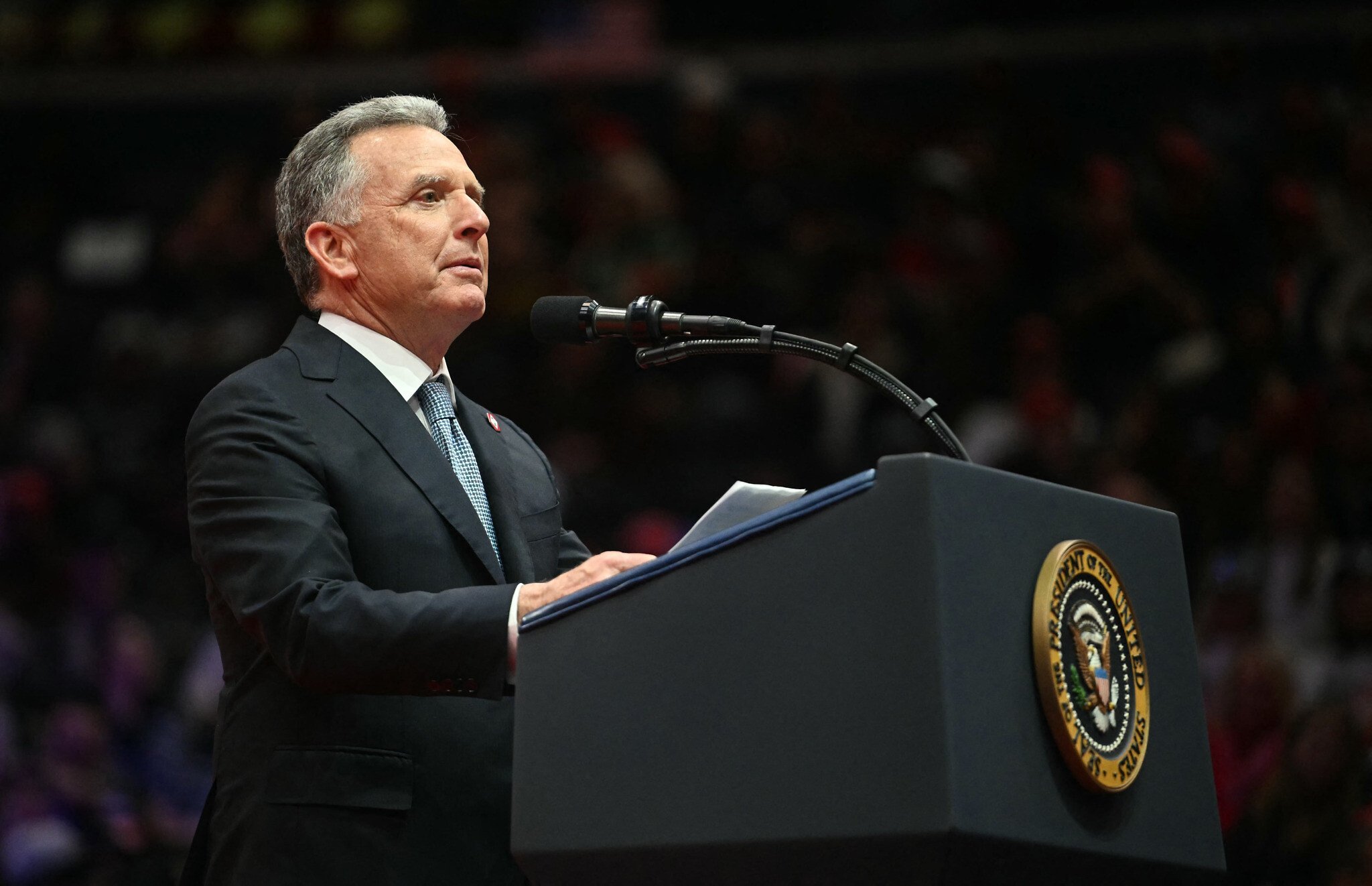
 

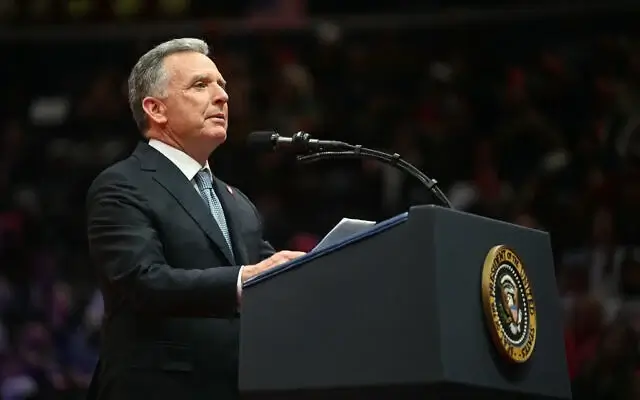
Special envoy to the Middle East Steve Witkoff speaks during the inaugural parade inside Capital One Arena, in Washington, DC, on January 20, 2025. (Jim Watson/AFP)

Special envoy to the Middle East Steve Witkoff speaks during the inaugural parade inside Capital One Arena, in Washington, DC, on January 20, 2025. (Jim Watson/AFP)

US President Donald Trump’s Middle East envoy Steve Witkoff will visit Israel next week after first making a stop in Saudi Arabia, Israeli television reported Thursday.

According to Channel 12 news, Witkoff’s trip to Israel is expected to focus on negotiating the second phase of the hostage release and ceasefire deal between Israel and Hamas, the first stage of which took effect this Sunday.

His talks in Saudi Arabia, whose crown prince was the first foreign leader Trump spoke with since returning to office, are expected to address the administration’s efforts to broker a normalization agreement between Jerusalem and Riyadh.

While in the region, Witkoff is also planning to visit the Gaza Strip, which he confirmed publicly earlier this week.

“I’m actually going to be going over to Israel. I’m going to be part of an inspection team at the Netzarim Corridor, and also at the Philadelphi Corridor,” Witkoff said Wednesday in an interview with Fox News but did not give an exact timeline for when he’ll depart.

“That’s where you have outside overseers, sort of making sure that people are safe and people who are entering are not armed and no one has bad motivations,” Witkoff added.
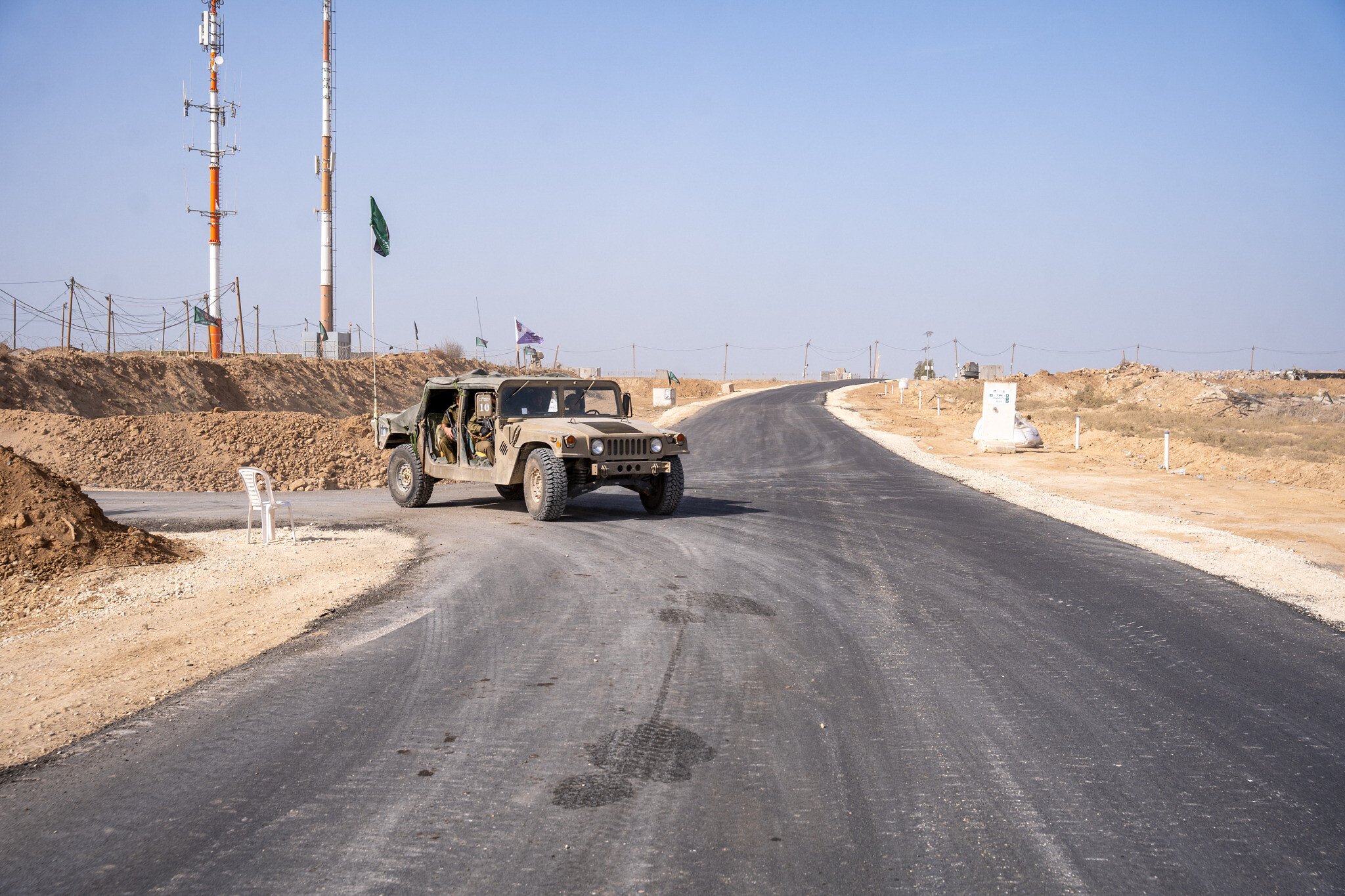
A view of the Netzarim Corridor in the central Gaza Strip, December 26, 2024. (Emanuel Fabian/Times of Israel)

He did not say who else might be part of the inspection teams, though reports Thursday by the New York Times and Axios new site said US security contractors will be responsible for overseeing the truce along the Netzarim Corridor as Palestinians travel between the south and north of the enclave, with their duties to include ensuring Palestinian cars are not being used to carry weapons.

Palestinians traveling on foot will not be subject to inspection, according to the agreement between Israel and Hamas, which also stipulates that they cannot be armed.

The deal also states that the inspection of vehicles “will be performed by a private company to be determined by the mediators in sync with the Israeli side, based on an agreed-upon mechanism.” The New York Times said one of the companies hired, Safe Reach Solutions, will be responsible for the operational management of crossings along the corridor, while another American firm and an Egyptian company will carry out the inspections. Axios named the other US company as UG Solutions.

“There may be additional members and nationalities in the future,” a source familiar with the matter told the news site.

Rubio cheers flow of aid into Gaza

Also Thursday, US Secretary of State Marco Rubio held his first phone call with his Israeli counterpart Gideon Sa’ar, a day after speaking with Prime Minister Benjamin Netanyahu.

The US readout on Rubio’s call with Sa’ar was largely the same as the one released after he spoke to Netanyahu, though notably, it said America’s new top diplomat “welcomed continued flow of aid into Gaza,” indicating the issue will continue to be at the top of mind for the US under the new administration.

The readout on the call with Sa’ar also included Rubio’s praise for Israel’s “ongoing efforts to implement” the ceasefire with Hezbollah, as next week’s deadline for Israeli troops to withdraw from Lebanon quickly approaches.

Rubio also “conveyed the mutual understanding that the pursuit of peace in the region requires addressing the threats posed by Iran,” the State Department added.
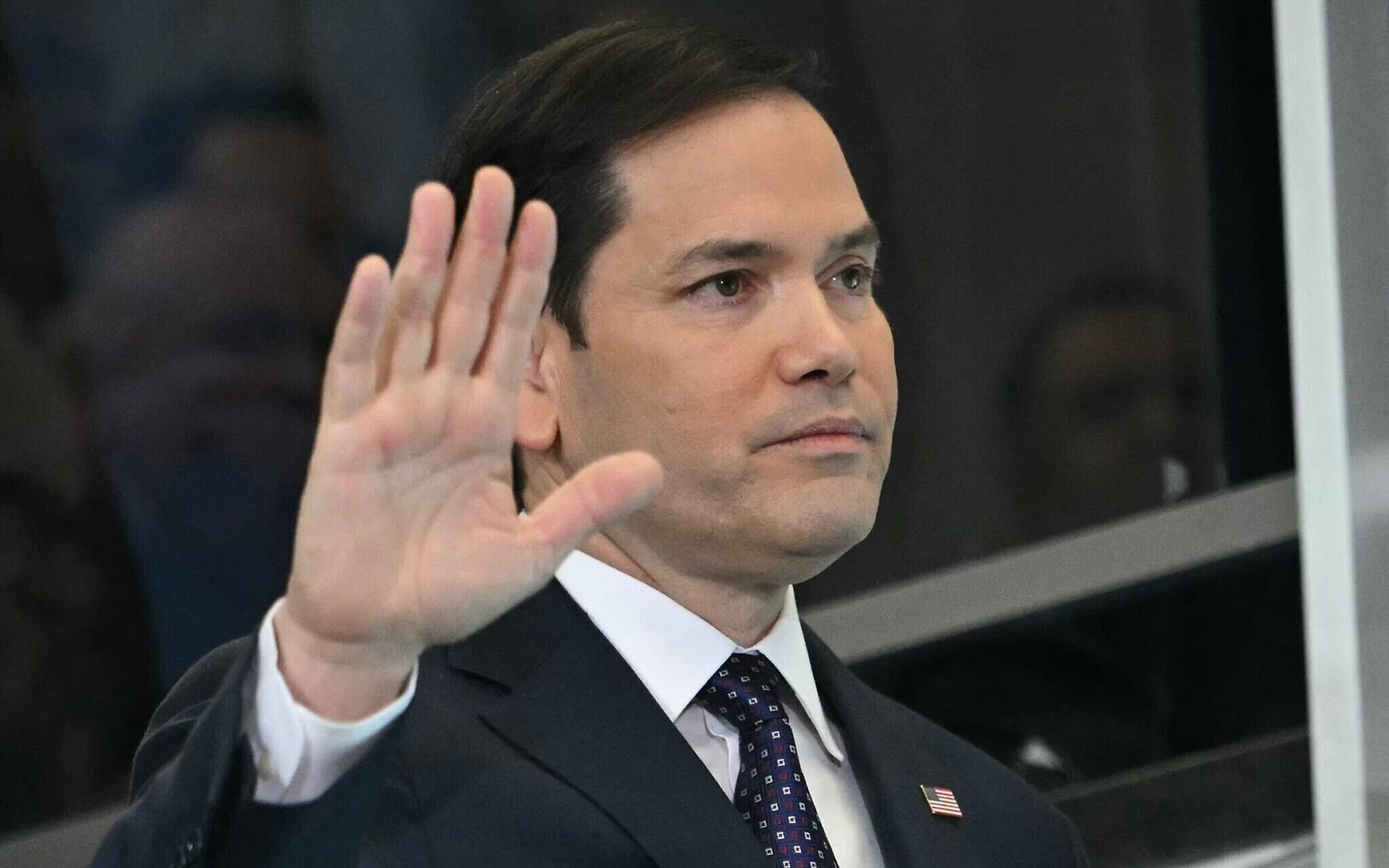
US Secretary of State Marco Rubio waves to employees upon arriving at the State Department in Washington, on January 21, 2025. (Andrew Caballero-Reynolds/AFP)

The Israeli statement on the call said Sa’ar thanked Rubio for the steps Trump has taken in his first days in office.

“I expressed Israel’s appreciation for President Trump’s decisive executive actions against the International Criminal Court, the Houthis, and removing the unjust sanctions against Israelis in Judea and Samaria,” Sa’ar was quoted as saying.

The foreign minister said the pair also spoke about “the politicized ‘international legal institutions’ and the steps that must be taken in that regard,” an apparent reference to actions against Israel in both the ICC and the International Court of Justice (ICJ) over the war with Hamas in Gaza, which was started by the terror group’s October 7, 2023, invasion of southern Israel.

Sa’ar said he invited Rubio to visit Israel and the pair agreed to meet soon. Israel is “committed to working hard and closely with President Trump and his administration to deal with our common challenges and to expand our alliances,” he added.

Jacob Magid and Amy Spiro contributed to this report.
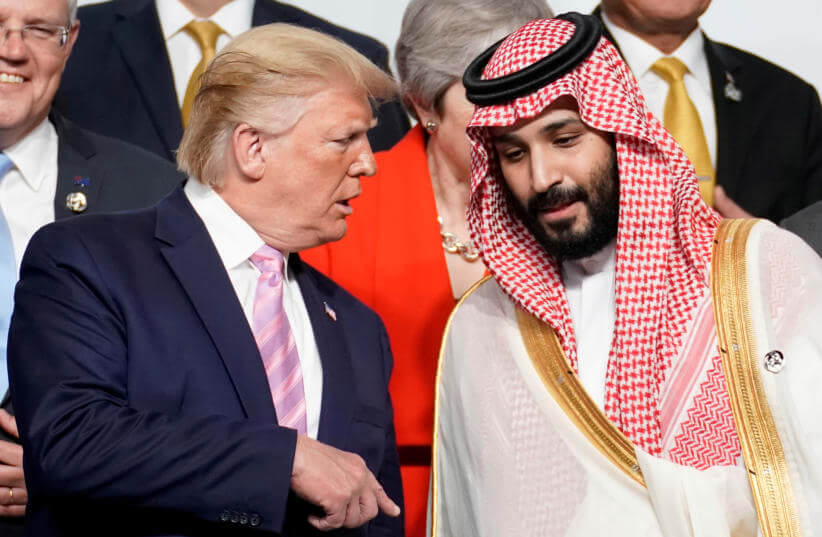

The US doubles down on Middle East strategy: Trump designates Houthis as terrorists while increasing communication with Saudi Arabia.

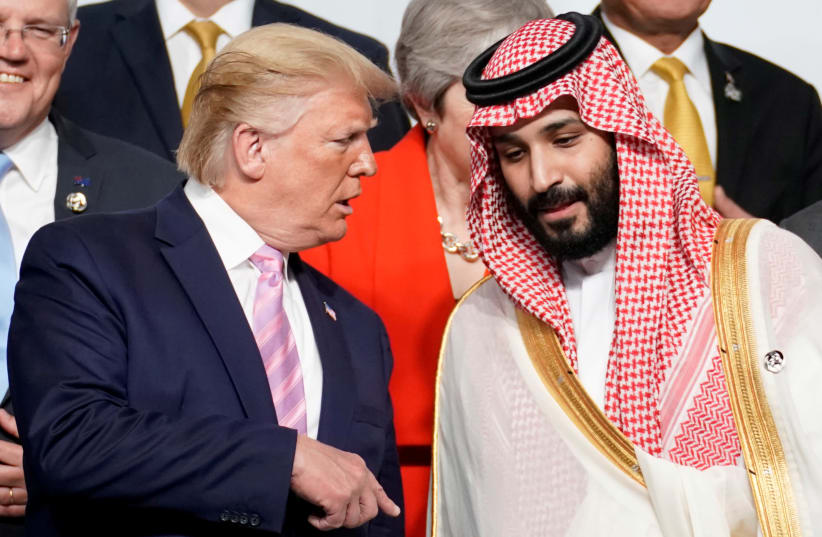
 FILE PHOTO: U.S. President Donald Trump speaks with Saudi Arabia's Crown Prince Mohammed bin Salman during photo session with other leaders and attendees at the G20 leaders summit in Osaka, Japan, June 28, 2019 (photo credit: REUTERS/KEVIN LAMARQUE/FILE PHOTO)
FILE PHOTO: U.S. President Donald Trump speaks with Saudi Arabia’s Crown Prince Mohammed bin Salman during photo session with other leaders and attendees at the G20 leaders summit in Osaka, Japan, June 28, 2019
(photo credit: REUTERS/KEVIN LAMARQUE/FILE PHOTO)
The new US administration is spotlighting its first priorities in the Middle East. US President Donald Trump spoke to Saudi Crown Prince Mohammed bin Salman on Wednesday, the first phone call with a leader in the Middle East, according to reports.

This is important because it also comes as the US is re-designating the Iranian-backed Houthis as terrorists. Taken together, this can be seen as returning to the pillars of policy of the first Trump administration when Saudi Arabia was a close friend, and the Houthis were seen as terrorists.

It should be recalled that the Biden administration sought to take the Houthis off the list of terrorist groups in the region. This was despite the fact that the Houthis never moderated or changed their policy. After the Hamas attack on Israel, the group began attacking Israel and attacking shipping. This has wreaked havoc in the region. In recent months, the Houthis stepped up their attacks on Israel with numerous ballistic missile attacks on Israel.

Trump designated the Houthis as a terrorist group on January 22 via executive order. The executive order refers to them as Ansar Allah. “This order sets in motion a process by which Ansar Allah, also known as the Houthis, shall be considered for designation as a Foreign Terrorist Organization, consistent with section 219 of the INA (8 U.S.C. 1189),” the White House statement notes.

It says the group is backed by Iran’s Islamic Revolutionary Guard Corps Quds Force (IRGC-QF) and says that Iran has trained and armed the Houthis. It says the group has fired on US Navy warships “dozens” of times in the last two years.

 HOUTHI MILITARY spokesman Yahya Saree delivers a statement in Sanaa, Yemen, last month.  (credit: KHALED ABDULLAH/REUTERS)Enlrage image
HOUTHI MILITARY spokesman Yahya Saree delivers a statement in Sanaa, Yemen, last month. (credit: KHALED ABDULLAH/REUTERS)

“Since seizing most Yemeni population centers by force from the legitimate Yemeni government in 2014-2015، the Houthis have launched numerous attacks on civilian infrastructure, including multiple attacks on civilian airports in Saudi Arabia, the deadly January 2022 attacks on the United Arab Emirates, and more than 300 projectiles fired at Israel since October 2023.

 The Houthis have also attacked commercial vessels transiting Bab al-Mandeb more than 100 times, killing at least four civilian sailors and forcing some Red Sea maritime commercial traffic to reroute, which has contributed to global inflation,” the executive order notes.

The order goes on to say that the US will work with “regional partners to eliminate Ansar Allah’s capabilities and operations, deprive it of resources, and thereby end its attacks on U.S. personnel and civilians, U.S. partners, and maritime shipping in the Red Sea.”

A long history of conflict 

The new designation has raised eyebrows in the Gulf. It should be recalled that the Houthis tried to take over Yemen’s port of Aden in 2015, and this triggered an intervention by Saudi Arabia and other countries. However, the civil war in Yemen, with the Saudis on the side of the government against the Houthis, became a difficult war.

The Houthis targeted Riyadh with ballistic missiles and attacked Saudi Arabia with drones. Iran used this as a test bed for its missiles and drones. Eventually, a ceasefire was signed, and the countries involved in the war all sought to distance themselves from it. They also felt the US and the West were not being supportive enough.

Now, voices are rising that say that the new order by the White House could isolate the Houthis and weaken them. According to experts who spoke to the UAE media Al-Ain Al-Akhbariya, “disastrous repercussions will befall the Houthi militias following this classification, including the group losing its participation in a comprehensive peace process, and it will allow the Yemeni government and its regional and international allies to make a decisive military decision to end the coup.”

For the first time in a while, there is optimism. Al-Ain quotes Yemeni politician Khaled Salman, who said the designation is “a prelude to dismantling the Houthi entity attached to the Iranian body, and a prelude to the process of breaking the last nail and depriving Iran of waging war to defend it through tools.”

Salman told Al-Ain that the classification is “a blow to the Houthis who practiced three-dimensional trade, blackmailing major shipping companies, smuggling weapons to terrorist groups, collaborating with them, and striking at the interests of the West and the economies of Washington’s allies from Saudi Arabia to Egypt.” This is a step toward dismantling the group.

This may be too optimistic a belief, but clearly, the White House is putting wind in the sails of the region. It is part of a wider effort of the new Trump doctrine, which is designed to bolster friends and allies.

The new US Secretary of State, Marco Rubio, spoke with Israeli Prime Minister Benjamin Netanyahu and discussed the importance of deterring Iran. Gulf media sees this as another pillar of Trump’s policy, designating Houthis and backing Saudi Arabia and Israel. These are important moments.

Saudi Arabia is celebrating the tenth anniversary of King Salman assuming power this week. Meanwhile, Riyadh has also indicated it could invest up to $600 billion in the US, according to a report in the Associated Press about a phone call with Trump.

Other issues are in motion in the region. Steve Witkoff, Trump’s special envoy, is expected to come back to the region soon. He may visit Gaza to see the ceasefire up close, according to reports. His recent comments in an interview with Fox News have raised eyebrows in some pro-Israel circles. What is important now is that the ceasefire deal continues and hostages continue to be released on time.


Iran researcher says that regime is concerned about Trump, now willing to engage inn negotiations over future of its nuclear development program.

By World Israel News Staff

The Iranian regime is extremely concerned about the future of its nuclear program and crippling economic sanctions following the inauguration of President Donald Trump, an Iranian affairs analyst told Hebrew-language outlet Ma’ariv.

Benny Sabati, an Iran researcher at the Institute for National Security Studies, said that “the Iranian regime is really afraid of Trump taking office.”

He noted that “every day, there is another statement from a senior Iranian official, declaring that the regime wants talks and that they want negotiations, and do not want nuclear weapons, and that the economic situation is difficult.”

Sabati said these statements “really scream ‘come talk to us.’”

He noted that the willingness to engage in talks was mostly coming from the more “moderate wing of the Iranian regime,” which may include President Masoud Pezeshkian and his advisors.

Sabati explained that Trump’s election had exacerbated existing schisms with Iran’s leadership.

“The regime is in conflict with itself, because there are two schools of thought within the Iranian regime. Iran is in a kind of mess,” he told Ma’ariv.

With its public threats to Israel, Tehran “has climbed a very high tree, and it is difficult for it to get down.”

The conservative flank of the Iranian government includes many influential personalities who are “unwilling to agree to talks and negotiations,” Sabati said.

Those leaders are pushing for Iran to emphasize its strength, along with encouraging the “Revolutionary Guards continue to bare their teeth.”

Sabati said that the Iranian people – unlike their government – are excited about Trump’s election, and have high hopes for the American president’s potential impact on their country.

“The public is very happy with Trump’s inauguration. They believe that his arrival will bring about a very significant change in the Iranian regime, and perhaps even overthrow it,” Sabati said.

“These are [the Iranian people’s] heartfelt wishes.”